



Condo downpayment Singapore: cash and CPF you need in 2026
Buying a condo in Singapore requires a minimum 25% downpayment, and at least 5% of that must be cash. The remaining 20% can come from cash or CPF Ordinary Account savings.
TL;DR:
- The minimum downpayment for a Singapore condo is 25%, with at least 5% paid in cash, and the remaining 20% can be from cash or CPF savings.
- CPF use is limited to 120% of the property’s valuation, and only Ordinary Account funds can cover the downpayment, stamp duties, or reimbursements, not special or savings accounts.
- Buying a second or higher property significantly increases the required cash and CPF contributions, with foreigners facing even higher costs and no CPF access.
- Stamp duties, including Buyer’s Stamp Duty and Additional Buyer’s Stamp Duty, can amount to over S$40,000 for a S$1.5 million condo and are payable within 14 days of signing.
- The mortgage approval process is constrained by debt servicing ratio rules, requiring higher stress test rates that can limit the loan size, especially for buyers with tight income-to-debt ratios.
Table of Contents
- What is the minimum condo downpayment in Singapore?
- How does your buyer profile change the downpayment math?
- What stamp duties apply and when are they due?
- Will you pass the loan test? TDSR and the 4% stress rate
- New launch vs resale: how payment timing changes your cash needs
- What conveyancing and legal costs should you budget for?
- Worked examples: S$800k, S$1.5m and S$2m condos
- Your practical checklist before you commit
- Start your condo search with the right numbers
- Where to verify these rules yourself
- Sources
What is the minimum condo downpayment in Singapore?
The Monetary Authority of Singapore sets the ceiling on how much a bank can lend against a residential property. For a first home loan, that ceiling sits at 75% of the purchase price or valuation, whichever is lower. Work backwards from that number and the arithmetic is simple: you need to fund the other 25% yourself.
There’s no way around this. CPF savings, however generous your Ordinary Account balance, cannot touch that slice. The MAS Loan-to-Value limits framework is explicit on this point, and every bank in Singapore applies it identically because it’s a regulatory floor, not a lending policy any single institution can waive.
You can pay it entirely in cash, entirely from CPF Ordinary Account, or split it however suits your finances. CPF Board guidance confirms this 20% portion, plus later reimbursement of stamp duties, can be drawn from OA subject to your CPF withdrawal limits and the property’s Valuation Limit, which caps how much CPF you can use relative to the home’s value.
On a condominium priced in the mid-million-dollar range, a mandatory minimum cash portion is required, with a substantial portion of the downpayment potentially covered by cash and CPF savings combined, before accounting for stamp duties.
A few points that buyers consistently misunderstand:
- The 120% Valuation Limit rule means once your CPF withdrawals for a property exceed 120% of its valuation, you must top up with cash for any further CPF-eligible costs.
- CPF OA can also reimburse Buyer’s Stamp Duty and Additional Buyer’s Stamp Duty after the fact, but only within your remaining withdrawal limits.
- Fixed deposits, insurance payouts, and CPF Special Account savings are not part of this downpayment calculation. Only Ordinary Account funds apply.
Every one of these rules comes from MAS, CPF Board, or the Inland Revenue Authority of Singapore. Bank marketing pages sometimes simplify or round these figures, so when in doubt, the regulator’s own page is the one to trust.
How does your buyer profile change the downpayment math?
Every subsequent property purchase tightens both the loan ceiling and the cash you must produce.
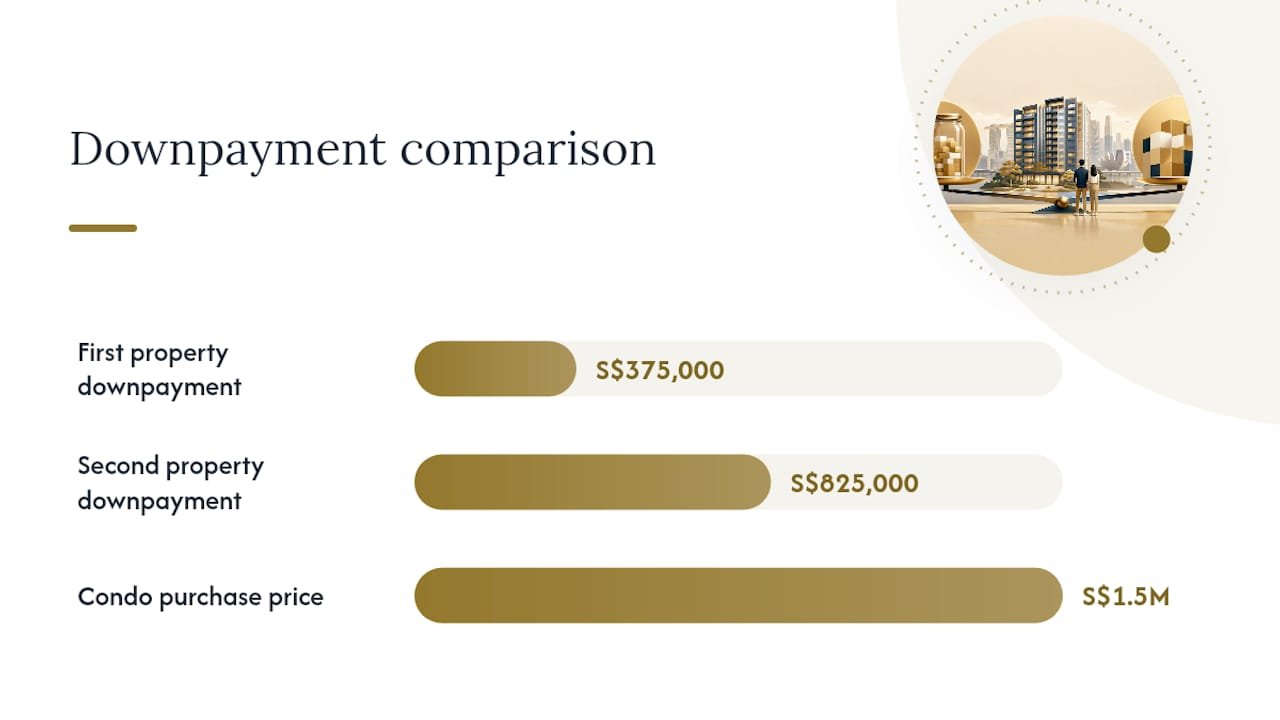
These aren’t small adjustments. On a S$1.5 million condo, moving from a first to a second property loan roughly doubles your required upfront contribution, from S$375,000 to S$825,000.
The mandatory cash portion rises too. This is on top of, not instead of, the higher overall contribution.
Foreigners face a materially different picture again:
- CPF is a Singapore citizen and Permanent Resident scheme; foreign buyers have no CPF savings to draw on, so their entire downpayment and stamp duty burden must be cash or bank financing.
- Additional Buyer’s Stamp Duty rates are highest for foreign buyers, adding a substantial layer to day-one costs that citizens and PRs don’t face at the same rate.
- Some banks apply more conservative LTV limits to foreign-income applicants, particularly where income is earned and taxed outside Singapore, which can shrink the loan quantum below the regulatory ceiling.
It rarely applies once you look past a first purchase.
What stamp duties apply and when are they due?
Buyer’s Stamp Duty is charged on every property purchase in Singapore, calculated on a progressive scale against the purchase price or market value, whichever is higher. IRAS’s BSD schedule) sets the exact bands, and the duty climbs as the price climbs, so a S$3 million condo pays a noticeably higher effective rate than a S$1 million one.
Additional Buyer’s Stamp Duty sits on top of BSD and depends entirely on your buyer profile: citizen, Permanent Resident, or foreigner, and how many residential properties you already own. This is where Registertoday’s clients often see the largest planning gains, since structuring a purchase to minimise or avoid ABSD exposure can materially change what’s affordable.
On a S$1.5 million condo, BSD alone comes to approximately S$44,600 for a first-property buyer, according to figures commonly cited in local guides using the IRAS schedule. That’s before any ABSD applies.
The timing matters as much as the amount. Both BSD and ABSD must be paid within 14 days of exercising your Option to Purchase or signing the Sale and Purchase Agreement. CPF can reimburse you afterwards, but the initial payment typically needs to be cash or a bridging arrangement, because CPF reimbursement processing isn’t instant. Buyers who assume CPF will simply “cover” stamp duty on the day it’s due are often the ones scrambling for cash at the fortnight mark.
Will you pass the loan test? TDSR and the 4% stress rate
This is a hard ceiling that applies regardless of how comfortable the LTV limit makes your downpayment look on paper.
The catch is how banks calculate the mortgage instalment for TDSR purposes. The MAS explainer on new housing loans confirms this conservative approach is standard practice across lenders, not a one-off underwriting quirk.
Here’s what that means in practice for a S$1.2 million loan over 25 years:
- At an actual rate of around 3%, monthly repayments would sit near S$5,690.
- Under the 4% stress-test rate banks must use for TDSR calculations, the same loan is assessed at closer to S$6,330 a month.
- If that stressed figure pushes you past 55% of your gross income, the bank reduces your loan quantum, not your stress rate.
This is the mechanism that catches buyers off guard most often. When that happens, the shortfall has to come from somewhere, usually more cash or a lower-priced property.
New launch vs resale: how payment timing changes your cash needs
New launch condos and resale units demand your money on very different schedules, and that difference shapes how much liquidity you need ready at any one point.
For a new launch bought under the Progressive Payment Scheme, the timeline typically runs like this:
- A 1% option fee secures the unit and locks in your right to purchase.
- Exercising the Option to Purchase within the stipulated period requires a further 4%, bringing your initial commitment to 5%, which is exactly your mandatory cash portion.
- Further payments follow in stages tied to construction milestones, foundation, structural work, roofing, and so on, spreading the remaining 20% downpayment and the loan drawdown across several years rather than demanding it all at once.
Resale purchases work differently. There’s no construction schedule to spread payments across, so the cash and CPF you need must be assembled far sooner.
Pro Tip: If you’re buying resale while your CPF withdrawal or a property sale hasn’t fully cleared yet, speak to your solicitor early about a bridging facility rather than assuming completion dates will simply flex to match your cash position.
Common pitfalls include underestimating how long CPF withdrawal applications take to process, and assuming a bank’s in-principle approval guarantees the final loan amount. Both can leave you short at completion.
What conveyancing and legal costs should you budget for?
Beyond the downpayment and stamp duties, private condo transactions carry legal and administrative costs that catch first-time buyers off guard. Buyer’s solicitor fees, bank mortgage legal costs, valuation fees, and disbursements typically add several thousand dollars on top of everything else, according to conveyancing cost breakdowns published locally.
Some of these costs are payable in cash on completion; others, such as CPF-related legal work tied to your withdrawal, may be settled through CPF after the relevant applications are processed. Your solicitor’s completion statement will itemise exactly which is which, but budgeting for the full invoice in cash upfront is the safer approach.
A few things worth watching closely:
- Bank “legal subsidies” advertised alongside home loans rarely cover the entire conveyancing bill. Treat the subsidy as a partial offset, not a free service.
- Unusually cheap conveyancing quotes sometimes exclude essential steps such as CPF requisitions or statutory filings, according to conveyancing fee insights from YYLee, leaving you with surprise disbursements later.
- Ask for an all-in quote before engaging a solicitor, not a headline rate that excludes the extras.
Pro Tip: Request your solicitor’s full fee schedule, including disbursements, before signing the Option to Purchase, not after. It’s far easier to negotiate or shop around when you’re not already on a 14-day stamp duty clock.
Worked examples: S$800k, S$1.5m and S$2m condos
BSD figures follow the IRAS progressive schedule; ABSD is excluded here since it depends entirely on buyer profile.
S$800,000 condo:
- Mandatory 5% cash: S$40,000
- Remaining 20% (cash or CPF): S$160,000
- BSD: approximately S$21,600
- Total day-one cash if using CPF for the 20% portion: roughly S$61,600
S$1,500,000 condo:
- Mandatory 5% cash: S$75,000
- Remaining 20% (cash or CPF): S$300,000
- BSD: approximately S$44,600
- Total day-one cash if using CPF for the 20% portion: roughly S$119,600
S$2,000,000 condo:
- Mandatory 5% cash: S$100,000
- Remaining 20% (cash or CPF): S$400,000
- BSD: approximately S$64,600
- Total day-one cash if using CPF for the 20% portion: roughly S$164,600
Notice how the “total cash if using CPF” figure, not the headline 5%, is the number that actually determines whether you can proceed on your target completion date.
Your practical checklist before you commit
Getting the downpayment right isn’t really about knowing the percentages. Where deals actually stumble is in the gap between having money and having accessible money on the day it’s due.
Add a contingency buffer on top. Legal disbursements, valuation fees, and minor bank charges have a habit of appearing after you thought the budgeting was finished.
This is where a second pair of eyes earns its keep. Registertoday’s team works through ABSD-aware structuring and home valuation checks with clients specifically so the cash-flow surprises above don’t derail a purchase you’ve already committed to. If you’re unsure whether your target price point is realistic against your current liquidity, that’s the conversation to have before, not after, you sign anything.
— Anderson
Start your condo search with the right numbers
Most of the guidance above assumes you already know your budget. If you don’t, that’s the gap Registertoday closes for you: a free property evaluation that tells you what you can realistically afford before you start viewing units, not after you’ve fallen for one.

Registertoday’s advanced search lets you filter condo listings by price, location, and layout once you’ve settled your downpayment figures, and the platform’s property listings cover both resale and new launch stock across Singapore. If you already own a property and want to understand its current market value before deciding how much cash you can free up for a purchase, the home valuation tool gives you a grounded estimate rather than a guess. Registertoday’s team also specialises in ABSD-aware negotiation, structuring purchases so investors and upgraders don’t pay more Additional Buyer’s Stamp Duty than their situation requires. Run a free valuation or start a saved search today, and get numbers you can actually plan a purchase around.
Where to verify these rules yourself
For the latest LTV notices, check MAS directly. CPF withdrawal conditions sit with CPF Board, and the current BSD/ABSD tables live on IRAS’s stamp duty pages, both linked earlier in this guide. Rules and rates change; regulator pages are always the final word.
Sources
- CPF Board — Using your CPF to buy a home
- LovelyHomes — Condo downpayment Singapore 2026: LTV, cash & CPF