

Stamp in 14 Days: Singapore Tenancy Agreement and CEA/HDB Templates
A tenancy agreement is the legally binding contract that fixes the rent, deposit, lease period and obligations between a landlord and tenant in Singapore. Once you have found a property, download the correct Council for Estate Agencies or HDB template, arrange IRAS e-stamping within 14 days of signing, and confirm HDB eligibility if the flat is public housing. Deposits typically run to a duration equivalent to the lease period, with one to two months’ rent commonly requested.
TL;DR:
- Using the correct prescribed templates from CEA or HDB is essential, as private or non-specific agreements may not reflect the property’s rules and regulations.
- Confirm that the tenancy agreement is properly stamped within 14 days of signing and keep the IRAS e-stamp certificate to avoid enforcement issues.
- Pay close attention to clauses on rent payments, security deposits, and break or diplomatic clauses, ensuring they are clear, written, and agreed upon in the contract.
- Ensure HDB approval and proper registration of tenants or subtenants before signing to prevent tenancy voidance or legal issues.
- Building good practices, like proper inventory checks, negotiating clauses, and understanding renewal procedures, can prevent most common disputes.
Table of Contents
- Where to get a valid tenancy agreement template in Singapore
- Which clauses in a Singapore lease contract actually matter?
- How much stamp duty do you pay on a Singapore lease?
- What HDB rules apply to renting or subletting a flat?
- Signing day: a step-by-step checklist for landlords and tenants
- What can you do if a tenancy dispute arises?
- How Register Today supports Singapore rental transactions
- How does renewal and extension work at the end of a lease?
- How much notice do landlords and tenants need to give?
- What are the most common mistakes in Singapore tenancy agreements?
- Do exceptional circumstances like COVID-19 change tenancy terms?
- Should tenants and landlords take out insurance?
- What does the research actually tell tenants and landlords to prioritise?
- Ready to find your next rental or list your property?
- Sources
Where to get a valid tenancy agreement template in Singapore
Do not draft a rental agreement Singapore document from scratch or copy one off a random property forum. The Council for Estate Agencies (CEA) publishes prescribed tenancy templates for private residential property, and HDB has its own version built specifically around subletting rules for public flats. Using the wrong one is a common early mistake. A private condo template will not reflect HDB occupancy caps, and an HDB template will not suit a landed house or condo unit.
Both templates cover the same broad structure, adapted to their respective property types:
- Names and identification of the landlord, tenant, and any co-tenants
- Full property address, unit description and permitted use (residential only)
- Lease term, commencement date and renewal or option terms
- Rent amount, payment due date and accepted payment methods
- Security deposit amount and conditions for deductions
- Inventory list of furniture, fittings and appliances
- Responsibility for repairs, maintenance and utilities
- Termination, notice and diplomatic clause provisions where applicable
CEA itself notes that landlords and tenants can negotiate and amend these templates before signing, so treat them as a strong starting point rather than a rigid script. Keep the final executed copy and the IRAS stamp certificate together. You will need both if a dispute arises later.
Which clauses in a Singapore lease contract actually matter?
Most tenancy disputes trace back to a handful of clauses that either weren’t checked carefully or weren’t written clearly enough. Before signing, work through these:
- Rent schedule and payment terms. Confirm the due date, acceptable payment methods (bank transfer is standard; avoid cash without a receipt), and whether a late fee applies and how it is calculated.
- Security deposit. Security deposit amounts commonly align with the lease duration, often around one to two months’ rent depending on the lease term. Check what deductions are permitted (unpaid utilities, damage beyond normal wear) and how many days after move-out the balance must be refunded.
- Early-termination, diplomatic and break clauses. These only work if they are written into the signed contract. A diplomatic clause is a negotiated contractual term, not a statutory right, and it typically requires a minimum occupancy period (often 12 months), a set notice period, and documentary proof of the trigger, such as a relocation letter from an employer.
- Inventory and repair reporting. Most templates provide tenants a period after move-in to flag any faults or discrepancies against the inventory list.
- Subletting and permitted occupants. Check the wording carefully if the property is an HDB flat, since unauthorised subletting or unapproved occupants can void the tenancy.
Pro Tip: When calculating a break clause notice period, count from the date the landlord or agent actually receives written notice, not the date you sent it. Disputes over notice timing are among the most common issues raised at the Small Claims Tribunal.
How much stamp duty do you pay on a Singapore lease?
Stamping is not optional, and skipping it can cost you the ability to enforce your own contract. IRAS requires stamp duty on almost every tenancy agreement, and for most leases of four years or less, the duty is 0.4% of the total rent payable over the entire lease period.
- Stamp the agreement within 14 days of signing if it’s executed in Singapore (a longer period applies if signed overseas).
- Late stamping attracts penalties from IRAS on top of the duty owed
- Either party can pay, though convention usually has the tenant covering it
- The e-stamp certificate is generated online and should be kept alongside the signed contract
An unstamped tenancy agreement is ordinarily not admissible as evidence in court or before a tribunal until the duty and any penalty are paid. Many tenants only discover how much this matters when they try to dispute a deposit deduction and realise their main piece of evidence was never properly stamped.
What HDB rules apply to renting or subletting a flat?
Tenancy law Singapore treats HDB flats differently from private property, and the constraints are stricter than most first-time landlords expect. HDB’s tenancy guidance sets out the rules that apply whether you are renting an entire flat or a single bedroom.
- Flat owners generally need to satisfy a minimum occupation period before subletting is allowed
- Subletting the whole flat requires HDB approval, and all occupants must be registered with HDB
- There are caps on the number of unrelated occupants per flat, and these caps differ for citizens versus non-citizens
- Failing to register tenants correctly can put the landlord’s approval, and the tenancy itself, at risk
Confirm HDB approval status before signing anything, and keep copies of all correspondence with HDB. If a dispute ever reaches the Small Claims Tribunal, that paperwork becomes part of your evidence trail.
Signing day: a step-by-step checklist for landlords and tenants
Execution day is where good preparation either pays off or falls apart. Work through this sequence:
- Verify the agent’s registration on the CEA public register before handing over any money, and ask to see a prescribed estate agency agreement that spells out commission and scope of work.
- Sign and date the tenancy agreement. The signing date starts the 14-day stamping clock, so note it precisely.
- Pay the deposit and first month’s rent. This is usually due on signing, by bank transfer with a paper trail rather than cash.
- Complete the inventory check. Walk through the unit, photograph existing fittings and any defects, and get both parties to sign off within roughly 30 days.
- Arrange IRAS e-stamping promptly and file the certificate with your copy of the agreement.
Pro Tip: Never wire a deposit to a personal bank account you haven’t verified against the landlord’s NRIC or the agency’s business registration. If anything about the payment request feels off, check it against ScamShield before transferring anything.
What can you do if a tenancy dispute arises?
Start by pulling the stamped agreement itself. An unstamped or improperly stamped contract is a genuine handicap here, since it can be excluded as evidence until the duty is settled retrospectively along with any penalty.
- Confirm you have the IRAS e-stamp certificate on file before lodging a claim
- Gather the signed inventory list, rent payment receipts, and any written correspondence about the dispute
- Keep proof of service for any termination or diplomatic clause notices you sent
- The Small Claims Tribunal handles tenancy disputes up to its claim value threshold; larger or more complex disputes may need the State Courts or legal advice
- Mediation is often faster and cheaper than a tribunal hearing, and many landlords and tenants settle this way
Landlord rights Singapore and tenant obligations Singapore both hinge on the same document, so whichever side you’re on, the stamped agreement and inventory are your strongest cards.
How Register Today supports Singapore rental transactions
A real estate platform helps landlords and tenants get to a signed tenancy faster by giving both sides a clearer starting point. You can search current listings, compare rents across similar units, and request a property evaluation before agreeing a figure with the other party. For landlords weighing up whether to rent or sell, that evaluation also flags where a unit sits against the wider market. None of this replaces the templates from CEA or HDB, but it does narrow the guesswork before you get to the paperwork stage.
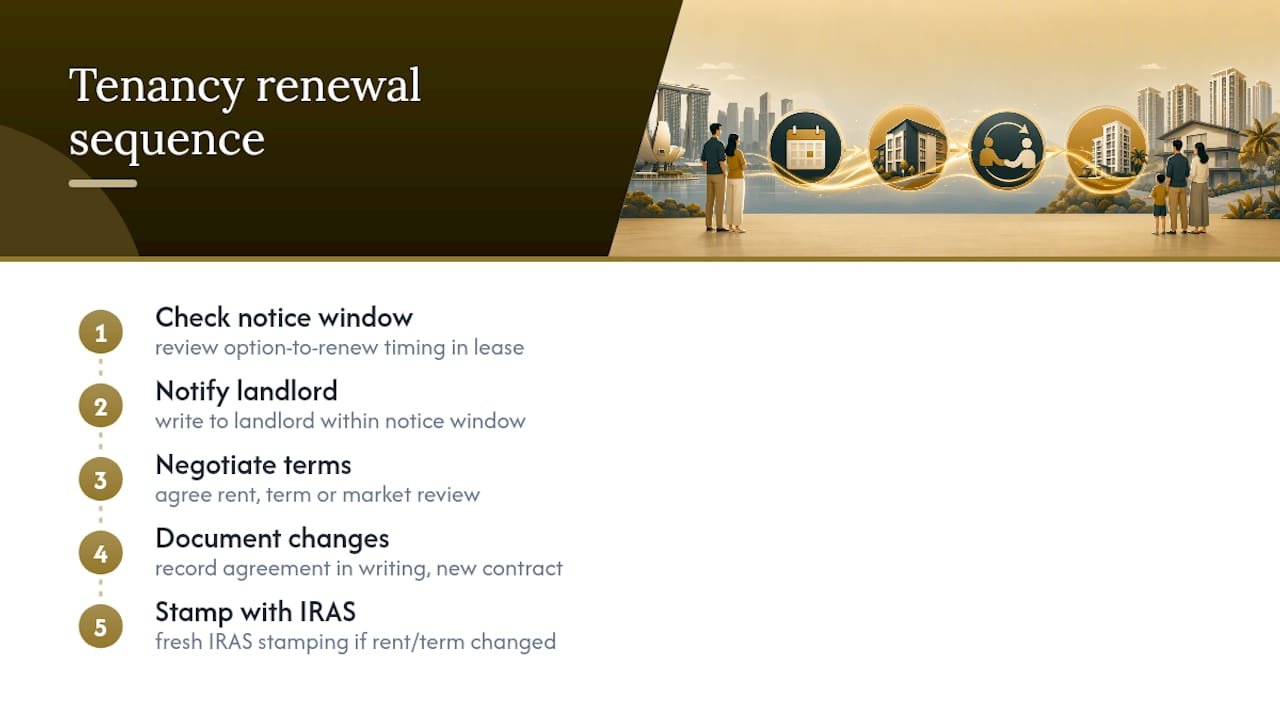
How does renewal and extension work at the end of a lease?
Many tenancy agreements in Singapore run for one or two years, and neither side is obliged to continue beyond that fixed term unless the contract says otherwise. Renewal only happens if it’s negotiated and documented, either as a fresh agreement or through an option to renew clause agreed at the outset.
An option to renew clause typically fixes the notice period for exercising it, often a few months before expiry, and sets out how the new rent will be calculated, whether that’s a fixed percentage increase, a market-rate review, or a straight renewal at the same figure. Without that clause, renewal becomes a fresh negotiation, and either party can walk away or demand different terms.
Practically, if you want to stay on, write to the landlord within the notice window stated in your current agreement, even if there’s no formal renewal clause. Silence from either side close to the expiry date tends to create confusion about whether the tenancy is continuing on the same terms or lapsing entirely. Whatever is agreed, put it in writing and, if the rent or term changes, treat it as a new agreement requiring fresh stamping with IRAS. A verbal understanding to “just carry on” is one of the more common sources of later disputes over what was actually agreed.
How much notice do landlords and tenants need to give?
Notice period requirements come from whatever the signed tenancy agreement specifies, not from a general legal default, so the actual clause you signed is what governs. Many Singapore tenancy contracts set a notice period of about one to two months for either party to end the lease at expiry, and a separate, usually longer, notice period for any early termination clause Singapore landlords include for breach of contract.
For a landlord wanting to end a tenancy at the natural expiry, the standard approach is written notice within the period stated in the agreement, generally one to two months out. Ending a tenancy early for cause, such as persistent rent arrears or breach of the permitted use clause, usually requires the landlord to follow whatever remedy period the contract sets out before terminating.
For tenants, notice to vacate at the end of the fixed term follows the same clause. If a diplomatic clause or break clause applies, the tenant typically needs to give the specified notice and meet any documentary proof requirements, together with the documentary proof the clause requires, and rent in lieu of notice may be payable if the notice period isn’t fully served. Whichever side you’re on, check the exact wording rather than assuming a standard figure. Notice periods vary from one contract to the next, and courts and tribunals will hold both parties to what was actually signed.
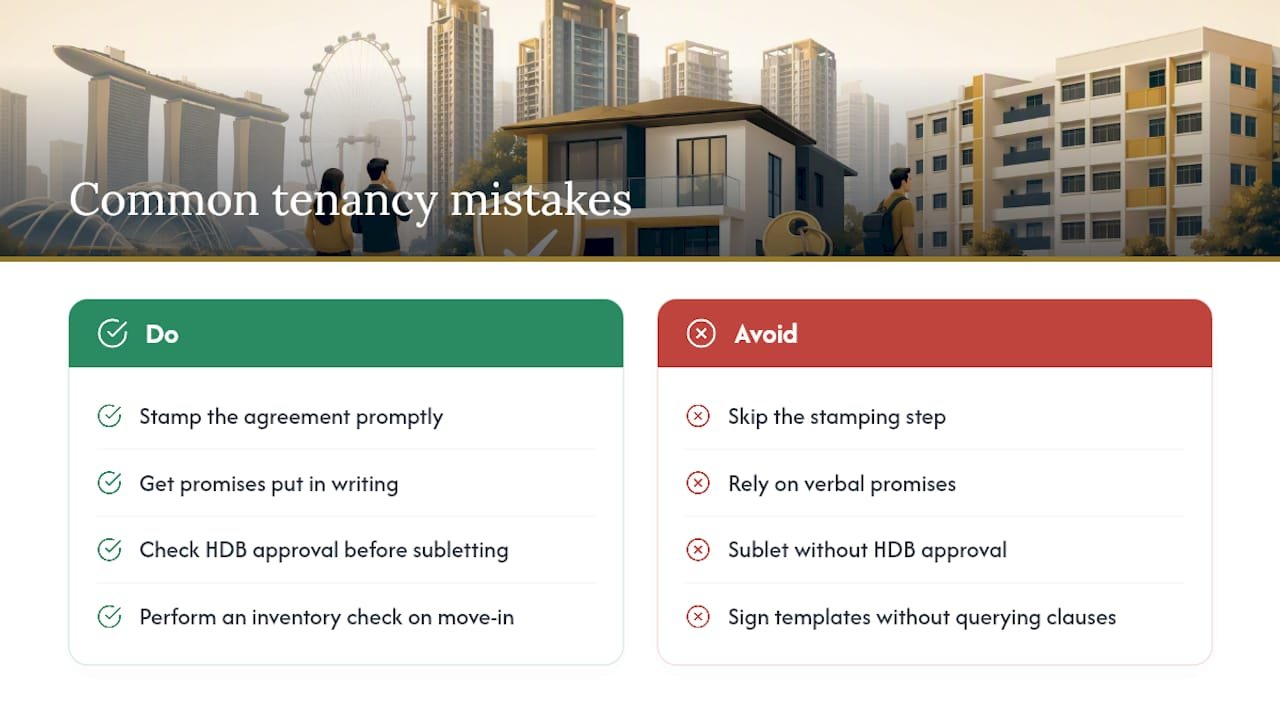
What are the most common mistakes in Singapore tenancy agreements?
The mistakes that cause the most grief are rarely dramatic. They’re small oversights that surface months later when money is on the line.
Skipping the stamping step is the single most costly one, because it can leave you without usable evidence exactly when you need it most. A close second is relying on a verbal promise, whether that’s a verbal agreement to renew, a verbal understanding about who pays for aircon servicing, or a verbal assurance about subletting. None of it holds up if the other side disputes it later, and none of it appears in a stamped contract unless someone wrote it in.
Landlords frequently forget to check HDB approval status before subletting, which can jeopardise the entire tenancy regardless of what the contract says. Tenants often skip the inventory check, then find themselves disputing deposit deductions for damage they can’t prove was pre-existing. Another frequent error: assuming a diplomatic clause exists because it’s “standard practice”, when in fact it only applies if the specific clause, with its trigger, notice period and proof requirements, was actually written into the agreement you signed.
Finally, many people treat the CEA or HDB template as fixed rather than negotiable, and sign without querying clauses that don’t suit their situation. Both bodies expect some negotiation and amendment before signing, so raising a query at that stage costs nothing and can save considerable trouble later.
Do exceptional circumstances like COVID-19 change tenancy terms?
Exceptional events don’t automatically change a signed tenancy agreement’s terms. Singapore’s COVID-19 relief measures for tenancies were temporary, legislated interventions rather than a permanent feature of tenancy law Singapore, and they applied to specific periods and specific categories of tenancy affected by pandemic restrictions.
Outside of a specific legislated relief period, a tenant or landlord facing an unexpected event, whether that’s a job loss, a posting overseas, or a business closure, has no automatic right to break or vary the lease. Any flexibility has to come from what’s written into the contract, most commonly a diplomatic clause covering relocation, or from a fresh negotiation with the other party. This is precisely why a well-drafted diplomatic clause or break clause matters more than most tenants realise when they sign. It’s the only built-in safety valve for circumstances that fall outside anyone’s control.
If an exceptional event does arise, the same evidence rules apply as any other dispute: document everything, keep the stamped agreement and correspondence on hand, and approach the landlord in writing before assuming a right that the contract may not actually grant.
Should tenants and landlords take out insurance?
Tenancy agreements rarely mention insurance directly, but both sides carry exposure that a policy can cover. Tenants are generally responsible for their own belongings inside the unit. A basic contents or renter’s insurance policy covers theft, fire and water damage to personal property, which the landlord’s own insurance typically won’t extend to.
Landlords carry a different set of risks. A landlord insurance policy usually covers the structure, fixtures and fittings, plus loss of rental income if the property becomes uninhabitable, and public liability if a visitor or the tenant is injured on the property. For HDB flats, some coverage may already sit within existing home insurance the owner holds, so it’s worth checking what’s included before assuming a gap exists.
Neither type of policy is a legal requirement to sign a lease contract Singapore agreement, but the security deposit alone rarely covers major damage, fire, or a liability claim. For landlords renting out higher-value units, or tenants moving in with valuable belongings, the modest premium on either policy is usually far cheaper than the dispute it prevents.
What does the research actually tell tenants and landlords to prioritise?
The conventional advice on tenancy agreements spends far too much time on finding the “right” clause wording and not enough on the two things that actually decide most disputes: whether the agreement was stamped, and whether the diplomatic or break clause was drafted with real specificity. A beautifully worded rent clause means nothing if the contract sits unstamped in a drawer when a dispute lands at the Small Claims Tribunal.
If there’s one habit worth building above all others, it’s treating the CEA or HDB template as a working document, not a formality to rush through. Query the clauses that don’t fit your situation. Confirm the diplomatic clause’s trigger and proof requirements in plain language before signing, not after you need it. And do the inventory check properly, with photos, on day one, because that thirty-day window closes faster than most tenants expect.
Landlords and tenants who get this right aren’t necessarily the ones with the most legal knowledge. They’re the ones who treated the paperwork stage as seriously as the viewing stage.
— Anderson
Ready to find your next rental or list your property?
Once your tenancy agreement is sorted, the harder part is often finding the right property or the right tenant in the first place, and that’s where a dedicated property platform proves useful. Rather than trawling scattered listings across multiple sites, you can search current rentals in one place, compare units against similar properties nearby, and get a straight read on where a property sits in the market before you commit to a figure.

If you’re a tenant, start with the property listings to see what’s currently available across Singapore. If you’re a landlord weighing up your next move, request a free evaluation to see what your unit could realistically command before you fix a rent and start drafting the tenancy agreement. Either way, the fastest next step is the same: browse the current property list and get in touch with the team once you’ve found something worth pursuing.
This article is general information, not a substitute for advice from a qualified lawyer. Consult a qualified legal professional about your own circumstances before acting on anything here.