

URA/HDB Screening: Find Undervalued Properties in Singapore, 5–15% Gap
An undervalued property in Singapore is one trading at a genuine discount to adjusted comparables, not just a low headline price. The gap needs a fixable cause such as an outdated unit, a slow seller, or a quiet corner of the market, typically moderately below what similar transacted units fetch, such as in the range used by experienced practitioners. The first move is always the same: pull the URA or HDB transacted price data for the project or block and check it against the asking price before you check anything else.
TL;DR:
- A genuinely undervalued property in Singapore has a fixable reason for its discount, such as outdated features or slow market conditions, not structural problems or lease issues.
- Adjusted comparables are crucial: compare asking prices against median prices per square foot derived from recent, normalized caveat data for the same project or block.
- Key due diligence steps include checking seller motivation, screening for fixable faults, confirming lease and financing eligibility, and assessing exit liquidity based on recent transaction volume.
- Investment calculations should incorporate full costs like stamp duty, legal fees, and renovation, with rental yield based on net income over total acquisition cost, not just purchase price.
- Avoid value traps like lease decay or thin markets by monitoring market resets, official reprice signals, and proximity to nearby supply completions to ensure investment viability.
Table of Contents
- What does “undervalued” actually mean in the Singapore market?
- Building adjusted comparables from URA and HDB caveat data
- The step-by-step checklist before you make an offer
- Modelling returns: net yield, XIRR, and what acquisition really costs
- Value traps that catch even experienced buyers
- What recent Singapore transactions can teach you
- An editorial view on running this workflow properly
- Get a valuation before you commit capital
- Sources
- FAQ
What does “undervalued” actually mean in the Singapore market?
Cheap and undervalued are not the same thing. A unit can be listed low because it has a genuine structural problem, a short remaining lease, or an awkward layout that will always struggle to sell. That is a value trap, not an opportunity.
A genuinely undervalued property has a fixable reason for its discount, once you adjust for floor level, facing, layout, lease tenure, and financing constraints such as CPF usage limits on shorter leases. Practitioner guides on spotting undervalued property in Singapore consistently point to the same test: strip out cosmetic factors, then compare like with like.
The 5% to 15% gap rule works as a screening filter, not a verdict. A unit priced 20% below comparables usually has a reason you have not found yet. Below 5%, you are likely looking at normal listing noise rather than a real signal.
Building adjusted comparables from URA and HDB caveat data
Listing portals show asking prices, which sellers set and often revise. Transacted prices, drawn from lodged caveats, show what buyers actually paid. That gap is where most of the useful information sits.
Two datasets do the heavy lifting for cheap real estate Singapore hunters who want more than gut feel:
- URA Private Residential Property Transactions, which gives caveat-level data for condos and private houses, including unit floor, size, and transacted price.
- HDB’s resale price e-service, which covers block, storey range, flat type, and remaining lease for every lodged HDB resale transaction.
Pull transactions from the same project or block over the past 6 to 12 months, then normalise them. Adjust for floor premium (higher floors typically carry a per-storey premium in most condos), facing and view, renovation state, and remaining lease. A unit with 60 years left will trade at a meaningful discount to one with 90, because CPF and loan tenure both shrink as lease decays.
Once adjusted, calculate a median price per square foot for that specific micro-market. Compare the asking price of your candidate against that adjusted median, not against the headline PSF quoted in the listing. Practitioner notes on caveat-based screening stress this exact discipline: normalise before you compare, because raw PSF averages hide as much as they reveal.
A published screen of projects with the lowest average PSF over 12 months is a reasonable starting shortlist, but treat it as a long list for further adjustment, not a buy list.
The step-by-step checklist before you make an offer
Once a candidate clears the adjusted-comparable screen, work through operational due diligence in this order.
- Check seller motivation. Look at how long the caveat or listing has been live, whether the sale is tied to probate or an estate settlement, and how the agent has repriced the listing over time, as explained in this practical guide for property agents.
- Separate fixable faults from permanent ones. Dated fittings, awkward furniture placement, and a tired kitchen are fixable. A structural pillar through the living room or a unit facing a rubbish chute is not.
- Screen lease and financing eligibility. Confirm the remaining lease supports your intended loan tenure and CPF usage, particularly for buyers near the 65-year lease threshold where CPF withdrawal rules tighten.
- Test exit liquidity. Count how many caveats have been lodged in that project or block over the past 24 months. Fewer than five suggests a thin resale pool that could work against you later.
Pro Tip: Ask the agent directly how many other units in the same block have transacted in the last year. A hesitant answer is itself a data point.
Modelling returns: net yield, XIRR, and what acquisition really costs
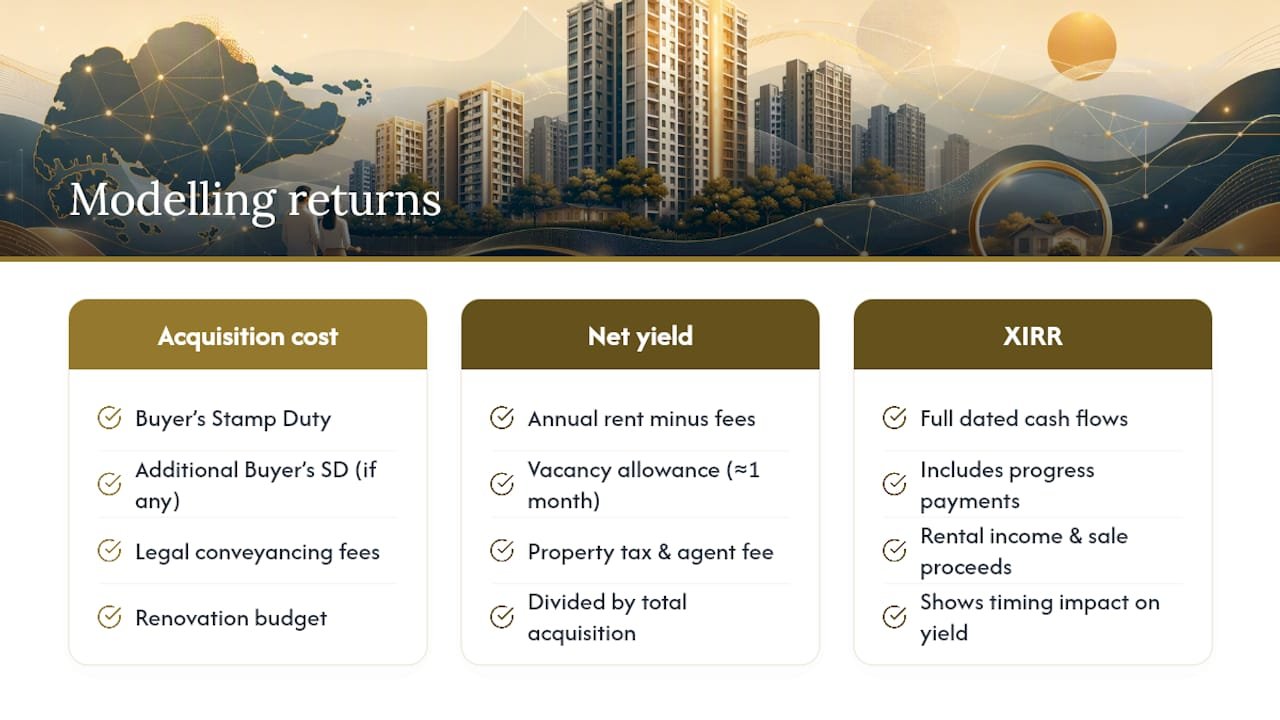
Run the numbers before you fall for the story. Total acquisition cost includes Buyer’s Stamp Duty on a tiered scale, Additional Buyer’s Stamp Duty if it applies to your buyer profile, legal conveyancing fees, and renovation budget where the unit needs work.
Net rental yield is annual rent minus MCST maintenance fees, a realistic vacancy allowance (typically one month a year), property tax, and agent commission, divided by total acquisition cost, not just the purchase price. Private condo gross yields currently sit broadly in the 3.0% to 4.0% range, with HDB and OCR units often showing higher headline numbers because entry prices are lower.
XIRR captures the full cash-flow timeline: your initial outlay, staggered progress payments if buying a new launch, rental income, and eventual sale proceeds, all at their actual dates rather than assumed annual intervals. This matters because resale units start earning rent almost immediately, while new launches carry years of holding cost before Temporary Occupation Permit. Investment playbooks for 2026 generally favour resale over new launch for yield-focused buyers precisely because of this timing gap, even when the new launch looks cheaper per square foot on paper.
Value traps that catch even experienced buyers
Lease decay is the trap that hurts most because it compounds. As a leasehold property crosses roughly 60 years remaining, CPF usage and bank loan tenure both shrink, shrinking your future buyer pool and your exit price. This isn’t priced in gradually; it often shows up as a step change once a project crosses that threshold.
High-quantum units in a project with few comparable buyers face the same liquidity problem from a different angle. A four-bedroom penthouse might look like a bargain per square foot, but if only two similar units have transacted in three years, that discount may simply reflect a thin market.
Watch the supply pipeline too. A wave of nearby completions hitting TOP in the same 12 months as your purchase can pressure both rents and resale prices. And some faults are simply permanent: irregular layouts, low ceiling pockets, and units backing onto expressways rarely improve with a paint job, whatever the listing photos suggest.
What recent Singapore transactions can teach you
A trio of conservation shophouses in Chinatown was relaunched with a guide price of $45 million, 18% below its year-ago asking level. That kind of guide-price reset is exactly the signal worth tracking: official repricing, not agent chatter, is where real entry points appear.
To do this yourself:
- Pull the caveat history for the specific project or block and compare guide price against PSF on GFA, not just headline quantum.
- Check whether the discount reflects a genuine market reset or a seller simply testing a lower number.
- Verify any nearby catalyst, such as an HDB masterplan announcement, directly on the official portal rather than through a secondhand summary, since many “priced-in” stories overstate how much upside is left.
An editorial view on running this workflow properly
The mistake most buyers make is treating a low PSF as the finish line rather than the starting point. A PSF screen tells you where to look; it never tells you why the price is low, and that “why” is the entire investment decision.
. What consistently separates a genuine gap from a value trap is discipline in the adjustment step, floor, facing, lease, and layout, applied to actual caveats rather than asking prices. .
For readers who want the screening done with local market context, a free property valuation is a practical way to sanity-check a candidate before you commit to an offer.
— Anderson
Get a valuation before you commit capital
A key advantage of some platforms is enabling investment in Singapore property without the burden of Additional Buyer’s Stamp Duty, which changes the entire returns calculation you just ran through above.

Once you have a shortlist from your own adjusted-comparable screen, the next step is verification, not guesswork. Registertoday’s free property valuation service checks your candidate against current market evaluations and flags gaps you may have missed. From there, the team can build a personalised shortlist matched to your criteria and handle negotiations directly with the seller, drawing on detailed market gap analysis rather than a single listing price. Browse current residential opportunities or request a valuation today to see where your numbers actually stand before you make an offer.
FAQ
How do I find undervalued property in Singapore?
Start by pulling transacted prices from URA or HDB’s e-service for the specific project or block, then adjust for floor, facing, lease, and layout to build a fair comparable median. Compare the asking price against that adjusted figure rather than the headline PSF, and treat any gap under 5% as noise rather than a signal.
What are the most undervalued stocks in Singapore?
This question is usually confused with property screening, and stock-level valuation sits outside the scope of a caveat-based property workflow. If you are looking at real estate specifically, a published screen of projects with the lowest average PSF over the past 12 months is a reasonable starting shortlist for further adjustment.
Will property prices drop in 2026 in Singapore?
Broad market direction depends on interest rates, cooling measures, and supply pipeline, and no single figure applies across every segment. Private condo rental yields currently sit in the 3.0% to 4.0% range, and buyers should check district-level supply and completion waves rather than rely on a single national forecast.
Where do the ultra-rich live in Singapore?
Prime districts such as those around Orchard, Sentosa Cove, and the Good Class Bungalow areas in the core central region remain the traditional addresses for high-net-worth buyers. These segments rarely show up in undervalued screens because transaction volumes are thin and comparables are scarce, which is itself a liquidity risk worth weighing before buying there.
Does Registertoday charge for a property valuation?
Registertoday’s property valuation is free, with no published fee for the service. It is designed to help buyers check a candidate property against current market data before making an offer.