
Plan Around ABSD in Singapore 2026: Cash Examples & myTax Steps
Additional Buyer’s Stamp Duty in Singapore is applied on top of standard Buyer’s Stamp Duty, with rates varying by buyer profile. It is charged on whichever is higher: the purchase price or the market value. Remissions exist for married couples, HDB upgraders and eligible seniors, but every buyer pays ABSD upfront before any refund is considered.
TL;DR:
- Foreign buyers and entities face significantly higher ABSD rates, with foreigners paying 60% regardless of the number of properties held.
- When purchasing jointly, IRAS applies the highest applicable rate among all buyers to the entire property, not a blended average.
- ABSD is calculated on the higher of the purchase price or market value and must be paid within 14 days of signing the sale agreement.
- Remissions are available for married couples, HDB upgraders, and seniors but require full upfront payment of ABSD before claiming refunds.
- Accurate valuation and early planning help buyers avoid costly surprises and strengthen negotiating positions when making offers.
Table of Contents
- Current ABSD rates in Singapore by buyer profile
- Who actually pays ABSD: profiles, joint buyers and property counts
- How ABSD is calculated and when it must be paid
- Remissions and concessions that can reduce your ABSD bill
- ABSD on trusts, companies and housing developers
- Paying ABSD and claiming remissions through myTax
- Penalties and mistakes that catch buyers out
- Worked scenarios: what different buyers actually pay
- Where to verify the current ABSD figures
- Register Today’s perspective on navigating ABSD
- Plan your purchase around the real ABSD number, not the estimate
- Sources
Current ABSD rates in Singapore by buyer profile
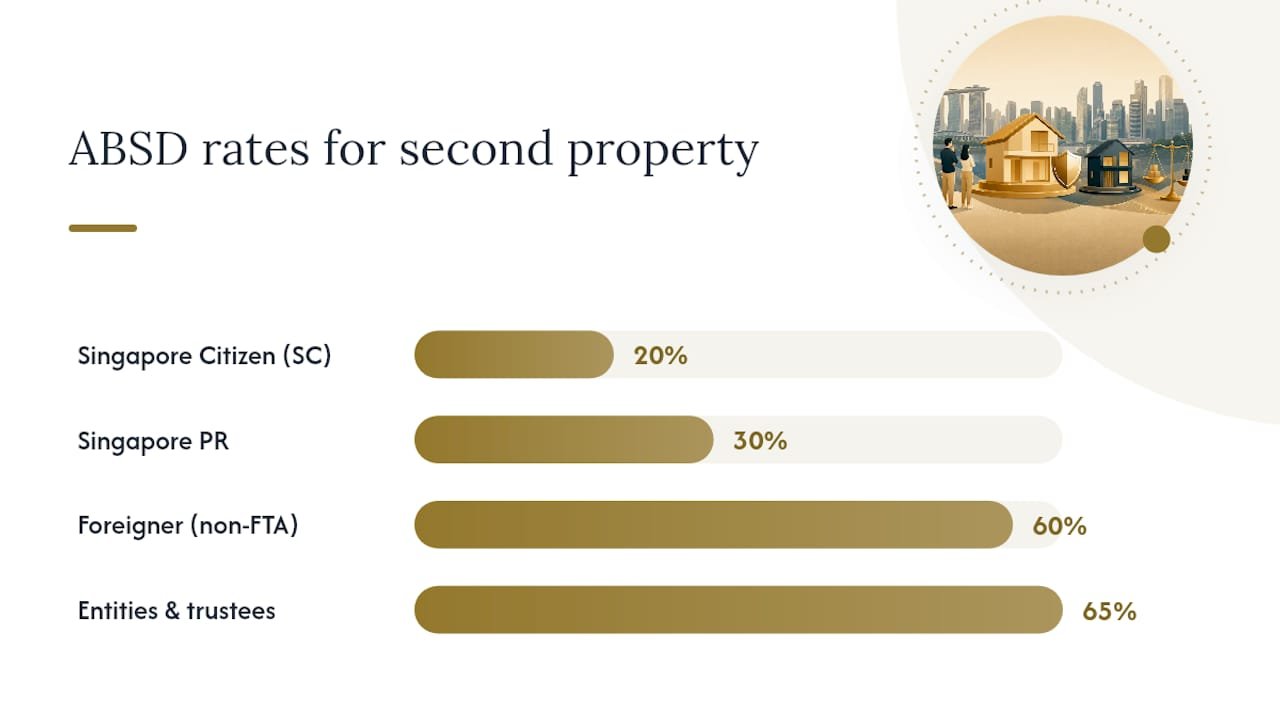
The rates below have applied since 27 April 2023 and remain the framework for ABSD rates 2026) planning. Singapore Citizens buying a first residential property pay nothing extra. Everyone else, from second-time PR buyers to first-time foreign buyers, pays a meaningful slice of the purchase price before they even get to legal fees.
| Buyer profile | 1st property | 2nd property | 3rd and subsequent |
|---|---|---|---|
| Singapore Citizen (SC) | 0% | 20% | 30% |
| Singapore PR | 5% | 30% | 35% |
| Foreigner (non FTA) | 60% | 60% | 60% |
| Entities and trustees | 65% | 65% | 65% |
| Housing developers | 35% + 5% non‑remittable | 35% + 5% non‑remittable | 35% + 5% non‑remittable |
The 2023 revision doubled the foreigner rate overnight, from 30% to 60%, and lifted the entity/trustee rate from 35% to 65% in a single announcement. That kind of jump is exactly why “current ABSD rates” searches spike whenever a Budget statement is due: the official IRAS table is the only version worth trusting, because third-party summaries lag behind policy changes.
One detail catches out a lot of couples and business partners: on a joint purchase, IRAS applies the highest applicable rate among all buyers to the entire transaction, not a blended average. A Singapore Citizen buying jointly with a foreigner pays 60% on the whole property, not a mix of 0% or 20% for the citizen’s share and 60% for the foreigner’s. This single rule trips up more first-time joint buyers than any other part of the ABSD framework.
Who actually pays ABSD: profiles, joint buyers and property counts
Liability hinges on three questions: who is buying, how many residential properties they already hold, and whether the purchase is joint. Getting any of these wrong on the stamping form is a compliance risk, not just a paperwork slip.
- Singapore Citizens (SC): pay 0% on a first property, 20% on a second, 30% on a third or beyond.
- Singapore Permanent Residents (PR): pay 5% even on a first property, rising to 30% and 35%.
- Foreigners: pay a flat 60% regardless of whether it is their first Singapore property or their fifth, with the notable exception of nationals from countries covered by a free trade agreement (FTA) with Singapore, including the United States, Iceland, Liechtenstein, Norway and Switzerland, who are treated as Singapore Citizens for ABSD purposes.
- Entities and trustees: pay 65% on any residential purchase, with no first-property concession at all.
- Housing developers: pay 35% plus a 5% non‑remittable top-up, addressed further below.
Property counting looks at what a buyer holds at the time of the new purchase, including properties held overseas by citizens and PRs. Decoupling, gifting a share to a spouse, or restructuring ownership through a trust can all shift a buyer’s profile, but IRAS assesses the transaction’s substance and stated intention at the point of purchase. A tactic that looks clean on paper can still draw scrutiny if the underlying intent was to sidestep ABSD.
How ABSD is calculated and when it must be paid
ABSD is a flat rate applied to the entire transaction value, not a marginal rate that only bites on the portion above a threshold. It is calculated on whichever figure is higher: the actual purchase price or the property’s market valuation, then added on top of standard Buyer’s Stamp Duty rather than replacing it, per IRAS’s published methodology.
A worked example makes this concrete:
- A Singapore Citizen buying a second property agrees a purchase price of $1,500,000, and the property is independently valued at $1,520,000.
- ABSD is calculated on the higher figure, $1,520,000, at the 20% second-property rate.
- That gives an ABSD bill of $304,000, due on top of BSD, which is calculated separately on a tiered scale.
- Total upfront stamp duty easily exceeds $350,000 once BSD is added, before legal fees or the deposit itself.
ABSD and BSD must both be settled within 14 days of signing the Sale and Purchase Agreement (or the Option to Purchase, if exercised), typically through e‑stamping on myTax. Because ABSD is due in cash, not financed through the mortgage, it directly reduces the funds available for the deposit and can push a buyer’s effective loan-to-value position lower than the MAS LTV limits would otherwise allow. Duty amounts are rounded to the nearest dollar, and there is no minimum duty waiver below a small transaction value.
Remissions and concessions that can reduce your ABSD bill
ABSD remissions are narrow by design. The Ministry of Finance has consistently framed ABSD as a demand-moderating tool, which is why MOF’s remission framework keeps eligibility tightly conditioned rather than broadly available.
- Married couples (matrimonial home remission): a Singapore Citizen married to another Singapore Citizen or PR can claim a refund if they sell their first property within six months of buying the second (or within six months of the new property’s Temporary Occupation Permit, for uncompleted units).
- HDB upgraders: couples selling an HDB flat to buy a private property can qualify under similar conditions, provided the flat is sold within the same six-month window.
- Single SC seniors aged 55 and above: can claim an ABSD concession when right-sizing to a smaller home, again conditional on selling the first residential property within six months.
- FTA nationals: buyers from FTA-covered countries are simply charged at the Singapore Citizen rate from the outset, so no separate refund claim is needed.
Pro Tip: Every one of these remissions requires ABSD to be paid in full at the point of purchase first. There is no “pay the reduced rate upfront” option, so budget for the full amount and treat the refund as a separate, later cash inflow, not a discount you receive at completion.
ABSD on trusts, companies and housing developers
Buying through a company, a trustee arrangement, or a development vehicle pushes ABSD to its highest tier, and the rules tightened further in 2022.
| Purchaser type | ABSD rate | Notes |
|---|---|---|
| Entity or company | 65% | No first-property concession |
| Trustee (living trust) | 65% | Applies to transfers from May 2022 |
| Housing developer | 35% + 5% non‑remittable | 5% component cannot be remitted under any circumstance |
Housing developers face a structural surcharge: the 35% base rate can be remitted under specific conditions tied to development timelines and unit-count thresholds, but the 5% top-up is non‑remittable no matter what. Developer remissions are only available to genuine development projects meeting IRAS’s defined criteria, not to entities buying residential units for holding or rental purposes. Readers exploring the developer side of the market, including project-level remission mechanics, may find Haio’s development resources a useful complement to IRAS guidance.
Paying ABSD and claiming remissions through myTax
Every ABSD transaction runs through the same portal, whether you are paying in full or applying for a refund afterwards.
- Stamp the document: log into myTax’s e‑stamping service and select the Sale and Purchase Agreement (or transfer instrument) under the property stamping menu, entering buyer profiles and property details accurately.
- Pay ABSD and BSD: the portal calculates both duties together; payment can be made by GIRO, PayNow or credit card, and a digital receipt is issued immediately, which you should keep with your conveyancing file.
- Submit remission or refund claims: where you qualify for a married-couple, HDB upgrader or senior concession, lodge the application through myTax within the stipulated window, attaching the sale contract for the disposed property and any supporting valuation documents.
Payment status and stamp certificates can be checked directly in your myTax account. For anything outside standard scenarios, such as disputed property counts or overseas holdings, IRAS’s stamp duty helpline is the right first call before a conveyancer files anything.
Penalties and mistakes that catch buyers out
Late stamping is not a minor administrative slip. IRAS treats it as a compliance breach, with penalties that can run to multiples of the unpaid duty depending on how late the document is stamped.
- Assuming a quick resale erases ABSD: selling shortly after purchase does not cancel the original liability; ABSD was due at the point of acquisition regardless of what happens afterwards.
- Missing the six-month refund window: married-couple and senior remissions lapse if the qualifying property is not sold within the stipulated period, and IRAS does not offer discretionary extensions in most cases.
- Misdeclaring buyer profile or property count: overlooking an overseas property, or misclassifying a joint buyer’s residency status, can result in reassessment and back-dated duty plus penalties.
Engaging a conveyancer before the Option to Purchase is signed, not after, gives enough time to confirm the correct rate and remission eligibility. Keep every valuation report on file; it is the document IRAS will ask for first if a “higher of price or value” calculation is ever queried.
Worked scenarios: what different buyers actually pay
Numbers make ABSD real in a way percentages alone do not.
- A Singapore Citizen buying a second property at $1.2 million pays 20% ABSD, a cash outlay of $240,000, on top of BSD of roughly $33,600, before legal costs.
- A Singapore PR buying a second property at the same $1.2 million price pays 30% ABSD, or $360,000, a full $120,000 more than an SC buyer would pay for an identical unit.
- A foreigner buying a $2 million property, their first in Singapore, pays 60% ABSD: $1.2 million in duty alone, more than half the purchase price again on top of the price itself.
- An entity purchasing through a corporate vehicle at $2 million pays 65%, or $1.3 million; a housing developer acquiring the same site for a qualifying project pays 35% base plus a non‑remittable 5%, or $800,000 minimum regardless of any later remission claim.
These figures show why liquidity planning, not just loan pre-approval, decides whether a purchase is realistic at all.
Where to verify the current ABSD figures
For the definitive rate table, go directly to IRAS’s ABSD page, which is updated whenever policy changes. The Ministry of Finance’s remission announcements explain the reasoning behind each concession, while myTax remains the only portal for stamping documents, paying duty and lodging refund claims.
Register Today’s perspective on navigating ABSD
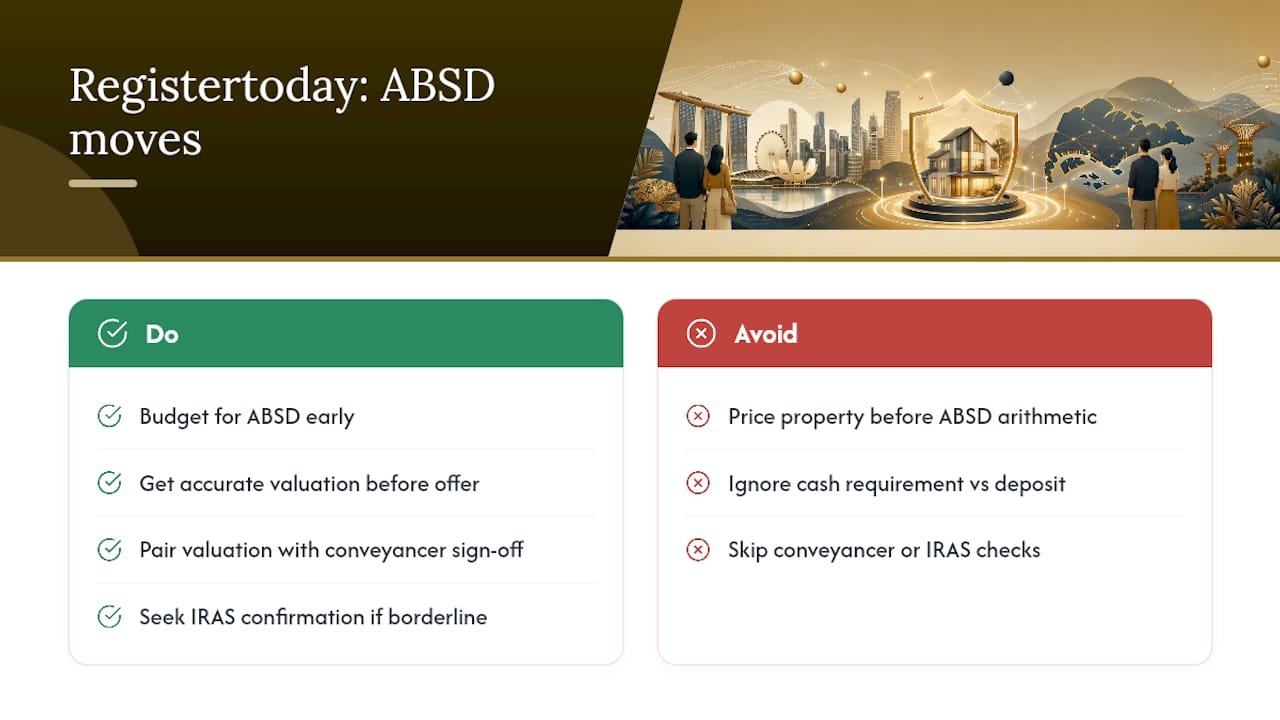
The conventional advice on ABSD is to “budget for it and move on.” That undersells how much the flat-rate structure distorts decision-making. A buyer weighing a $1.5 million second property does not just face a 20% or 30% tax line, they face a cash requirement that can dwarf their deposit and force a choice between a smaller unit and a delayed purchase entirely. Too many buyers price the property first and discover the ABSD arithmetic second, by which point they have already lost negotiating leverage.
Registertoday has handled over $1 billion in property transactions, and the pattern is consistent: buyers who get an accurate market valuation before making an offer negotiate from a stronger position, because they know exactly what “higher of price or market value” will mean for their ABSD bill before it becomes a surprise at stamping. Our valuation and negotiation services exist precisely to close that gap. For anything touching trusts, decoupling, or FTA eligibility, pair that valuation with a conveyancer’s sign-off and, where the case is genuinely borderline, direct confirmation from IRAS.
— Anderson
Plan your purchase around the real ABSD number, not the estimate
Most buyers researching ABSD are trying to answer one question: what will this actually cost me in cash, today, not in theory.

Beyond valuation, our team runs personalised negotiation on your behalf, factoring your ABSD profile into the offer strategy from the start rather than treating it as an afterthought once terms are agreed. That matters most for second-property buyers and foreign purchasers, where the duty gap between profiles can run into hundreds of thousands of dollars and change what price actually makes sense. Browse our current property listings with your ABSD position already factored in, or request a home valuation directly to see where you stand before you make an offer.
This article is general information, not a substitute for advice from a qualified financial advisor. Consult a qualified financial professional about your own circumstances before acting on anything here.