


Property Valuation Singapore: 3 Ways to Avoid Loan Shortfalls
A quick online estimator gives you a useful indicative range within seconds, but it isn’t the number that decides your mortgage. Before you exercise the option to purchase, get an indicative desktop valuation to sense-check the asking price. After OTP, your bank orders a formal valuation, and that figure, not your offer price, sets your loan-to-value ratio. Cross-check every estimate against URA caveats, the HDB Resale Portal, and IRAS annual value records.
TL;DR:
- Instant portal estimates are useful for quick checks but should not replace formal valuations when applying for a mortgage.
- Bank valuations take 5 to 10 days, cost between S$300 and S$700 plus GST for private properties, and are the decisive figure for loan approval and shortfall payments.
- Using recent caveats, URA data, and HDB resale records helps verify valuation accuracy, but market speed and unique property features can still cause discrepancies.
- Buyers should prepare detailed documents and recent comparables before valuation visits to reduce conservative adjustments and improve results.
- Registertoday offers free pre-OTP valuations and negotiation support to help buyers make informed decisions before committing financially.
Table of Contents
- Instant valuation tools and what they deliver in Singapore
- Formal bank valuation: timing, purpose, cost and consequences
- Valuation methods used in Singapore and how valuers apply them
- Typical fees, timelines and what to budget for
- How to prepare for a valuation and improve the result
- When to hire a licensed valuer or use Register Today for valuation help
- Legal and regulatory framework governing property valuations in Singapore
- How property valuation impacts property taxes and stamp duties
- Factors affecting property valuation specific to Singapore’s market
- Common pitfalls or errors in property valuations and how to address them
- Author’s perspective: three priorities to avoid valuation surprises
- How Registertoday helps: valuation, negotiation and sale support
- Sources
Instant valuation tools and what they deliver in Singapore
Three types of instant tools sit between a gut feeling and a formal report, and each answers a different question.
Portal estimators are the fastest route. Tools like SRX’s X-Value pull from URA and HDB transaction data and run it through an automated model to spit out a market value range in seconds. They’re free or near-free, updated regularly, and genuinely useful for a first-pass check before you even shortlist units to view.
Bank AIP (Approval In Principle) estimates come next. When you approach a bank for pre-approval, its in-house valuation team often gives an indicative figure alongside your loan eligibility. This isn’t a formal valuation, but it reflects what that specific lender’s panel is likely to land on later, which makes it more predictive than a generic portal number.
Independent desktop valuations sit at the top of the instant tier. A licensed valuer reviews comparable transactions and recent caveats without visiting the property, typically turning around a report within a day or two. Buyers use these to negotiate with more confidence, especially on resale units where the asking price looks stretched against recent sales.
Accuracy depends entirely on the data feeding the model. URA caveat data is updated weekly, and the HDB Resale Portal reflects registered resale transactions, so both are solid primary sources. The catch is timing: in a fast-moving market, a transaction from six weeks ago may already sit below current asking prices, and thinly traded segments (landed homes, penthouses, unusual layouts) have too few comparables for any automated model to be reliable.
Here’s when each tool is genuinely enough, and when it isn’t:
- Quick market check before viewing units: portal estimator is sufficient.
- Negotiating an offer on a resale flat or condo: independent desktop valuation adds real weight.
- Sizing your loan or budget before OTP: bank AIP estimate, but treat it as indicative only.
- Confirming actual loan quantum: none of the above. You need the formal valuation described next.
- Valuing a landed property, GCB, or heritage shophouse: skip automated tools entirely; comparables are too sparse.
None of these instant checks bind your bank to anything. Automated tools are improving, but they still can’t replace a physical inspection when the lender requires a formal report, which is every single time you take out a mortgage.
Formal bank valuation: timing, purpose, cost and consequences
Once you’ve exercised the option to purchase, your bank orders a formal valuation from a valuer on its MAS-appointed panel. You don’t choose the valuer, and you don’t get to negotiate the outcome. This report, not the price you agreed with the seller, is what the bank actually lends against.
The mechanics are straightforward but unforgiving:
- You exercise the OTP and submit your loan application.
- The bank instructs a panel valuer, who typically inspects the unit or relies on a desktop assessment for straightforward resale cases.
- The report lands within 5 to 10 working days.
- The bank calculates your maximum loan using the lower of the valuation or the purchase price.
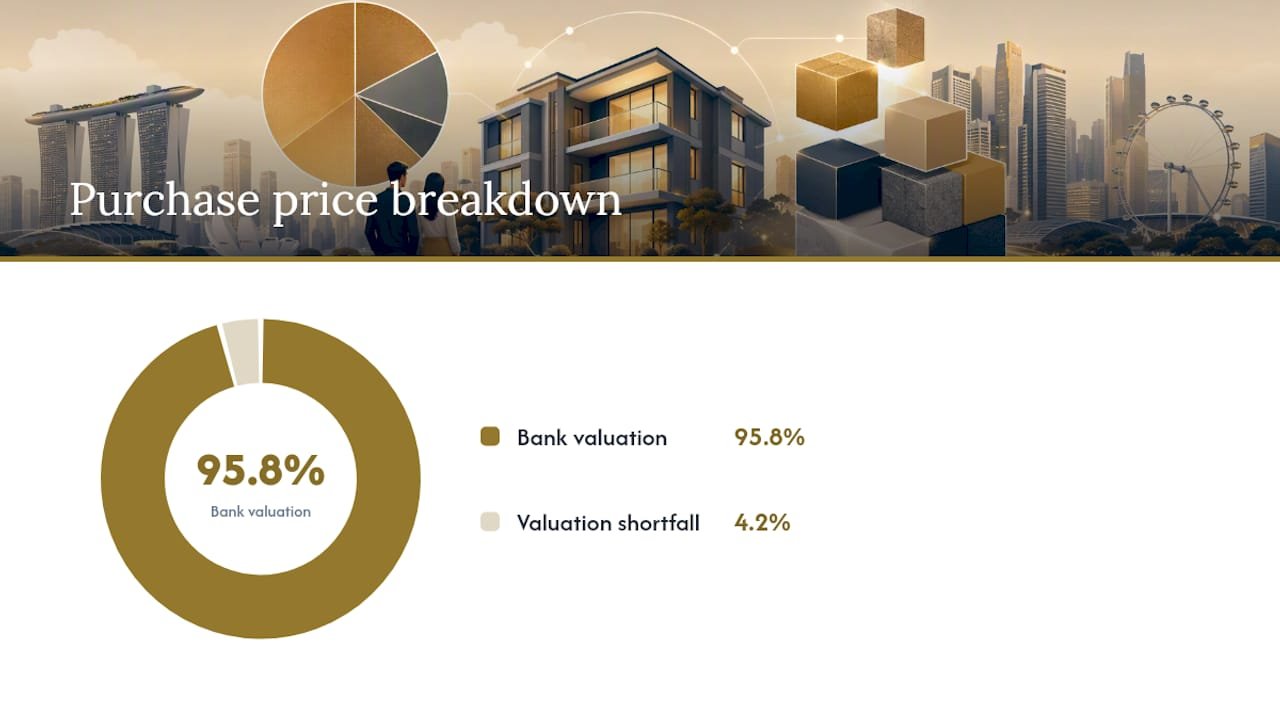
- Any shortfall between valuation and purchase price must be covered in cash, on top of your existing down payment.
Fees run S$300 to S$700 plus GST for private property, and a flat S$120 for HDB flats. Buyers pay this fee regardless of the outcome, and it’s non-refundable even if the valuation comes in below your offer.
The consequence that catches buyers off guard is the shortfall itself. Say you agree to buy a resale condo for $1.2 million, but the panel valuer assesses it at $1.15 million. Valuation shortfalls are the most common reason buyers need a cash bridge at completion, and they tend to surface at the worst possible time, when your funds are already earmarked for renovation or stamp duty.
Plan for this before you sign anything. If a resale unit is being marketed noticeably above recent caveats, treat that gap as a real risk to your liquidity, not a negotiating quirk.
Valuation methods used in Singapore and how valuers apply them
Singapore valuers rely on three core methods, and which one applies depends almost entirely on what you’re buying.
Comparable sales (direct comparison) dominates HDB flats and mass-market condos, where enough recent transactions exist to build a reliable benchmark. The valuer pulls similar units sold recently in the same development or precinct, then adjusts for floor level, orientation, renovation status, and remaining lease. A high-floor unit with a clear view commands a premium over an identical low-floor layout facing a car park. A flat with 60 years left on its lease is valued differently from one with 90.
Income capitalisation applies to income-producing assets: shophouses, retail units, and commercial buildings bought partly or wholly for rental yield. The valuer estimates achievable market rent, then capitalises it using a market cap rate to arrive at value. A shift of even half a percentage point in the assumed cap rate can move the resulting valuation substantially, which is why commercial valuations often carry wider ranges than residential ones.
Replacement cost and residual methods cover niche assets where comparables barely exist: Good Class Bungalows, conserved shophouses, and development or en-bloc sites. These take longer and cost more, typically S$1,500 to S$3,500 with a two to three week turnaround, because the valuer is effectively reconstructing value from land cost, construction cost, and depreciation rather than reading it off recent sales.
- HDB flats and condos → comparable sales method, adjusted for unit-specific factors.
- Shophouses, retail, offices → income capitalisation, driven by achievable rent and cap rate.
- GCBs, conserved properties, en-bloc land → replacement cost or residual method.
- Mixed-use or unusual layouts → often a blend of comparable and income approaches.
Pro Tip: If your unit has a rare feature (a private lift, an unusually large balcony, a renovated layout that adds a room), gather photos and receipts before the valuer’s visit. Valuers can only apply an adjustment if they can see and verify what’s changed.
Typical fees, timelines and what to budget for
Costs scale with how much certainty you need, and the gap between the cheapest and most rigorous option is wider than most buyers expect.
| Valuation type | Typical cost | Turnaround |
|---|---|---|
| Bank in-house indicative estimate | Free (part of AIP) | Instant to 1 day |
| HDB indicative valuation (Resale Portal) | S$120 | 1 to 2 working days |
| Independent desktop valuation | S$300 to S$500 | 1 to 2 working days |
| Formal bank valuation, HDB | S$120 | 5 to 10 working days |
| Formal bank valuation, private property | S$300 to S$700 plus GST | 5 to 10 working days |
| Specialist valuation (GCB, en-bloc, shophouse) | S$1,500 to S$3,500 | 2 to 3 weeks |
That buffer covers a shortfall between purchase price and bank valuation without forcing you to liquidate CPF savings or scramble for a personal loan days before completion.
The pattern worth remembering: cheap and fast tools (portal estimators, HDB indicative valuations) are fine for decisions you can reverse. Expensive and slow ones (formal bank valuations, specialist reports) apply exactly when the decision is irreversible, at the point you’ve committed cash under an OTP.
How to prepare for a valuation and improve the result
Valuers work from evidence, not impressions, so the more verifiable detail you hand them, the less room there is for a conservative adjustment.
Before the valuer’s visit, have these ready:
- Floor plan and unit layout, especially if it differs from the original developer plan.
- Renovation receipts and dates, particularly for structural or layout changes.
- Strata title or management corporation documents for condos.
- Recent tenancy agreements, if the unit is rented, since this affects income-based adjustments.
- Any URA or HDB approval letters for additions or reconfigurations.
Providing this paperwork upfront reduces the valuer’s uncertainty, and uncertainty is what drives conservative, downward adjustments.
On presentation, small things matter more than sellers expect. A decluttered, well-lit unit photographs and inspects better, and while a valuer isn’t swayed by staging the way a buyer might be, an unmaintained unit (visible damp, unrepaired fixtures) can trigger a physical condition adjustment that a tidy one avoids entirely.
The most overlooked lever is comparable selection. You can’t dictate which transactions a valuer uses, but you can flag genuinely comparable recent sales in your development, especially ones you know the valuer might otherwise miss if they sit just outside the standard search radius or block grouping.
Pro Tip: Pull your own comparables from caveat data before the valuation is ordered. If three units on your floor sold within the last quarter at prices close to your offer, having that evidence ready gives your case more weight than hoping the valuer finds it independently.
When to hire a licensed valuer or use Register Today for valuation help
Most residential transactions run through bank-panel valuers automatically, so you rarely choose one yourself. But some situations call for hiring a valuer directly, outside the bank process.
You need a licensed valuer, holding an Appraiser’s Licence and SISV membership, when dealing with:
- Good Class Bungalows or other high-value landed property with sparse comparables.
- En-bloc sales, where valuation underpins the entire collective sale price.
- Financial reporting or accounting purposes, where the report must follow IVS and SFRS(I) 13 standards.
- Probate, matrimonial settlements, or other legal disputes requiring an independent, defensible figure.
Registertoday supports buyers and sellers through this exact gap between an instant estimate and a fully formal process, offering free property valuations alongside negotiation support and access to a wide base of listings. If you’re weighing whether your asking price reflects genuine market value or need a second opinion before committing to an OTP, that’s the point to reach out.
Legal and regulatory framework governing property valuations in Singapore
Valuation practice in Singapore isn’t a free-for-all. Anyone charging fees to appraise land or buildings must hold an Appraiser’s Licence issued under the Appraisers Act, administered through IRAS. Qualification requires a relevant degree, professional testimonials, and membership with the Singapore Institute of Surveyors and Valuers (SISV). The licence fee is S$125 annually, and renewal isn’t automatic; lapsed practitioners can’t legally issue chargeable valuation reports.
For bank-ordered valuations, MAS oversees the panel system indirectly through its supervision of financial institutions, meaning banks must appoint valuers who meet professional standards before relying on their reports for lending decisions. That’s why you can’t simply hire your preferred valuer for a mortgage valuation; the bank’s panel structure exists specifically to keep an arm’s length between the buyer’s interests and the figure the loan is sized against.
Valuations prepared for financial reporting or statutory purposes sit under a stricter regime again. ISCA guidance requires these reports to follow International Valuation Standards and SFRS(I) 13, with a clearly agreed scope of work before the valuer starts. Skipping that step is one of the more common reasons a valuation gets challenged later, whether by auditors, a court, or a co-owner in a dispute.
How property valuation impacts property taxes and stamp duties
Two entirely different valuation figures affect your tax bill, and confusing them causes real problems.
IRAS annual value is a rent-based estimate: what your property could reasonably fetch in annual rent on the open market. This figure, not your purchase price or a bank valuation, is what IRAS uses to calculate your property tax each year. You can check it directly through the myTax Portal.
Market capital value, the figure from your comparable sales or formal bank valuation, is what matters for stamp duty. Buyer’s Stamp Duty (BSD) is calculated on whichever is higher: the actual purchase price or the property’s market value at the point of sale. If you negotiate a price well below market value, IRAS can still assess stamp duty against the higher market figure, so a suspiciously low purchase price doesn’t reduce your duty the way some buyers assume.
These two figures move independently. Annual value tends to shift gradually, reviewed periodically against rental trends, while market capital value can jump sharply within months during a hot market. A flat with a stable annual value of $18,000 might still see its capital value climb 15% in a year if comparable transactions in the block spike, and your stamp duty follows the capital value, not the annual value. Keep both numbers straight when budgeting for a purchase; conflating them is a common and costly mistake.
Factors affecting property valuation specific to Singapore’s market
Location carries more weight in Singapore’s valuation logic than almost anywhere else, largely because of how tightly transport and school proximity correlate with price, as shown by the largest real estate companies by market cap which reflect these market dynamics. A unit within 500 metres of an MRT station routinely commands a premium over an otherwise identical one a fifteen-minute walk away, and valuers factor this in explicitly through comparable selection rather than a flat percentage bump.
Lease decay is a uniquely Singapore concern for HDB flats and leasehold condos. As remaining lease drops below roughly 60 years, CPF usage and loan eligibility both tighten, which suppresses buyer demand and, in turn, valuation. A 99-year leasehold flat with 40 years remaining is valued on a fundamentally different curve than a freehold equivalent, even with identical floor space and finishes.
Property age interacts with renovation status rather than acting alone. An older unit with a recent, well-documented renovation can value close to a newer equivalent, while a similarly aged unit left untouched since handover typically absorbs a downward adjustment for wear and dated fittings.
Amenities matter, but unevenly. Proximity to a mall or hawker centre adds modest value; proximity to a top primary school within the 1km priority admission radius can add considerably more, reflecting how much Singaporean buyers factor school placement into a purchase decision years before their children reach enrolment age.
Finally, floor level and facing direction remain persistent local variables. High floors with unblocked views, and units avoiding direct west-facing afternoon sun, consistently outvalue otherwise identical lower or less favourably oriented units in the same block.
Common pitfalls or errors in property valuations and how to address them
The most frequent mistake is treating a portal estimate as a substitute for a formal valuation when applying for a mortgage. It isn’t, and no bank will lend against it. Use instant tools for orientation only, then budget time and cash for the formal step your bank actually requires.
A second common error is relying on stale comparables. Buyers often anchor on a transaction from a year ago that no longer reflects current pricing, especially in a rising or falling market. Always check the transaction date on any caveat you’re using, and weight recent sales far more heavily than older ones.
Undisclosed defects or unauthorised renovations cause a third recurring problem. If a unit has an unapproved structural change (a knocked-through wall, an added loft), the valuer may either exclude the improvement from the valuation entirely or flag a compliance risk that lowers confidence in the figure. Regularise any unauthorised works with HDB or URA before your valuation, where possible, rather than hoping it goes unnoticed.
Buyers also frequently underestimate the shortfall risk on properties marketed above recent comparables. If a seller’s asking price sits meaningfully higher than the last three transactions in the same block, treat that gap as a red flag rather than simply a starting point for negotiation.
Finally, don’t assume every valuer reaches an identical figure. Reasonable valuations for the same property can differ by a few percentage points depending on which comparables were weighted most heavily. If a formal valuation comes in surprisingly low, you can request a second opinion or ask your bank whether the panel valuer would reconsider with additional comparable evidence you supply.
Author’s perspective: three priorities to avoid valuation surprises
Three things matter more than anything else here: check where your number actually came from, get an indicative valuation before you exercise the OTP, and keep a cash buffer for the gap a formal valuation might reveal. Most valuation disputes I’ve seen traced back to buyers skipping the middle step, assuming the seller’s asking price and the eventual bank figure would simply match. They often don’t, and the difference lands on you at the worst possible moment.
— Anderson
How Registertoday helps: valuation, negotiation and sale support
Registertoday is the direct alternative to guessing your way through an offer. Rather than relying solely on a portal estimate or waiting for your bank’s panel valuer to deliver the only number you get, you can request a free property valuation from Registertoday before you commit to an OTP, giving you a grounded figure to negotiate from rather than a rough guide.

The platform pairs that valuation with personalised negotiation support and access to a substantial base of listings, drawing on more than $1 billion in completed sales to inform how it prices and positions properties. Whether you’re buying, selling, or trying to understand what a unit is genuinely worth before you make an offer, Registertoday’s team works through the same comparable and market-gap analysis a formal process eventually confirms, just earlier, when it can still change your decision. Browse current opportunities through the property listings, or check what your property is worth today to get a grounded starting figure before you sign anything.
Sources
Four sources cover almost everything you’ll need to verify a valuation independently.