


Refinance Singapore Mortgage: Break Even Checklist for Homeowners
Most Singapore homeowners with a significant duration left on a fixed rate should reprice with their current bank; those past the lock-in on an older package should refinance. The two market anchors right now are 3-month compounded SORA, sitting near 1.07%, and the HDB concessionary loan rate. Before contacting anyone, pull your outstanding balance, lock-in end date, and current revert rate, then run a break-even calculation.
TL;DR:
- Repricing with your current bank is faster and simpler but may not yield as much savings as refinancing to a new lender, which involves legal costs.
- A 0.25 to 0.50 percentage point rate reduction on loans above $500,000 typically recovers switching costs within one to two years.
- Lock-in periods of two to three years usually carry prepayment penalties of 1.0% to 1.5% of the redeemed amount, so timing and fee comparison are critical.
- A full comparison should include all-in interest over the entire lock-in period, subsidy clawback rules, legal fees, and processing times, not just headline rates.
- Homeowners should prepare their outstanding balance, lock-in expiry, and property value before contacting banks to improve negotiation leverage and avoid valuation risks.
Table of Contents
- What to compare across bank mortgage refinancing packages in Singapore
- How does refinancing differ from repricing in Singapore?
- Costs, penalties and a worked break-even example
- MAS rules, TDSR and loan tenure caps you need to clear
- HDB flats versus private property: does the decision change?
- How to choose the right refinancing package and bank
- Getting quotes from multiple banks without wasting weeks
- Does your credit score affect refinancing eligibility?
- Register Today’s view: preparing before you approach any bank
- How Register Today speeds up your refinancing decision
- Where to verify the figures in this article
- Sources
What to compare across bank mortgage refinancing packages in Singapore
The headline rate on a bank flyer is almost never the number that decides whether refinancing pays off.
Here’s what actually moves the outcome:
- All-in interest, year 1 to year 3, weighted average: a floating package pegged to SORA might start cheaper but drift upward; a fixed rate costs more upfront but removes that uncertainty over your typical review period.
- Lock-in length and prepayment penalties: most packages run two to three years, with penalties of 1.0% to 1.5% of the redeemed amount if you exit early.
- Cashback, legal, and valuation subsidies: banks routinely offer to cover legal and valuation costs for refinancers, but these subsidies typically claw back if you redeem the loan within a set window, often three years.
- Processing time and admin fees: refinancing with a new bank generally takes four to six weeks from application to disbursement, versus a much shorter turnaround for repricing.
Compare DBS, OCBC, UOB, Standard Chartered’s SCB Home Loan, HSBC, Citibank, Maybank, and CIMB on these four axes side by side, not on the rate alone.
How does refinancing differ from repricing in Singapore?
Repricing means switching to a different package with your existing bank. It skips conveyancing, usually costs a modest admin fee, and can be completed in days. Refinancing means moving your loan to a new lender entirely, which brings legal and valuation work but often unlocks a meaningfully lower rate and a cash subsidy.
The timing matters more than most homeowners expect. Start the process about four months before your lock-in expires, because most Singapore mortgages require three months’ written notice before redemption, and missing that window means paying notice interest on top of your existing rate.
A rough sequence looks like this:
- Request your latest statement showing outstanding balance and lock-in expiry.
- Approach your current bank for a repricing quote, and two to three other banks for refinance quotes, roughly four months out.
- Submit income documents (IRAS Notice of Assessment, three months’ payslips, CPF statements) and property documents (title deed, existing loan letter).
- Accept a Letter of Offer, engage a lawyer for the new charge, and complete before your notice period lapses.
Processing typically runs four to six weeks once documents are in.
Costs, penalties and a worked break-even example
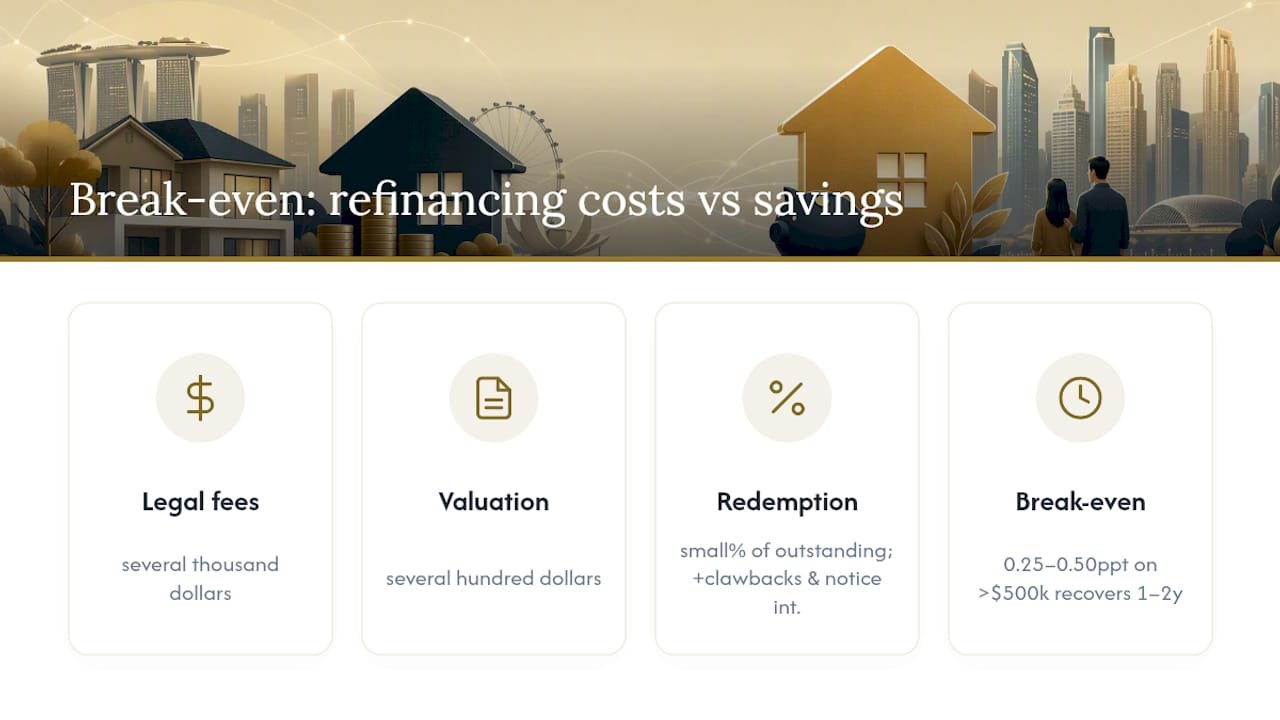
Three cost categories decide whether switching is worth it: legal fees, valuation fees, and redemption penalties. Legal fees for a private refinance typically run several thousand dollars if not subsidized; valuation usually costs several hundred dollars; and prepayment penalties inside a lock-in period commonly amount to a small percentage of the outstanding amount. Subsidy clawbacks and unpaid notice interest are the two costs homeowners most often forget to add back in.
Here’s a simplified break-even worked from public rate context and typical fee ranges:
Pro Tip: A 0.25 to 0.50 percentage-point improvement on a loan above $500,000 usually recovers its switching costs within one to two years — below that threshold, run the numbers before assuming it’s worth the paperwork.
The most common mistake is comparing only the first-year promotional rate instead of the full lock-in weighted average, which hides a rate that reverts upward sharply in year two.
MAS rules, TDSR and loan tenure caps you need to clear
Refinancing isn’t just a rate decision. The Monetary Authority of Singapore sets structural limits that determine whether a bank can approve your application at all, regardless of how attractive its rate looks.
- Loan tenure caps: 30 years for HDB flats, 35 years for private property, measured from your original loan start date, not the refinance date.
- No separate LTV cap on refinances: lenders can extend up to the full outstanding amount, subject to their own credit assessment.
- TDSR re-test: your Total Debt Servicing Ratio gets recalculated using the MAS Notice 645 stress rate of 4.0%, which can fail an otherwise attractive refinance if your income or other debts have shifted since you first took the loan.
- MSR applies to HDB flats and executive condominiums, capping mortgage repayments at 30% of gross monthly income.
Rehearse your TDSR calculation before applying, not after receiving a rejection.
HDB flats versus private property: does the decision change?
Loan structure changes the maths considerably. HDB households on a concessionary loan face a decision private owners never do: switching to a bank loan is a one-way move that you cannot reverse.
- HDB concessionary loans track the CPF Ordinary Account rate plus 0.1%, which sits below most bank floating rates, so many households stay put even when a bank package looks marginally cheaper on paper.
- Private property refinances commonly need a minimum loan size, often around $200,000 to $300,000, before legal and valuation subsidies make the switch worthwhile.
- If your remaining loan is small, or you value the flexibility of the HDB scheme over a modest rate saving, staying put is often the sounder call.
Pro Tip: If you’re on an HDB concessionary loan, treat any refinance offer as a permanent exit, not a trial. Once you switch to a bank, you cannot switch back to the HDB rate later.
How to choose the right refinancing package and bank
Getting comparable quotes from DBS, OCBC, UOB, HSBC, Citibank, Maybank, CIMB, and SCB Home Loan means asking each one the same set of questions, in the same order, so the answers can actually be lined up against each other.
Prepare these figures before calling anyone:
- Outstanding loan balance and current lock-in end date.
- Property type (HDB, condominium, landed) and remaining tenure.
- CPF Ordinary Account position, if you plan to use CPF for repayment.
Then ask each bank directly:
- “What is the all-in cost across the full lock-in period, not just year one?”
- “What are the exact clawback rules on any legal or valuation subsidy?”
- “Who pays legal fees, and is that conditional on loan size?”
- “How is notice interest calculated if I redeem early?”
Watch for red flags: banks that won’t quote an all-in weighted rate in writing, clawback terms buried in fine print rather than stated plainly, processing timelines that stretch past six weeks without explanation, or rebate terms that change between the verbal quote and the Letter of Offer. A bank confident in its package will answer all four questions without hesitation.
Getting quotes from multiple banks without wasting weeks
Requesting quotes from several banks at once is the single biggest lever homeowners underuse, mostly because it feels like extra admin. It isn’t, if you sequence it properly.
Start by contacting your current bank first and asking for a repricing quote in writing. This gives you a baseline figure to beat, and many banks will sharpen their offer once they know you’re shopping around. Next, approach two or three others from the DBS, OCBC, UOB, SCB Home Loan, HSBC, Citibank, Maybank, and CIMB roster, sending each the same income and property documents so the quotes arrive on comparable terms.
Most banks will issue an indicative quote within a few working days once they see your Notice of Assessment and existing loan statement, though a formal Letter of Offer takes longer because it requires full underwriting. Ask each bank to confirm the quote’s validity period in writing, since promotional rates can shift within weeks.
A mortgage broker can run this process in parallel across several banks for you, which saves time if you’d rather not chase five separate relationship managers. Whichever route you take, insist on getting each quote in a comparable format: all-in rate, lock-in length, subsidy amount, and clawback terms, laid out the same way for every bank. Anything less makes the comparison unreliable, and unreliable comparisons lead homeowners back to their default bank out of fatigue rather than genuine preference.
Does your credit score affect refinancing eligibility?
Singapore banks don’t publish a single refinancing credit score threshold, but your credit bureau record still shapes both approval odds and the rate you’re offered. A clean repayment history across credit cards, personal loans, and your existing mortgage signals lower risk, and banks price that into their offer.
Late payments on other credit facilities in the twelve months before you apply can push a bank toward a higher margin or, in marginal cases, a decline. This matters more for refinancing than it did when you first bought the property, because the TDSR re-test at application means the bank is reassessing your entire debt profile, not just the mortgage.
Two other eligibility factors carry more weight than most homeowners expect. First, your CPF Ordinary Account usage on the current loan gets reviewed, and any shortfall or catch-up requirement can slow approval. Second, if you’ve taken on new debt since your original loan (a car loan, a renovation loan, a second property), the TDSR calculation absorbs that immediately and can shrink your borrowing capacity even if your income has risen since then.
The practical fix is straightforward: settle or reduce revolving credit balances before applying, avoid opening new credit lines in the months leading up to a refinance application, and request your own credit report so you know what the bank will see before it does.
Register Today’s view: preparing before you approach any bank
Homeowners often approach banks before they know their property’s current market value, which weakens their negotiating position from the start. A free home valuation gives you a defensible figure to work from when a bank’s valuer comes back lower than expected, and it feeds directly into your break-even maths since your outstanding balance relative to current value affects which packages you’ll qualify for.
Register Today’s market evaluations also flag where recent comparable sales sit, which strengthens your position if you need to push back on a valuation or negotiate subsidy terms. Get a valuation before requesting bank quotes, not after.
— Anderson
How Register Today speeds up your refinancing decision
Comparing bank packages is only half the job. The other half is knowing where your property actually sits in the market, and that’s where most refinancing timelines stall.

Register Today gives Singapore homeowners a free property valuation, access to recent comparable sale prices, and a network of agents who can support negotiation once you’ve decided which route to take. Rather than guessing at your property’s value before a bank valuer arrives, you walk into that conversation with a figure already backed by market data. Check recent sold prices in your area, request a home valuation, then run your break-even calculation with real numbers instead of estimates. If you’d rather have someone review your position directly, browse property listings or connect with an agent through Register Today to get a second opinion before you commit to a bank.
Where to verify the figures in this article
Check these sources directly before finalising any decision, since rates and rules change:
- MAS refinancing rules for tenure caps and TDSR requirements.
- HDB’s refinance guidance for concessionary loan terms.
- DBS’s refinance page and OCBC’s refinancing page for current package features.
- A rate comparison calculator to run your own break-even numbers with today’s figures.
This article is general information, not a substitute for advice from a qualified financial advisor. Consult a qualified financial professional about your own circumstances before acting on anything here.
Sources
- Refinancing Rules for Housing Loans
- Refinance your HDB housing loan
- HDB interest rate pages (rate context)
- Refinance your existing home loan from another bank | DBS Singapore
- Best home loan rates Singapore – analysis and calculator