

Avoid Probate Delays: Joint Tenancy or Tenancy in Common in Singapore
Joint tenancy means co-owners hold a property as one indivisible unit, so when one owner dies, the survivor automatically inherits the whole share regardless of what any will says. Tenancy in common means each owner holds a distinct, defined share that forms part of their personal estate on death, passing through a will or intestacy rules instead. That single distinction, survivorship versus a share that sits in your estate, drives almost every practical decision covered below, from CPF refunds to decoupling for a second property.
TL;DR:
- Joint tenancy automatically transfers ownership to the surviving owner upon death, bypassing probate and making it suitable for married couples.
- Tenancy in common allows each owner to set specific shares, which pass through their estate and require probate, offering more control for investors and co-buyers.
- Severance of joint tenancy can convert the holding into tenancy in common and involves registering a legal declaration with the Land Authority, often affecting stamp duty.
- Changing between joint tenancy and tenancy in common requires formal instruments, approval from HDB or SLA, and may trigger stamp duty or ABSD depending on the transfer specifics.
- Deciding the right structure depends on your relationship to co-owners, estate plans, and future property purchases, with proper legal and valuation advice crucial beforehand.
Table of Contents
- Tenancy in common vs joint tenancy: the key differences at a glance
- What joint tenancy means in Singapore
- What tenancy in common means in Singapore
- How your manner of holding affects inheritance, CPF, and ABSD
- Checking and changing your manner of holding: HDB and private property
- Which manner of holding suits your situation?
- Your next steps once you’ve decided
- How Registertoday supports Singapore owners through this decision
- Get practical help before you change your title
- Sources
Tenancy in common vs joint tenancy: the key differences at a glance
The two manners of holding look similar on a title deed but behave very differently once death, sale, or divorce enters the picture.
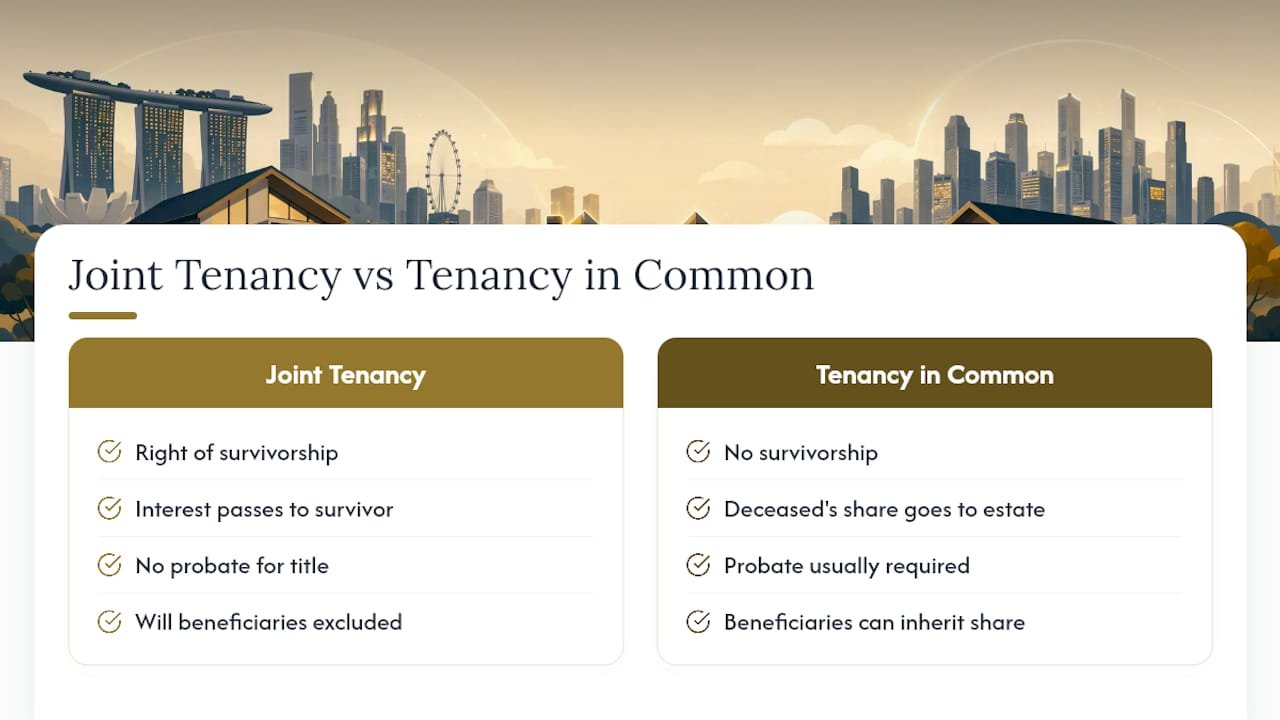
- Ownership shares: Joint tenancy has no defined shares, all owners hold the whole property together; tenancy in common (TIC) assigns specific percentages, such as an equal split or other specified percentages.
- On death: Joint tenancy triggers automatic survivorship to the remaining owner(s); TIC sends the deceased’s share to their estate for probate or intestacy.
- Effect on a will: A will cannot override survivorship under joint tenancy, but it fully governs a TIC share.
- Selling a share: Joint tenants cannot sell an individual share without first severing the tenancy; TIC owners can sell, mortgage, or gift their specific share independently.
- Typical users: Married couples buying a matrimonial home tend to choose joint tenancy; investors, unmarried co-buyers, and those planning unequal contributions usually pick TIC.
- Converting between the two: Possible for both private property and HDB flats, though it involves legal instruments, HDB approval, and sometimes stamp duty.
Joint tenancy’s advantage is simplicity: no probate delay for the family home. Its disadvantage is rigidity: you cannot leave your share to someone outside the co-ownership. TIC’s advantage is control over your estate; its disadvantage is that shares must go through probate, which can take months.
What joint tenancy means in Singapore
Under the Land Titles Act, co-owners who take title under an instrument are presumed to hold as joint tenants unless the document explicitly describes them as tenants in common. This presumption catches many first-time buyers off guard when they assumed they had specified otherwise.
Joint tenancy rests on what lawyers call the four unities: unity of possession, interest, title, and time. Practically, this means every owner has an equal, undivided claim to the whole property, not a percentage of it. There is no “60% owner” in a joint tenancy; everyone owns everything together.
The right of survivorship is the defining feature. When one joint tenant dies, their interest vests automatically in the surviving owner or owners, bypassing the deceased’s will entirely and avoiding probate on that share. This is why joint tenancy suits married couples who want the family home to pass cleanly to the surviving spouse.
Severance breaks this arrangement. A joint tenant can unilaterally sever by serving a written instrument of declaration on the co-owners, converting the holding into tenancy in common, usually in equal shares, and registering the change with the Singapore Land Authority (SLA). Once severed, survivorship no longer applies.
What tenancy in common means in Singapore
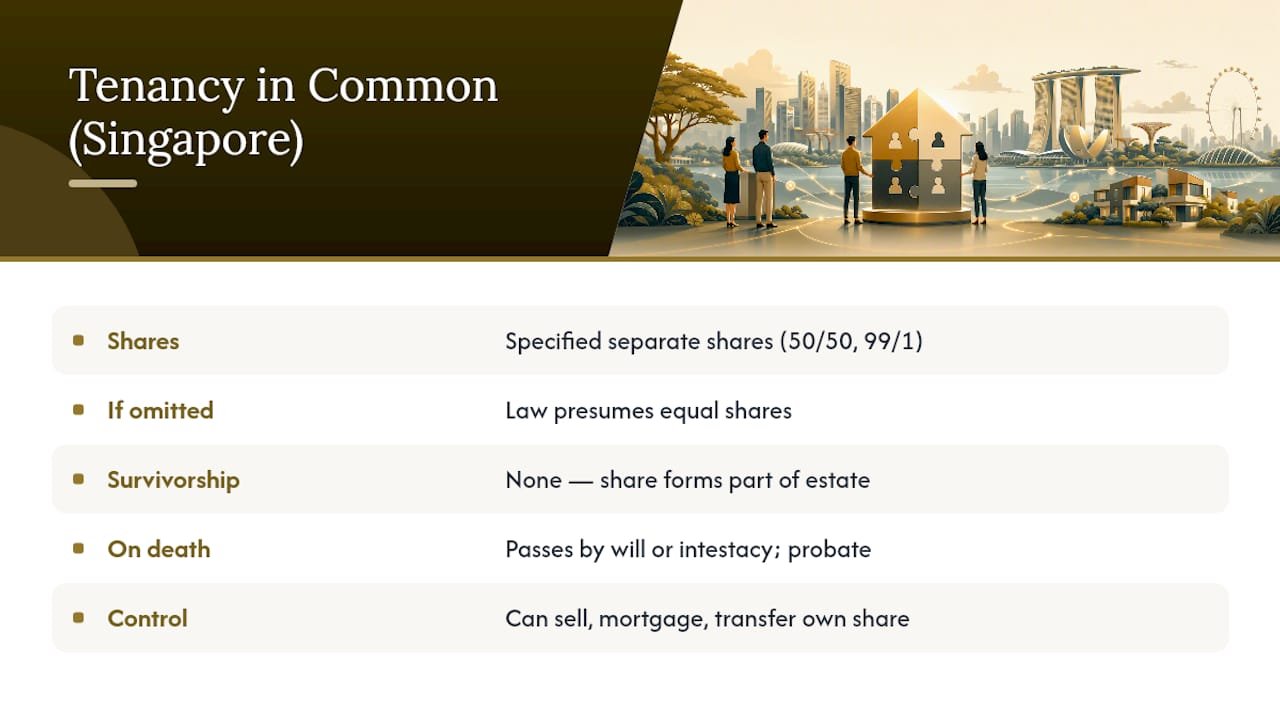
Tenancy in common (TIC) records each owner’s interest as a specified, separate share, commonly 50/50 between spouses or an unequal split such as 99/1 between an investor and a family member. Where a title document names owners as tenants in common but omits the shares, Singapore law presumes equal shares unless there is clear evidence otherwise, according to guidance from JCP Law.
There is no survivorship. When a tenant in common dies, their share does not pass to the co-owner automatically; it becomes part of their estate and passes according to their will, or under the Intestate Succession Act or the Administration of Muslim Law Act if there is no valid will. That means probate, executors, and potentially months of delay before beneficiaries can deal with the property.
This structure gives owners far more flexibility while alive. A tenant in common can sell, mortgage, or transfer their specific share independently, without needing consent to sever anything first, because no joint tenancy exists. That flexibility is precisely why property investors, business partners, and couples planning to decouple for future purchases gravitate towards TIC, according to YYLee’s analysis of ownership structures used in Singapore.
How your manner of holding affects inheritance, CPF, and ABSD
The manner of holding you choose ripples through inheritance, your CPF Ordinary Account, mortgage liability, and any future decoupling plans, often years after the purchase.
Inheritance: Under joint tenancy, beneficiaries named in a will have no claim over the deceased’s interest in the jointly held property, since it passes to the survivor outright. Under tenancy in common, executors must include the deceased’s share in the estate, which usually means a Grant of Probate or Letters of Administration before anything can be sold or transferred.
CPF Ordinary Account: The CPF Board clarifies that manner of holding does not by itself decide who repays CPF monies used for the purchase. Each owner must refund their own CPF withdrawal, with accrued interest, from their share of the sale proceeds, regardless of whether the title is joint tenancy or TIC.
Mortgage liability: Co-owners on a joint mortgage are usually jointly and severally liable, meaning the bank can pursue any owner for the full outstanding loan if the other defaults. This liability exists independently of the manner of holding and matters heavily if one owner faces bankruptcy.
ABSD and decoupling: Owners sometimes assume that holding a property as tenants in common with an unequal split allows the smaller owner to “decouple” and buy a second property free of Additional Buyer’s Stamp Duty. That is not automatically true. As LovelyHomes explains, ABSD is assessed on the buyer’s total property count, and decoupling still typically requires a transfer of the remaining share, which can trigger Buyer’s Stamp Duty and, in some cases, ABSD depending on the parties and structure involved. TIC makes decoupling mechanically possible; it does not exempt anyone from stamp duty rules.
Checking and changing your manner of holding: HDB and private property
Before deciding anything, confirm what your title actually says. For private property, a title search through the Singapore Land Authority (SLA) shows the registered manner of holding. For HDB flats, the manner of holding appears on your lease and HDB’s own ownership records.
Changing from joint tenancy to tenancy in common (severance) requires a formal instrument of declaration served on the other joint tenant, then registered with SLA. Practitioner guidance notes that severing into equal shares usually does not trigger stamp duty, but converting into unequal shares typically requires an actual transfer of interest, which can attract Buyer’s Stamp Duty or ABSD.
Converting the other way, from tenancy in common to joint tenancy, requires all owners to hold equal shares and to execute the appropriate instrument for registration. For HDB flats, HDB’s own procedure sets out specific forms and eligibility conditions that differ from private conveyancing, so flat owners cannot simply follow SLA’s private property process. Given the stamp duty triggers and paperwork involved, most owners engage a conveyancing lawyer for anything beyond a straightforward equal-share severance.
Which manner of holding suits your situation?
The right choice depends on your relationship to your co-owner, your estate plans, and whether a future purchase is on the horizon.
- Married couples buying a first home: Joint tenancy usually fits best, giving the surviving spouse automatic ownership without probate delays.
- Investors or business partners with unequal contributions: Tenancy in common lets each party’s share reflect what they actually put in.
- Parents wanting specific children to inherit specific shares: TIC is essential, since joint tenancy overrides any will.
- Couples planning to decouple for a second property: TIC is a prerequisite, but confirm the ABSD and stamp duty impact before assuming it saves money.
Pro Tip: Never sever a joint tenancy without updating your will on the same day. A severed share with an outdated or non-existent will can end up distributed under intestacy rules you never intended.
Common mistakes include assuming a 99/1 TIC split avoids ABSD outright, and forgetting that CPF refund obligations follow each individual owner, not the title structure.
— Anderson
Your next steps once you’ve decided
Start with a title search to confirm your current manner of holding, then review your outstanding mortgage and CPF usage with your bank and the CPF Board. Draft or update your will to match whichever structure you keep or convert to. Engage a conveyancing lawyer early, most severance or conversion instruments take two to six weeks to register, plus lawyer’s fees.
How Registertoday supports Singapore owners through this decision
A specialist property platform has guided numerous property transactions across Singapore, providing direct insight into how ownership structure affects real sales, transfers, and decoupling plans. Services include helping owners commission title checks, arrange valuations, and connect with conveyancing lawyers before they commit to severing or converting a title. If you are weighing your options, our dashboard profile shows how our team has supported similar cases.
Get practical help before you change your title
Deciding between joint tenancy and tenancy in common is only half the job. The other half is knowing what your specific property is worth before you sever a title, transfer a share, or decouple ahead of a second purchase, because that valuation shapes your stamp duty exposure and your negotiating position with a co-owner or lender.

The platform provides owners with property evaluations and personalised negotiation support, aiming to present numbers so clients and their lawyers can make informed legal decisions. Detailed market gap analysis can be useful when converting to tenancy in common ahead of a decoupling move, since the value of the transferred share directly affects stamp duty calculations. If you are ready to see what your current property is worth before making a title change, get a home valuation from our team today.
This article is general information, not a substitute for advice from a qualified lawyer. Consult a qualified legal professional about your own circumstances before acting on anything here.