
Recover $300,000–$900,000 With 6 Month ABSD Remission in Singapore
You can recover the Additional Buyer’s Stamp Duty paid on a second home if at least one spouse is a Singapore Citizen, the property is bought jointly, and your first residential property is sold and legally completed within 6 months. Miss that window and the refund is gone. Apply through myTax Portal after completion, not before.
TL;DR:
- A couple must sell their first property within 6 months of legal completion to qualify for a full ABSD refund when buying a second property jointly.
- The refund process involves declaring remission at stamping, then submitting supporting documents within the deadline through myTax Portal after the sale completes.
- Missing the 6-month deadline, which starts from the sale’s legal completion or TOP/CSC, results in forfeiting the entire ABSD refund.
- For mixed citizenship couples, the higher ABSD rate applies upfront, but remission can still recover the full amount if conditions are met.
- Options like decoupling or bridging loans can help manage timing issues, but require careful planning before signing the new property purchase.
Table of Contents
- What are the eligibility rules for ABSD remission for married couples.
- How do you apply for ABSD remission and refund?
- What are the deadlines and how long does the refund take?
- Worked examples: how much ABSD comes back, and when
- Common pitfalls and practical alternatives
- Developer ABSD remission and timeline extensions
- How Register Today helps clients navigate ABSD timelines
- Why the standard advice on ABSD remission misses the point
- Sell faster, claim your ABSD refund with confidence
- Sources
What are the eligibility rules for ABSD remission for married couples.
IRAS sets out three conditions under the Stamp Duties (Spouses) (Remission of ABSD) Rules, and all three must be met at the same time. There’s no partial credit here.
- Citizenship test: at least one spouse must be a Singapore Citizen at the time of purchase.
- Joint-purchase requirement: the second residential property must be bought in the names of both spouses, not one alone.
- Ownership test: neither spouse may own more than one residential property (the one being replaced) at the point of purchase.
Meet those, and a married couple can qualify for full ABSD remission on the new purchase, provided the first property is disposed of on time.
Mixed citizenship status changes the maths, not the eligibility. If one spouse is a Singapore Citizen and the other is a Permanent Resident or a foreigner, IRAS assesses the ABSD charge using the highest rate that applies to any of the buyers, according to IRAS guidance on married-couple remission. A Singapore Citizen and foreigner couple still pays ABSD at the foreigner rate upfront, even though remission can bring that money back once the first property is sold within the deadline. That upfront cash requirement catches many couples off guard, because the tax bill on completion day looks nothing like what they’ll eventually keep.
Ownership structure on the first property also matters. Whether it was held solely by one spouse or jointly by both, the remission conditions apply the same way, provided it is genuinely the couple’s only other residential property at the time of the new purchase. Couples going through matrimonial proceedings face a different set of rules entirely, since a pending or finalised divorce can change how IRAS treats ownership counts. If that applies to you, it’s worth checking your specific position with IRAS or a conveyancing solicitor before assuming the standard spouse remission applies.
How do you apply for ABSD remission and refund?
Applications run through myTax Portal (Stamp Duty Login), and the process splits into two distinct actions: stamping the new purchase, and separately applying for the remission or refund once your first property is sold. Confusing the two is a common source of delay.
- Log in to myTax Portal using Singpass, then go to the Stamp Duty section.
- When stamping the second property’s Sale and Purchase Agreement, declare your intention to claim spouse remission at the point of stamping, where the portal allows it.
- Once your first property is sold and the sale is legally completed, gather your documents and submit a Request for Refund / Assessment under the Stamp Duty menu.
- Upload supporting documents and submit before the 6‑month deadline from the date your first property’s sale is completed.
IRAS typically asks for the ABSD payment receipt, evidence of the first property’s sale completion (such as the Notice of Transfer), your marriage certificate, both spouses’ identity documents, and bank account details for the refund payout. Keep clear scans of all of these ready well before completion day, since chasing paperwork under time pressure is how deadlines get missed.
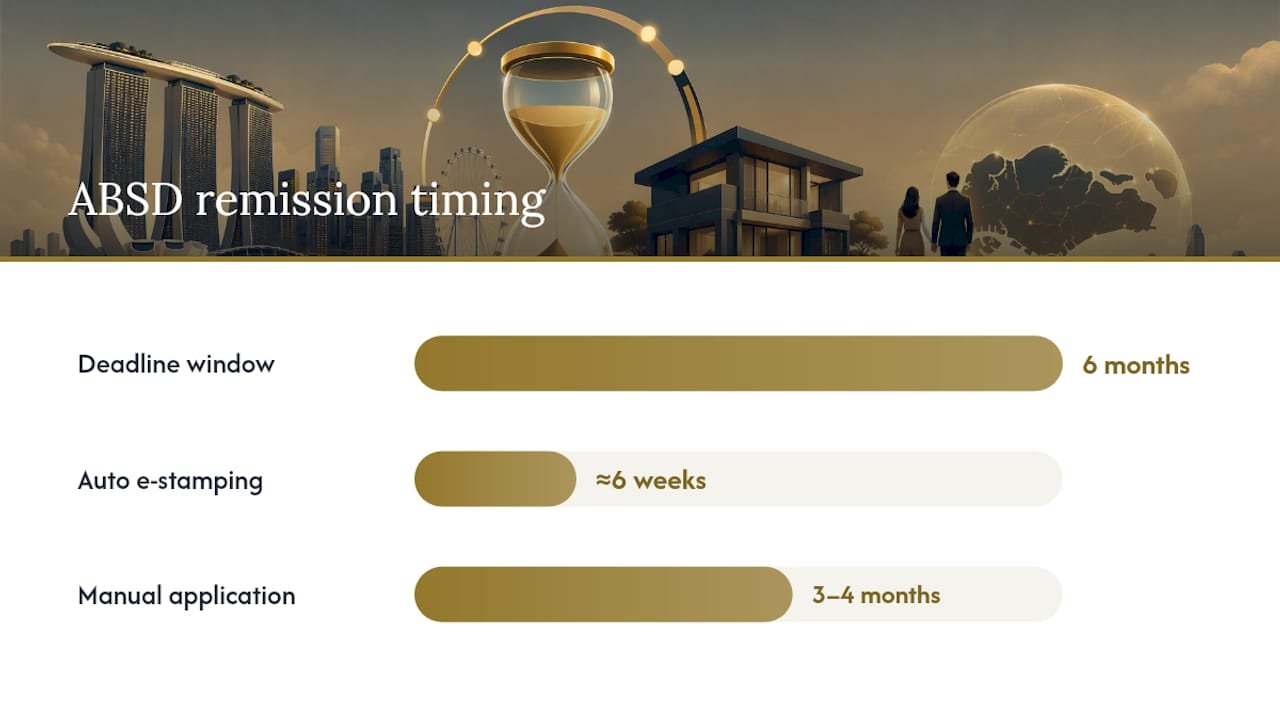
For stamping done on or after 2 July 2023, some e‑stamped submissions may be automatically refunded within roughly six weeks of stamping, provided the declaration was made correctly at the outset. That’s a meaningful improvement over the manual application route, but it only works if the initial e‑stamping form flags the remission intent.
Pro Tip: Some myTax Portal functions, particularly document uploads for stamp duty requests, work more reliably on desktop browsers than mobile. Save yourself a frustrating half hour and do this from a laptop.
What are the deadlines and how long does the refund take?
The 6‑month clock starts differently depending on what you’re selling. For a completed property, it runs from the date the sale is legally completed, meaning the point of full payment and transfer, not the date you signed the Option to Purchase. For an uncompleted new launch, the countdown begins from the Temporary Occupation Permit (TOP) or Certificate of Statutory Completion (CSC), whichever comes earlier.
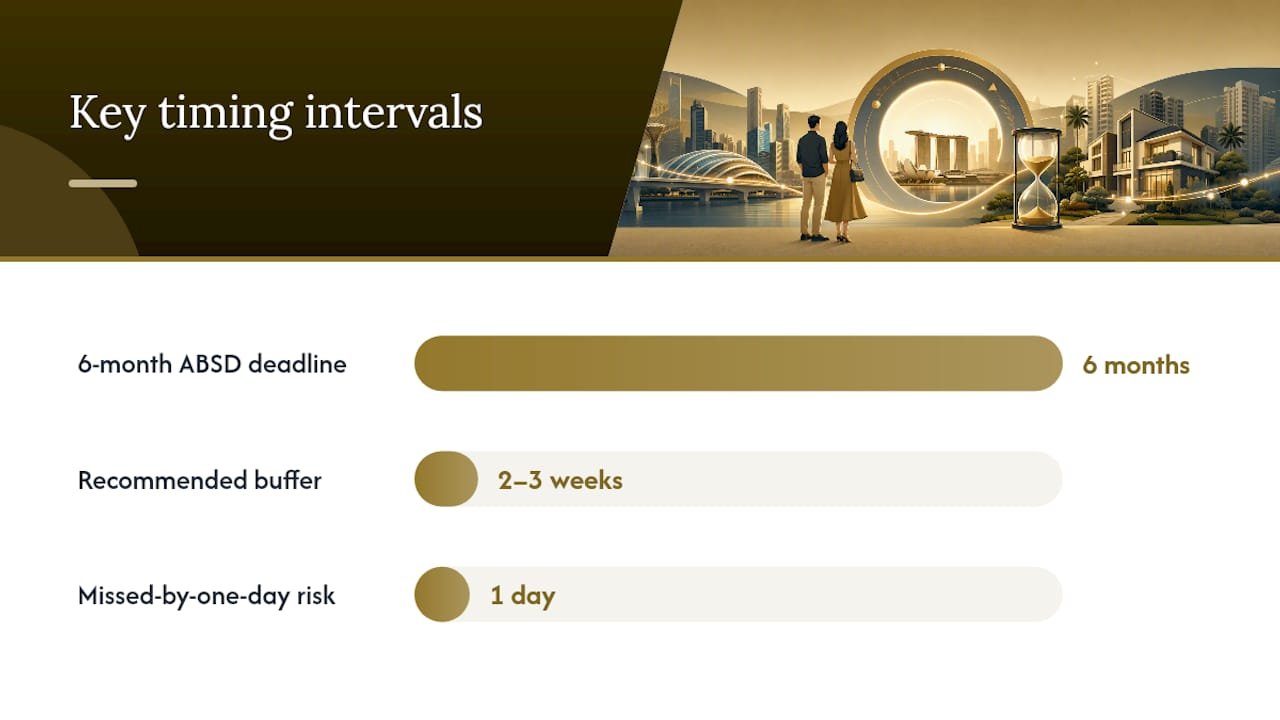
A single day late can forfeit the entire remission. IRAS applies the deadline strictly, with no grace period built into the standard rules.
- Completed property: 6 months from legal completion of the sale.
- Uncompleted property (BUC): 6 months from TOP or CSC, whichever is earlier.
- Refund application: submitted within 6 months from the date the first property’s sale is completed.
- Automatic e‑stamping refund: typically within six weeks of correctly flagged stamping, for submissions from 2 July 2023 onward.
Manual applications generally take longer. IRAS processes many remission requests within roughly two months of a complete submission, with approved refunds often paid out within about a month after approval. Add those together and a manual claim can realistically take three to four months from application to cash in the bank.
Miss the deadline, and there’s no remission. Couples who assumed a buyer’s Option to Purchase counted as “sold” have lost claims this way, since IRAS only recognises legal completion. Extensions to the 6‑month window are rare and largely historical, tied to specific COVID‑19 relief periods that no longer apply. Don’t build your financial plan around the assumption that IRAS will grant you more time.
Worked examples: how much ABSD comes back, and when
Numbers make the stakes clearer than any rule summary. Take a Singapore Citizen couple buying a $1.5 million second property. ABSD for citizens buying a second residential property currently sits at 20%, meaning they pay $300,000 upfront at the point of stamping. If they sell their first property and complete that sale within 6 months, and apply correctly, the full $300,000 becomes refundable.
A mixed-status couple, say a Singapore Citizen married to a foreigner, faces a steeper bill on the same $1.5 million purchase. Because IRAS applies the highest rate among the buyers, the couple pays ABSD at the foreigner rate, currently 60%, working out to $900,000 upfront. Remission can still recover that full amount, but the cash-flow gap while waiting is far larger, and the couple needs to be certain they can fund that outlay without straining other commitments.
| Scenario | Property price | ABSD rate applied | ABSD paid upfront | Refundable if conditions met |
|---|---|---|---|---|
| SC + SC couple | $1.5 million | 20% | $300,000 | $300,000 |
| SC + Foreigner couple | $1.5 million | 60% | $900,000 | $900,000 |
There’s a wrinkle worth budgeting for: Seller’s Stamp Duty (SSD) on the first property, which applies if that home is sold within three years of purchase. A simple way to reason about net benefit: take the ABSD refund you expect, subtract any SSD payable on the first sale, subtract legal and agent fees, and what remains is your actual cash gain from timing the moves correctly.
Given that a manual refund can take three to four months to land, most couples need to fund the ABSD outlay from savings or a bridging facility rather than counting on quick reimbursement.
Common pitfalls and practical alternatives
The single biggest cause of forfeited claims is timing based on the wrong date. Couples frequently treat the Option to Purchase exercise date, or even a buyer’s signed offer, as “sold.” IRAS only counts legal completion, and a claim missed by even one day is rejected outright.
- Confirm the legal completion date with your conveyancing lawyer in writing, not just the OTP exercise date.
- Build a buffer of at least two to three weeks before the 6‑month deadline to account for delays in the buyer’s financing or paperwork.
- If completion timing looks tight, discuss decoupling as an alternative before committing to the remission route.
- Line up bridging finance early if you expect a gap between paying ABSD and receiving the refund.
Decoupling means transferring one spouse’s share of the existing property to the other, so only one spouse owns it and the couple becomes eligible to buy a second property without triggering ABSD at all. Costs typically include Buyer’s Stamp Duty on the transferred share and legal conveyancing fees, which can be considerably cheaper than the ABSD sum itself for lower-value first properties, though it becomes less attractive as property values rise.
Bridging loans cover the ABSD outlay while you wait for your first property’s sale proceeds or the eventual refund, but they carry interest costs and lender-specific terms that erode the benefit if the sale drags on.
Pro Tip: Speak to your lawyer and lender about completion timing before you sign anything on the new purchase, not after. Aligning both transactions from the start avoids the scramble that causes missed deadlines.
Developer ABSD remission and timeline extensions
Housing developers operate under a separate remission framework. A remittable portion of the ABSD charge, such as 35% against a 40% charge, can be remitted upfront, but only if the developer meets strict commencement, completion, and sale timelines.
- Developers must sell a specified proportion of units within set periods after project completion.
- Failing those thresholds triggers clawback of the remitted ABSD, calculated against the unsold proportion.
- IRAS has introduced timeline extensions tied to CORENET X for genuinely complex projects, subject to specific conditions.
- Developers must submit formal undertakings and supporting documentation to IRAS to qualify for both the initial remission and any extension.
This framework runs in parallel to the spouse remission rules and follows its own clawback schedule, so developers and married-couple buyers shouldn’t confuse one set of conditions for the other.
How Register Today helps clients navigate ABSD timelines
Most couples come to us mid-decision: they’ve found the next home and now need to sell the current one fast enough to protect their remission claim. Anderson has watched this play out repeatedly, and the pattern is consistent. Cashflow anxiety spikes the moment ABSD is paid, and it doesn’t ease until the refund clears months later.
Register Today’s sold properties track record reflects over $1 billion in transactions, giving us a practical read on realistic sale timeframes across different property types. Fast, accurate home valuations and hands-on negotiation support are the two levers that most directly protect a tight completion date.
Why the standard advice on ABSD remission misses the point
Most guidance on ABSD remission treats it as a paperwork exercise: meet the criteria, file the forms, collect the refund. That’s technically accurate and practically incomplete. The real risk isn’t ignorance of the rules, it’s the gap between when you must pay and when you get paid back.
Conventional advice underweights cashflow planning. A couple facing a $900,000 upfront ABSD bill on a mixed-status purchase needs a financing plan for that sum months before any refund materialises, not a reassurance that remission “applies to their situation.”
The priority should be sequencing, not eligibility checking. Confirm the legal completion date on your first sale before you commit to anything on the second purchase. Decoupling deserves a serious look earlier than most couples give it, particularly where the first property’s value is modest enough that Buyer’s Stamp Duty on a transferred share beats the ABSD sum outright. Rules matter, but the calendar decides whether they help you or cost you.
— Anderson
Sell faster, claim your ABSD refund with confidence
Meeting the 6‑month sale deadline depends on one thing above all else: how quickly and accurately your first property is priced and moved to market. The platform offers married couples racing an ABSD clock a route that emphasizes direct valuation, negotiation support, and a focus on completed transactions rather than lengthy viewings.

Our home valuation service gives you a realistic asking price from day one, which matters when every week of delay eats into your 6‑month window. Listings go live through our property portal, and our negotiation team works to close sales at a pace that protects your remission deadline rather than a pace that suits a slow buyer’s market. For couples exploring interim financing while waiting on IRAS to process a refund, proptech resources like Prop Report offer useful context on managing property transitions efficiently.
If your ABSD clock is already running, get a free valuation and speak to our team today through Registertoday to map out a realistic completion date before the deadline creeps closer than you think.