

55% Borrowing Limit: How TDSR Rules in Singapore Set Your Price Band
The Total Debt Servicing Ratio is capped at 55% of your gross monthly income for most property loans in Singapore, and this single figure decides how much a bank will lend you. Set by the Monetary Authority of Singapore, TDSR factors in every debt you carry, applies stress rates well above current mortgage pricing, and comes with exemptions that catch many borrowers off guard. The calculation is stricter than it first appears, but it is also entirely predictable once you know the formula.
TL;DR:
- Borrowers with existing debts must reduce or clear them before applying, as every obligation directly reduces the maximum mortgage installment allowed.
- TDSR calculations exclude certain loans like bridging or collateral pools under 50%, but proper documentation is required to qualify for these exemptions.
- The stress rate used in calculations is the higher of 4% or the loan’s “thereafter” rate, which can significantly lower the permissible loan amount compared to current mortgage rates.
- Internal bank standards often tighten the 55% TDSR limit, meaning actual loan offers may be lower than the regulatory ceiling.
- Calculating TDSR with accurate income and debt documentation can reveal a more realistic property price limit, preventing pursuit of unaffordable homes.
Table of Contents
- What TDSR rules in Singapore actually mean for you
- How TDSR is calculated: formula, floors and haircuts
- Who TDSR applies to, and where the exemptions sit
- How TDSR changes the loan you can actually get
- Worked examples you can follow
- Strengthening your TDSR position before you apply
- Questions to ask lenders before you commit
- Searching smart once you know your number
- Finding a property that fits what you can actually borrow
- Sources
What TDSR rules in Singapore actually mean for you
The Total Debt Servicing Ratio measures how much of your gross monthly income goes towards repaying debt, mortgage instalments included. MAS introduced the framework as a macro‑prudential tool, designed to stop households borrowing beyond what their income can safely support, rather than as a device to make loans harder to get for its own sake.
For any property loan where the option to purchase was granted on or after 16 December 2021, the TDSR threshold sits at 55%. Loans that would push a borrower above that line are only approved in exceptional circumstances, with extra scrutiny and reporting attached.
That 55% is a regulatory ceiling, not a lender’s default. Individual banks often run tighter internal standards, so the number MAS allows and the number a specific bank will actually offer can differ.
A few things worth holding in mind as you read further:
- TDSR applies at the point the loan is assessed, not just at the point you first budget for a property.
- The ratio uses gross income, not take‑home pay after CPF contributions.
- Meeting 55% does not guarantee approval. It sets the outer limit lenders are permitted to work within.
How TDSR is calculated: formula, floors and haircuts
The formula itself is simple: divide your total monthly debt obligations by your gross monthly income, then multiply by 100 to get a percentage. The complexity sits inside those two numbers, not in the arithmetic.
The numerator includes your prospective mortgage instalment plus every other recurring debt: car loans, personal loans, credit card minimum payments, education loans and instalments on other property. The denominator is your gross monthly income, and this is where variable earners need to pay attention. MAS requires variable income such as bonuses and commissions to be averaged over 12 months, and rental income is similarly discounted rather than counted at face value.
Banks cannot use today’s attractive mortgage rate to calculate your instalment for TDSR purposes. Instead, they apply a medium‑term interest rate floor, using the higher of a 4% floor or the loan’s own “thereafter” rate for residential property loans. This stress test exists precisely so that a rate hike a few years down the line does not leave borrowers unable to pay.
Financial assets can supplement income, but only after a haircut and an amortisation schedule are applied.
| Component | MAS treatment |
|---|---|
| Residential loan stress rate | Higher of 4% floor or the thereafter rate |
| Variable income (bonus, commission) | Averaged over 12 months |
| Pledged SGD deposits | Minimum haircut |
| Unpledged financial assets | Significant haircut |
| Eligible assets used as income | Amortised over 48 months |
A $500,000 investment portfolio does not translate into anywhere near $500,000 of borrowing power once MAS’s haircut and 48‑month amortisation are applied.
Who TDSR applies to, and where the exemptions sit
TDSR applies to individuals, sole proprietors, and individuals acting behind property‑buying entities, wherever the loan is used to purchase property or is secured against property. This covers Singapore citizens, permanent residents and foreigners alike; nationality does not change whether the rule applies, though it does affect other levies such as stamp duty.
Several situations sit outside the standard calculation, and knowing which one applies to you can materially change your outcome:
- Owner‑occupier refinancing. Homeowners refinancing their own residence may exclude the instalment on an existing property loan, subject to conditions MAS sets out in its guidance on who TDSR applies to.
- Bridging loans. Short‑term bridging finance repayable within six months typically falls outside TDSR.
- Collateral pools under 50% property. Loans secured by a mixed collateral pool, where property makes up less than half the value, can escape the standard calculation.
- Mortgage equity withdrawal under 50% LTV. Cash‑out refinancing kept below 50% loan‑to‑value is treated differently from a full property purchase loan.
Each of these exemptions needs documentary proof, such as a signed sale undertaking or the relevant HDB letter, before a bank will apply it. Homeowners refinancing HDB flats often find HDB’s own housing loan rules shape which paperwork is accepted for these exclusions.
How TDSR changes the loan you can actually get
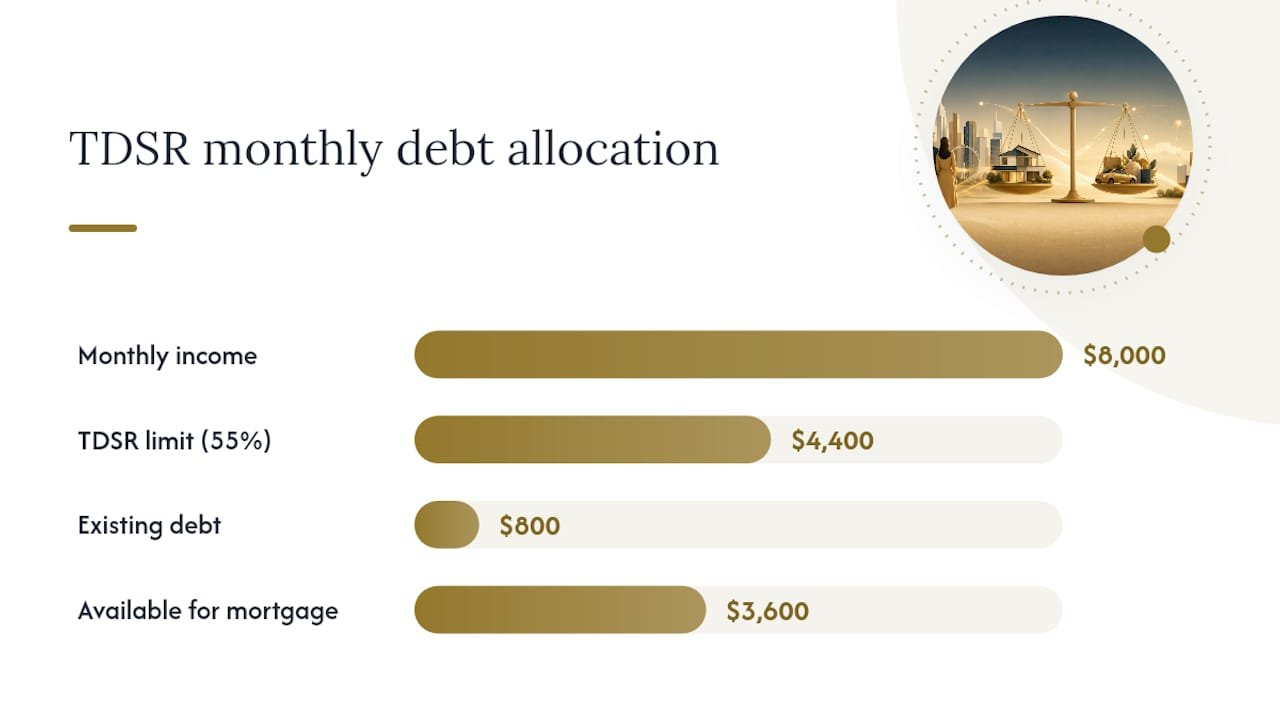
Every existing debt you carry eats directly into the income available for a new mortgage. A borrower earning $8,000 a month has, at 55%, a maximum of $4,400 across all debt obligations. If a car loan and personal loan already claim $800 of that, only $3,600 remains for the mortgage instalment itself, which shrinks the loan size a bank will approve.
MAS requires enhanced credit evaluation, senior sign‑off and a debt reduction plan before such a loan proceeds, and the bank must report the exception to MAS.
Refinancing sits in a slightly different lane. Owner‑occupiers refinancing their primary residence can often exclude the existing instalment, but a second property purchase or an investment refinance does not usually qualify for that concession.
- Existing debt reduces the mortgage instalment a bank will approve, not just the total loan quantum.
- Exceptional approvals require documentation, committee sign‑off and MAS reporting.
- A bank’s own stress test may be stricter than MAS’s floor, which can lower the LTV actually offered even when TDSR technically clears.
Worked examples you can follow
- Single borrower, no other debts. Gross income $6,000 a month, no existing loans. At a stress rate of 4%, a 30‑year loan of roughly $850,000 produces a monthly instalment near $3,300, giving a TDSR of 55%, right at the ceiling. Any additional debt would push the application over the limit.
- Dual‑income household with a car loan and renovation loan. Combined gross income $12,000, with $600 in car loan repayments and $400 in renovation loan repayments already committed. The numerator starts at $1,000 before the mortgage is even added, leaving roughly $5,600 of headroom at 55% for the new instalment, a noticeably smaller loan than the income alone would suggest.
- Refinancing with an exclusion. A homeowner earning $9,000 a month is refinancing their own flat and can exclude the $2,000 instalment on that existing loan under the owner‑occupier concession. Without the exclusion, TDSR would already sit close to the ceiling; with it applied correctly and documented, the household regains meaningful borrowing room.
Strengthening your TDSR position before you apply
Paying down revolving balances and short‑term instalment loans before submitting a mortgage application has an immediate effect on the numerator, often more than borrowers expect.
On the income side, document bonuses and commissions with at least 12 months of payslips and IRAS records, since MAS requires that averaging period before variable income counts. Rental income needs a stamped tenancy agreement to be accepted, and pledged financial assets are treated more generously than unpledged ones, so pledging where you can genuinely afford to is often worth exploring with your bank.
Lenders typically ask for:
- CPF contribution history and IRAS tax statements
- Recent payslips and, for variable earners, 12 months of income records
- Bank statements covering existing loan and credit facilities
- Tenancy agreements for any rental income being declared
- Proof of bonuses, commissions or other variable pay
Pro Tip: Clear or pay down short‑term debts a full billing cycle before applying, and bring your 12‑month income documentation to the first meeting rather than waiting for the bank to ask. It routinely shaves weeks off assessment time.
Questions to ask lenders before you commit
Not every bank applies the same internal cushion above the MAS floor, so asking direct questions early avoids surprises later.
- Which medium‑term rate and stress floor will you apply to my instalment?
- How is my variable income or rental income averaged and haircut?
- What documentation do you need to support an owner‑occupier refinancing exclusion?
- What happens, procedurally, if my TDSR comes out above 55%?
Be cautious of any adviser who suggests omitting a debt from the calculation or who cannot clearly explain their exceptional approval process. Transparency on these four questions is a reasonable minimum to expect from any bank or broker.
Searching smart once you know your number
Work out your TDSR‑supported price band before you start viewing, not after you have fallen for a flat you cannot finance. Bring your income documentation early; it speeds up every conversation that follows. At Registertoday, our home valuation service helps buyers check whether an asking price is realistic against that budget before they negotiate.
— Anderson
Finding a property that fits what you can actually borrow
You can find services that help match real listings against your TDSR‑calculated budget, rather than falling for a price that only works on paper. Some platforms provide property evaluations, negotiation support and market gap analysis across residential and commercial listings, so once you know your borrowing ceiling, you can search with a realistic number instead of a hopeful one.

Run the worked examples above against your own income and debts first. Then head to our property search to filter listings within that band, or request a home valuation to check whether a property you have your eye on is priced sensibly against your loan capacity. It takes a few minutes and saves you chasing homes you were never going to be approved for.