

S$400,000 Upfront: Second Property Singapore Costs and Sequencing
Yes, a second residential property attracts Additional Buyer’s Stamp Duty in Singapore, on top of the standard Buyer’s Stamp Duty every purchase carries. The bigger shock for most buyers is financing: loan-to-value caps drop sharply on a second property, so the cash and CPF you need upfront rises far more than the ABSD figure alone suggests.
TL;DR:
- A second property in Singapore attracts an ABSD rate of 20% for citizens, 30% for permanent residents, and up to 65% for entities, on top of BSD.
- Financing restrictions significantly reduce the loan-to-value ratio for second properties, often to 45%, increasing the upfront cash and CPF needed.
- Ownership count includes legal and beneficial interests like shares, trusts, or joint tenancies, which can trigger ABSD even with minor stakes.
- Timing the sale of the first property within six months of the second purchase is crucial to qualify for ABSD remission for married couples.
- Foreigners can only buy condominiums or apartments, and ABSD rates for second properties are higher than for citizens, with no special first property discounts.
Table of Contents
- Second property Singapore ABSD rates and how liability is calculated
- HDB rules, MOP and situations that change your second-property status
- How second-property financing tightens: LTV limits and your cash position
- ABSD remission, refunds and the legal routes worth knowing
- A worked example: what a second property actually costs upfront
- The purchase timeline: sequencing to protect remission eligibility
- How Registertoday supports second-property sequencing
- What a second property does to your income tax and property tax bill
- Can foreigners buy a second property in Singapore?
- Comparing property types for a second purchase
- What can go wrong: risks worth weighing before you commit
- An agent’s honest read on second-property buying in Singapore
- Ready to sequence your second property purchase?
- Sources
Second property Singapore ABSD rates and how liability is calculated
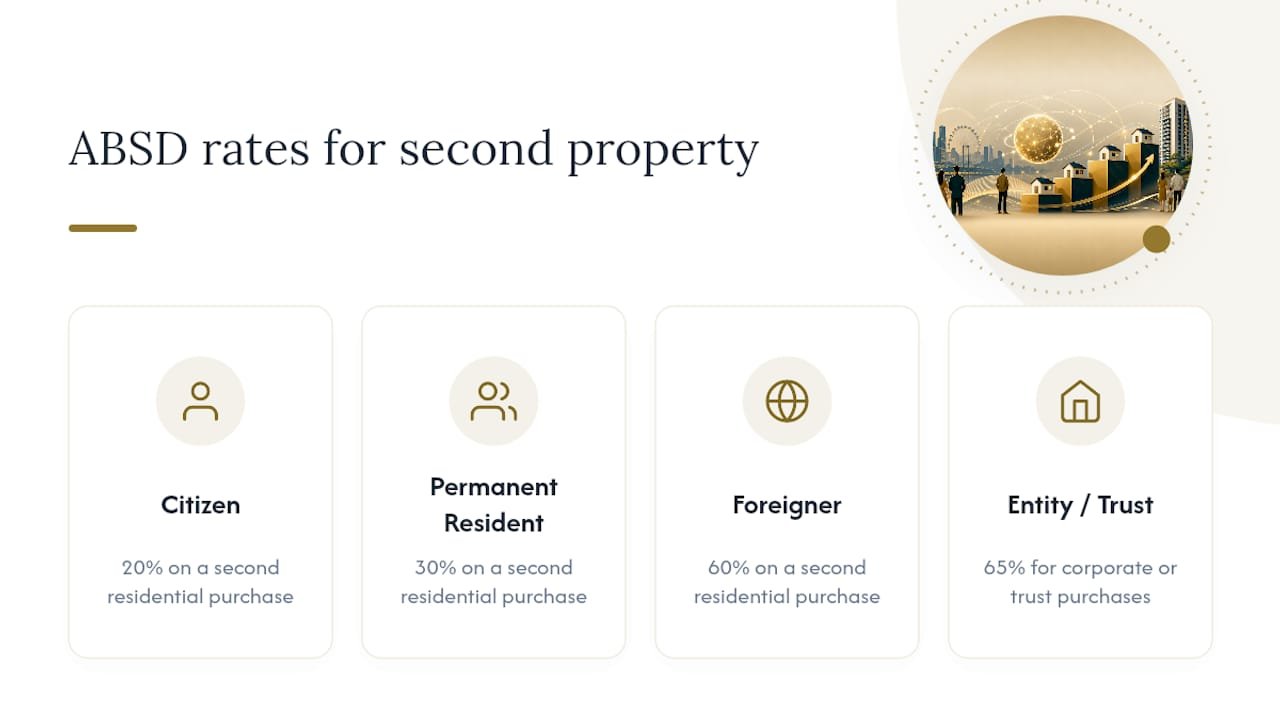
The Inland Revenue Authority of Singapore sets Additional Buyer’s Stamp Duty rates by counting how many residential properties a buyer already holds and by their residency profile. On a second residential property, IRAS charges Singapore citizens 20% ABSD, permanent residents 30%, foreigners 60%, and entities 65%). These rates apply on top of Buyer’s Stamp Duty, which is charged progressively regardless of how many properties you own.
Read the table carefully, because the “second property” column is where most buyers get caught out. A citizen who already owns one home and buys another pays 20% ABSD on the new purchase, even if the first property is an HDB flat bought decades ago and never intended as an investment. Ownership counts by name on the title, not by intention.
Property count is where the rules get genuinely tricky. IRAS looks at legal and beneficial interest, so a share in an inherited flat, a name on a property held in trust, or a joint tenancy with a parent all count towards your total, even a 1% stake. Buying through a company or trust does not reset the counter either. IRAS treats corporate and trust purchases as attracting the highest ABSD tier of 65%, and the authority actively reviews structures that appear designed purely to sidestep the duty.
Co-ownership creates its own arithmetic. If you and your spouse jointly buy a second property, IRAS assesses ABSD based on the profile that attracts the higher rate between the two of you. A citizen married to a foreigner, for instance, will find the purchase assessed at the foreigner rate of 60% unless a remission applies, which is covered further down.
ABSD and BSD share a computation basis worth remembering: both duties are charged on the higher of the purchase price or the market value of the property, whichever the IRAS stamp duty framework determines is greater. If you negotiate a below-market price on a resale unit, you cannot use that discount to reduce your stamp duty bill. Valuers and IRAS both check this, and any material gap between agreed price and assessed value gets flagged during the e-stamping process.
One point that trips up first-time second-property buyers: BSD is not waived or reduced just because ABSD applies. You pay both, calculated independently, then add them together for your total stamp duty liability. On a S$2 million purchase, that combination becomes a serious five-figure sum before you have even applied for a mortgage.
HDB rules, MOP and situations that change your second-property status
Whether a purchase counts as your “second property” often depends on rules that have nothing to do with the new unit itself. HDB’s Minimum Occupation Period sits at the centre of this for many Singaporean households.
If you own an HDB flat, you generally cannot buy a private residential property until you have satisfied the Minimum Occupation Period on that flat, typically five years from the completion of your purchase. Once MOP is met, buying a private condominium while retaining the HDB flat makes the private purchase your second property, triggering ABSD at the appropriate rate for your profile. Selling the HDB flat before or shortly after completing the private purchase avoids the second-property classification entirely, which is why so many upgraders time their HDB sale carefully around their private purchase.
A change introduced in 2024 gave some relief to a specific group: single seniors selling their HDB flat to downsize. Under that scheme, eligible single seniors aged 55 and above can apply for an ABSD refund when they sell their existing flat within a defined window after buying a replacement property, recognising that downsizing is a lifestyle decision rather than an investment move.
Co-ownership scenarios generate the most confusion in practice. A few situations worth checking before you sign anything:
- If you are added to a property title as a co-owner, even with a small percentage share, that property counts towards your total for ABSD purposes on any future purchase.
- Buying out a parent’s share of a jointly held property (a common succession planning move) can itself trigger ABSD if you already own another home.
- Inheriting a share of a property through a will still counts as an interest held, even if you never intended to keep it.
- Holding property through a trust for the benefit of a child or relative usually still counts towards the settlor’s or trustee’s ABSD profile, depending on the trust structure.
- Divorced individuals who retain a share in the matrimonial home while purchasing separately need to check whether that share has been formally transferred before the new purchase completes.
Before signing an Option to Purchase on what you believe is your second property, run two quick checks: confirm exactly who is named on the title of every property you currently hold an interest in, and confirm whether your first property’s MOP or minimum holding period has actually been satisfied. Getting either wrong after the option fee changes hands is an expensive mistake to unwind.
How second-property financing tightens: LTV limits and your cash position
Loan-to-value limits fall considerably once you are financing a second residential property, and this typically hurts affordability more than ABSD does. The Monetary Authority of Singapore sets LTV caps that scale down with each additional outstanding housing loan, and market-wide lender guidance puts the second-property LTV cap at 45% when your first housing loan is still outstanding, compared with up to 75% on a first property.
That LTV compression compounds with ABSD in a way many buyers underestimate. A lower loan ceiling means a much larger slice of the purchase price has to come from cash or CPF, on top of the ABSD you are already funding upfront. The two costs don’t simply add together; they stack against the same pool of savings at the same moment, right when your mortgage application is also being assessed against your Total Debt Servicing Ratio with your existing home loan still counted in full.
A short checklist before you commit to a second purchase:
- Confirm your outstanding balance on the first property’s mortgage, since that determines which LTV tier you fall into.
- Get a bank pre-approval or in-principle approval that explicitly models the second-property LTV cap, not the first-property rate.
- Calculate your Total Debt Servicing Ratio including both mortgages, not just the new one.
- Work out your combined cash and CPF requirement: ABSD, BSD, and the equity gap left by the lower LTV.
- Stress-test the numbers against a higher interest rate than your current quote, since rates can move before completion.
- Check whether CPF Ordinary Account funds can be used for the second property, since usage rules differ once you already own a home financed with CPF.
Pro Tip: Run your affordability numbers at an interest rate one to two percentage points above the bank’s current quote. Rates on second-property loans have room to move before your loan is disbursed, and a mortgage that looks comfortable today can feel very different if rates climb during a long completion period.
The practical effect of tighter LTV limits is that a second property is rarely a leveraged play in the way a first home purchase can be. You are funding a much larger proportion of the price yourself, which changes the return profile of the purchase substantially, whether you intend to occupy it or rent it out.
ABSD remission, refunds and the legal routes worth knowing
Married couples buying a second property jointly have one genuine, lawful route to reclaim ABSD, and it is worth understanding in detail before you assume the duty is unavoidable. Under conditions set out by the Ministry of Finance, couples who jointly purchase a replacement residential property and sell their first one within six months of the later of the two completion dates can apply for an ABSD remission. For completed properties, the six-month clock starts from the date of the new purchase’s completion; for uncompleted properties bought off-plan, it runs from the Temporary Occupation Permit or Certificate of Statutory Completion.
The application itself runs through myTax Portal, and the sequencing matters enormously. You pay the full ABSD at the point of purchase, then apply for the refund once the first property sale completes within the window. Miss the six-month deadline, even by a few days because of a delayed completion, and the remission is generally forfeited with no discretion to extend it informally.
A few practical points worth flagging:
- Remission applies to married couples where at least one party is a Singapore citizen; the specific eligibility depends on both parties’ residency status.
- The property must be held jointly by the couple, and the remission does not apply to purchases made solely in one spouse’s name while claiming a joint benefit.
- MOF has adjusted remission conditions and waiting periods in recent years, so it is worth checking the current announcement rather than relying on rules from a previous property cycle.
Decoupling is the other legal mechanism buyers ask about. This involves one spouse selling their share of an existing property to the other, usually through a part-sale, so that the selling spouse becomes eligible to buy a second property in their own name without triggering ABSD as if they still owned the first. It works, but it carries real transaction costs: legal fees, valuation fees, and potentially BSD on the transferred share, plus the loss of the first property’s original loan terms if refinancing is required. Decoupling only makes financial sense when the ABSD saved genuinely exceeds these combined costs, and that calculation depends heavily on the property values involved.
What does not work, and what IRAS pursues actively, is routing a purchase through a company or trust purely to avoid ABSD. Treat any scheme promising to “avoid ABSD entirely” through a corporate wrapper with real scepticism.
A worked example: what a second property actually costs upfront
Numbers make the ABSD and LTV interaction concrete. Take a Singapore citizen buying a second property, a private condominium priced at S$2,000,000, with an outstanding mortgage still owed on their first home.
On a S$2 million second property, a Singapore citizen faces S$400,000 in ABSD alone, funded entirely upfront and separately from the mortgage, a figure confirmed by market analysis of current second-property financing structures.
These figures assume a straightforward citizen purchase with no remission pending and a standard bank loan. Actual BSD calculations follow progressive bands published on the IRAS stamp duty rates page, and the exact figure should always be confirmed at the point of e-stamping through the IRAS e-stamping portal, since rounding and specific transaction details can shift the final number slightly.
Before you get to this stage, gather a short set of documents: your NRIC or passport, income documents for TDSR assessment, CPF statements if you plan to use CPF funds, the Option to Purchase or Sale and Purchase Agreement for the new property, and, if you are pursuing married-couple remission, proof of your first property’s sale agreement and completion date. Having these ready shortens the gap between signing and settling your stamp duty position.
The purchase timeline: sequencing to protect remission eligibility
Timing errors cost more in a second-property purchase than almost any other mistake, because remission eligibility and ABSD liability both hinge on specific dates rather than intentions.
- Confirm your property count and MOP status first. Before viewing anything seriously, verify who holds legal interest in every property connected to your name and whether any HDB Minimum Occupation Period has been satisfied.
- Get bank pre-approval modelled on second-property LTV. Ask explicitly for the 45% (or lower) tier calculation, not a generic quote based on first-property rates.
- Exercise the Option to Purchase and pay ABSD in full at that point. IRAS expects payment within 14 days of exercising the option, via e-stamping.
- If pursuing married-couple remission, list your first property for sale immediately. The six-month window for remission starts from completion of the new purchase (or TOP/CSC for uncompleted units), and it runs regardless of how the sale process is going.
- Complete the sale of your first property and gather the completion documents. You will need these as evidence for the remission application.
- File the ABSD remission application through myTax Portal once the sale has completed, attaching the required proof of disposal within the six-month deadline.
The most common pitfall is underestimating how long a resale sale can take in a slower transaction environment. Market commentary on the 2026 outlook notes that transaction volumes have softened even as mortgage rates ease, which means a first-property sale that might have taken six weeks in a hotter market could now stretch closer to the six-month remission deadline. Build in a buffer, price your first property to sell rather than to test the market, and keep your solicitor informed of the remission timeline from day one, not after the sale is already underway.
How Registertoday supports second-property sequencing
Getting the sequencing right, selling the first property inside the remission window while securing the right second purchase, is where most of the financial risk in this process sits. Some real estate platforms work with second-property buyers on exactly this problem, combining a free home valuation to establish realistic sale proceeds with market gap analysis that identifies where genuine value exists in current listings.
Services relevant to a second-property purchase can include:
- Property evaluations to set a realistic asking price for your first home before the remission clock starts.
- Negotiation support on the new purchase, aimed at protecting your budget once ABSD and financing costs are factored in.
- Market gap analysis across residential listings, from condominiums to landed property, to help identify genuine opportunities rather than overpriced stock.
Some real estate teams have handled sequencing scenarios where a client needed a first property sold and settled within a tight remission window while a second purchase was still under negotiation, a coordination problem that rewards experience over guesswork.
What a second property does to your income tax and property tax bill
Owning a second residential property changes your property tax bill immediately and permanently, and it can affect your income tax position depending on how you use the unit.
Property tax in Singapore is charged on the Annual Value of a property, and owner-occupied residential properties benefit from lower, progressive owner-occupier tax rates. The moment a second property is not your primary residence, it is taxed at the higher non-owner-occupied residential rates, which apply across a broader band of Annual Value than the owner-occupier schedule. This applies whether the second unit sits empty, is used by family members rent-free, or is rented out, since the non-owner-occupier rate is tied to occupancy status, not rental income.
Income tax only enters the picture if you rent the second property out. Rental income is taxable and must be declared in your annual tax return, though you can deduct allowable expenses such as mortgage interest, property tax paid, maintenance fees, and agent commissions against that rental income before arriving at your taxable amount. Many landlords underestimate how much mortgage interest deduction offsets rental income in the early years of a loan, when interest forms a larger share of each repayment.
If you sell the second property later at a profit, Singapore does not currently impose a capital gains tax on individuals, though a pattern of frequent buying and selling can prompt IRAS to assess whether the activity constitutes trading income rather than a capital gain, which would then be taxable.
Can foreigners buy a second property in Singapore?
Foreigners face a narrower set of eligible property types before ABSD even enters the discussion, and this restriction applies regardless of whether it is a first or second purchase.
Under the Residential Property Act, foreigners generally cannot buy landed residential property (terrace houses, semi-detached, bungalows) without approval from the Singapore Land Authority, which is granted only in limited circumstances tied to significant economic contribution. Private condominium units and apartments are open to foreign buyers without special approval, which is why the vast majority of foreign-owned second properties in Singapore are condominiums rather than landed homes.
There is no lower “first property” rate for foreigners the way there is for citizens and permanent residents, so the second-property distinction that matters so much to Singaporeans is largely irrelevant to a foreign buyer’s stamp duty calculation.
Some countries have Free Trade Agreements with Singapore that grant their citizens the same ABSD treatment as Singapore citizens on a first purchase; the United States, Iceland, Liechtenstein, Norway, and Switzerland currently benefit from this. On a second property, though, this concession typically no longer applies at the citizen rate, and the standard foreigner rate returns. Anyone relying on an FTA exemption should verify current eligibility directly with IRAS before assuming it applies to a second purchase.
Comparing property types for a second purchase
Not every property type carries the same practical or financial profile once it becomes your second home, and the differences go beyond ABSD, which applies at the same rate regardless of type for a given buyer profile.
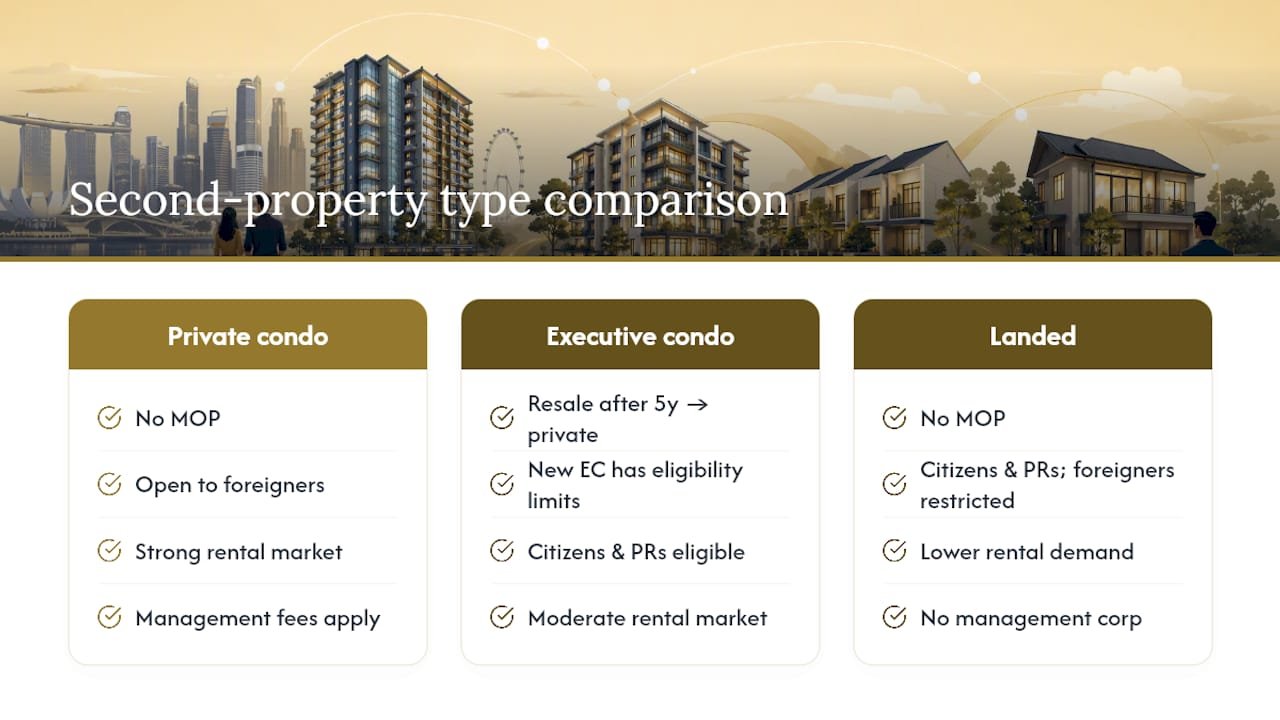
Private condominiums are the most common second-property choice, largely because they carry no MOP once purchased (unlike HDB flats) and no restrictions on foreign ownership. They also tend to have the most active rental market among the three types, which matters if you plan to lease the unit out. Maintenance fees and a management corporation add ongoing costs a landed property owner doesn’t face, but the trade-off is lower maintenance responsibility.
Executive condominiums occupy an unusual middle position. A resale EC that has passed its five-year Minimum Occupation Period functions like a private condominium for ABSD and eligibility purposes, and both Singapore citizens and PRs can buy one. A new EC still under its initial ownership restrictions carries eligibility conditions closer to HDB rules, including income ceilings, which makes it a less practical second-property option for most buyers already past that stage of homeownership.
Landed properties (terrace houses, semi-detached, bungalows) are open to citizens and PRs without restriction, subject to the same ABSD rates as any other private property. Foreigners face the Residential Property Act restriction described above. Landed property tends to carry higher absolute stamp duty costs simply because land values push purchase prices higher, and rental yields on landed homes typically run lower than on comparably priced condominiums, since tenant demand skews toward apartments with facilities.
What can go wrong: risks worth weighing before you commit
A second property is rarely a simple continuation of the logic that worked for your first home, and the risks deserve honest treatment rather than glossing over.
The most immediate risk is liquidity. Once ABSD, BSD, and the reduced LTV equity requirement are all funded, a large share of your savings sits inside one illiquid asset. If your income situation changes or an emergency arises, you cannot access that capital quickly without selling the property itself.
Rental yield risk matters if the second property is an investment rather than a family home. Net rental yield, after mortgage interest, property tax at the higher non-owner-occupied rate, and periods of vacancy, needs to comfortably cover the drag created by ABSD and the larger equity commitment for the purchase to make sense as an investment rather than a lifestyle decision. Many buyers calculate gross yield and skip this step entirely, then find the real return is thinner than expected.
Interest rate exposure runs for the life of the loan. Even with rates easing into 2026, a second mortgage taken today will likely see at least one rate cycle over a typical loan tenure, and TDSR calculations at approval time don’t guarantee comfort years later if your income growth stalls while rates climb.
Finally, policy risk is real and recurring in Singapore’s property market. ABSD rates, LTV caps, and remission conditions have all changed multiple times over the past decade, usually with immediate effect from the date of announcement. A strategy built entirely around current rules can be disrupted by a policy adjustment between your decision to buy and your actual purchase date.
An agent’s honest read on second-property buying in Singapore
Buyers researching this topic tend to focus on the ABSD percentage and forget that financing, not tax, usually decides whether a second property is workable. A client working through a similar sequencing challenge once needed a first-property sale to land inside a tight window while a second purchase was already committed, and the stress came almost entirely from cash flow timing, not the ABSD bill itself.
Three things matter more than most guides suggest: plan your cash and CPF position around the lower second-property LTV before you fall in love with a listing, verify your exact property count and any MOP obligations before you sign anything, and only lean on ABSD remission if your sale sequencing is realistic, not aspirational. Get those three right, and the rest of the process is largely administrative.
— Anderson
Ready to sequence your second property purchase?
Registertoday exists for exactly the situation this guide has walked through: a Singapore buyer who needs a first property sold on a realistic timeline while a second purchase moves forward without missing a remission deadline or overpaying on financing.

Rather than guessing what your current home is worth, or hunting listings without a clear view of where genuine value sits in today’s market, start with a straightforward step. Get a free home valuation from Registertoday to establish a realistic sale price and timeline for your first property, then browse current second-property listings with that number in hand. Having both pieces in front of you turns a stressful sequencing decision into a manageable one.
This article is general information, not a substitute for advice from a qualified financial advisor. Consult a qualified financial professional about your own circumstances before acting on anything here.