
Avoid a Second-Property ABSD With a Dual-Key Condo in Singapore
A dual-key condo is a single strata-titled unit split into two self-contained living spaces, usually a main apartment plus a studio, sharing one entrance foyer. In Singapore, this legal structure means the whole unit counts as one property for Additional Buyer’s Stamp Duty purposes, which is exactly why multi-generational families and owner-occupiers who want rental income keep this format on their shortlist.
TL;DR:
- Dual-key units are assessed as a single property for ABSD, meaning no additional stamp duty applies regardless of internal layout or number of living spaces.
- While developers usually charge a 10 to 25% premium per square foot for dual-key units, rental income often falls short of covering this extra cost within a typical breakeven period of several years.
- Dual-key layouts are best suited for multi-generational families or owner-occupiers seeking rental income, while pure yield investors or those prioritizing resale value may find better options elsewhere.
- Confirm utility sub-metering, shared access, and any internal alterations during viewings, as these factors impact rental potential, costs, and legal compliance.
Table of Contents
- What is a dual-key condo in Singapore?
- How ABSD, stamp duty and loan rules treat dual-key units
- Is the ABSD saving worth the premium and rental risk?
- Who should buy a dual-key condo (and who shouldn’t)
- What to check when viewing and comparing dual-key units
- Where to find dual-key listings across new launches and resale
- Publisher perspective: how Registertoday supports dual-key buyers
- Running costs and shared services in a dual-key layout
- Financing a dual-key purchase: what banks actually assess
- Contracts and legal points unique to dual-key transactions
- The ABSD arithmetic decides more than the layout does
- Get a tailored valuation before you commit to a dual-key purchase
- Sources
What is a dual-key condo in Singapore?
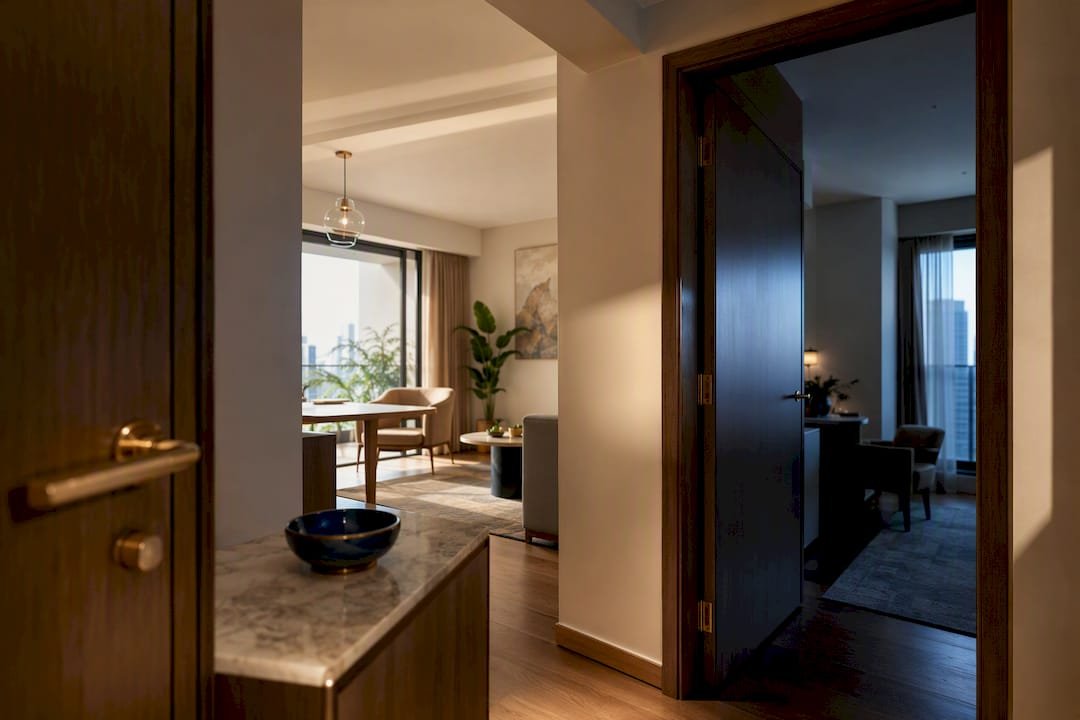
A dual-key layout gives you two locked-off living spaces behind one shared entrance, each with its own kitchen and bathroom. The main unit typically runs two to three bedrooms; the sub-unit is a self-contained studio with its own kitchenette. Grandparents live in the studio while the main household occupies the larger space, or the studio goes to a tenant while the owner lives in the primary unit.
Total floor areas for dual-key units in Singapore commonly range from 1,100 to 1,600 sqft, with the sub-unit typically sitting between 200 and 450 sqft. A few structural points matter more than the square footage:
- Both spaces sit under one strata title, not two separate titles.
- You cannot sell or mortgage the sub-unit independently of the main unit.
- Access to the sub-unit runs through a shared internal or external foyer, not a fully private lobby.
- Utilities can sometimes be sub-metered separately, but this depends on the development’s build.
That single-title structure is the entire reason dual-key units exist as a category. It is also the source of every tax advantage discussed below.
How ABSD, stamp duty and loan rules treat dual-key units
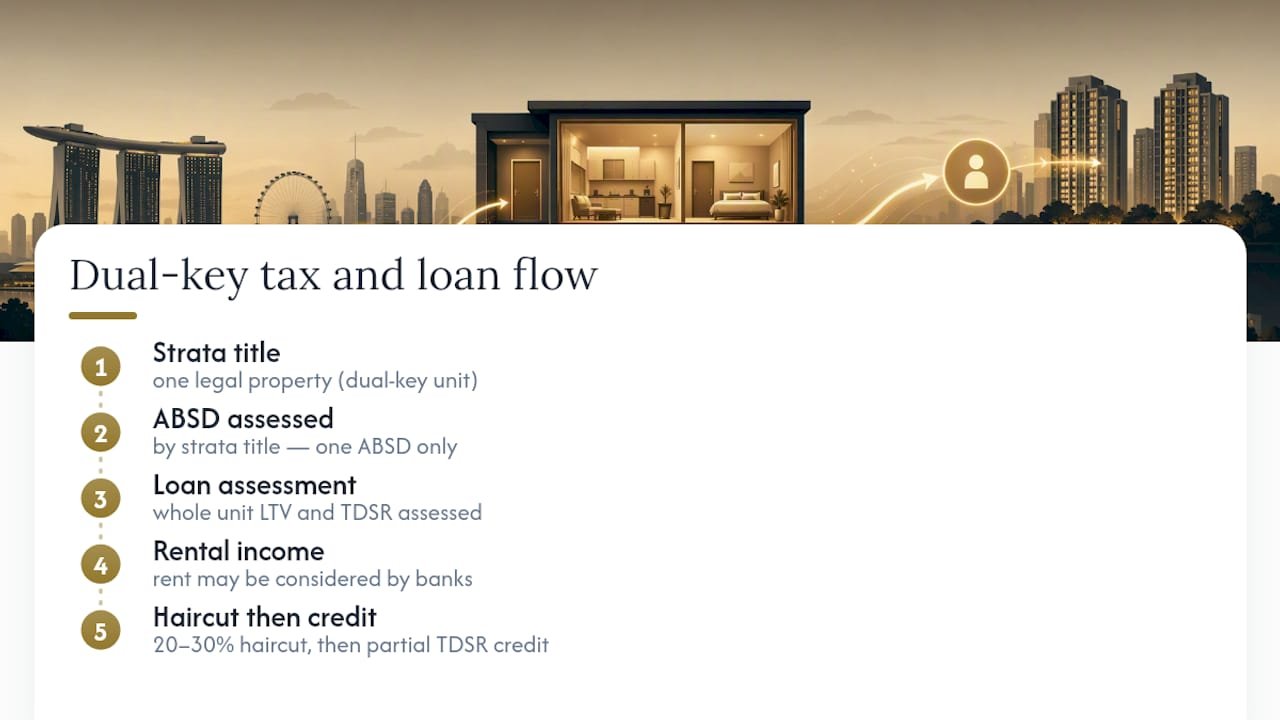
The Inland Revenue Authority of Singapore assesses Additional Buyer’s Stamp Duty by strata title, not by the number of self-contained living spaces inside that title. A dual-key unit, however many kitchens it has, is one property for ABSD purposes.
ABSD rates depend on citizenship and the number of residential properties already owned. Singapore Citizens pay no ABSD on a first residential property, and progressively higher rates on subsequent purchases. Permanent Residents and foreigners face ABSD from their first purchase, at materially higher rates than citizens. Because a dual-key unit is legally one property, a Singapore Citizen buying it as a first home avoids the ABSD they would otherwise pay if they instead bought two separate titled units to house two generations of the same family.
Loan qualification works differently from the tax treatment. Banks assess Loan-to-Value limits and the Total Debt Servicing Ratio against the whole unit as a single purchase, not two. If you plan to rent out the sub-unit and want that income counted towards TDSR, most banks will only credit a portion of it. Published advisory guidance cites a haircut of 20 to 30% applied to rental income before it feeds into your debt servicing calculation. Factor that discount in before assuming the rental cheque solves your affordability gap.
Is the ABSD saving worth the premium and rental risk?
Developers price dual-key units at a premium over comparable single-key floor area, and market commentary puts that premium in a typical range of 10 to 25% per square foot. That premium exists because the format is genuinely more expensive to design and build, and because demand from ABSD-conscious buyers lets developers charge for it.
Run the numbers before assuming the ABSD saving wins automatically:
- Estimate the ABSD you would pay on a second property at your applicable rate, and treat that as the saving a dual-key structure lets you avoid.
- Calculate the PSF premium in dollar terms against a comparable single-key unit of similar total size.
- Apply the bank’s rental haircut to your expected sub-unit rent, then subtract financing costs on the premium amount.
- Divide the premium by the net monthly rental contribution to find your breakeven period in months.
In practice, rental income from the sub-unit often falls short of covering the premium quickly. Breakeven horizons commonly stretch across several years, depending on occupancy and financing costs. For a Singapore Citizen avoiding a second-property ABSD bill, the maths still frequently favours the dual-key route. For a buyer who does not have an ABSD liability to avoid, the premium is much harder to justify on rental yield alone.
A single empty month can push your breakeven horizon out by a year or more once financing costs on the premium are added back in.*
Who should buy a dual-key condo (and who shouldn’t)
Dual-key units suit a narrow but real set of buyer profiles. Multi-generational households get separate living spaces without buying two properties. Owner-occupiers who want rental income from part of their home, without the ABSD hit of a second title, are the format’s core buyer. Buyers who need extra provable income to clear TDSR sometimes use the sub-unit’s rental potential to strengthen their loan application, subject to the bank’s haircut.
The profiles that don’t fit are just as clear:
- Pure yield investors chasing the highest rental return per dollar invested usually get better numbers from a well-located single-key unit without the premium.
- Buyers who prioritise broad resale appeal should know that dual-key stock trades in a narrower resale market than standard layouts, since the pool of buyers wanting this exact configuration is smaller.
- Anyone uncomfortable sharing an entrance foyer with a tenant, even one behind a locked door, should view the layout in person before committing.
Weigh the lifestyle trade-off honestly. Shared circulation space, however minor on paper, changes daily life in a way floor plans don’t always convey.
What to check when viewing and comparing dual-key units
Numbers on a brochure rarely tell you whether a specific unit works. Walk the sub-unit yourself and check for natural ventilation, window placement, and whether the kitchenette is a genuine cooking space or a token pantry counter. Weak ventilation in a studio sub-unit is a common complaint once tenants move in.
A short checklist keeps viewings focused:
- Measure the sub-unit’s actual usable floor area, not just the marketed figure, and check for wasted circulation space.
- Ask the agent or developer for the maintenance fee structure and whether utilities are sub-metered for the two spaces.
- Request tenancy history if the unit is resale, including past rental rates and vacancy periods.
- Check renovation records for any resale unit, since dual-key layouts sometimes get altered in ways that affect strata compliance.
- Build a simple spreadsheet comparing the PSF premium against your estimated ABSD saving and rental income, using the breakeven formula above.
Pro Tip: Ask specifically whether the shared foyer has any acoustic or privacy separation. Some older dual-key designs place both front doors within arm’s reach of each other, which matters more once a tenant actually moves in.
Use Registertoday’s property evaluation tools to structure this comparison against live listings rather than working from a blank spreadsheet.
Where to find dual-key listings across new launches and resale
New launch brochures usually flag dual-key stacks explicitly in their floor plan legends, so check showflat plans before assuming a unit type exists in a project. Resale listings are less consistent about labelling, and dual-key units sometimes get buried among project results.
A few practical filters speed up the search:
- Search portal listings using floor area bands matching the 1,100 to 1,600 sqft range typical of dual-key units.
- Look for the keyword “dual-key” or “dual key” directly in listing titles and descriptions, since agents don’t always tag the attribute as a filter.
- Cross-check district demand and rare-stack availability, since dual-key stacks in older projects are limited in number and command premiums when they do resell.
- Compare new launch marketing brochures against resale PSF data to see whether the premium has held or narrowed over time.
Registertoday’s advanced search tool lets you filter by size band and keyword together, which narrows results faster than scrolling generic listings.
Publisher perspective: how Registertoday supports dual-key buyers
Registertoday has closed over $1 billion in property transactions across Singapore’s residential and commercial markets. That transaction history feeds directly into how the team runs ABSD-aware searches for clients weighing dual-key options against standard units.
Every evaluation starts free, and negotiation support is built into the service rather than billed separately. Request a tailored dual-key assessment through Registertoday to see the actual numbers behind a specific listing before you commit to a viewing.
Running costs and shared services in a dual-key layout
Maintenance fees for dual-key units are billed against the single strata title, so you pay one management fee to the Management Corporation Strata Title (MCST) covering both spaces, not two separate bills. This matters when comparing running costs against buying two smaller separate units, where you’d pay two maintenance fees and two sets of conservancy charges.
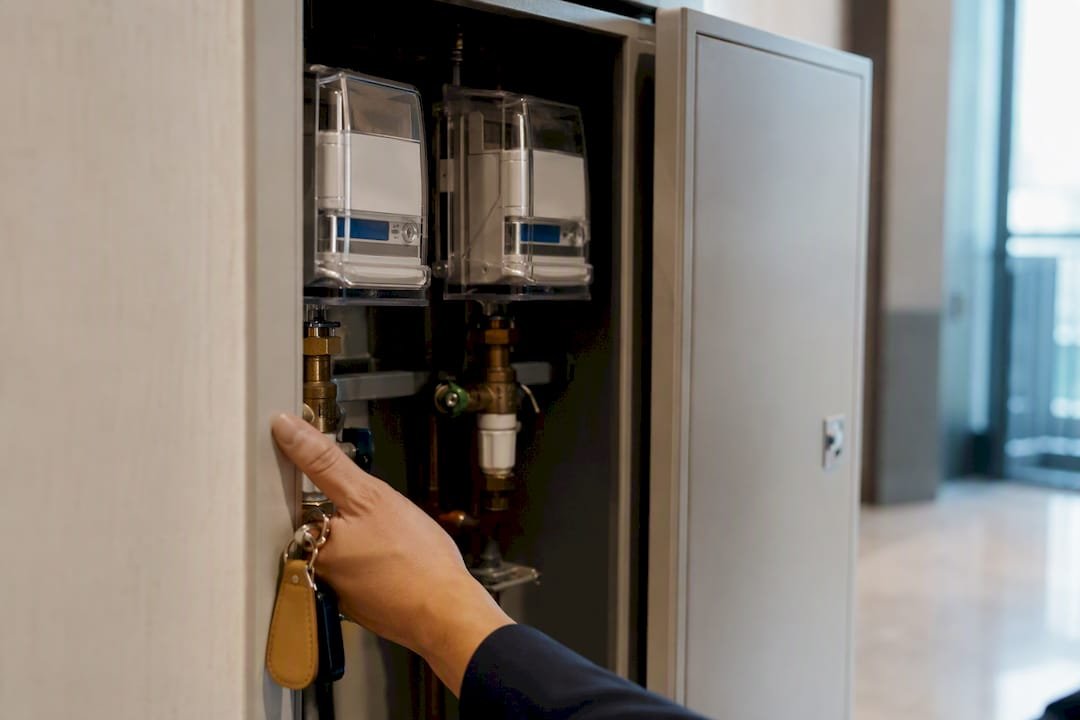
Utilities are where dual-key units diverge in practice. Some developments sub-meter electricity and water separately for the main unit and the sub-unit, which lets you bill a tenant directly for their consumption. Others run a single meter for the whole unit, meaning you either absorb the tenant’s utility usage yourself or arrange a private reimbursement agreement with them. Check this specifically during viewings, since it isn’t always obvious from the floor plan and affects your actual net rental yield.
Shared foyer maintenance, lift lobby access, and any common internal corridor between the two spaces fall under the same MCST arrangement as the rest of the development. If the sub-unit tenant has separate access hours or security card requirements, confirm this with the managing agent before purchase, particularly if you’re renting to a tenant who values privacy from the main household.
Wear and tear also runs differently across the two spaces. A studio sub-unit with rotating tenants typically needs repainting and appliance servicing more frequently than an owner-occupied main unit, so budget renovation reserves accordingly when planning your holding costs over a five to ten year horizon.
Financing a dual-key purchase: what banks actually assess
Banks evaluate a dual-key purchase as a single loan against a single property, using the combined valuation of both spaces together. Your Loan-to-Value ratio and Total Debt Servicing Ratio calculations run against the whole unit price, not against the main unit and sub-unit separately.
Where dual-key financing gets more complex is in how banks treat prospective rental income from the sub-unit. If you’re relying on that rental income to help you qualify under TDSR, most banks require either an existing tenancy agreement or a conservative projected rental figure, and they’ll typically only count a portion of it. The 20 to 30% haircut mentioned earlier applies here specifically, meaning $2,000 in projected monthly rent might only contribute $1,400 to $1,600 towards your TDSR calculation.
Valuation itself can also differ slightly from a standard unit, since bank valuers sometimes apply a marginally different approach to a layout with two kitchens and two bathrooms under one title. Get an indicative valuation early in your purchase process rather than assuming the PSF rate quoted by the seller or developer will match what your bank’s valuer returns.
If you’re buying with a joint applicant, note that TDSR calculations use combined income and combined existing debt obligations, same as any other property purchase. The dual-key structure changes what rental income you can credit, not how the underlying TDSR formula works.
Contracts and legal points unique to dual-key transactions
The Option to Purchase and Sale and Purchase Agreement for a dual-key unit cover the entire unit as one property, describing both the main unit and sub-unit as components of a single title. There is no separate contract for the sub-unit, and no mechanism to purchase or finance it independently of the main space.
Tenancy agreements for the sub-unit fall under standard Urban Redevelopment Authority private residential tenancy rules, meaning minimum lease terms of three months apply. You cannot legally run the sub-unit as a short-term rental or serviced apartment under three months, regardless of how self-contained it is, since URA rules apply to the entire dual-key unit under one strata title.
If you plan to rent both the main unit and the sub-unit to different tenants simultaneously, check whether the development’s house rules or the specific unit’s layout support two concurrent tenancies without disputes over shared foyer access. Some MCSTs have specific bylaws addressing dual-key tenancy arrangements, particularly around visitor access and security registration for two separate households sharing one address.
For resale purchases, request the full renovation history and any structural alteration records, since some older dual-key units have had internal walls modified in ways that may not comply with the original strata plan. A property lawyer reviewing the Sale and Purchase Agreement should confirm the unit’s current configuration matches its approved strata plan before you complete the purchase.
The ABSD arithmetic decides more than the layout does
The conventional pitch for dual-key units treats them as a lifestyle solution for multi-generational families. That framing understates what actually drives the Singapore market for this format: the ABSD saving is doing almost all the work, and rental yield from the sub-unit is a secondary benefit that rarely justifies the premium on its own.
Where most buyers go wrong is treating the premium and the ABSD saving as automatically offsetting each other. They don’t, not reliably. A Singapore Citizen avoiding ABSD on a second property has a straightforward, quantifiable saving to weigh against the premium.
Prioritise the arithmetic before the floor plan. Run the breakeven calculation with a conservative vacancy assumption and the bank’s rental haircut applied, and only then judge whether the multi-generational or rental-income appeal is worth paying for. The layout is rarely the deciding factor. The tax position almost always is.
— Anderson
Get a tailored valuation before you commit to a dual-key purchase
If you’re weighing a dual-key unit against standard alternatives, the fastest way to test the numbers is against live market data rather than brochure projections. The platform gives Singapore buyers a direct route to real transaction comparables and valuation services on any dual-key unit considered, without the guessing that comes from working off a developer’s marketing PSF alone.

The platform’s track record of over $1 billion in completed transactions means the team has priced enough dual-key units to know where the premium is justified and where it isn’t. Browse current dual-key stock on the property listing page, or request a free evaluation and negotiation support directly through Registertoday before you make an offer.