

Avoid ABSD on a Second Singapore Property Without an IRAS Audit
Singapore offers five legitimate routes to avoid or reduce Additional Buyer’s Stamp Duty: selling your existing home first, claiming the married-couple replacement remission, decoupling where the sums genuinely work, relying on Free Trade Agreement national treatment for eligible passport holders, or buying commercial or industrial property instead. Every route demands real commercial substance. IRAS actively disregards contrived arrangements and can claw back duty with penalties, so each strategy needs proper legal advice before you sign anything.
TL;DR:
- Selling your existing home before purchasing a new one allows you to buy as a first-time buyer, avoiding ABSD entirely, but requires careful timing and planning.
- Decoupling can reduce ABSD costs if the combined expenses of transfer, legal fees, and refunds are less than the duty owed, but depends heavily on affordability and lender approval.
- Using Free Trade Agreement passport treatment only benefits specific nationalities and requires confirmed eligibility, while trusts and entities generally incur higher flat ABSD rates than individual buyers.
- Buying commercial or industrial property completely avoids ABSD but involves different financial considerations like yield, liquidity, and legal structures.
- The 14-day signing window for stamping and strict six-month sale deadlines for remission claims make timing and proper documentation essential to avoid penalties and loss of benefits.
Table of Contents
- Legitimate strategies to avoid or reduce ABSD at a glance
- How is ABSD calculated and what are the 2026 Singapore rates?
- Decoupling explained: process, costs and when it actually pays off
- How do you qualify for the married-couple and senior ABSD remission?
- FTA passport treatment, trusts and entities: what actually works
- Is buying commercial or industrial property really ABSD-free?
- Timing, CPF and financing details that can derail your plan
- How does IRAS police ABSD avoidance and what triggers an audit?
- Step-by-step checklist before you commit to an ABSD strategy
- How Registertoday supports ABSD-aware buyers
- What SSD costs apply when you’re also managing ABSD?
- What is the realistic timeline for an ABSD planning transaction?
- What compliance checklist keeps your ABSD arrangement inside IRAS rules?
- Tax planning shouldn’t outrun the investment case
- Ready to explore ABSD-efficient properties in Singapore?
- Official resources to check before you act
- Sources
- FAQ
Legitimate strategies to avoid or reduce ABSD at a glance
Before picking a strategy, understand that IRAS treats each option differently in terms of conditions, cost, and risk. Here is the shortlist worth working through with a conveyancing solicitor.
- Sell first, buy second. If you sell your only residential property before completing on the next one, you purchase as a first-time buyer with no ABSD exposure at all. The cost is timing risk: you may need to rent temporarily between transactions.
- Married-couple replacement remission. Buy the new home, then sell the old one within six months of the purchase date (or TOP/CSC for uncompleted property) to claim a full refund of ABSD paid. Miss the window and the remission is forfeited permanently.
- Decoupling. One spouse transfers or sells their share of an existing property to the other, freeing the exiting spouse to buy a second property as a first-timer. This only works when Buyer’s Stamp Duty, legal fees, and CPF refund costs are lower than the ABSD you would otherwise pay.
- FTA national treatment. Nationals of the United States, Switzerland, Liechtenstein, Norway, and Iceland get treated as Singapore Citizens for ABSD purposes under Singapore’s Free Trade Agreements. Passport eligibility must be confirmed in writing.
- Buy commercial or industrial property. Non-residential property carries no ABSD whatsoever, though it comes with different financing, yield, and liquidity profiles.
- Trusts and private entities. These are rarely useful for ABSD avoidance, since entities and trustees pay a flat 65% rate regardless of the underlying beneficiary’s citizenship.
Each of these carries its own cost drivers, whether that’s the 14-day stamping deadline, CPF refund processing time, or the legal fees of restructuring ownership. The sections below unpack the mechanics, the paperwork, and where buyers most often trip up.
How is ABSD calculated and what are the 2026 Singapore rates?
ABSD is charged on whichever figure is higher: the purchase price stated in the agreement or the IRAS-assessed market valuation) of the property. That single rule closes off the most obvious workaround. If you try to transact at an artificially low price to shrink the ABSD base, IRAS simply substitutes its own valuation and charges duty on that instead.
Rates vary sharply by buyer profile. Singapore Citizens pay nothing on a first residential property but progressively higher rates on a second and subsequent purchase. Singapore Permanent Residents face ABSD from their first property onward, at higher rates than citizens. Foreign buyers who don’t qualify for FTA treatment pay a flat 60% on any residential purchase, and entities or trustees pay 65%, according to IRAS.
Duty is payable within 14 days of signing the sale and purchase agreement (or 30 days if the document is signed overseas), so there’s no room to defer payment while you work out your strategy.
Joint purchases follow a strict rule: the buyer profile attracting the highest ABSD rate applies to the entire transaction, not just that person’s share. If a Singapore Citizen buys jointly with a foreign national, the whole purchase is taxed at the foreigner’s 60% rate. This single mechanic derails more purchase structures than any other, and it’s worth modelling before you even shortlist properties.
Decoupling explained: process, costs and when it actually pays off
Decoupling means one spouse exits their share of an existing residential property, either by sale or gift, so the remaining spouse becomes the sole owner. The exiting spouse then qualifies as a first-time buyer for the next purchase, since they no longer have a residential interest on record.
The process typically runs in this order: a solicitor values the exiting spouse’s share, drafts the transfer document, and stamps it. The remaining spouse then refinances the mortgage solely in their name, since lenders won’t usually allow the exiting party to remain as a guarantor once they’ve disposed of their interest. CPF monies used for the original purchase must be refunded, with accrued interest, before the transfer completes.
The costs to model against your projected ABSD saving include:
- Buyer’s Stamp Duty on the transferred share, calculated on its value.
- Seller’s Stamp Duty, which applies if the property has been held for under three years.
- Legal fees for the conveyancing and refinancing work, typically running into several thousand dollars.
- CPF refund obligations, which must be settled in full and can take weeks to process.
- Loan refinancing costs, including valuation fees and potential penalty charges for early redemption.
The decision rule is straightforward in principle: only proceed if the combined cost of BSD, SSD, legal fees, and refinancing sits below the ABSD you would otherwise pay, and only if the remaining spouse can qualify for the full mortgage alone under the lender’s Total Debt Servicing Ratio test. That second condition kills more decoupling plans than the tax maths ever does. A spouse with lower income or existing debt obligations may simply not pass affordability checks solo, making the entire saving theoretical.
IRAS watches decoupling closely. Genuine commercial reasons, such as a documented change in financial circumstances or a legitimate estate-planning objective, need to be evidenced. A transfer executed purely to dodge ABSD, with no independent rationale and immediately followed by a second property purchase, is exactly the pattern legal researchers warn invites scrutiny.
How do you qualify for the married-couple and senior ABSD remission?
Married couples who buy a replacement home while still owning their existing matrimonial property can pay ABSD upfront and then claim a full refund, provided they sell the old property within six months of the new purchase’s completion date, or within six months of the Temporary Occupation Permit or Certificate of Statutory Completion if the new property is uncompleted, per IRAS’s remission rules.
A related concession exists for single Singapore Citizens aged 55 and above who are downsizing. They can claim a refund of ABSD paid on a second residential property, subject to the same strict six-month sale requirement and a set of eligibility conditions covering property value and ownership history, as IRAS confirms.
The claim itself runs through myTax Portal under the Stamp Duty login. You’ll need the stamped sale and purchase agreements for both properties, proof of the sale completion date, and evidence that at least one applicant meets the citizenship or age criteria. Processing isn’t instant, so build in weeks rather than days.
The most common pitfall is the calendar, not the paperwork. Buyers sometimes assume the six months starts from when they decide to sell, not from the fixed purchase or TOP date IRAS actually uses. Pro Tip: Mark the six-month deadline the day you receive your Option to Purchase for the new home, not the day you start marketing the old one. IRAS applies the clock strictly, and there’s no discretion to extend it.
FTA passport treatment, trusts and entities: what actually works
Nationals of the United States, Switzerland, Liechtenstein, Norway, and Iceland receive the same ABSD treatment as Singapore Citizens under Singapore’s Free Trade Agreements, provided they hold citizenship of one of those countries at the time of purchase. This isn’t a discretionary concession. It’s written into the FTA framework itself, but eligibility still needs confirming in writing with your solicitor before you commit, since dual nationals and permanent residency status elsewhere can complicate the assessment.
Trusts and private limited companies are frequently pitched as ABSD workarounds, and almost always disappoint. IRAS charges a flat 65% ABSD on any residential property bought by an entity or a trustee, regardless of the citizenship of the underlying shareholders or beneficiaries, according to IRAS’s published rates. That rate is higher than what most foreign individual buyers pay directly, which means routing a purchase through a company or trust to “hide” beneficial ownership typically increases your tax bill rather than reducing it.
There are legitimate reasons to hold property in trust, usually tied to estate planning, asset protection for minor beneficiaries, or succession structuring rather than ABSD avoidance. If a trust structure is under consideration, get specialist tax and trust advice before purchase, not after, since restructuring an existing trust holding to fix an ABSD problem is far harder than getting the structure right from day one.
Is buying commercial or industrial property really ABSD-free?
Yes. Commercial and industrial property sits entirely outside the ABSD regime, attracting only standard Buyer’s Stamp Duty and, for GST-registered purchases, Goods and Services Tax on the transaction. This makes it a genuine alternative for investors who have exhausted their residential ABSD-efficient options and still want to deploy capital into Singapore property.
The trade-offs are real, though. Rental yields on commercial and industrial space can be attractive, but tenancy turnover, fit-out costs, and sensitivity to business cycles make income less predictable than residential rent. Liquidity is thinner too. Commercial units sit on the market longer than comparable residential stock when you eventually want to sell.
Commercial property makes sense when you’re specifically optimising to avoid ABSD entirely rather than reduce it, when you have the capital buffer to handle a lower LTV, and when you’re comfortable with a different tenant risk profile. Browsing the property listings across both commercial and residential categories side by side helps put the yield and price comparison in context before deciding.
Timing, CPF and financing details that can derail your plan
IRAS fixes your buyer profile, and therefore your ABSD rate, on the date you exercise the Option to Purchase, not on the completion date. This matters enormously for sequencing: if you sign a new OTP before your existing property sale has completed, you may lock yourself into a higher ABSD bracket than intended, even if the old property sells days later.
CPF refunds after paying ABSD follow a defined but not instant process. Once a remission claim is approved, the refund of principal and accrued interest to your CPF account typically takes several weeks to process after IRAS confirms the sale conditions are met. Don’t assume the cash will be available for your next purchase’s deposit on a tight timeline.
Lenders reassess affordability whenever ownership structures change. After a decoupling exercise, the remaining spouse must pass the Total Debt Servicing Ratio and Loan-to-Value tests solo, using their own income and existing liabilities. This is precisely where many ABSD strategies that look sound on paper collapse in practice, because the theoretical tax saving means nothing if the bank won’t lend.
How does IRAS police ABSD avoidance and what triggers an audit?
IRAS holds explicit anti-avoidance powers. It can substitute its own market valuation for a stated purchase price, disregard the legal form of a transaction that lacks genuine commercial substance, and impose a clawback of the ABSD that should have been paid, alongside a 50% surcharge and penalties that can reach four times the unpaid duty.
Common audit triggers include related-party transfers priced well below market value, a decoupled property that’s immediately followed by a second purchase with no independent rationale, and ownership restructuring that has no documented commercial purpose beyond tax reduction. IRAS has also pursued criminal prosecution in cases involving false or misleading information supplied during a stamp duty audit, which underlines that this isn’t a purely administrative risk.
The defence is documentation, built before the transaction, not after an audit letter arrives. Keep a written record of the commercial reason for any transfer, an independent valuation supporting the transaction price, and solicitor correspondence confirming the structure was reviewed for compliance. If a strategy only makes sense assuming IRAS never looks closely, it’s not a strategy worth pursuing.
Step-by-step checklist before you commit to an ABSD strategy
Work through these steps in order, and don’t skip the modelling stage just because a strategy looks obviously cheaper on the surface.
- List every residential interest you and your spouse hold, including overseas property and any trust or entity holdings, since these all count toward your ABSD profile.
- Model the total cost of each viable route, sell-first, decoupling, and paying ABSD outright, side by side, including BSD, SSD, legal fees, and CPF refund timing.
- Confirm FTA eligibility in writing with a conveyancing solicitor if either buyer holds a qualifying passport.
- Engage a lender early to stress-test affordability under a restructured ownership scenario before committing to decoupling.
- Set calendar triggers for the OTP date, the 14-day stamping deadline, the TOP or completion date, and the six-month remission sale window.
- File remission claims via myTax Portal promptly, with the stamped agreements and sale evidence ready in advance.
Pro Tip: Build your calendar backwards from the six-month remission deadline, not forwards from your purchase date. Working backwards forces you to confirm your existing property is genuinely saleable within that window, rather than discovering the market’s slower than expected after you’ve already paid ABSD.
How Registertoday supports ABSD-aware buyers
Registertoday is a Singapore property platform built for exactly this kind of planning, with listings spanning commercial and residential properties so buyers can compare ABSD-free alternatives against standard residential purchases in one place. The platform’s free property evaluations help model the IRAS valuation risk that sits behind every decoupling or related-party transfer, and its negotiation support means buyers aren’t structuring these transactions alone.
What SSD costs apply when you’re also managing ABSD?
Seller’s Stamp Duty applies whenever you sell a residential property within a specified holding period from purchase, and it interacts directly with several ABSD avoidance strategies rather than sitting separately from them. If your sell-first plan involves disposing of a property you’ve held for a short period, SSD gets charged on top of any ABSD considerations, on a sliding scale that decreases the longer you’ve held the asset.
This matters most for decoupling. If the property being transferred or sold as part of a decoupling exercise was purchased within the SSD holding period, that cost must be added to the BSD, legal fees, and CPF refund already in your calculation. Skipping SSD from the maths is one of the most common ways buyers underestimate the true cost of freeing a spouse up to buy again.
It also matters for the married-couple remission route. Selling your existing property within the six-month window to claim the ABSD refund is exactly the kind of quick disposal that can trigger SSD if you haven’t held that property long enough to clear the holding period. You could end up successfully reclaiming ABSD on the new purchase while simultaneously paying SSD on the sale of the old one, which shrinks the net saving considerably.
Before committing to any timeline-sensitive strategy, check your existing property’s purchase date against the current SSD holding period and rate schedule. A strategy that looks like a clean ABSD save on paper can lose much of its advantage once SSD is factored in against a property sold too soon.
What is the realistic timeline for an ABSD planning transaction?
A well-sequenced ABSD strategy runs on a tighter clock than most buyers expect, and missing a single date can forfeit the entire saving.
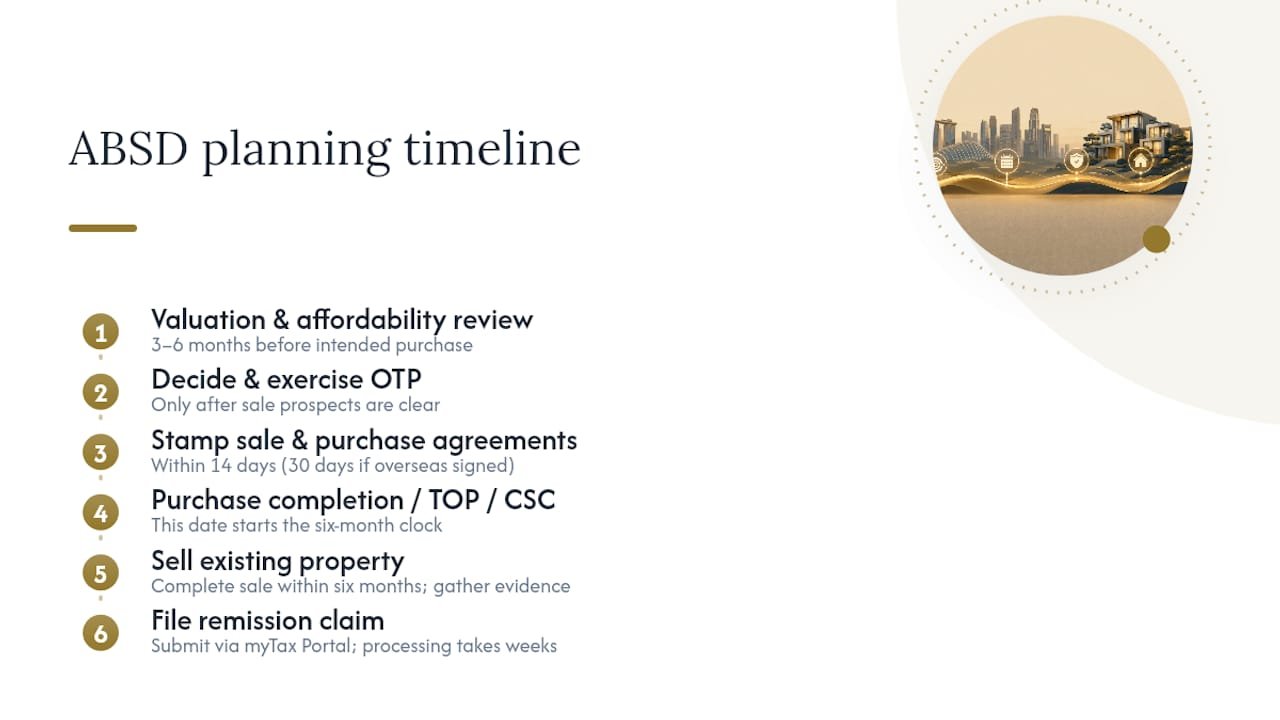
Start with a valuation and affordability review of your current property, ideally three to six months before you intend to purchase. This gives you a realistic read on how quickly it will sell and what a lender will approve for the next purchase. Next comes the decision point: exercise the Option to Purchase on the new property only once you have clarity on your existing property’s sale prospects, since the OTP date is what fixes your ABSD buyer profile.
If you’re relying on the married-couple or senior remission, the six-month sale clock starts from the new property’s purchase completion date, or its TOP or CSC date if bought uncompleted. Stamping of both the sale and purchase agreements must happen within 14 days of signing (30 days for overseas-signed documents), with ABSD paid upfront where applicable. Once the existing property sale completes within the six-month window, gather the stamped agreements and completion evidence, then file the remission claim through myTax Portal without delay, since processing itself takes further weeks.
For decoupling, sequence the ownership transfer and CPF refund settlement before applying for refinancing, and only exercise the next OTP once the remaining spouse’s solo mortgage approval is confirmed in writing by the lender.
What compliance checklist keeps your ABSD arrangement inside IRAS rules?
Every ABSD strategy should pass a documentation test before you sign anything, because IRAS assesses substance, not just paperwork that looks correct on its face.
Confirm that any property transfer or sale has an independent valuation supporting the transaction price, particularly for related-party transfers where IRAS is entitled to substitute its own market assessment. Keep a written record of the genuine commercial or personal reason behind any restructuring, whether that’s a change in financial circumstances, an estate planning objective, or a straightforward sale to a third party. Retain solicitor correspondence confirming the structure was reviewed for ABSD compliance before completion, not drafted retrospectively to justify a transaction already done.
Verify FTA passport eligibility in writing if you’re relying on national treatment, and don’t assume permanent residency elsewhere doesn’t complicate the assessment. Cross-check the six-month remission clock against the correct trigger date, whether that’s completion or TOP, and file remission claims through myTax Portal as soon as the sale condition is satisfied rather than waiting. Finally, brief your lender and solicitor on the full strategy early, since a plan that only one adviser understands is far more likely to trip over a detail nobody flagged.
Tax planning shouldn’t outrun the investment case
Avoiding ABSD is worth pursuing, but only as one input into a broader return calculation, not the entire justification for a purchase. A property that only makes sense once you strip out the tax saving was probably never a strong investment to begin with.
Model your expected returns and liquidity position after ABSD, not before it, and stress-test what happens if a decoupling plan takes longer than expected or a commercial property’s yield underperforms. Professional advice, properly documented, protects you twice: once from IRAS scrutiny, and once from a decision driven by tax logic rather than sound investment reasoning. Registertoday is a useful partner precisely because it treats the two as connected, not separate, questions.
— Anderson
Ready to explore ABSD-efficient properties in Singapore?
Certain real estate platforms provide options to compare ABSD-free commercial properties against standard residential purchases side by side. Such platforms may offer free property evaluations to help model IRAS valuation risk and negotiation support for structuring decoupling or remission claims with professional guidance.

Whether you’re weighing a sell-first plan, checking whether a commercial unit stacks up against a residential purchase, or simply want a realistic valuation before deciding on a transfer, the team can walk through the numbers with you. Start by browsing the advanced property search to see what’s currently available across residential and commercial categories, or request a home valuation if you’re assessing an existing property ahead of a sale or transfer.
Official resources to check before you act
Confirm every figure and deadline against primary sources before signing anything. Start with IRAS’s ABSD page for current rates and the calculation method, and the married-couple remission guidance for the six-month sale rule and required documents.
The Ministry of Finance’s stamp duty policy page sets out how ABSD fits within Singapore’s broader property cooling framework. For a practitioner’s walkthrough of decoupling costs and process, the decoupling guide from Aurea is a useful companion read. Always get written confirmation from a conveyancing solicitor for FTA eligibility claims and any related-party transfer before proceeding.
This article is general information, not a substitute for advice from a qualified financial advisor. Consult a qualified financial professional about your own circumstances before acting on anything here.
Sources
FAQ
How can I buy a second property without paying ABSD?
The cleanest route is selling your first property before completing on the second, which makes you a first-time buyer again. Alternatively, married couples can pay ABSD upfront and claim a full refund by selling their existing home within six months of the new purchase.
Who is exempt from paying ABSD in Singapore?
Singapore Citizens buying their first residential property pay no ABSD, and nationals of the United States, Switzerland, Liechtenstein, Norway, and Iceland receive citizen treatment under Singapore’s Free Trade Agreements. Buyers of commercial or industrial property are also exempt, since ABSD only applies to residential purchases.
Can I own an HDB flat and a condo without paying ABSD?
Only if you sell the HDB flat before or shortly after buying the condo, or if you’re a married couple claiming the replacement remission by selling the HDB flat within six months of the condo’s purchase or TOP date. Holding both simultaneously beyond that window means ABSD applies and generally isn’t refundable.
Can I avoid ABSD if I sell my HDB flat and buy a condo?
Yes, if the HDB sale completes before you exercise the Option to Purchase on the condo, you buy as a first-time buyer with no ABSD due at all. If you buy the condo first, you’ll need to sell the HDB flat within six months to qualify for the married-couple remission refund instead.
Does decoupling always save money on ABSD?
Not always. Decoupling only pays off when the combined cost of Buyer’s Stamp Duty, Seller’s Stamp Duty, legal fees, and CPF refund is lower than the ABSD you’d otherwise owe, and only when the remaining spouse can qualify for the mortgage alone.