
4 Financial Metrics to Choose Commercial or Residential in Singapore
Residential property suits investors with smaller capital who want a hands-on role and steady, recession-resistant demand. Commercial property suits those with larger capital, a preference for longer leases and passive income from business tenants, and higher yield tolerance for higher volatility. Yields, lease length, and entry cost separate the two, and in Singapore, Additional Buyer’s Stamp Duty) makes commercial assets more attractive for a second or third purchase.
TL;DR:
- Commercial properties generally offer longer lease terms of three to ten years or more, providing more predictable cash flow than the often annual renewal cycles of residential leases.
- Yields for commercial assets tend to be higher due to income from business tenants, but financing depends heavily on the property’s income performance rather than the borrower’s credit profile.
- Commercial vacancy periods can last months if tenants leave, while residential vacancies are usually shorter because housing demand remains steady even during downturns.
- Investors should carefully evaluate cap rates and debt service coverage ratios to ensure the property’s income and financing conditions align before purchase.
- For buyers, matching asset type to capital, management preference, and growth target is crucial, with registered listings and valuation services available to help assess genuine value and select suitable investments.
Table of Contents
- Commercial vs residential investment: the metrics compared
- Metrics every investor should calculate before buying
- Where the real risk sits in each asset class
- How to choose between commercial and residential property
- How Registertoday supports both routes
- Which asset class actually fits you
- Ready to act on your decision
- Sources
- FAQ
Commercial vs residential investment: the metrics compared
The clearest way to separate commercial vs residential investment is to line up the numbers that actually drive returns, rather than relying on general impressions of which sector “feels” safer.
Lease length is the first divide. Commercial leases typically run from 3 to 10 years or longer, giving landlords predictable income for years at a stretch. Residential leases in Singapore usually reset annually, meaning more frequent tenant turnover, more re-letting costs, and more exposure to short-term rental market swings.
Yields follow a similar pattern. Commercial property tends to deliver higher yields than residential, reflecting the income-producing, business-tenant nature of the asset. Residential yields sit lower but come with steadier, more predictable demand because housing is a basic need rather than a discretionary business expense.
Entry cost and financing complexity diverge sharply too. Residential mortgages are underwritten mainly on the borrower’s income and credit profile, governed in Singapore by MAS lending rules on MSR and TDSR limits, which cap how much of your income can service housing debt. Commercial financing works differently: lenders lean heavily on the property’s own income performance, often expressed through debt service coverage, because the deal is judged more on what the asset earns than on the borrower’s payslip.
Management burden shifts the calculation again. Residential landlords typically handle repairs, agent fees, and vacancy periods directly. Many commercial deals use triple net (NNN) lease structures, where the tenant covers property tax, insurance, and maintenance, cutting the owner’s day-to-day involvement considerably.
Liquidity rounds out the comparison:
- Residential units generally sell faster, benefiting from a larger pool of owner-occupier and small-investor buyers.
- Commercial assets attract a narrower buyer base, often institutional or business owners, which lengthens typical marketing and sale periods.
- Vacancy in commercial space can persist for months between tenants, while residential vacancy periods are usually shorter given constant rental demand.
- Market-cycle sensitivity hits commercial harder, since business tenants cut back or close during downturns in ways households rarely do with housing.
Metrics every investor should calculate before buying
Four figures separate an informed decision from a guess.
- Cap rate. Net operating income divided by purchase price, expressed as a percentage. A property earning a net yield in the mid-single digits sits within typical ranges for many Singapore commercial assets, though the exact figure depends heavily on location, tenant quality, and lease terms.
- Cash-on-cash return. Annual cash flow divided by the actual cash invested, not the full purchase price. Leverage amplifies this figure: a smaller deposit financed mostly by debt can produce a higher cash-on-cash return than an all-cash purchase, provided rental income comfortably covers repayments.
- DSCR (debt service coverage ratio). Net operating income divided by annual debt payments. Commercial lenders scrutinise this closely because the loan is repaid from the property’s earnings, not the borrower’s salary.
- WALT (weighted average lease term). The average remaining lease length across all tenants, weighted by rental income. A longer WALT signals more stable, contracted income and typically supports a stronger valuation, a principle RICS applies in professional valuation practice.
Pro Tip: Run the cap rate and DSCR together before making an offer. A property can show an attractive cap rate on paper while still failing a lender’s DSCR threshold, which stalls financing at the worst possible moment.
Where the real risk sits in each asset class
Vacancy risk cuts differently across the two. Commercial units can remain vacant longer while suitable business tenants are sought, impacting cash flow given the larger rents involved. Residential units re-let faster because demand for housing rarely disappears.
Tenant credit matters more in commercial deals. A retail or office tenant’s business can fail with the wider economy, and commercial income proves more sensitive to business cycles than residential rent, which households prioritise even in a downturn.
- Residential landlords face regulatory protections around tenancy terms and more frequent, smaller-scale turnover.
- Commercial landlords face concentrated risk: losing one anchor tenant can wipe out a large share of income overnight.
- Transaction costs differ too. Residential purchases beyond the first attract ABSD, while buyers in Singapore sometimes shift to commercial or industrial assets specifically to sidestep that tax.
- Mitigation comes down to lease structure, tenant diversification across multiple units where possible, and conservative leverage that leaves headroom if a tenant leaves early.
How to choose between commercial and residential property
Work through four questions before committing capital: How much cash can you deploy without stretching your own liquidity? Can you qualify for financing on the terms the asset demands? Do you want to manage tenants directly, or would you rather leases and NNN terms carry that load? And what return horizon are you targeting, quick cash flow or long-term capital growth?
Three profiles map cleanly onto these answers:
- The first-time or smaller-capital investor usually fits residential property best. Lower entry cost, standard MAS-governed financing, and steady tenant demand suit a more hands-on, lower-risk approach.
- The capital-rich, passive investor tends to favour commercial property. Longer leases, NNN structures, and higher yields reward patience and a larger deposit.
- The multi-property investor already holding residential stock often turns to commercial or industrial assets to diversify and avoid stacking ABSD on further residential purchases.
Once you know your profile, run the cap rate and DSCR on any candidate deal, order a proper valuation, and speak to a market agent who knows current listings.
Pro Tip: Watch for cap rates that look too generous relative to the local market average. An unusually high advertised yield often signals a weak tenant covenant or a lease about to expire, not a genuine bargain.
Avoid over-leveraging on either asset class, and be wary of any deal where the seller cannot clearly show lease terms and tenant payment history.
How Registertoday supports both routes
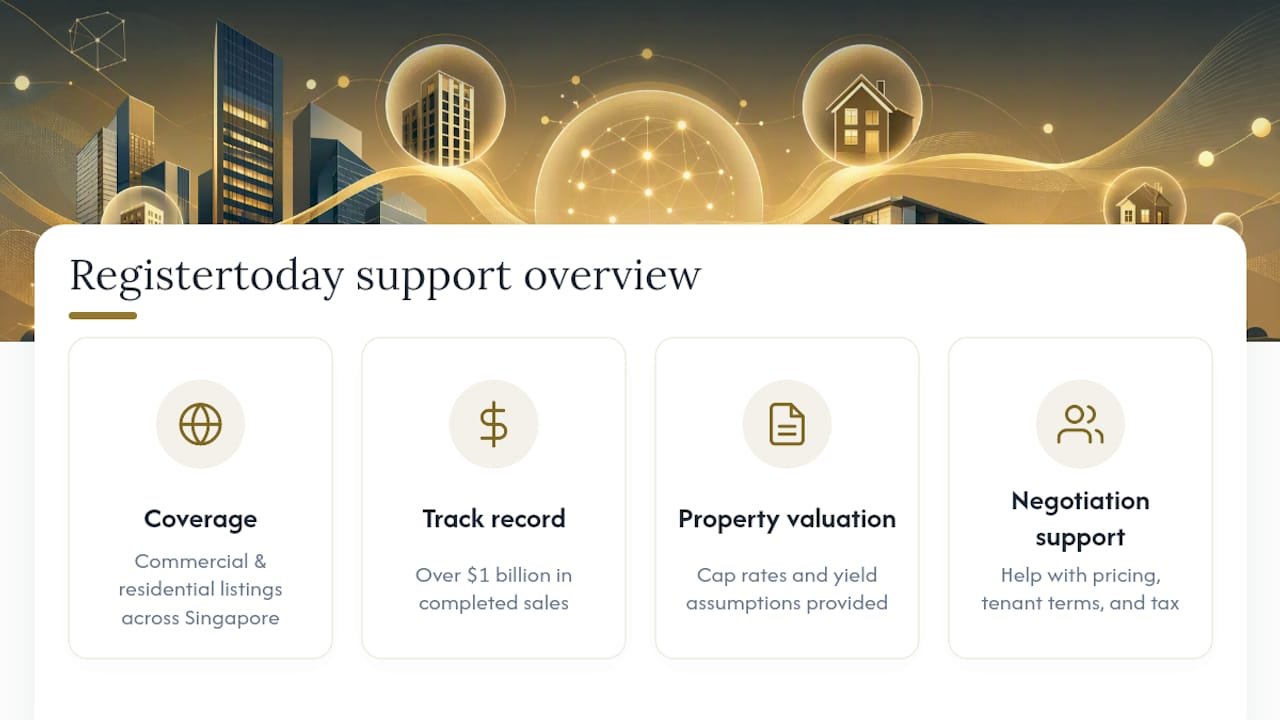
Registertoday lists both commercial and residential opportunities across Singapore, backed by over $1 billion in completed sales. Listings often come with a property evaluation service that helps buyers assess cap rates and yield assumptions before making an offer. Negotiation support may assist with pricing gaps, tenant terms, and potential tax implications on additional residential purchases, helping buyers understand true costs before committing capital.
Which asset class actually fits you
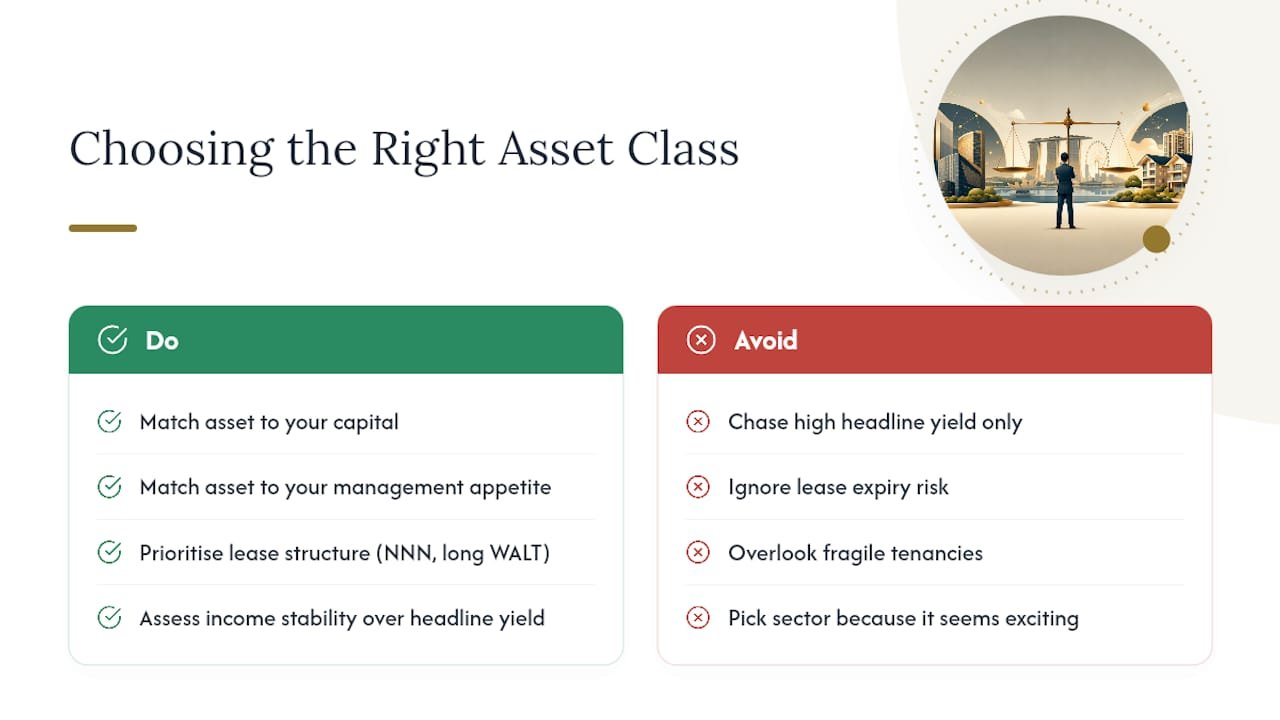
The comparison above points to a simple rule: match the asset to your capital and your appetite for hands-on management, not to whichever sector currently sounds more exciting.
One detail gets overlooked constantly. Buyers fixate on headline yield and skip the lease structure behind it. A commercial deal with a strong NNN lease and a long WALT can outperform a higher-yielding property with a fragile, soon-to-expire tenancy, because income stability matters more than the number on day one.
Next, see how Registertoday turns this decision into action.
— Anderson
Ready to act on your decision
Once you know whether commercial or residential fits your capital and risk appetite, the next step is seeing what is actually available and what it is genuinely worth. Registertoday gives you both in one place: a searchable property list covering commercial and residential stock across Singapore, and a free home valuation service that benchmarks your target price before you negotiate.

Negotiation support may assist in addressing pricing gaps and structuring purchases to manage tax exposure on additional residential buys. You can also browse past closed deals to see how pricing has moved on comparable properties. Search current listings now, or request a free valuation before you make an offer.
Sources
- A guide to Commercial real estate investing in Singapore
- Commercial vs. Residential Real Estate Investing
- MAS explainer — MSR and TDSR rules
FAQ
Is commercial property a good investment in Singapore?
It can be, particularly for investors with larger capital who want higher yields and want to avoid ABSD on additional residential purchases, but it carries longer vacancy risk and more complex financing than residential property.
What is the 2% rule for properties?
The 2% rule is a rough screening guide stating that monthly rent should be a meaningful fraction of the purchase price for a deal to look attractive on cash flow. It works better as a quick filter than a precise valuation tool, since actual viability depends on financing costs, lease terms, and local market conditions.
Is it worth buying a commercial property?
It is worth it for investors who can meet the larger deposit and stricter DSCR-based financing requirements, want longer lease terms, and are comfortable with tenant concentration risk and slower resale liquidity than residential property offers.
What is the difference between commercial and residential property?
Commercial property is leased to businesses on multi-year terms, often with NNN structures that shift running costs to tenants, while residential property is leased to individuals or families on roughly one-year terms with the landlord typically covering maintenance and tax.