


Option to Purchase in Singapore: What Buyers and Sellers Must Do
An Option to Purchase gives a buyer the exclusive right to buy a property at an agreed price within a fixed window, in exchange for a fee paid to the seller. For HDB resale flats, that window is 21 calendar days, the Option Fee sits between $1 and $1,000, and the form must be the HDB-prescribed one with no changes. Buyers should lock in financing before the clock runs out; sellers must have completed their Intent to Sell and cooling-off period before granting it.
TL;DR:
- The HDB resale OTP window lasts exactly 21 calendar days, with a strict expiry cutoff at 4pm on the final day, including weekends and holidays.
- The Option Fee must be between $1 and $1,000, and combined with the Option Exercise Fee cannot exceed $5,000, with payment confirmed via signed receipt.
- Before granting an OTP, sellers must meet the cooling-off period, register Intent to Sell, and ensure the buyer has valid HDB eligibility, all steps that cannot be skipped.
- Exercising the OTP requires paying the Option Exercise Fee and signing the document before the 4pm deadline to avoid forfeiting the Option Fee and losing exclusivity.
- Private property OTPs are negotiated individually without a prescribed form, making the review of contractual clauses and conditional terms crucial to avoid future disputes.
Table of Contents
- What is an Option to Purchase (OTP) in Singapore?
- Key terms and numbers to check on any OTP
- How does the OTP process work for HDB resale flats?
- How do private property OTPs differ from HDB’s?
- After you exercise the OTP: what happens next
- What happens if a party backs out or the OTP is invalid?
- Practical checklist before signing or accepting an OTP
- Author perspective: lessons from common OTP pitfalls
- How Registertoday helps you execute an OTP with fewer surprises
- Where to verify HDB rules and download the prescribed OTP form
- Sources
- FAQ
What is an Option to Purchase (OTP) in Singapore?
An Option to Purchase is a legal instrument, not a casual promise. It grants the buyer a unilateral right to buy the property at a fixed price, within a fixed period, provided the buyer pays the seller a sum of money called the Option Fee as consideration. This is a standard feature of option contracts in property law generally: they must be in writing, signed, and backed by real consideration to hold up if challenged, a principle that applies well beyond Singapore’s own rules.
Once signed, the seller cannot offer the flat to anyone else during the option period. That exclusivity is the entire point. The buyer is paying for time and certainty, not for the property itself yet.
For HDB resale flats specifically, the OTP must use HDB’s own prescribed form, obtained through the HDB Flat Portal. No agent or lawyer can add clauses, alter wording, or issue a supplementary agreement alongside it. This rigidity exists for a reason:
- It prevents undeclared side deals that could distort the declared resale price.
- It stops agents from inserting clauses that favour one party without both parties signing off through the proper channel.
- It gives HDB a single, consistent document to verify when processing the resale application.
Private property OTPs work differently, and that distinction trips up more buyers than almost anything else in the process. A prescribed HDB form has no equivalent in the private market, where each OTP is negotiated between the parties involved.
Key terms and numbers to check on any OTP
Before signing anything, check every field in the document against what was actually agreed verbally. Mismatches between the verbal agreement and the printed OTP happen more often than most buyers expect, particularly on price and expiry timing.
The fields that matter most: full names and NRICs of every buyer and seller (including co-owners), the exact purchase price, the date the option is granted, the exact expiry date and time, the Option Fee, and the Option Exercise Fee. For HDB resale transactions, these figures are capped by regulation rather than left to negotiation.
| Item | HDB resale limit |
|---|---|
| Option Fee | within a regulated range |
| Deposit (Option Fee + Option Exercise Fee combined) | Not exceeding $5,000 |
| Option period | 21 calendar days from grant |
| Expiry time | 4pm on day 21 |
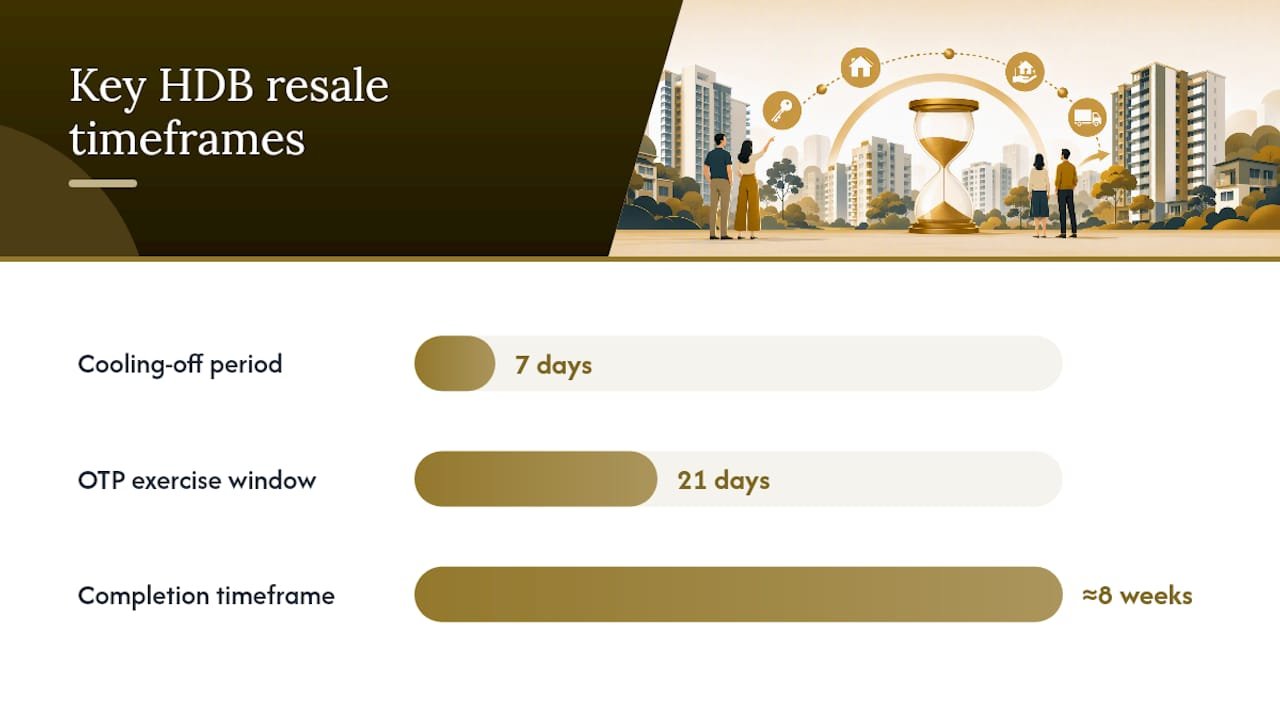
The 21-day count includes weekends and public holidays, so a Friday grant does not buy extra runway. HDB’s guidance is explicit that the option lapses at 4pm sharp on the 21st day, with no informal grace period.
Payment is usually made by cashier’s order or cheque, and both parties should keep a signed acknowledgement of receipt. This matters if a dispute ever arises over whether the Option Fee was actually paid on time.
Pro Tip: Don’t wait until the afternoon of day 21 to exercise. Bank processing, cheque clearance, and last-minute document checks can eat hours you don’t have when the deadline is a hard 4pm cutoff.
How does the OTP process work for HDB resale flats?
The sequence for HDB resale is fixed by regulation, and skipping a step can invalidate the whole transaction. Here is how it runs in practice.
- Seller registers Intent to Sell on the HDB Flat Portal and must then observe a mandatory 7-day cooling-off period before granting any OTP.
- Seller confirms Minimum Occupation Period (MOP) has been met. Granting an OTP before MOP is fulfilled produces a transaction HDB will not recognise.
- Buyer secures a valid HFE letter (HDB Flat Eligibility letter) before the OTP is granted. Without it, the seller should not proceed.
- Seller grants the OTP on the prescribed form, collects the Option Fee, and both parties sign.
- Buyer arranges financing during the 21-day window, ideally securing a bank Letter of Offer if using a home loan, or confirming CPF and cash arrangements otherwise.
- Buyer exercises the OTP by paying the Option Exercise Fee before the 4pm deadline on day 21, bringing the combined deposit up to the agreed cap.
- Both parties submit their resale application to HDB within the agreed timeframes.
- Completion follows, typically within eight weeks of HDB accepting the resale application, unless both parties jointly request an extension.
The HFE letter requirement runs through two checkpoints, not one: buyers need it valid when the OTP is granted, and again when the resale application is submitted. Letting it lapse in between is a common, avoidable hold-up.
Pro Tip: If you’re financing through a bank, apply for your Letter of Offer the moment the OTP is signed, not after you’ve shopped around for the best rate. Rate comparison can happen before you commit to a flat; the 21-day window is not the time for it.
How do private property OTPs differ from HDB’s?
Private property transactions have no single government-issued form. Each OTP is drafted, usually by the seller’s lawyer or the developer, and its terms are open to negotiation in a way HDB’s version is not.
That flexibility cuts both ways. It lets buyers and sellers agree on option periods longer or shorter than 21 days, structure deposits differently, and negotiate price adjustments tied to conditions. It also creates far more room for a poorly worded clause to cause real damage later.
Watch for these features when reviewing a private OTP:
- Option period length, which is commonly two to three weeks for resale private property but can vary considerably.
- Price fixation clauses, especially where a loan quantum or valuation condition affects the final figure.
- Re-issuing or extension policies, which some sellers build in and others explicitly exclude.
- Developer-specific procedures for new launches, including balloting systems and standard operating procedures that differ from resale norms.
- Conditional clauses, such as the sale being subject to the buyer selling an existing property first.
Ambiguous dates and loosely worded conditional clauses cause the most disputes in private transactions. A tailored legal review before signing is not optional caution here; it is the only real safeguard, since there is no prescribed form protecting either party by default.
After you exercise the OTP: what happens next
Exercising the OTP is not the finish line. It triggers a tight sequence of financing, legal, and administrative steps that both parties need to move through in step.
Confirm your financing position before you exercise, not after. If you’re using a bank loan, have the Letter of Offer in hand; if you’re paying with CPF savings and cash, confirm the exact breakdown with your solicitor. Once exercised, backing out because financing fell through will not undo the contract.
- Engage a conveyancing lawyer immediately if you haven’t already, since they handle the resale application submission and title checks.
- Confirm stamp duty obligations, which apply to the buyer and are calculated on the purchase price, following IRAS guidance.
- Submit your portion of the resale application to HDB within the agreed window, since delays on either side can push back the whole timeline.
- Keep copies of every signed document, receipt, and correspondence in one place.
Completion typically falls within eight weeks of HDB accepting the resale application. Both parties can jointly request an extension if genuinely needed, but HDB does not grant this unilaterally to one side.
The eight-week window feels generous until you’re three weeks in and still waiting on a bank valuation report. Start every downstream task the day you exercise, not the day the resale application is accepted.
What happens if a party backs out or the OTP is invalid?
Consequences differ sharply depending on who backs out and why. Understanding the split protects you from assuming a fee will simply be refunded.
If a buyer lets the option lapse without exercising it, the Option Fee is forfeited to the seller, and the seller is then free to list and grant an OTP to someone else. There is no automatic refund mechanism for a buyer who simply changes their mind or misses the deadline.
If a seller has used a non-prescribed form, altered the HDB template, or granted the OTP before the cooling-off period or MOP was satisfied, the contract risks being declared invalid outright under the Housing and Development Act. Neither party can rely on an invalid document, regardless of what was verbally agreed.
- Keep every signed page, receipt, and dated communication from day one.
- If a dispute arises, a conveyancing lawyer can advise whether specific performance or damages is the realistic path.
- For genuine breaches, mediation through a lawyer is usually faster and cheaper than litigation before escalating further.
Practical checklist before signing or accepting an OTP
Run through this before any signature goes on the form.
- Sellers: confirm Intent to Sell is registered, the 7-day cooling-off period has passed, MOP is met, all co-owners have signed, and CPF/bank clearance timelines are understood.
- Buyers: confirm your HFE letter is valid, check the exact option period dates and 4pm expiry time, agree the payment method for the Option Fee, and get a signed acknowledgement of receipt.
- Both parties: agree in writing on anything outside the prescribed HDB fields, since the core form itself cannot legally be altered for resale transactions.
- Everyone: keep a dated file of the OTP, all receipts, correspondence, and financing documents in one place.
Pro Tip: Sellers unsure of a realistic asking price before granting an OTP should get an independent valuation first. Pricing too high stalls buyer interest; pricing too low leaves money on the table you can’t recover once the OTP is signed.
Author perspective: lessons from common OTP pitfalls
The mistakes that derail OTPs are rarely dramatic. A co-owner’s copy goes unsigned because everyone assumed someone else handled it. A buyer’s HFE letter quietly expires between grant and resale submission because nobody diarised it. These small gaps cause real financial pain, and they’re entirely preventable with basic document tracking.
What’s underappreciated is how much of the OTP process is really a paperwork discipline problem, not a legal complexity problem. The rules themselves are clear. Where transactions fail is in coordination, missed deadlines, unclear valuations, and documents that don’t match what was verbally agreed.
Platforms that centralise valuation and negotiation support address exactly this gap, giving sellers a realistic price before granting an OTP and keeping documentation organised through to completion.
— Anderson
How Registertoday helps you execute an OTP with fewer surprises
Registertoday is the alternative to juggling agents, spreadsheets, and paper files separately during an OTP transaction. Sellers get a home valuation before they grant an OTP, so pricing is grounded in real market data rather than guesswork, and negotiation support that keeps offers moving without the back-and-forth delays that eat into the 21-day window.

Because Registertoday also structures deals to help investors avoid Additional Buyer’s Stamp Duty where eligible, buyers exploring resale or investment purchases get a clearer view of the true cost before they commit an Option Fee. Document handling, enquiries, and negotiation threads sit in one place rather than scattered across calls and messages, which matters most in the fortnight after an OTP is exercised, when financing and paperwork deadlines stack up fast.
If you’re preparing to grant or exercise an OTP, browse current property listings or get a home valuation started today to see where your transaction stands before you sign anything.
Where to verify HDB rules and download the prescribed OTP form
Check these sources directly rather than relying on secondhand summaries, since HDB updates procedural notes periodically.
- The HDB Option to Purchase page covers the full resale process, fees, and deadlines.
- The Important Notes on OTP PDF sets out the prescribed form requirements and prohibitions on amendments.
- HDB’s seller-side guidance explains Intent to Sell, cooling-off, and MOP obligations in full.
- For private property clauses, Singapore Legal Advice’s OTP guide is a useful starting point before engaging a lawyer.
Sources
- Option to Purchase When Buying a Resale Flat
- Important notes on Option to Purchase (OTP) — HDB PDF
- Option to Purchase — HDB guidance (seller prerequisites)
- Option to Purchase — HDB guidance (resale application and completion)
FAQ
How much should you pay for an Option to Purchase?
For HDB resale flats, the Option Fee ranges from $1 to $1,000, and the combined deposit (Option Fee plus Option Exercise Fee) cannot exceed $5,000. Private property Option Fees are negotiated and vary by transaction.
Can a seller withdraw after granting an OTP?
No. Once an HDB seller grants the OTP and accepts the Option Fee, they cannot sell to another party or withdraw during the 21-day option period; doing so would breach the contract.
How long does it take from OTP to completion?
For HDB resale, completion is typically within eight weeks of HDB accepting the resale application, though both parties can jointly request an extension if needed.
How do you exercise an OTP?
You exercise an OTP by signing it and paying the Option Exercise Fee to the seller before the expiry deadline, which for HDB resale flats is 4pm on the 21st calendar day after it was granted.
What happens if you let an OTP expire without exercising it?
The Option Fee is forfeited to the seller, the contract lapses, and the seller becomes free to grant an OTP to a different buyer.