

LTV Limits Singapore Buyers Face: 75% First Loan, 45% Second
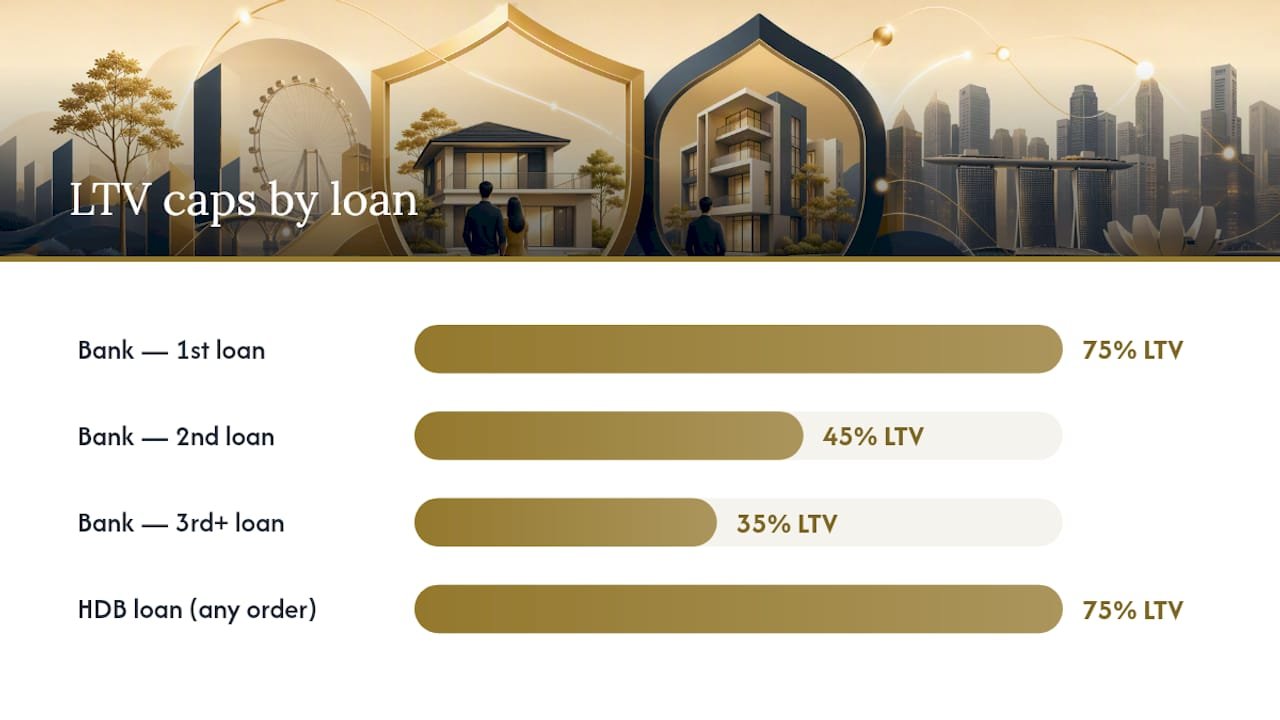
The maximum loan-to-value ratio for a first housing loan in Singapore is 75%, whether you borrow from HDB or a bank regulated under MAS rules. Long loan tenures, older borrowers, and lender affordability checks such as TDSR can push your real borrowing limit lower still.
TL;DR:
- Borrowers should be aware that LTV limits decline significantly for second and subsequent loans, with a cap of 45% for second loans and 35% for third or more.
- Loan tenure over 30 years or extending beyond age 65 reduces the maximum LTV, often forcing buyers to provide more cash or CPF to cover shortfalls.
- Affordability assessments like TDSR and MSR can lower the actual usable loan amount, even if the LTV ceiling is technically met.
- Calculating the real cash and CPF needed involves determining the LTV tier, the lower of asking price or valuation, and running serviceability checks before making an offer.
- Borrowers should consider market valuation and potential risks of borrowing near the maximum LTV, especially in a rising interest rate environment.
Table of Contents
- LTV limits Singapore: the current MAS and HDB rules explained
- How tenure and borrower age change the LTV you can actually get
- How LTV fits with TDSR, MSR and lenders’ credit assessments
- Practical steps and a worked example: calculating the cash and CPF you need
- Practical trade-offs and investor cautions in Singapore
- Plan your purchase within your real LTV budget
- Sources
- FAQ
LTV limits Singapore: the current MAS and HDB rules explained
The Monetary Authority of Singapore sets LTV ceilings that scale down with each additional outstanding housing loan. This tiered structure exists precisely to cool speculative borrowing without shutting genuine owner-occupiers out of the market, and it has shifted several times since 2009 as MAS macroprudential policy responded to market conditions.
For bank loans, the current tiers work like this:
- First housing loan: up to 75% LTV, provided tenure and age thresholds aren’t breached
- Second housing loan: capped at 45% LTV
- Third or subsequent housing loan: capped at 35% LTV
- Mortgage equity withdrawal loans (MWL): subject to separate, generally lower caps depending on existing loan count
HDB loans work differently. The maximum is a flat 75% of the purchase price or valuation, whichever is lower, and this applies regardless of whether it’s your first flat, subject to the HDB Flat Eligibility (HFE) letter process that determines your loan eligibility upfront. That HFE letter isn’t a formality. It tells you your loan ceiling before you commit to a flat, which matters far more than most first-time buyers realise until they’re already in negotiations.
Minimum cash downpayment scales inversely with LTV. This is the single most overlooked consequence of owning multiple properties: it isn’t just the Additional Buyer’s Stamp Duty that bites, it’s the shrinking loan ceiling itself.
How tenure and borrower age change the LTV you can actually get
LTV isn’t fixed once you know your loan count. Tenure and age push it lower still, and this catches out more buyers than the headline percentages suggest.
MAS applies a reduced LTV whenever loan tenure exceeds 30 years for private property or 25 years for HDB flats, or when the loan period extends beyond the borrower’s age of 65.
Joint applications complicate this further. Lenders use a weighted average age across co-borrowers to determine maximum tenure, so pairing a 60-year-old parent with a 30-year-old child doesn’t simply average out to a young borrower’s terms. The weighting can quietly trigger the reduced-LTV threshold even when one applicant is decades from retirement.
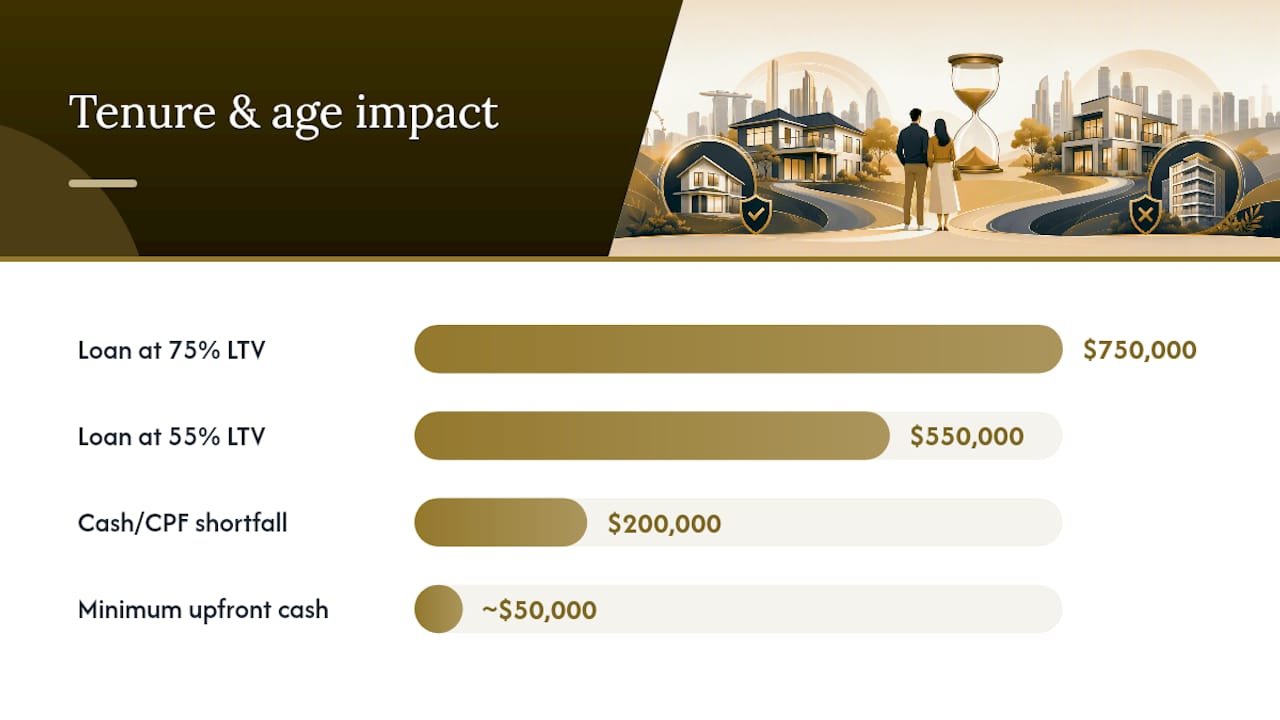
Here’s how the numbers actually play out for a $1,000,000 private property:
- Tenure kept under 30 years, borrower under 65 at maturity: 75% LTV, loan of $750,000, minimum cash of roughly $50,000
- Tenure exceeds 30 years or extends past age 65: LTV drops to 55%, loan falls to $550,000
- The $200,000 shortfall must be found in cash or CPF, on top of stamp duties and legal costs
Pro Tip: Before shortlisting a tenure length with your mortgage broker, check your age at loan maturity first. Shaving two or three years off tenure to stay under the 65 threshold can preserve tens of thousands of dollars in borrowing power.
How LTV fits with TDSR, MSR and lenders’ credit assessments
LTV tells you the maximum loan as a percentage of price or valuation. It doesn’t tell you whether you can actually service that loan, and that’s where affordability rules take over.
For HDB flats and executive condominiums bought with a bank loan, the Mortgage Servicing Ratio applies an additional, tighter cap of 30% of gross income specifically for property loan repayments, as MoneySense explains. Both tests run independently of LTV, and either one can shrink your usable loan well below the LTV ceiling.
Lenders then layer on their own credit assessment, which commonly reduces the offer further based on:
- Existing unsecured debt, car loans, and credit card balances
- Variable or commission-based income, which banks often discount
- Credit bureau history and any prior loan defaults
- The specific bank’s internal risk appetite for your income profile
This is why two buyers with identical LTV entitlements can walk away with very different loan offers. A detailed breakdown of TDSR mechanics is worth reading before you make assumptions about what you can borrow. Getting an in-principle approval from a bank, as DBS recommends, confirms your real number before you pay an option fee you can’t get back.
Practical steps and a worked example: calculating the cash and CPF you need
Work through these steps before you make an offer on any property:
- Identify your LTV tier based on the number of outstanding housing loans you’ll have after this purchase
- Confirm the lower of purchase price or bank valuation, since LTV applies to whichever figure is smaller
- Multiply that figure by your LTV percentage to get your maximum loan quantum
- Calculate the downpayment gap and confirm the minimum cash portion required
- Run TDSR and MSR checks against your income to confirm the loan is actually serviceable, not just permitted
A worked example makes this concrete. On a $900,000 private condominium bought as a first home, with tenure kept under 30 years, the 75% LTV cap gives a maximum loan of $675,000. For an HDB resale flat at $500,000, the 75% HDB LTV gives a maximum loan of $375,000, leaving $125,000 to fund through cash and CPF.
Before signing anything, gather your latest income documents, CPF statements, and existing loan records, and use an advanced property search alongside a home valuation check to see whether the asking price is likely to match what a bank will actually value the unit at. A valuation shortfall is one of the most common reasons buyers scramble for extra cash at the eleventh hour.
Practical trade-offs and investor cautions in Singapore
Maximising your LTV isn’t always the smart move. Borrowing to the ceiling leaves no margin if interest rates climb, and stretching tenure to preserve a higher LTV can trap you against the age-65 threshold later. A grounded market evaluation, the kind Register Today’s team runs against comparable transactions, helps match your property choice to what you can realistically finance rather than what a listing price suggests you can afford.
— Anderson
Plan your purchase within your real LTV budget
Our platform gives you a direct route to properties that fit inside your actual borrowing limit, not just the asking price on a listing. Its home valuation tool checks likely valuation against asking price before you commit to an option fee, which matters far more once you know how sharply LTV falls for a second or third loan.

The team’s sold properties record reflects over $1 billion in completed transactions, built on negotiated outcomes rather than listed prices alone. The platform also features deals designed to help investors avoid Additional Buyer’s Stamp Duty, which changes the maths on financing a second or third property considerably. Browse the current property listings or reach out for a tailored evaluation before you make an offer, so your financing plan and your property choice are aligned from the outset.
Sources
Check MAS’s macroprudential policy pages for the exact current LTV tiers, HDB’s housing loan page for flat eligibility and the HFE process, and MoneySense for TDSR and MSR affordability calculators. HDB-bound buyers should start with the HDB page; private property buyers should start with MAS.
- Macroprudential policies in Singapore — MAS
- Housing loan from HDB — HDB
- Buying a property: how much can you afford? — MoneySense
- All about home loans — DBS
FAQ
What is the maximum LTV for a first housing loan in Singapore?
The maximum is 75% of the purchase price or valuation, whichever is lower, for both HDB loans and a first bank housing loan under MAS rules.
How do I check my LTV for a second property in Singapore?
Confirm your outstanding loan count first, since a second housing loan caps LTV at 45%; a mortgage broker or a home valuation check can confirm the exact figures against a specific property.