
Rent in Singapore 2026: Mid $3,000 Condos, 3 Months Upfront
A room in a shared flat typically runs from about the low hundreds to mid-thousands of dollars a month, an HDB whole flat from around two to three thousand dollars, and a private condo from low thousands for a studio up to several thousands for a two-bedroom unit. Property type and location, specifically whether you’re in the Core Central Region, Rest of Central Region, or Outside Central Region, drive most of that spread. Budget for a heavier cash outlay in month one, since deposits and advance rent add to the quoted monthly figure.
TL;DR:
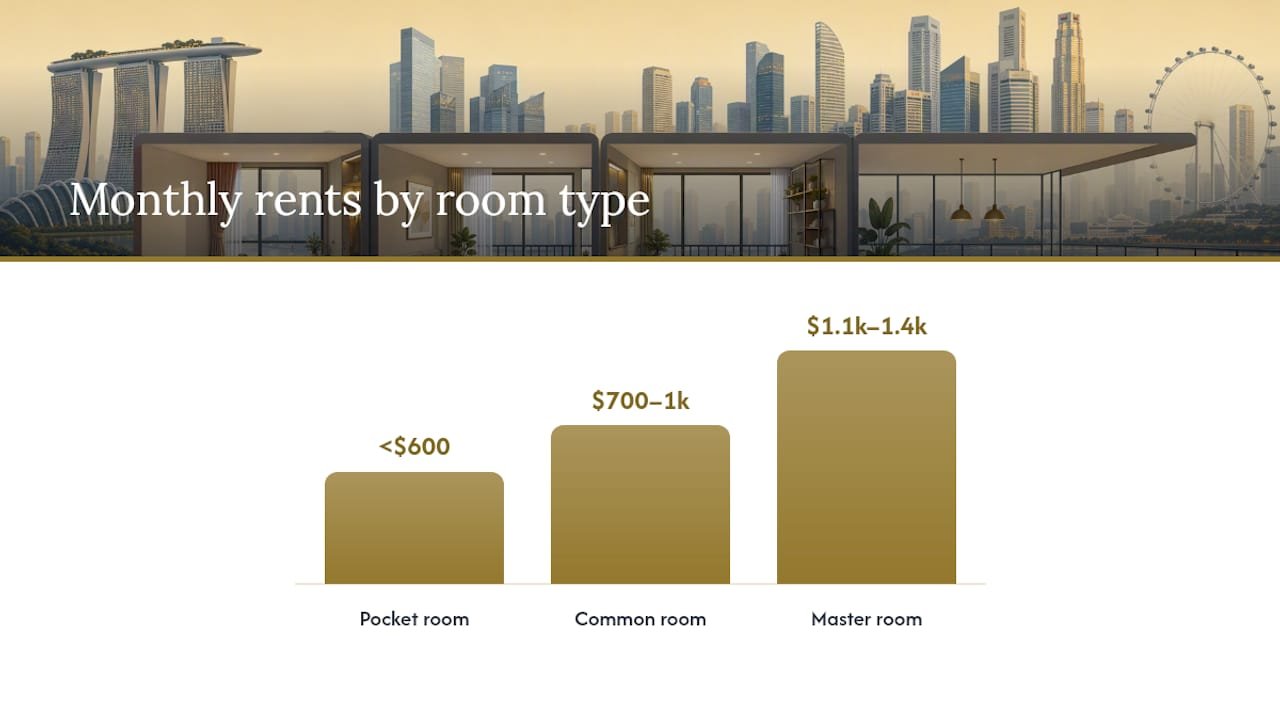
- Renting a room in Singapore can range from under $600 for a small pocket room to over $1,400 for a well-located master with amenities, depending on furnishings and location.
- HDB flats typically rent for over $2,200 for a 3‑room in non-mature estates, and up to $3,200 or more for larger flats in mature neighborhoods; premiums apply for prime locations.
- Private condos start around $2,800 for a studio and can go above $5,500 for a 2-bedroom, with land scarcity driving higher prices for landed estates.
- Location differences between the Core Central Region and Outside Central Region can significantly lower rent costs by several hundred dollars, with moving one MRT stop out often making a big difference.
- Initial costs beyond rent usually include deposits, advance rent, utility deposits, agent fees, and possible stamp duty, which can double or triple the monthly rent cost upfront.
Table of Contents
- Typical monthly rents by property type in Singapore
- How much does location change the rent?
- What upfront costs should you budget beyond rent?
- What are the tenancy rules you need to know?
- Simple ways to lower your monthly rent
- How Registertoday supports renters through the search
- A quick note on the numbers
- Ready to find a rental that fits your budget?
- Sources
- FAQ
Typical monthly rents by property type in Singapore
Room rentals sit at the affordable end of the market, and the range within that category is wide enough to catch first‑time renters off guard. A pocket room, often windowless and barely fitting a single bed, can go for under $600 in an older estate. A standard common room typically lands between $700 and $1,000, while a master room with an ensuite bathroom pushes past $1,100 and sometimes touches $1,400 in a well‑located condo. Furnishings, air conditioning, and proximity to an MRT station explain most of the variation between two rooms that look identical on a floor plan; renters should consider insights from a fully furnished rental property Singapore guide to understand furnished rental considerations and common tenancy charges.
HDB whole flats remain the backbone of rental housing for local families and long‑staying expats who don’t need a private condo’s facilities. Community‑reported figures put the median rent for an HDB whole unit at around the upper two-thousands of dollars as of April 2026, though the actual figure depends heavily on flat size and estate. A 3‑room flat in a non‑mature estate can rent for under $2,200, while a 5‑room flat in a mature town such as Bishan or Toa Payoh regularly clears $3,200. HDB’s rental statistics break these medians down by town and flat type, and they’re worth checking before you commit to a viewing.
Private condos sit at the top of the market, but the gap between a studio and a family‑sized unit is enormous.
- Studio or 1‑bedroom condo: roughly $2,800 to $3,800, with older or smaller developments at the lower end and new launches near the CBD pushing higher.
- 2‑bedroom condo: typically $4,000 to $5,500, depending on district and building age.
- Landed property (terrace or semi‑detached): usually $6,000 upwards, reflecting land scarcity rather than square footage alone.
- Serviced apartments: a premium alternative for short stays, often 20–40% above equivalent unfurnished condos but bundling utilities and housekeeping.
- Co‑living spaces: priced closer to room rentals, often $900 to $1,600, and increasingly popular with young professionals who want flexibility without hunting for flatmates.
The overall condo median sits near the mid-three-thousands of dollars according to recent tenant‑reported data, which tracks close to what agents quote on the ground. That figure has been drifting upward too: industry reporting from August 2026 shows condo rents up about 2.5% year‑on‑year, with the Core Central Region and Rest of Central Region both edging higher month‑on‑month despite a typical seasonal lull.
How much does location change the rent?
Singapore’s rental market splits into three broad zones, and each one carries its own price band. The Core Central Region (CCR) covers Orchard, Marina Bay, and the prime districts closest to the CBD, and commands the highest rents in the country. The Outside Central Region (OCR) covers everything further out, including Ang Mo Kio, Bedok, and Serangoon, and offers the most affordable rental rates Singapore has to offer without sacrificing MRT access.
Real numbers make the gap concrete. A 2‑bedroom condo in Tanjong Pagar (RCR) might list several thousand dollars, while a similarly specced unit a few MRT stops away in Bedok (OCR) could rent for noticeably less. HDB rents follow the same pattern at a smaller scale:
- Ang Mo Kio (OCR): 4‑room flats often rent for $2,400 to $2,800.
- Bedok (OCR): similar flat types average slightly lower, reflecting its distance from the city core.
- Serangoon (RCR‑adjacent): rents run a touch higher due to its proximity to newer malls and the Circle Line.
- Orchard and Tanjong Pagar (CCR/RCR): condo studios rarely dip below $3,200, even for older stock.
Analysis of listing data shows location is the single biggest lever most renters can pull. Moving one MRT stop out, or shifting from CCR to RCR, often shaves several hundred dollars off the monthly figure without adding meaningfully to a daily commute. If your workplace sits near Raffles Place, for instance, renting in Tanjong Pagar rather than directly in the CCR can mean a shorter walk to the office than a CCR unit further from a station, at a lower price.
What upfront costs should you budget beyond rent?
The quoted monthly rent is never the full cash outlay you need on hand when signing a lease. Landlords in Singapore follow fairly consistent conventions, and knowing them in advance avoids an unpleasant surprise at the signing table.
- Security deposit: one month’s rent for a 1‑year lease, two months’ rent for a 2‑year lease, refundable at the end subject to no damage or outstanding bills.
- Advance rent: the first month is almost always paid upfront alongside the deposit, before you receive the keys.
- Utility deposit: SP Group typically requires a deposit of $200 to $600 depending on property size, refunded once you close the account or transfer it out.
- Stamp duty: payable by the tenant on the signed tenancy agreement, calculated on total rent for the lease term, though many landlords absorb this as a gesture in a tenant’s market.
- Agent commission: usually half a month’s rent for a 1‑year lease, paid by the tenant, though co‑broking arrangements can shift or reduce who owes what.
Pro Tip: Ask upfront whether the landlord’s agent and your agent are co‑broking. In some arrangements, the landlord’s side covers the full commission, saving you a half‑month’s rent.
A worked example makes the scale clearer. For a 2-bedroom condo at around four thousand dollars a month on a 1-year lease, expect deposits, advance rent, utilities, and agent commission to add substantially, potentially more than doubling the advertised monthly figure for initial move-in costs. Guidance for foreigners renting in Singapore suggests budgeting more than three months’ rent as an initial buffer once every cost is stacked together.
What are the tenancy rules you need to know?
Most landlords in Singapore prefer a 1‑year or 2‑year lease, and a longer term often comes with a modest discount because it reduces vacancy risk for the owner. Shorter leases, particularly under six months, tend to carry a premium and are harder to find outside serviced apartments and co‑living operators.
- HDB whole‑flat rentals require the tenant to be a Singapore citizen or permanent resident for most arrangements, with additional approval needed for subletting to foreigners on certain passes.
- Room rentals in HDB flats are more flexible and widely available to foreigners on Employment Passes, S Passes, or student visas, subject to the flat owner’s own eligibility to sublet.
- Private condos and landed property carry no nationality restriction, making them the default choice for expats who don’t qualify for HDB rental schemes.
- Notice periods typically run one to two months and should be spelled out clearly in the tenancy agreement before signing.
Pro Tip: Always check that a property agent is registered with the Council for Estate Agencies before handing over any deposit. A quick search on the CEA public register takes under a minute and can save you from an unlicensed operator.
Simple ways to lower your monthly rent
Sharing is the fastest lever available. Splitting a 2‑bedroom condo between two tenants can bring the per‑person cost closer to a single room’s rent while giving each person more living space. Choosing a mature OCR estate over a CCR address, as covered above, routinely saves several hundred dollars without a meaningful commute penalty.
- Sign a 2‑year lease if you’re confident about staying; landlords preferring longer stability often shave 3–5% off the monthly rate.
- Ask about unfurnished units, which typically rent lower than furnished ones once you factor in the cost of buying your own furniture over a longer stay.
- Consider a slightly older building over a new launch in the same postal district.
- Negotiate directly on renewal rather than waiting for the landlord to hand you a fixed increase.
Pro Tip: Never compromise on natural light, water pressure, and mobile signal strength during a viewing. These are near‑impossible to fix after signing, unlike cosmetic issues such as paint or fittings.
How Registertoday supports renters through the search
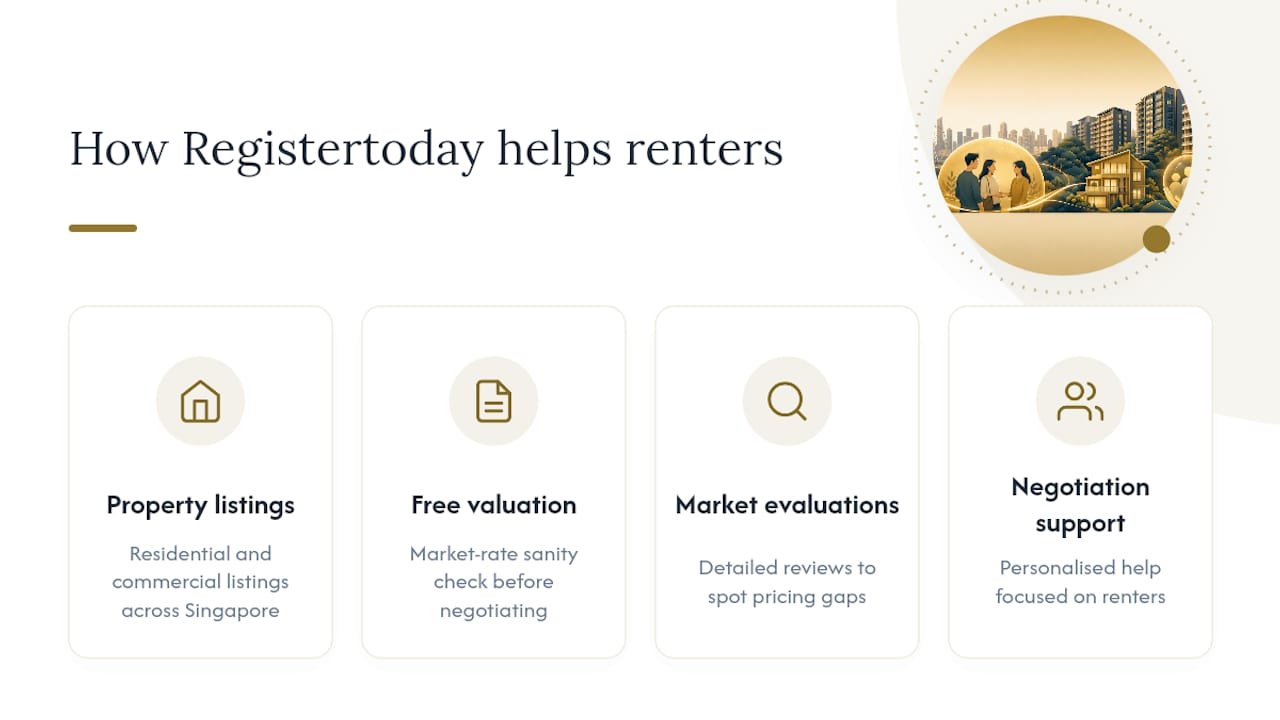
Registertoday lists residential and commercial properties across Singapore and offers a free property valuation service, useful for renters who want a market‑rate sanity check before negotiating. The platform’s approach includes detailed market evaluations designed to spot pricing gaps, alongside personalised negotiation support for people finding a rental rather than only buyers and sellers. That combination can save time and reduce the risk of overpaying, though every tenant should still confirm final terms, deposit conditions, and lease length directly with the landlord or agent before signing.
A quick note on the numbers
Every average in this guide hides real variation between individual buildings and even individual floors. The HDB medians and tenant‑reported figures cited throughout are a solid starting point, not a guarantee of what you’ll pay on any given street. Before committing to anything, check the HDB’s market rental rate e‑service for the specific town you’re considering, and cross‑reference against current listings rather than a report that’s already a few months old.
— Anderson
Ready to find a rental that fits your budget?
Comparing dozens of listings across HDB towns and condo districts eats hours you probably don’t have, especially if you’re juggling a job search or a relocation deadline. Various online platforms provide places to search residential listings across Singapore, often backed by market evaluations that flag when a unit is priced above or below its neighbourhood’s going rate.
If you already have a specific unit in mind, or you’re negotiating a renewal and want to know whether the asking rent is fair, request a free property valuation before you sign anything. Renters weighing up whole flats against condos can also browse current residential listings directly, or head to the Registertoday homepage to get in touch with an advisor about a specific neighbourhood or budget.
Sources
- Singapore Rent report — April 2026
- How much does it cost to rent in Singapore? A data‑backed guide (Cove)
- Condo rents up 2.5% in August despite Ghost Month volume pullback — SBR
FAQ
Is $3,000 a month good for rent in Singapore?
A monthly rent around $3,000 comfortably covers a 1-bedroom or small 2-bedroom condo in the OCR, or a good HDB whole flat in most towns. It’s on the lower side for a 2‑bedroom condo in the RCR or CCR, where rents often start closer to $4,000.
Is a 70,000 SGD annual salary good in Singapore?
An annual salary sufficient to cover typical living costs comfortably supports renting an HDB flat or a modest condo. It becomes tighter if you’re aiming for a private condo in the Core Central Region alongside other financial commitments like loans or family support.
Can I find a room for rent in Singapore for $300 a month?
A room under $600 a month is possible but uncommon; most basic pocket rooms in older estates start around that figure, with standard common rooms typically between $700 and $1,000.
What salary do you need to live comfortably in Singapore?
Monthly income needs vary widely depending on rental type, with single renters budgeting more for whole units and couples or sharers able to split costs effectively. Couples or sharers can stretch a similar household income further by splitting a 2‑bedroom condo or HDB flat.
Is it cheaper to rent or buy in Singapore?
Renting almost always requires less upfront cash than buying, since a purchase involves a downpayment, legal fees, and potentially the Additional Buyer’s Stamp Duty for certain buyers. For those exploring ownership without that ABSD burden, it’s worth reviewing options through Registertoday, which specialises in structuring purchases that avoid that cost.