

4 SORA fact sheet checks to pick fixed or floating loans in Singapore
Fixed home loans suit buyers who want certainty and plan to stay put; floating loans suit those who can absorb rate swings or expect to refinance or sell within a few years. Neither is universally better. The right choice depends less on the headline rate and more on the lock-in period, the spread mechanics, and what the Residential Property Loan Fact Sheet actually discloses about your total repayment.
TL;DR:
- Fixed-rate loans are better for buyers planning to stay long-term and seek stable monthly payments, while floating rates suit those comfortable with rate fluctuations over short periods.
- The decision should be based on your expected holding period, with short-term owners preferring floating options and long-term buyers favoring fixed rates for certainty.
- Always review the full fact sheet, focusing on the effective interest rate, reset mechanics, and penalty conditions, rather than just the advertised headline rate.
- Stress-test your loan by simulating rate increases to ensure higher repayments do not severely impact your financial stability.
- Obtaining a free property valuation before choosing a loan helps ensure you base your decision on fair market value and negotiate better terms.
Table of Contents
- What fixed and floating home loans mean in Singapore
- How to decide which is better for you
- Comparing loan packages: fact sheet, EIR, and reset mechanics
- What happens when your fixed period ends
- Stress-testing your repayments: a practical scenario guide
- Cushioning higher repayments: practical risk management
- Credit score and eligibility: how they shape your choice
- Fees and charges when switching or refinancing
- Tax and government incentive considerations
- Where Register Today fits into your financing decision
- Get a free valuation before you lock in a rate
- Sources
- FAQ
What fixed and floating home loans mean in Singapore
A fixed-rate home loan keeps your interest rate unchanged for a set period, often a few years, so your monthly instalment stays the same regardless of what happens in the broader rate environment. Once that fixed period lapses, the loan commonly reverts to a floating structure, and banks are required to give you a Residential Property Loan Fact Sheet that shows the lock-in period, the rate schedule, and illustrations of what happens if rates move.
Floating (or variable) loans work differently. The rate is built from a reference benchmark plus a bank spread, and that reference moves with the market. In Singapore, the dominant public benchmark is now the Singapore Overnight Rate Average, but “floating” doesn’t automatically mean SORA.
- SORA-pegged loans track a compounded average of the benchmark, adjusted at set intervals.
- Bank-administered rate loans use an internal board rate the bank can adjust at its own discretion, subject to disclosure rules.
- Two floating packages can carry the same spread yet expose you to very different risk, depending on which reference sits underneath.
Buyers using an HDB loan face a separate structure entirely, pegged to the CPF Ordinary Account rate rather than SORA, so the fixed-versus-floating debate mostly applies to bank loans. If you’re weighing an HDB loan against a bank loan, that distinction matters before you even get to fixed or floating.
How to decide which is better for you
Working out which loan is better starts with a simple question: how long do you expect to hold this loan without refinancing or selling? Answer that honestly and the rest of the decision gets much easier.
- Match the loan to your time horizon. If you plan to sell or refinance within two to three years, floating packages often come with shorter or no lock-in, giving you room to move without penalty. If you intend to stay for the long haul and want predictable budgeting, fixed offers that certainty.
- Run the affordability test using the full illustration. Don’t budget around the promotional first-year rate. The fact sheet shows a projected instalment for later years, and that’s the number that should fit comfortably into your finances.
- Check your buffer against MSR and TDSR headroom. If your Mortgage Servicing Ratio or Total Debt Servicing Ratio is already close to the ceiling, a floating loan’s potential rate increase could push you over it, which limits your future refinancing options.
- Read the prepayment and partial redemption terms. Some packages cap how much you can pay down each year without penalty, which matters if you’re planning to use bonuses or CPF top-ups to reduce principal early.
Pro Tip: Ask the bank to show you the instalment under both the current rate and a stressed scenario side by side. If the stressed figure makes you uncomfortable, that package probably isn’t the right fit, no matter how attractive the first-year rate looks.
Comparing loan packages: fact sheet, EIR, and reset mechanics
The advertised rate on a bank’s website rarely tells the full story. The number that matters more is the Effective Interest Rate, which MoneySense explains accounts for how interest compounds and when it’s charged, giving a truer picture of total cost than a flat promotional figure.
When you sit down with a fact sheet, work through it methodically:
- Lock-in versus fixed-rate period — these are not the same thing. The fixed period sets your rate; the lock-in period sets whether you pay a penalty to leave early.
- Effective Interest Rate and total repayment compared across at least two or three packages, not just the headline rate.
- Reset dates and notice periods for floating packages, so you know exactly when and how the rate can change.
- Floors and spread-change rights — some contracts let the bank adjust the spread under specific conditions, which MAS requires be disclosed clearly.
- Fees and penalties for early redemption, conversion, or partial prepayment.
Ask your loan officer directly whether the reference rate is public (SORA) or bank-administered, and ask them to point out where in the contract the bank retains discretion to change the spread. A private mortgage advisory can also help you cross-check terms if you want a second opinion before signing.
What happens when your fixed period ends
The end of a fixed-rate period isn’t the end of the loan. It’s a decision point, and it usually opens three paths: staying with the bank as the loan converts to floating, repricing to a new package with the same lender, or refinancing to a different bank entirely.
- Converting to floating happens automatically if you do nothing, and the rate that kicks in is disclosed in your original fact sheet.
- Repricing with your existing bank is often simpler and cheaper, since it may avoid a fresh valuation, though it usually resets your lock-in.
- Refinancing to another bank can secure a better rate but typically involves legal and valuation fees, and starts a new lock-in clock.
Some borrowers still hold older loans pegged to discontinued benchmarks like SIBOR. MoneySense’s guide on switching to SORA notes that fee-free, one-time conversion routes were made available during the transition, and that compounded SORA tends to move less erratically than the single-day benchmarks it replaced. Start reviewing your options three to four months before your fixed period ends. Rushed decisions in the final weeks rarely produce the best terms.
Stress-testing your repayments: a practical scenario guide
A package that looks affordable today can become uncomfortable fast if you haven’t checked how it behaves under stress. Running the numbers yourself takes twenty minutes and can save years of financial strain.
- Pull the fact sheet’s illustration table. It shows your instalment under the current rate and under at least one higher scenario.
- Simulate a one and two percentage point increase on top of the illustrated figures, and check whether your bank’s contract responds by raising the instalment, extending the tenure, or both. This detail changes your risk profile significantly.
- Add up your existing commitments against TDSR and, for HDB or EC purchases, MSR limits, factoring in CPF contribution caps that affect how much you can draw down.
- Watch for red flags such as a package with an unusually low first-year rate but a steep step-up in year two, or one where the fine print gives the bank wide discretion to adjust the spread without a capped ceiling.
If the stressed instalment eats a large share of your take-home income, that package carries more risk than the headline rate suggests.
Cushioning higher repayments: practical risk management
Buyers who weather rate rises comfortably tend to do a few things before they even sign.
- Build a liquid buffer covering roughly six months of instalments, kept outside CPF for quick access.
- Use partial prepayment strategically, checking the permitted annual amount and any penalty threshold first.
- Consider a split-package structure, part fixed and part floating, so you’re not fully exposed to one direction of rate movement.
- Ask the bank directly whether a rate rise triggers a higher instalment, a longer tenure, or a choice between the two.
Pro Tip: If you’re planning a property upgrade with an overlap period between selling and buying, look into how a bridging loan interacts with your new fixed or floating package, since the repayment timing can catch buyers off guard.
Credit score and eligibility: how they shape your choice
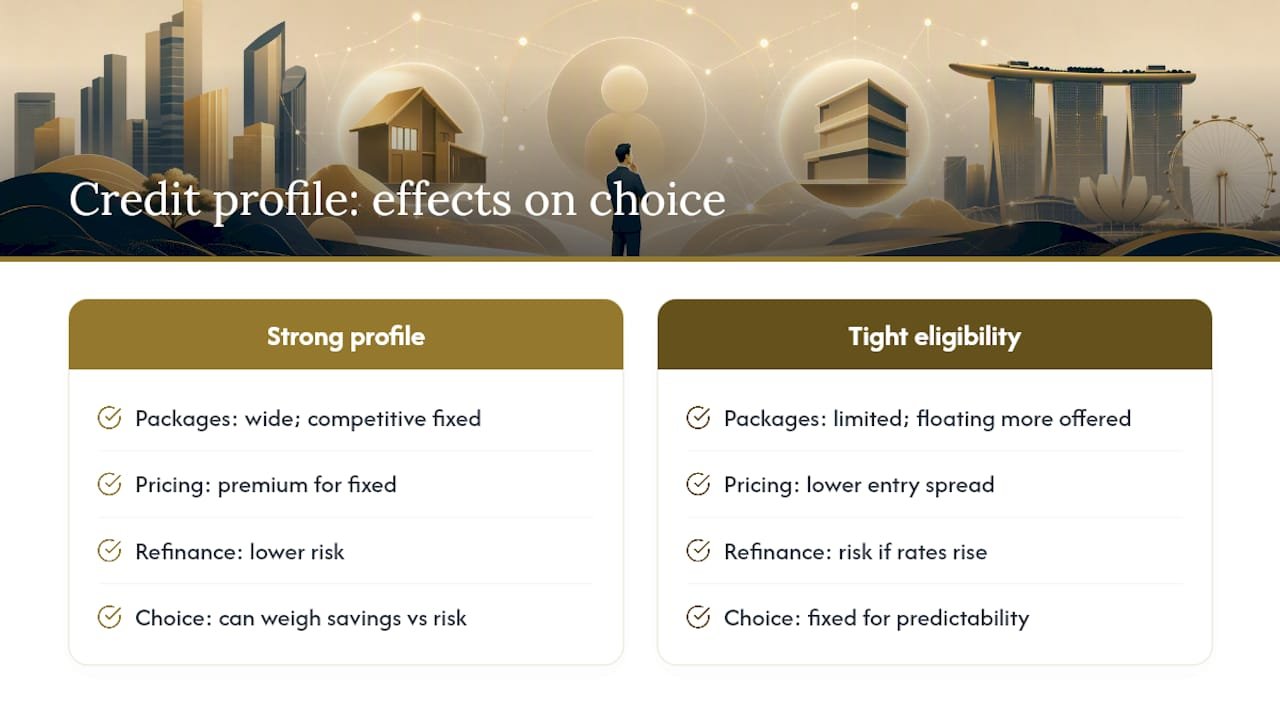
Your credit profile doesn’t just decide whether you get approved. It often decides which packages you’re even offered. Borrowers with strong credit history and comfortable TDSR and MSR headroom typically qualify for a wider spread of packages, including the most competitive fixed-rate offers, because banks price certainty at a premium for lower-risk borrowers.
Borrowers closer to their debt-servicing limits often find floating packages more accessible, simply because some banks price floating loans with a slightly lower entry spread. That’s not necessarily a bargain. If your eligibility is already tight, a floating loan’s potential rate increase could push a previously comfortable TDSR calculation past the ceiling at the next review, restricting your ability to refinance later.
This is where the loan officer’s assessment and your own stress test need to agree. A package you technically qualify for today isn’t automatically one you should hold for the full tenure. Buyers with thinner eligibility margins generally benefit more from the predictability of a fixed period, precisely because they have less room to absorb a shock. Those with stronger buffers have more genuine choice between the two, and can weigh potential savings against manageable risk rather than being pushed toward one option by eligibility constraints alone.
Fees and charges when switching or refinancing
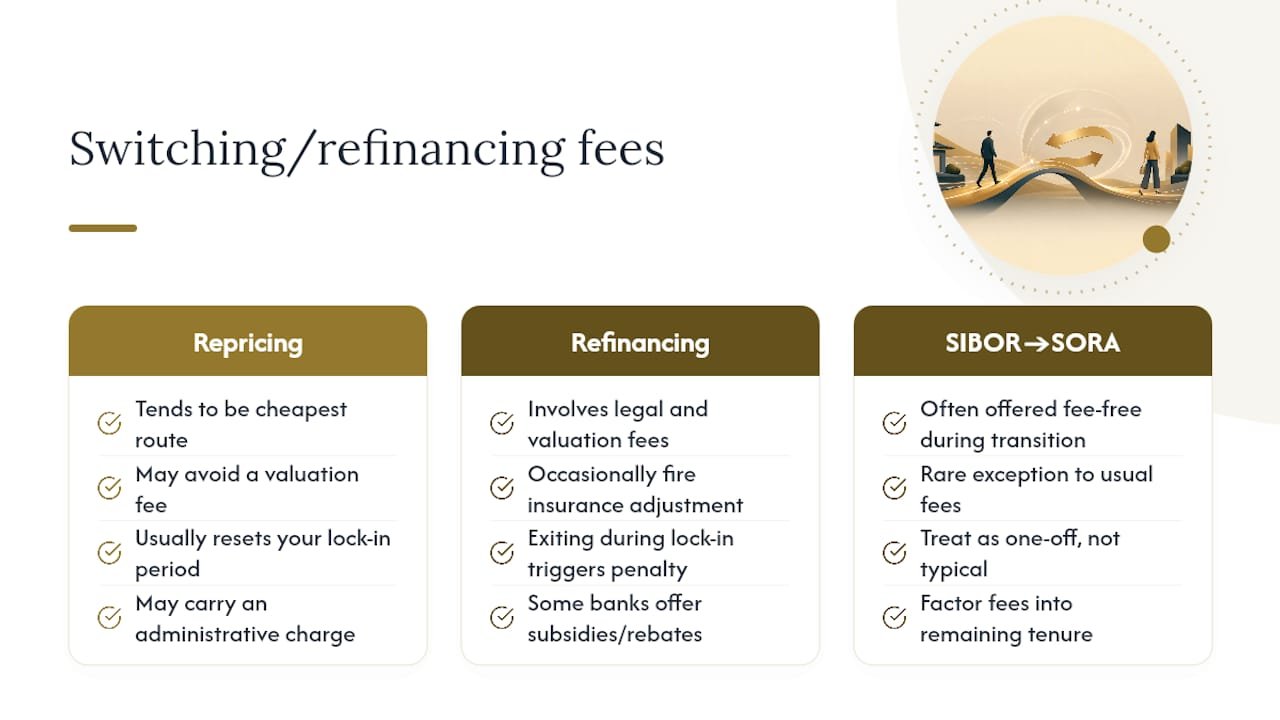
Moving between fixed and floating, or between banks entirely, rarely costs nothing. Repricing with your existing bank tends to be the cheapest route, sometimes avoiding a fresh valuation fee, but it usually resets your lock-in period and may carry an administrative charge.
Refinancing to a new lender typically involves a legal fee, a valuation fee, and occasionally a fire insurance adjustment, though some banks offer subsidies or cash rebates to offset these costs during the first year or two. Exiting a package before your lock-in period ends usually triggers a prepayment penalty, commonly a percentage of the outstanding loan amount, which is precisely why the ABS consumer guide urges borrowers to read the lock-in provisions separately from the fixed-rate period rather than assuming they’re the same clause.
Converting from SIBOR-pegged loans to SORA packages was, for many borrowers, offered as a one-time fee-free switch during the transition period, which is a rare exception to the usual fee structure. Outside that specific case, assume switching costs money, and factor those fees into whether a lower rate elsewhere genuinely saves you money over the remaining tenure.
Tax and government incentive considerations
Singapore doesn’t offer mortgage interest tax relief for owner-occupied residential property the way some other markets do, so the fixed-versus-floating decision isn’t really shaped by tax deductions. Where government policy does matter is indirectly, through CPF usage rules and housing grants for eligible buyers, which affect how much you need to borrow in the first place and therefore how sensitive you are to rate movements.
CPF Ordinary Account funds can be used to service either fixed or floating bank loan instalments, subject to the usual withdrawal limits, and HDB loans are pegged to the CPF Ordinary Account interest rate rather than SORA or a bank spread. Buyers using CPF housing grants should note that grant clawback rules apply on resale within a certain period, which is a separate consideration from your loan structure but worth factoring into the same affordability review. None of this changes which loan type is inherently better. It simply means the tax angle is largely a non-issue here, and the more useful calculation is how much CPF and cash you’ll commit under each scenario.
Where Register Today fits into your financing decision
Choosing between fixed and floating is only half the equation. Timing your purchase, understanding a property’s fair market value, and negotiating well matter just as much to your total cost. Registertoday works alongside that process, helping buyers get a clearer read on property valuation and market timing, so your loan comparison sits inside a realistic purchase price, not an inflated one.
Loan structuring itself remains a decision for you and your lender or a mortgage adviser. A trusted real estate platform’s role is to help ensure the property side of the equation, valuation, negotiation, and market gaps, is sound before you lock in any rate.
— Anderson
Get a free valuation before you lock in a rate
Registertoday gives Singapore buyers something most agencies don’t: a way to structure a purchase that avoids Additional Buyer’s Stamp Duty, which changes the real economics of the deal before your loan rate even enters the picture. Comparing fixed and floating packages matters, but the purchase price and structure you’re borrowing against matters just as much, and that’s where a clear-eyed valuation helps most.

Before you commit to a package, get a free property valuation so you know the fair value of the home you’re financing, not just the asking price. Registertoday’s team can walk you through the market gap analysis behind that number and help you negotiate from a stronger position. Loan decisions stay between you and your bank or mortgage adviser, but the property groundwork, valuation, timing, and negotiation, is where Registertoday adds the most value. Start with a valuation request and bring that figure into your next conversation with a loan officer.
Sources
- How home loans work | MoneySense
- Housing loans (consumer guide) | Association of Banks in Singapore (ABS)
- Information paper on residential mortgage pricing and disclosure practices | MAS
FAQ
What is better, a fixed or floating home loan?
Neither is universally better. Fixed suits buyers who want stable instalments and expect to hold the loan long term, while floating suits those who can absorb rate swings or plan to refinance or sell within a few years.
Is a floating rate better than a fixed rate?
Floating rates can work out cheaper when the reference benchmark falls, but they expose you to higher instalments if it rises. The better test is whether your budget and TDSR headroom can absorb the stressed scenario shown in the fact sheet, not just the current rate.
Which loan is better, floating or reducing?
“Reducing” typically refers to how interest is calculated on the outstanding balance rather than a separate loan type, and most Singapore home loans already use this monthly-rest structure regardless of whether they’re fixed or floating. The more relevant comparison is still fixed versus floating, based on your time horizon and risk tolerance.
How do I know if a home loan is floating or fixed?
Check the Residential Property Loan Fact Sheet: a fixed loan states an unchanged rate for a set period, while a floating loan lists a reference benchmark, such as SORA or a bank board rate, plus a spread. If the document mentions a reset date or adjustment mechanism, the loan is floating.
Can Registertoday help me decide between a fixed and floating loan?
Registertoday doesn’t structure loan terms, but it helps buyers get a free property valuation and market analysis that feeds directly into affordability planning before you approach a bank. Pairing that valuation with independent mortgage advice gives you a more complete picture of total cost.