


Protect Your Deposit, Singapore Tenants’ LOI Checklist With SLA, IRAS, HDB
A letter of intent (LOI) is a preliminary, usually non-binding document that reserves a rental unit and sets out the headline terms you and the landlord expect the tenancy agreement to reflect. Before you pay anything, verify the landlord actually owns the property, and get the deposit conditions in writing. Skip either step and you carry the risk, not the landlord.
TL;DR:
- Verifying property ownership through SLA land titles searches and IRAS property tax records is essential before paying a deposit to avoid disputes with unverified landlords.
- The standard deposit in Singapore is typically one month’s rent for a one-year lease and two months’ rent for a two-year lease, with the deposit clause often being the only enforceable part of an LOI.
- Set a clear, short validity window for your LOI, usually seven days, and include all key terms such as rent, lease dates, deposit details, and special clauses to prevent misunderstandings.
- The stamp duty for leases of four years or less is 0.4% of the total rent, payable after signing the tenancy agreement, and must be completed before the deadline to avoid penalties.
- Comparing the final tenancy agreement against the LOI clause-by-clause before signing is vital to address discrepancies and protect your deposit rights.
Table of Contents
- What a letter of intent means in a Singapore tenancy
- What to include in your letter of intent
- Deposits and stamp duty: what to budget for
- Verify ownership before you pay a cent
- What happens after the LOI is signed
- Building your own LOI checklist
- Avoiding the mistakes I see tenants make repeatedly
- Finding a rental the right way with Registertoday
- Where to verify the details yourself
- Sources
- FAQ
What a letter of intent means in a Singapore tenancy
An LOI is generally “subject to contract,” meaning it doesn’t create a lease by itself. The full tenancy comes later, once both sides sign the Tenancy Agreement (TA). What the LOI does is pause the landlord’s marketing of the unit and give both parties a short window to lock in terms before lawyers or agents draft the formal lease.
That said, not every clause in an LOI is toothless. The deposit clause usually is contractually enforceable even though the rest of the document isn’t, which is exactly why sloppy deposit wording causes so many disputes. Practitioners treat the LOI as the brief for whoever drafts the TA: if a term isn’t written into the LOI, it often doesn’t make it into the lease.
A working LOI typically covers:
- Confirmation of the unit and both parties’ names
- Proposed rent and lease term
- Deposit amount and payment deadline
- A statement that the document is “subject to contract”
- A validity window after which the offer lapses
Treat it as a commitment device, not paperwork. The precision you put into it now saves arguments later.
What to include in your letter of intent
A thin LOI invites disagreement once the TA lands on your desk. The fix is a checklist you tick off before signing, not after.
- Monthly rent and payment terms — state the figure, the currency, and when rent is due each month.
- Lease start date and duration — most residential leases run 12 or 24 months; write both dates, not just the term length.
- Deposit amount and deadline — specify exactly when the good faith deposit is due and how it converts if the TA proceeds.
- Diplomatic clause — relevant if your tenancy depends on a work pass or posting that could end early; without it, breaking the lease early can be costly.
- Inventory and furniture list — note what’s included and its condition, ideally with photos attached as an annex.
- Repair threshold — the amount below which the tenant covers minor repairs and above which the landlord steps in.
- HDB conditions — if the unit is an HDB flat, the LOI should reference the landlord’s subletting approval.
Pro Tip: Set an explicit validity window, commonly seven days, and write “subject to contract” clearly at the top. Without a deadline, a landlord can sit on your deposit and the unit indefinitely while still fielding other offers.
Guides for expat tenants routinely recommend attaching a short furniture and condition annex alongside the LOI. If the unit’s furniture looks worn, this practical guide to replacing worn rental furniture is worth reading before you negotiate replacement or repair terms.
Deposits and stamp duty: what to budget for
Deposit size in Singapore follows convention, not statute. The market norm sits at one month’s rent for a 12-month lease and two months’ rent for a 24-month lease. Nothing in law forces a landlord to accept less, but any figure well outside that range is worth questioning.
- Good faith deposit: paid on signing the LOI, usually equivalent to one month’s rent.
- Security deposit: the good faith deposit commonly rolls straight into this once the TA is signed, rather than being paid twice.
- Advance rental: sometimes bundled into the same payment, so check what the receipt actually covers.
Stamp duty applies to the tenancy agreement itself, not the LOI. For leases of four years or less, the basic lease duty rate is 0.4% of the total rent for the lease period, payable through IRAS e-stamping once the TA is signed.
Miss the e-stamping deadline and you risk penalties on top of the duty itself, so build that step into your timeline the moment the TA is ready. Worth noting too: electronic records, including emails and messages that form part of the deal, can in some cases be treated as chargeable documents under IRAS rules, so keep every exchange with the landlord or agent.
Verify ownership before you pay a cent
Paying a deposit to the wrong person is the single most avoidable mistake in Singapore rentals, and it’s entirely preventable with a few checks.
- Run a land titles search. SLA’s INLIS system lets you confirm the registered owner using the property’s lot or title number, which the landlord or agent should be able to supply.
- Cross-check via IRAS myTax. Property tax records can corroborate ownership details alongside the SLA search.
- For HDB flats, check the HDB portal. Confirm the flat is approved for subletting; an unapproved sublet can void the tenancy regardless of what the LOI says.
- Pay the landlord directly where possible, and insist on a signed receipt for every payment. Agents are intermediaries, not custodians of your deposit, so get written confirmation whenever money passes through one.
- Keep every document: the LOI, receipts, and all messages exchanged during negotiation.
Pro Tip: If the deal involves an HDB flat, unusual payment requests, or a large deposit for a long lease, a short consultation with a conveyancing lawyer before you sign the TA typically costs far less than untangling a dispute afterwards.
What happens after the LOI is signed
Once the LOI is signed and the deposit paid, the clock starts on a short, fairly predictable sequence. The landlord (or their agent) drafts the TA using the LOI as the reference document, and you should expect to review it within days, not weeks.
- A validity window, commonly seven days, caps how long the landlord can hold the unit and your deposit before finalising the TA.
- If the TA departs from what the LOI promised, that’s your leverage to renegotiate or, if the landlord won’t budge, to reclaim the good faith deposit.
- Disputes over forfeited deposits that go unresolved can be brought to the Small Claims Tribunal, particularly where the TA clearly deviates from agreed LOI terms.
- Compare the TA against the LOI line by line before signing: rent, dates, deposit handling, and any special clauses like the diplomatic clause or HDB approval.
Don’t treat this comparison as a formality. It’s the last point where you can flag a discrepancy before your signature makes the TA binding.
Building your own LOI checklist
A solid LOI doesn’t need to be complicated, but it does need to be complete. Before you sign or send one, confirm it states:
- Full names of landlord and tenant, and the property address
- Agreed monthly rent and lease duration
- Deposit amount, payment deadline, and what it converts into
- A clear “subject to contract” statement
- A validity window for the offer
- Any diplomatic clause, inventory list, or HDB subletting condition that applies to your situation
Deposit clauses deserve particular care. State plainly that the deposit is refundable in full if the landlord withdraws or the TA terms materially differ from the LOI, and specify the forfeiture condition if you withdraw instead. A basic template covers straightforward cases; an HDB flat, a company lease, or unusual clauses (rent-free periods, early termination rights) are good reasons to have a conveyancing lawyer review the wording before you sign.
Avoiding the mistakes I see tenants make repeatedly
Most LOI disputes trace back to two habits: paying before verifying ownership, and leaving deposit wording vague enough to argue about later. Neither takes long to fix. Verify the owner through SLA or IRAS, document every payment with a receipt, and keep copies of the LOI alongside all messages exchanged with the landlord or agent. Before you sign the TA, compare it against your LOI clause by clause. Searching verified listings rather than relying solely on word of mouth is one straightforward way to reduce exposure to unverified landlords from the outset.
— Anderson
Finding a rental the right way with Registertoday
Registertoday gives you a way to shortcut the guesswork that trips up so many tenants: searchable listings with clearer provenance, a free property valuation to check whether the asking rent matches the market, and negotiation support once you’ve found a unit worth pursuing.

Rather than negotiating an LOI blind against a rent figure you can’t benchmark, get a valuation first so you know whether the landlord’s asking price holds up. If you’re weighing a residential unit against something in the commercial or residential category, Registertoday’s team can walk you through the negotiation before you commit to an LOI. Start by browsing current listings or requesting your free valuation today.
Where to verify the details yourself
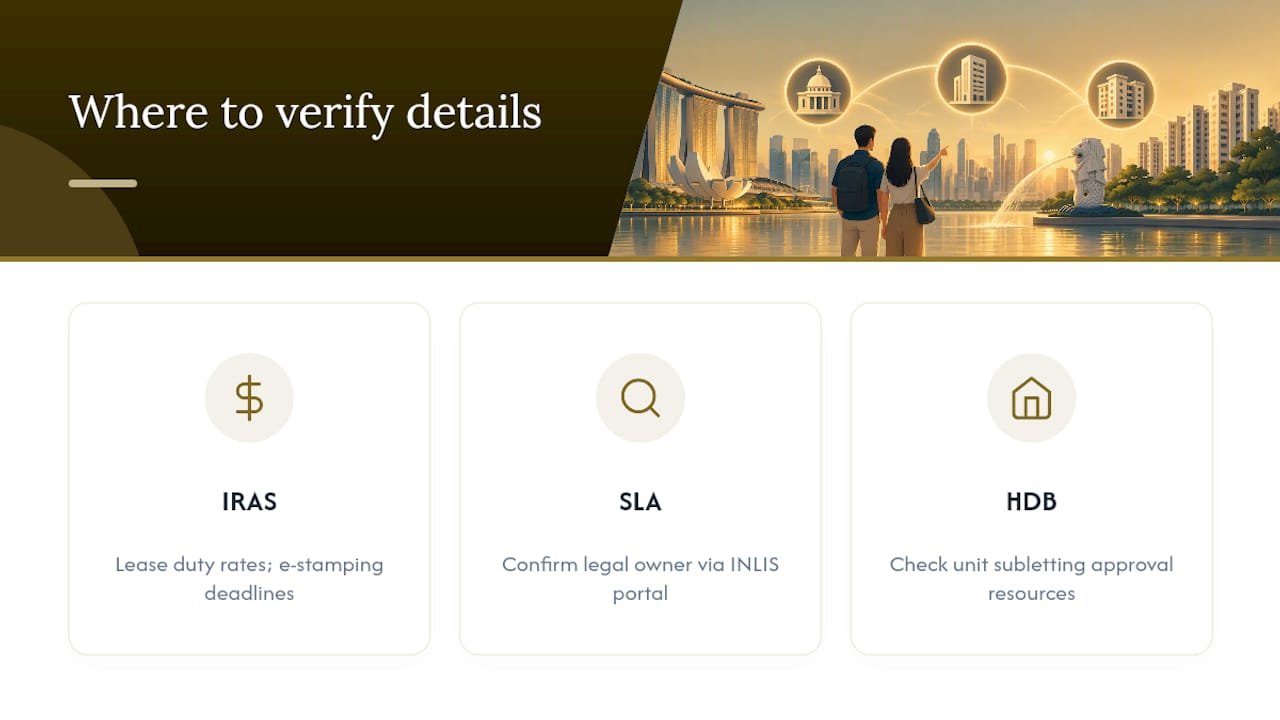
For the rules themselves rather than a summary of them, go straight to the source. IRAS’s stamp duty guidance covers lease duty rates and e-stamping deadlines in full. SLA’s INLIS portal is the correct place to confirm who actually owns a property before you pay a deposit. For HDB flats specifically, the HDB’s own subletting resources confirm whether a unit is approved for rental before you sign anything.
Sources
- Letter of Intent – Property (IRB Law)
- Guide to Letters of Intent for Property Rentals in Singapore (SingaporeLegalAdvice)
- Stamp duty for renting a property (IRAS)
- Land titles search (Singapore Land Authority)
FAQ
Is a letter of intent legally binding in Singapore?
Mostly no. An LOI is typically “subject to contract” and doesn’t create a binding lease, but the deposit clause within it is usually enforceable on its own. That’s why the deposit wording needs as much care as the rest of the document combined.
What is an LOI in a Singapore rental context?
A letter of intent is a preliminary document a prospective tenant sends to signal serious interest in a unit, usually accompanied by a good faith deposit. It sets out the terms both sides expect the eventual Tenancy Agreement to reflect, without itself being that agreement.
What does “letter of intent” mean outside real estate?
In general commercial use, a letter of intent signals one party’s intention to enter into a formal agreement with another, often used in business proposals or deal negotiations before contracts are drafted. In Singapore’s rental market specifically, it functions as the bridge document between viewing a unit and signing the Tenancy Agreement.
Can a landlord back out after signing the LOI?
Yes, because the LOI is generally non-binding on the lease terms themselves. If a landlord withdraws after signing, the good faith deposit should be refunded in full, and unresolved disputes over forfeited deposits can be brought to the Small Claims Tribunal.


