
CCR vs OCR: Which Singapore Region Suits You?
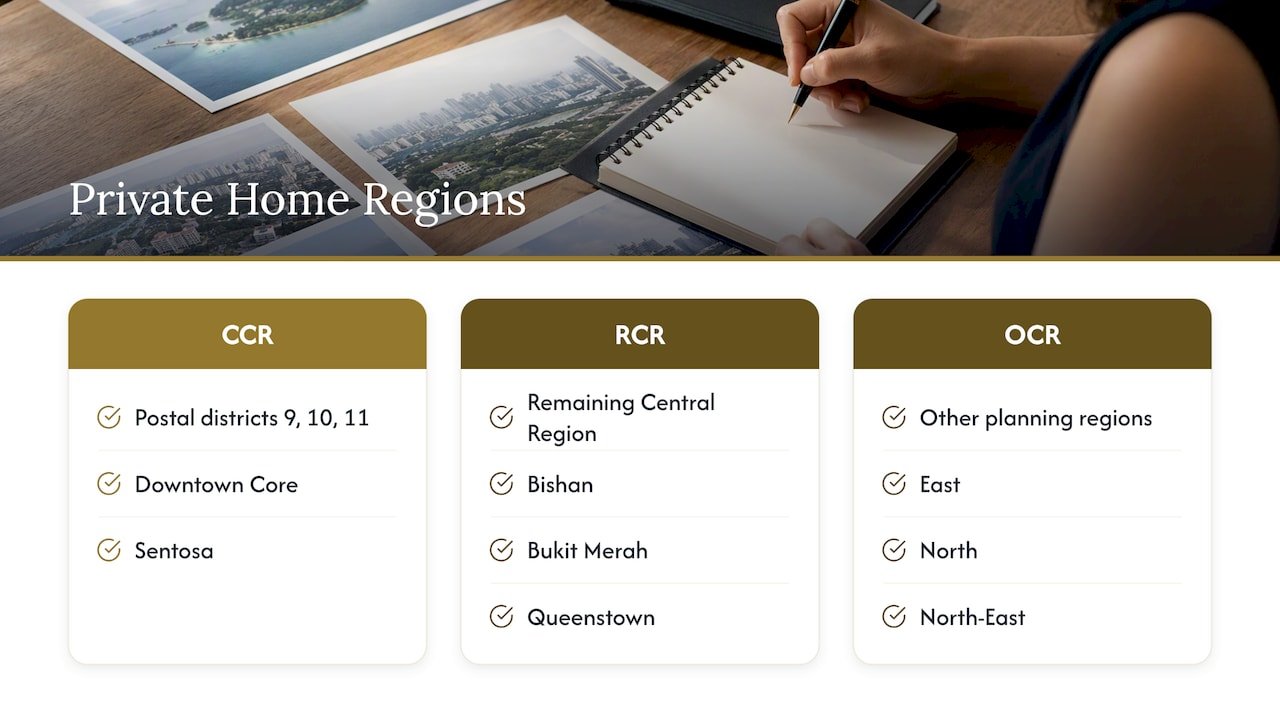
The Core Central Region (CCR) is Singapore’s prime core: districts 9, 10 and 11, the Downtown Core and Sentosa. The Outside Central Region (OCR) is everything beyond the Central Region, covering most of the suburban east, north, north-east and west. CCR generally means a higher entry price and a luxury, often foreign-buyer-heavy market. OCR generally means lower prices per square foot, a steady flow of new launches and a buyer pool dominated by HDB upgraders and young families. Neither is better in the abstract. The right choice depends on your budget, your buyer profile, how long you will hold and whether you plan to live in the home or rent it out.
TL;DR
- CCR, RCR and OCR are URA market segments for private non-landed homes. They are not neighbourhood brands, and the boundaries are fixed by postal district and planning area.
- CCR offers prime addresses and a lower volume of deals. OCR offers lower entry prices, more supply and, in 2026, the largest share of transactions.
- Stamp duty does not change by region. ABSD depends on who you are and how many homes you own, so your buyer profile matters more than your postcode.
- Families should check school distance rules before paying a premium for an address, and must actually live at the address they declare.
- Run the numbers on price, rental yield and holding costs for your own situation before comparing headline price trends.
Table of Contents
- What CCR, RCR and OCR actually mean
- CCR vs OCR at a glance
- How prices have behaved
- Stamp duty: the region does not decide it, you do
- Who tends to suit CCR
- Who tends to suit OCR
- Where RCR fits
- Executive condominiums and the cost question
- Families and school distance
- Our perspective
- A simple way to decide
- Start with a free valuation
- FAQ
- Sources
What CCR, RCR and OCR actually mean
The three regions are market segments used by the Urban Redevelopment Authority (URA). According to the URA glossary, the Core Central Region is made up of postal districts 9, 10, 11, the Downtown Core Planning Area and Sentosa. The Rest of Central Region (RCR) covers the remaining planning areas of the Central Region, such as Bishan, Bukit Merah, Queenstown, Kallang and Geylang. The OCR includes all other planning regions: East, North, North-East and West.
The URA’s REALIS methodology page applies these three segments to non-landed private properties, which means condominiums and apartments. That detail matters. Landed homes are tracked separately, and HDB flats sit outside the private market altogether. When a news report says OCR prices rose by a certain percentage, it is describing private non-landed homes in that region, not every property in the suburbs.
The segments also do not follow common speech. Someone might call Bishan or Bukit Merah “central”, yet both are RCR rather than CCR. A condo in Tampines or Jurong is OCR even if the area feels like a regional centre in its own right. Because market data is reported by segment, knowing the exact boundary tells you which set of price and supply figures applies to the home you are considering.
CCR vs OCR at a glance
| Factor | CCR | OCR |
|---|---|---|
| Where | Districts 9, 10, 11, Downtown Core, Sentosa | East, North, North-East and West regions |
| Typical buyer | Wealthy locals, long-term capital preservers, foreign buyers | HDB upgraders, young families, first-time private buyers |
| Entry price | Highest per square foot | Lowest of the three segments |
| Supply | Smaller, more selective | Large, steady pipeline of new launches |
| Rental profile | Expatriate and corporate tenants | Families, local tenants, those near MRT and amenities |
| Main risk | Thin demand at higher price points, longer to sell | Competition from new supply, price sensitivity |
The table is a pattern, not a rule. Individual projects vary widely by tenure, age, size and distance to the MRT, and a well-located OCR condo can outperform a tired CCR one.
How prices have behaved
Price comparisons between the regions depend on the period you choose, so be careful with any single headline figure. Over the long run, the lower-priced segments have grown faster in percentage terms. One recent comparison, published by a property portal, is the kind of figure that circulates widely, but a percentage always starts from a base. A segment that began cheaper can show a bigger percentage gain from a smaller dollar gain.
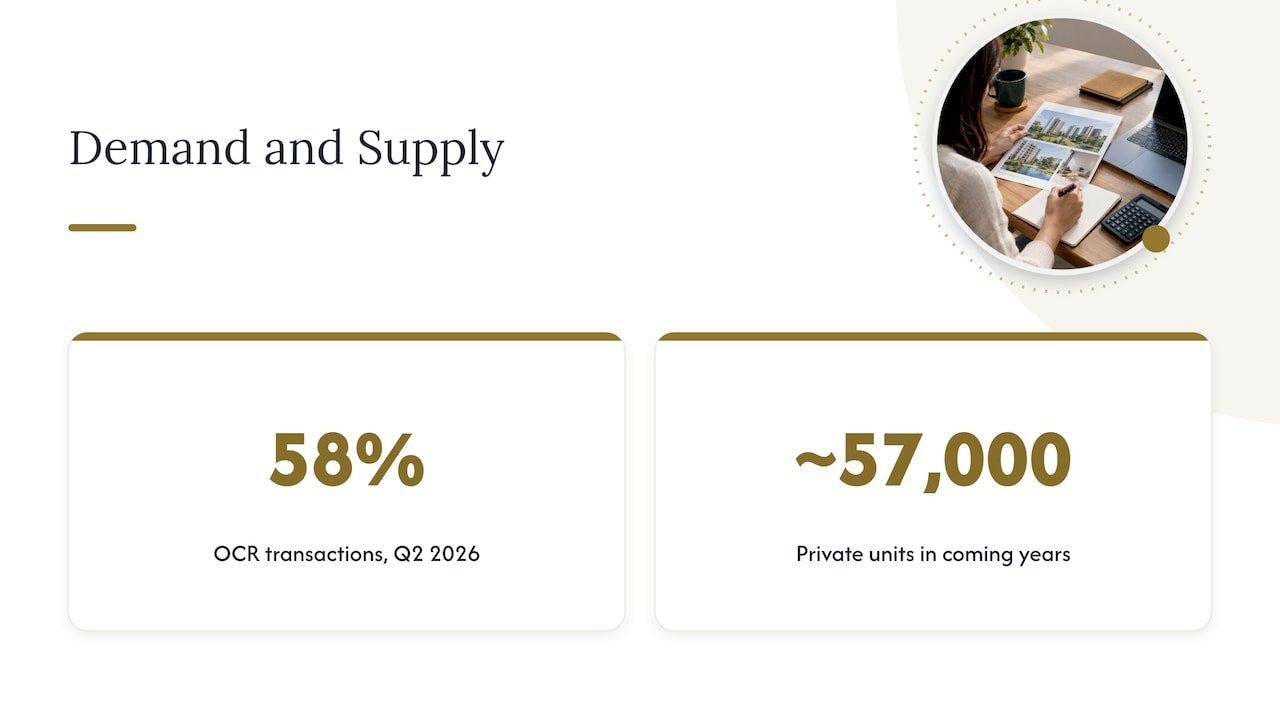
What is easier to verify is where demand sits today. According to Global Property Guide, the OCR accounted for 58% of private home transactions in Q2 2026. The same source reads this as buyers and investors moving towards suburban areas, likely because of affordability and the consistent supply of new launches.
Supply is the other half of the picture. The URA, in its latest market commentary, advises households to be prudent when buying property and taking on mortgage loans given the uncertain macroeconomic outlook. Market analysts quoted in the same release point to a pipeline of about 57,000 private residential units over the next few years as a major factor in shaping expectations. A large pipeline tends to give buyers more choice and more negotiating room, especially in segments with many competing launches.
For the OCR, that means two things at once: plenty to choose from, and plenty of competition when it is time to sell or find a tenant. Investors who want to see how landlords elsewhere think about growth and tenant demand can read a general overview of property growth strategies for real estate investors, though Singapore’s rules and segments are specific and need local checking.
Stamp duty: the region does not decide it, you do
A common assumption is that CCR buyers pay more stamp duty because the homes cost more. In practice, the price raises the amount of Buyer’s Stamp Duty (BSD) in dollar terms, but the rate schedule is the same across regions. The bigger variable is the Additional Buyer’s Stamp Duty (ABSD), which depends on the buyer’s profile and the number of properties owned.
As listed on the IRAS ABSD page), updated on 27 August 2026, ABSD is payable on top of BSD and is computed on the purchase price or market value, whichever is higher. Our research of the IRAS guidance for August 2026 shows these headline cases:
- A Singapore Citizen buying a first residential property: 0%.
- A foreigner buying any residential property: 60%.
- An entity buying any residential property: 65%.
Rates can change and remissions apply in specific cases, so confirm your own situation with IRAS before committing. The point for a CCR vs OCR decision is that a 60% ABSD on a CCR purchase is a very different proposition from the same rate on an OCR unit, simply because the base price is higher. For a foreign buyer, a lower entry price in the OCR reduces the absolute dollar duty. Our guide to 60% ABSD for foreign buyers walks through what to budget, and our page on ABSD rates and cash examples shows how the numbers work out.
If you already own a home and are thinking about a second property, region becomes secondary to sequencing and cash planning. Our notes on second property costs and sequencing and on avoiding ABSD on a second property cover the practical steps.
Who tends to suit CCR
CCR can make sense when:
- You want a prime address. Districts 9, 10 and 11 and the Downtown Core combine proximity to Orchard Road, the CBD and established amenities. Sentosa offers a resort setting.
- You are buying for the long term. Capital preservation is often the aim in the core, rather than quick gains.
- You are targeting expatriate tenants. Central, convenient locations attract corporate renters, although that demand can shift with the economy.
- Your budget is large. Entry prices are higher and unit sizes at lower budgets can be small.
The trade-offs are plain: higher entry cost, higher duties in dollar terms for non-citizens, and typically a thinner buyer pool when you come to sell. In a quarter when prices slip in the prime segment, holding costs and the lower yield become more visible.
Who tends to suit OCR
OCR can make sense when:
- You are upgrading from an HDB flat. The OCR is where most upgraders and first-time private buyers shop, which also means a deep pool of future buyers when you sell.
- You want more space for the money. A lower price per square foot usually gets you a bigger unit or a three-bedroom where the CCR would offer a two.
- You are focused on rental income. Lower purchase prices often lead to higher gross yields. Gross is not net, though. Our rental yield snapshot explains why net yield tends to be lower once costs are counted.
- You prefer new launches. Supply is steady, with new developments across all four suburban regions.
The trade-offs: more competing units, meaning less pricing power as a seller, and a need to check that the specific project has good MRT access, amenities and a sensible price relative to its neighbours.
Where RCR fits
Since the search is CCR vs OCR, it is tempting to ignore the middle, but RCR often decides the outcome. It covers city-fringe areas with short commutes to the CBD at prices typically below the core and above the suburbs. If CCR feels too expensive and OCR feels too far, RCR is the compromise. Check the actual planning area: the URA’s data dictionary lists the 22 planning areas that make up the Central Region, so you can see whether a project falls into CCR or RCR before you rely on a marketing label such as “city fringe”.
Executive condominiums and the cost question
Many first-time buyers searching for a cheaper route ask why an executive condominium (EC) costs less than a private condo. ECs are a hybrid: they are sold with eligibility conditions and a minimum occupation period (MOP). The HDB eligibility page sets out how a household is assessed, including the core family nucleus. Our research also notes a monthly household income ceiling of $16,000 for ECs.
The resale timeline has also changed. The HDB conditions page states that ECs can be sold on the open market after the 5-year MOP, computed from the Temporary Occupation Permit date. A separate HDB notice says units in projects whose land sales tender closed on or after 8 May 2026 can only be sold on the open market after a 10-year MOP. Check which rule applies to the project you are considering. ECs are almost entirely in the OCR, so for a first-time family buyer the OCR vs EC question often comes before CCR vs OCR.
Families and school distance
If you are choosing a region because of primary schools, read the rules before paying for an address. The Ministry of Education (MOE) gives priority to Singapore Citizens and Permanent Residents who live closer to the preferred school when places are limited, and its explanation of distance notes that the Home-School Distance is measured to the School Land Boundary rather than one reference point. A short distance on a map is therefore not a guarantee of priority.
The bigger risk is declaring an address you do not intend to use. The same MOE page says families who gain priority with an address must stay there for at least 30 months from the start of the P1 Registration Exercise, and that false declarations or failure to meet the requirement can lead to the child being transferred out and parents being referred to the police. MOE’s parliamentary reply of 12 January 2026 confirms it takes a serious view of falsified addresses. If you plan to rent out a property while claiming proximity, speak to MOE before you buy.
Our perspective
Most buyers who ask us about CCR vs OCR are really asking two other questions: what can I afford after duties, and what do I plan to do with the property? From what we see, the region label matters less than three things.
First, the buyer profile. Because ABSD depends on citizenship, residency, entity status and the number of properties owned, two buyers looking at the same unit can face very different total costs. We prefer to settle the structure before the search, not after a unit has been shortlisted.
Second, the gap between asking price and fair value. We screen listings against official data to look for gaps, which is why we publish our approach to finding undervalued properties. A well-priced OCR unit often beats a fully priced CCR one on total return, and the reverse can also happen.
Third, the holding plan. A buyer who will hold for ten years does not need to react to a single quarter of price data. A buyer who may sell in three needs to look closely at supply in the same segment. In every case we recommend modelling the full cost, including duties, financing and vacancy, then comparing two or three options side by side.
— Anderson
A simple way to decide
- Set your budget after duties. Include BSD, any ABSD, legal fees and financing costs. Confirm your ABSD position with IRAS.
- Pick your purpose. Own-stay, rental income, capital preservation or a mix.
- Choose a segment, then a project. Use the URA boundaries to confirm the segment before you trust any statistic.
- Compare at least three comparable units. Same bedroom count, similar tenure, similar distance to the MRT.
- Check supply nearby. A project beside five new launches competes with all of them.
- Plan the exit. Ask who the next buyer or tenant will be, and how long a sale would likely take.
For the wider market context, our property market outlook with three scenarios includes a buyer checklist that fits this process.
Start with a free valuation
If you already own a property and are weighing a move into the CCR or OCR, the first number you need is what your current home is worth. Register Today offers a free property valuation, and you can browse residential listings and condos on the site. We also provide personalised negotiation and detailed market evaluations, and we help investors plan around ABSD.
FAQ
What does OCR mean in property?
OCR stands for Outside Central Region. It is the URA market segment for areas outside the Central Region, covering the East, North, North-East and West regions. It is mainly used when reporting private non-landed home prices and transactions.
What is CCR in Singapore?
CCR is the Core Central Region. Under the URA definition it comprises postal districts 9, 10 and 11, the Downtown Core Planning Area and Sentosa. It is the prime segment of the private residential market.
Is OCR always cheaper than CCR?
In general, yes, per square foot, but not for every project. A new, large, luxury development in the OCR can cost more than an older, small CCR unit. Compare like with like on size, tenure and age before drawing conclusions.
Does ABSD differ between CCR and OCR?
No. ABSD rates depend on the buyer’s profile and the number of properties owned, not the region. Because ABSD is computed on the price, a CCR purchase will carry a larger duty in dollars than an OCR one at the same rate. Check current rates on the IRAS site before you buy.
Why is an EC cheaper than a condo?
ECs come with eligibility rules, an income ceiling and a minimum occupation period before they can be sold on the open market, and they are mostly in the OCR. Those conditions are part of why the entry price is lower. Check the HDB rules for the specific project.
Sources
- URA glossary
- URA REALIS coverage and methodology
- URA REALIS data dictionary
- URA market commentary
- Global Property Guide, Singapore price history
- IRAS, Additional Buyer’s Stamp Duty)
- HDB, EC conditions for tenders from 8 May 2026
- MOE, how distance affects P1 admission
- MOE, parliamentary reply on address verification