
Renting in Singapore as an Expat: Rules, Areas and Costs
Expats can rent in Singapore, and most do. Private condominiums and apartments are the most flexible route. HDB public housing is open to foreigners on valid work and study passes, but with extra rules, including a quota on whole-flat rentals. This guide covers who can rent what, which neighbourhoods expats choose, how the market looks now, and the checks to make before you pay anything.
TL;DR
- Foreigners with a valid Employment Pass, S Pass, Work Permit or Student Pass can rent HDB flats or bedrooms. Tourists cannot.
- Whole-flat HDB rentals to non-Malaysian non-citizens fall under a Non-Citizen Quota (8% per neighbourhood, 11% per block). Bedroom rentals are not subject to it.
- Private condos near the centre cost the most. HDB flats in heartland estates can cut housing costs sharply, at the price of a longer commute and fewer resort-style facilities.
- Verify any agent on the CEA Public Register, and never pay a deposit to a personal account before a viewing.
Table of Contents
- Who can rent what in Singapore
- Where expats live
- What the market looks like now
- From viewing to key collection: the steps
- Agents, commission and dual representation
- Avoiding rental scams
- Our perspective
- Looking for a home to rent?
- FAQ
- Sources
Who can rent what in Singapore
Private homes
Foreigners can rent private residential property as long as they are legally entitled to reside in Singapore. There is no equivalent of the HDB quota for private condominiums, landed homes or apartments. Landlords set their own conditions, which usually means proof of your pass, your employment details and a tenancy of one to two years.
HDB flats and bedrooms
According to the Council for Estate Agencies (CEA), a tenant must be a Singapore Citizen, a Permanent Resident, or a non-citizen legally residing in Singapore with an Employment Pass, S Pass, Work Permit, Student Pass or a similar eligible pass. The HDB eligibility guidelines set out the full list.
The main HDB rules for expats:
- Minimum term: 6 months for whole-flat tenancies.
- Maximum term: for non-Malaysian non-citizens, a single approval covers up to 2 years. Singaporeans and Malaysians can get up to 3 years per application.
- Pass validity: your pass should have at least 6 months’ validity when the landlord applies to rent out the unit.
- Non-Citizen Quota: when a non-Malaysian non-citizen rents a whole flat, the HDB quota is 8% at neighbourhood level and 11% at block level. A flat in a block that has reached its limit cannot be rented to you, however good the unit is.
- Occupancy limits: 6 tenants in a 3-room flat and 8 in a 4-room or larger flat, per HDB. Check the current limit before you plan a house share, as HDB has adjusted it before.
The quota is the reason availability in some estates is thinner than listings suggest. Ask your agent to confirm quota status before you view, not after you have fallen for a flat. The quota does not apply to renting a single bedroom.
Where expats live
Expats tend to fall into three clusters, organised by budget and priorities, as described in SingaGuide’s 2026 neighbourhood overview.
| Cluster | Typical areas | What you get | Trade-off |
|---|---|---|---|
| Central / premium | Orchard, River Valley, Tiong Bahru, Tanjong Pagar, Bukit Timah, Holland Village | Walkable dining, international schools nearby, condo facilities | Highest rents |
| Mid-tier | East Coast, Novena, Queenstown | Balance of space, MRT access and price | Fewer nightlife and retail options than the centre |
| Heartland | Clementi, Tampines, Sengkang | HDB flats, hawker centres, malls and MRT in one hub | Longer commutes, fewer Western-style amenities |
Choosing by lifestyle
Single professionals often favour Tanjong Pagar, Tiong Bahru or Holland Village, where cafés and bars are on the doorstep and offices are a short ride away.
Families weigh schools first. Bukit Timah and the East Coast are common choices, but your child’s school location should decide the shortlist. Check commute times at school-run hours, not on a Sunday viewing.
Long-term assignees who want to save can consider what SingaGuide calls a cost-of-living play: renting an HDB flat in a heartland estate instead of a central condominium. The same source estimates this can save S$30,000 to S$50,000 a year, at the cost of pools, gyms and a longer journey. Treat this as an estimate. Your own saving depends on the specific flat and condo you compare.
What the market looks like now
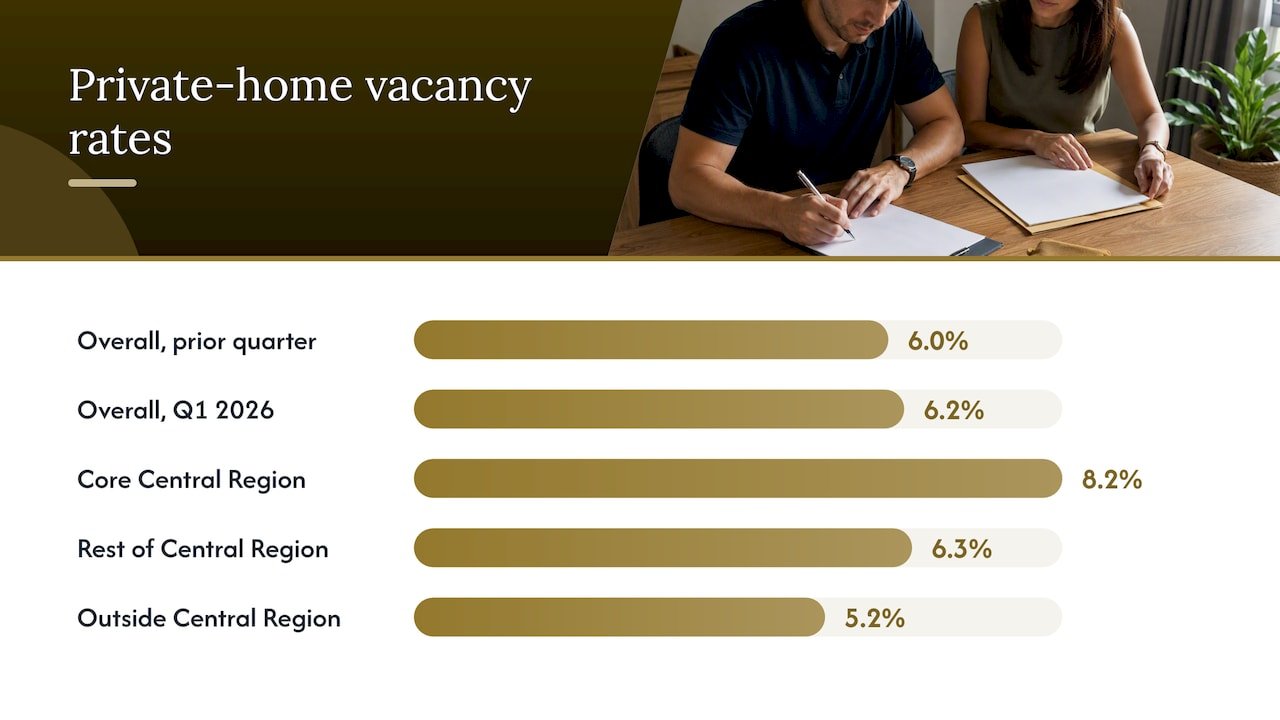
The rental market has cooled from its post-pandemic surge but remains firm. In its Q1 2026 release, the Urban Redevelopment Authority (URA) reported that the private residential rental index rose 0.3% in the quarter. The vacancy rate for completed private homes, excluding Executive Condominiums, was 6.2%, up slightly from 6.0%. By region it was 8.2% in the Core Central Region, 6.3% in the Rest of Central Region and 5.2% in the Outside Central Region.
For Q2 2026, Global Property Guide, summarising URA data, reports that rents rose 0.7% on the quarter and 1.7% on the year.
What this means for a tenant:
- Central areas carry the highest vacancy, so you have more room to negotiate on rent, furnishings or lease start dates.
- Outside the central region has lower vacancy, so good units move quickly. Be ready with documents.
- New supply helps over time. URA noted that about 55,800 private homes are expected to complete in the coming years, which should give tenants more choice. Well-located units in demand will still attract competition.
For a deeper look at owner and renter data, see our rental market outlook. For what a typical budget buys and how much cash to prepare upfront, see our cost of renting guide.
From viewing to key collection: the steps
- Set a budget and a commute limit. Decide the maximum you will spend and the longest journey to work you will accept. This narrows the area list quickly.
- Confirm your eligibility. For HDB, check your pass type and its remaining validity. For private homes, prepare your pass, employment letter and passport copies.
- Engage a registered agent, or check listings carefully. Verify registration on the CEA Public Register (see below).
- View at least three comparable units. Note noise, water pressure, aircon condition and the walk to the MRT.
- Submit a letter of intent. This sets out the rent, term and deposit, and usually comes with a good-faith payment. Read our letter of intent checklist before signing, so you know what is refundable.
- Negotiate and sign the tenancy agreement. Our guide to tenancy agreements and CEA and HDB templates covers stamping and the clauses worth checking.
- Do an inventory check on move-in. Photograph every defect and send the list to the landlord in writing.
Clauses to settle in writing
CEA notes that agents are not responsible for maintenance, repairs or disputes between landlord and tenant, so these belong in the tenancy agreement. Settle at least:
- who pays for aircon servicing and minor repairs;
- the diplomatic clause, which lets you end the lease early if you are relocated out of Singapore (landlords vary on whether they include it);
- the condition in which the unit must be returned;
- how and when the deposit is refunded.
Agents, commission and dual representation
Property agents can help with eligibility checks and negotiation. CEA recommends using the Prescribed Estate Agency Agreement when you engage one, so the agent’s duties are defined in writing.
One rule surprises many newcomers: an agent cannot act for both landlord and tenant in the same transaction, nor collect commission from both, even with everyone’s consent. Doing so is an offence under CEA’s guidance. Commission should be paid to the agency, not the individual agent, preferably by crossed cheque.
If you are unsure who pays what, read our guide to agent commission in Singapore and, if you are signing an exclusive arrangement, what to check in the forms.
Avoiding rental scams
CEA warns that scammers pose as agents on listing platforms, often asking for a deposit to “secure” a unit before any viewing. Its tenant guidance is clear on the response:
- Check the agent’s registration on the CEA Public Register using the registration number or mobile number.
- Do not pay a deposit or rent into an individual’s personal bank account.
- Do not pay anything before you have viewed the unit and seen the owner’s or agency’s documents.
If you are considering a short stay while you search, be aware that short-term letting is regulated. Our short-term rental checks explain how to avoid an illegal booking. If a dispute arises later, our tenant rights guide explains how to prepare a Small Claims Tribunal claim.
Our perspective
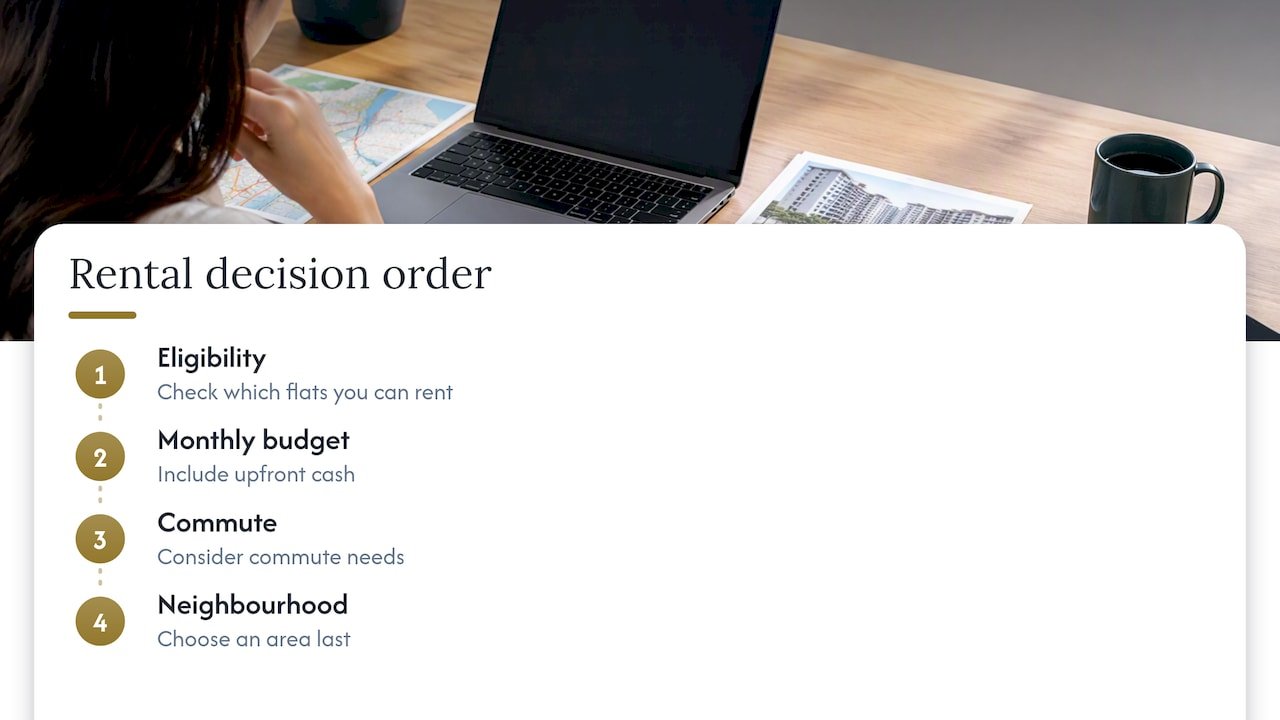
We see the same pattern with new arrivals. They fix on a district name before they know their budget, then lose weeks viewing flats they are not eligible for or cannot afford. The better order is eligibility first, then monthly budget including upfront cash, then commute, then neighbourhood.
We also think expats underrate the HDB route. It is more regulated, and the quota can rule out a block, but a heartland flat near an MRT station is a liveable and much cheaper base for many assignments. Equally, a central condo is worth the premium if it removes a daily commute and you will use the facilities.
Market data should shape your offer. With vacancy higher in the central regions, a tenant there can often ask for more than in the suburbs. Our approach is to read the numbers for the specific area, then negotiate with that evidence rather than a rule of thumb.
— Anderson
Looking for a home to rent?
Our team helps expats find residential rentals across Singapore, from apartments and condos to larger family homes, and negotiates terms on your behalf. Browse current residential listings or start from our Rent a Property page. If you own a property and are weighing a sale against letting it out, our free property valuation is a no-cost starting point.
FAQ
Can foreigners rent property in Singapore?
Yes. Foreigners can rent private residential property if they are legally residing in Singapore. They can also rent HDB flats or bedrooms if they hold an eligible pass such as an Employment Pass, S Pass, Work Permit or Student Pass. Tourists cannot rent HDB flats.
Is there a limit on how long an expat can rent an HDB flat?
The minimum term for a whole flat is 6 months. For non-Malaysian non-citizens, each approval covers a maximum of 2 years, according to HDB. A new application is needed to continue beyond that, subject to the quota and your pass validity.
Is it better to rent or buy as an expat?
Renting is the simpler choice for most expats on fixed-term assignments, because it avoids large upfront costs and the rules that apply to foreign buyers. Buying involves taxes such as Additional Buyer’s Stamp Duty, so the answer depends on your length of stay and finances. Our market outlook sets out scenarios if you are weighing a purchase.
How do I know an agent is genuine?
Search for the agent on the CEA Public Register using the registration number or mobile number. Be wary of anyone who asks for a deposit before a viewing, or for payment to a personal bank account, as CEA warns.
Which areas suit expat families?
Families often look at Bukit Timah, the East Coast and Holland Village, but the right area is the one with a workable commute to your child’s school. Shortlist two or three estates, then test the journey at peak hours before you commit.
Sources
- CEA: Renting an HDB flat or bedroom (tenant)
- CEA: Renting or renting out
- CEA
- HDB
- URA: Release of 1st Quarter 2026 real estate statistics
- Global Property Guide: Singapore residential property market analysis 2026
- SingaGuide: Best Singapore neighbourhoods for expats 2026