


Valuation Shortfall in Singapore: What It Costs and How to Plan
A valuation shortfall happens when the price you agree with a seller is higher than the value the bank or HDB assigns to the property. The difference is yours to pay, and it has to be paid in cash. For HDB flats this gap is called cash over valuation (COV). For condos and other private homes it is usually called a valuation gap or shortfall. This guide explains how each one arises, what it does to your budget, and how to plan for it before you sign anything.
TL;DR
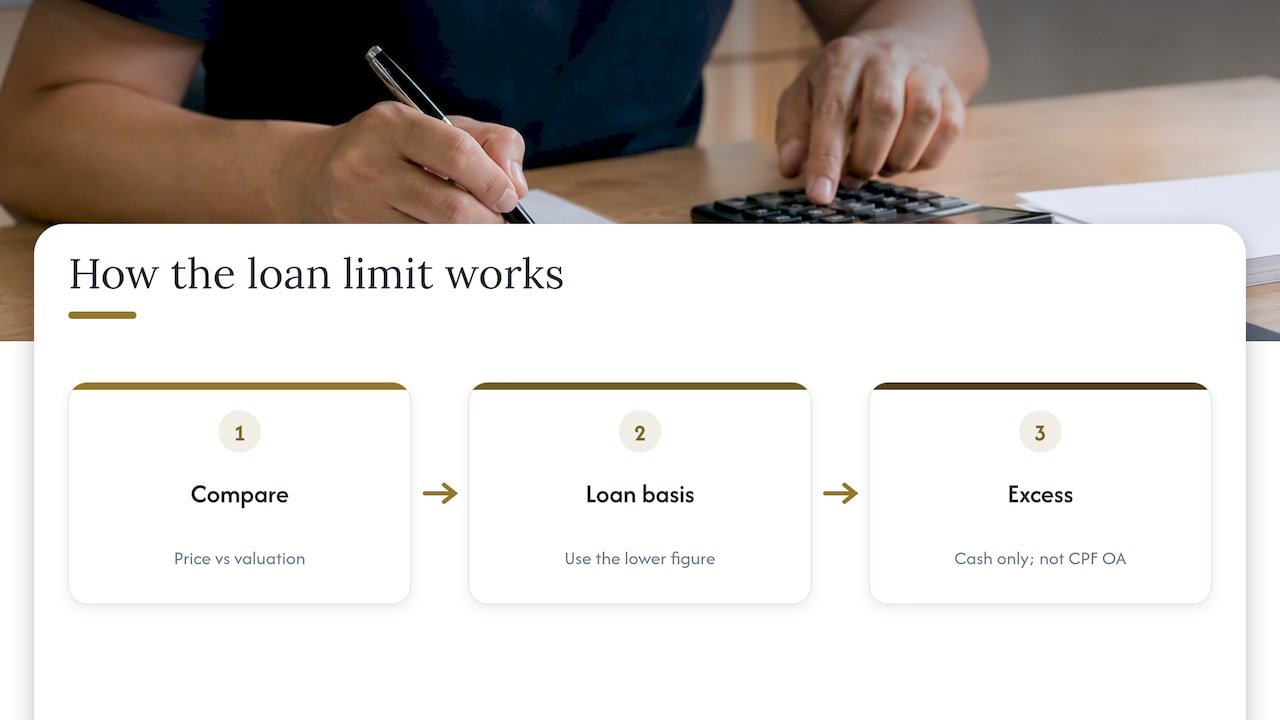
- Loans are capped on the lower of the purchase price or the valuation, so a low valuation shrinks your loan, not your price.
- The gap cannot be paid with CPF Ordinary Account savings or a housing loan. It is hard cash.
- For HDB resale flats, the buyer or agent requests the valuation by the next working day after the Option to Purchase is granted, for a S$120 fee including GST.
- Budget a cash buffer before you make an offer, and negotiate with recent transaction data rather than asking prices.
- A gap is a negotiating point, not only a cost: you can renegotiate, pay it, or walk away within the option period.
Table of Contents
- What a valuation shortfall actually is
- Why the gap must be paid in cash
- A worked example
- How the HDB valuation process works
- How private property differs
- Who is most exposed
- Planning before you make an offer
- What to do when the valuation comes in low
- Our perspective
- Get a valuation before you commit
- FAQ
- Sources
What a valuation shortfall actually is
Two numbers matter in every purchase: the price you and the seller agree, and the valuation. The valuation is an independent opinion of what the property is worth, produced by HDB for flats or by the lending bank for private property. Lenders use it to decide how much they will finance.
When the valuation equals or exceeds the price, nothing unusual happens. When it comes in lower, the shortfall equals price minus valuation. COV was a common feature of the HDB resale market for years, and the policy was reviewed on 10 March 2014. It has not gone away as a concept: any time buyers compete for flats in sought-after locations, agreed prices can run ahead of valuations.
The terms differ by property type:
| HDB resale flat | Private property (condo, landed) | |
|---|---|---|
| Common name | Cash over valuation (COV) | Valuation gap or shortfall |
| Who values | HDB, on request | The lending bank |
| When you learn the figure | After the OTP is granted | During loan processing |
| How the gap is paid | Cash only | Cash only |
Why the gap must be paid in cash
The rule comes from loan limits. Under MAS and HDB rules, the loan-to-value limit applies to the lower of the purchase price or the valuation. Whatever sits above that figure cannot be financed by a housing loan, and CPF Ordinary Account savings cannot cover it either. MAS sets these rules for bank loans; its explainer on new housing loans sets out the loan tenure and LTV framework.
The purpose is prudence. Capping the loan at the lower figure stops borrowers from taking on debt against a price that may reflect market sentiment more than underlying value.
For how LTV percentages change with your number of existing loans, see our guide to LTV limits for Singapore buyers.
A worked example
The figures below are hypothetical, to show the mechanics. Assume a bank loan at 75% LTV on a private home.
| Valuation matches price | Valuation S$20,000 below | |
|---|---|---|
| Agreed price | S$600,000 | S$600,000 |
| Valuation | S$600,000 | S$580,000 |
| Maximum loan (75%) | S$450,000 | S$435,000 |
| Downpayment on the value | S$150,000 | S$145,000 |
| Shortfall, cash only | S$0 | S$20,000 |
| Total you must find | S$150,000 | S$165,000 |
Two things stand out. The loan falls by S$15,000, because the bank lends on S$580,000. And the S$20,000 gap is added on top, in cash. In total, you need S$15,000 more than you planned, and S$20,000 of it cannot come from CPF.
Stamp duty is a separate cost that depends on the price paid. Our note on why valuation risk raises buyer’s stamp duty covers that side.
How the HDB valuation process works
For resale flats, the steps are fixed and time-limited:
- The seller grants you an Option to Purchase (OTP). The option period runs for 21 calendar days from the option date.
- The buyer or agent submits a Request for Value through My Flat Dashboard by the next working day after the OTP is granted. HDB’s published fee is S$120 including GST, and the typical turnaround is 10 working days.
- HDB returns the valuation. If it is below the agreed price, you see the COV figure.
- You decide whether to proceed, renegotiate, or let the option lapse.
Because the valuation arrives only after you have agreed a price, you cannot confirm COV in advance. That is why the cash buffer matters. HDB’s own Option to Purchase notes advise buyers and sellers to read the clauses before entering the contract, and the valuation clause is one to read closely. Our guide to the Option to Purchase in Singapore walks through what each side must do.
Timing also matters for cash. For resale flats, the downpayment is required at the point of purchase, so the funds need to be ready before you know the valuation.
How private property differs
Private purchases are usually financed through bank loans, and the bank orders its own valuation. There is no direct counterpart to the HDB request and its fixed fee, but a shortfall can still surprise buyers who did not budget for it. Valuers for different banks can also reach different figures, so an early indication from your lender is worth asking for before you commit.
Private buyers face a second limit alongside LTV: the total debt servicing ratio. A lower loan from a low valuation may leave TDSR room unused, but your cash need still goes up. See how TDSR rules set your price band.
For new launches bought on a progressive payment schedule, cash needs arrive in stages. The progressive payment schedule page shows how those stages fall.
Who is most exposed
- First-time buyers. They often have little cash outside CPF, and a gap of tens of thousands can use up an emergency reserve.
- Buyers in competitive towns. Where several offers arrive at once, agreed prices are more likely to exceed valuations.
- Upgraders with a tight timeline. A sale that completes late can leave less cash on hand when the gap appears.
- Buyers planning a second property. A lower LTV applies to additional loans, so a shortfall adds to an already larger cash requirement.
A common mistake is assuming that ample CPF savings protect you. They do not cover the gap, even if the balance looks large.
Planning before you make an offer
Set a cash buffer
Keep a separate amount that you can pay without touching your emergency fund. How large depends on the estate and the flat or unit type. One property platform suggests a buffer of S$20,000 to S$80,000 for hot estates, but treat that as a rough guide only. Your own number should come from recent transactions near the unit you want.
Do your own check
Look at recent caveated transactions for similar units in the same block or project. This is an unofficial check and never replaces the HDB or bank valuation, but it shows whether a price sits near the recent range. Our page on finding undervalued properties explains how URA and HDB data can be screened.
Negotiate with the gap in mind
A price that exceeds recent comparable sales gives you grounds to ask for less. You can also agree terms in which the seller shares part of the shortfall. Our article on negotiating property price in Singapore covers how the S$120 valuation request fits into that conversation.
Watch the other cash costs
Resale levies, stamp duties and legal fees all draw on cash as well. If you are moving from a subsidised flat, check the resale levy before you book, so a valuation gap does not land on top of an unplanned levy.
What to do when the valuation comes in low
- Work out the full gap. Price minus valuation, plus the smaller loan the lower figure allows.
- Check your cash. Confirm what you can pay without CPF.
- Ask the seller to reconsider. The valuation is evidence. A seller who wants a completed sale may accept a lower price or share the difference.
- Decide within the option period. If the numbers no longer work, you can let the option lapse instead of stretching your finances. Check the OTP clauses for what you may lose, such as the option fee.
- Speak to a licensed professional. A mortgage specialist or your bank can confirm your loan figure, and a conveyancing lawyer can explain the contract terms.
The government has also tracked how often flats sell below valuation. The Ministry of National Development published a written answer on resale flats sold below valuation, a reminder that valuations and prices can move in either direction.
Our perspective
We see valuation shortfalls most often when buyers fix on a price before they have looked at comparable sales. The shortfall is rarely the surprise. The surprise is the cash it takes, because CPF balances give a false sense of room.
Our view is that valuation should come first in the process, not last. Before a buyer makes an offer, we look at recent transactions and the gap between asking prices and what similar units have actually sold for. That market gap analysis is part of how we advise buyers and sellers, and it helps set a realistic price and cash plan from the start.
We also think sellers should care. A seller who prices far above the likely valuation may lose buyers when the number comes back, or face a renegotiation late in the option period. Realistic pricing from the beginning protects both sides.
— Anderson
Get a valuation before you commit
If you are buying, selling or comparing options, our free property valuation gives you a reference figure at no charge. You can also browse residential listings or start from the Register Today homepage to buy, sell or rent. Our guide to property valuation and loan shortfalls shows three ways to reduce the risk.
FAQ
Is cash over valuation the same as a valuation shortfall?
They describe the same gap from different angles. COV is the HDB term for the amount by which the price exceeds HDB’s valuation. For private property, the equivalent is a valuation gap or shortfall relative to the bank’s figure. In both cases the buyer pays the difference in cash.
Can I use CPF to pay the gap?
No. CPF Ordinary Account savings and housing loans cannot be used for the difference between price and valuation. Loans are capped on the lower of price or valuation, so the gap must be paid from your cash.
When do I find out the HDB valuation?
You submit the Request for Value by the next working day after the OTP is granted, and the typical turnaround is 10 working days. The option period is 21 calendar days, so you have time to decide once the result arrives. Check the exact steps on HDB’s Request for Value page.
What if the valuation is higher than the price?
Then there is no shortfall and the loan limit is based on the purchase price, because the lower figure applies. You are not required to pay more than the agreed price.
Can I avoid a valuation shortfall completely?
Not with certainty, because the official figure arrives after you agree a price. You can reduce the risk by checking recent transactions, keeping a cash buffer and negotiating with data.
Sources
- CPFB: HDB loan or bank loan? 3 differences you should know
- HDB
- MAS: Rules for New Housing Loans
- MND: Written answer on HDB resale flats sold below valuation
- Wikipedia: Cash-Over-Valuation
- OTP Law Corporation: Private property resale conveyancing
- Propertynet: HDB resale COV in 2026