
The 1km School Rule in Singapore: How P1 Distance Priority Works
The 1km school rule is the Ministry of Education’s (MOE) distance band for Primary 1 (P1) registration. When a school has more applicants than places, a child’s citizenship and Home-School Distance (HSD) decide who is admitted first, and living within 1km of the school puts a child in the highest distance band for their citizenship group. It improves priority. It does not by itself guarantee a place at a popular school. This guide explains how the rule works, how the distance is measured, what happens in a ballot, and what it means if you are buying or renting a home with a school in mind.
TL;DR
- Under MOE’s distance rules, priority runs by citizenship first, then by distance band: within 1km, between 1km and 2km, and beyond 2km.
- Distance only matters when a school is oversubscribed. Where a ballot is needed, every applicant in the group that must ballot has an equal chance.
- Distance is measured from the nearest point of the school boundary to your official residential address, and you can check it on OneMap School Query.
- A child admitted on distance must live at the registered address for at least 30 months from the start of the P1 Registration Exercise.
- From the 2027 exercise, 12 schools will use a Two-Track Scheme in Phase 2C with no HSD priority inside each track.
Table of Contents
- What the 1km school rule actually means
- When distance comes into play: phases and balloting
- Does living within 1km guarantee a place?
- How the distance is measured
- The address you register with
- The 30-month stay requirement
- What is changing: the Two-Track Scheme from 2027
- What this means if you are buying or renting a home
- Our perspective
- Find a home near your school of choice
- FAQ
- Sources
What the 1km school rule actually means
MOE does not run a single “1km rule”. It runs a priority order that combines two things: the child’s citizenship and the Home-School Distance category of the address used for registration. The distance bands are within 1km, between 1km and 2km, and outside 2km.
According to MOE, the order of priority when places run short is:
- Singapore Citizens living within 1km
- Singapore Citizens living between 1km and 2km
- Singapore Citizens living outside 2km
- Permanent Residents living within 1km
- Permanent Residents living between 1km and 2km
- Permanent Residents living outside 2km
Two points follow from this list. First, citizenship ranks above distance: a Singapore Citizen living outside 2km is placed ahead of a Permanent Resident living within 1km. Second, the bands are relative to a specific school. A home can be within 1km of one school and 1.5km from another, so the same address gives different priority at different schools.
The 1km band therefore describes a child’s position in a queue that only forms when demand is higher than supply. At a school with enough places for everyone who applies, distance has no effect on the outcome.
When distance comes into play: phases and balloting
P1 registration runs in phases. Per MOE’s phase overview, Phases 1 to 2C Supplementary apply to Singapore Citizens and Permanent Residents, while international students register through a separate process before Phase 3. If a child is unsuccessful in one phase, parents can register in the next phase for which the child is eligible. Exact dates change every year, so use MOE’s page for the current schedule.
Most families with no alumni, staff or community links to a school reach Phase 2C. This is where the distance bands are most visible, and where popular schools most often run short of places.
Reserved places in Phases 2B and 2C
At the start of the exercise, 60 places are reserved in each school for Phases 2B and 2C: 20 for Phase 2B and 40 for Phase 2C. This is why a school with a large Phase 1 and 2A intake can still have a competitive Phase 2C.
How the ballot works
When applicants outnumber vacancies, MOE conducts a computerised ballot centrally. MOE states that all applicants who are required to ballot have an equal chance of admission. In practice, the ballot is held within the group where places run short. For example, if the places are fewer than the number of Singapore Citizens living within 1km, only that group ballots, and applicants in lower-priority bands are not considered at that stage.
Balloting can happen in any phase from 2A through to 2C Supplementary, as CNA reported in its coverage of the 2026 exercise, which noted 33 primary schools that were oversubscribed in Phase 2B.
Does living within 1km guarantee a place?
No. Living within 1km gives your child the highest distance priority within their citizenship group. It does not secure a place if more children in that same group apply than there are vacancies. Those children then ballot against each other, and each has the same chance.
Three things decide how safe a 1km address is at a given school:
- Vacancies at Phase 2C. After Phases 1, 2A and 2B, the places left for Phase 2C may be limited. A school with a large number of nearby homes may have more Phase 2C applicants within 1km than places.
- Your citizenship group. Permanent Residents sit below all Singapore Citizens in the order, so a PR family within 1km may be behind citizens living 2km away.
- Demand from the neighbourhood. Young families clustered around a school increase the number of applicants in the 1km band.
A sensible approach is to treat 1km as a strong advantage, check MOE’s published balloting information for the school in recent years, and have a second-choice school in mind. The order in which parents submit an application within a phase does not change the result of a ballot, so there is no benefit to rushing on the first day of registration.
How the distance is measured
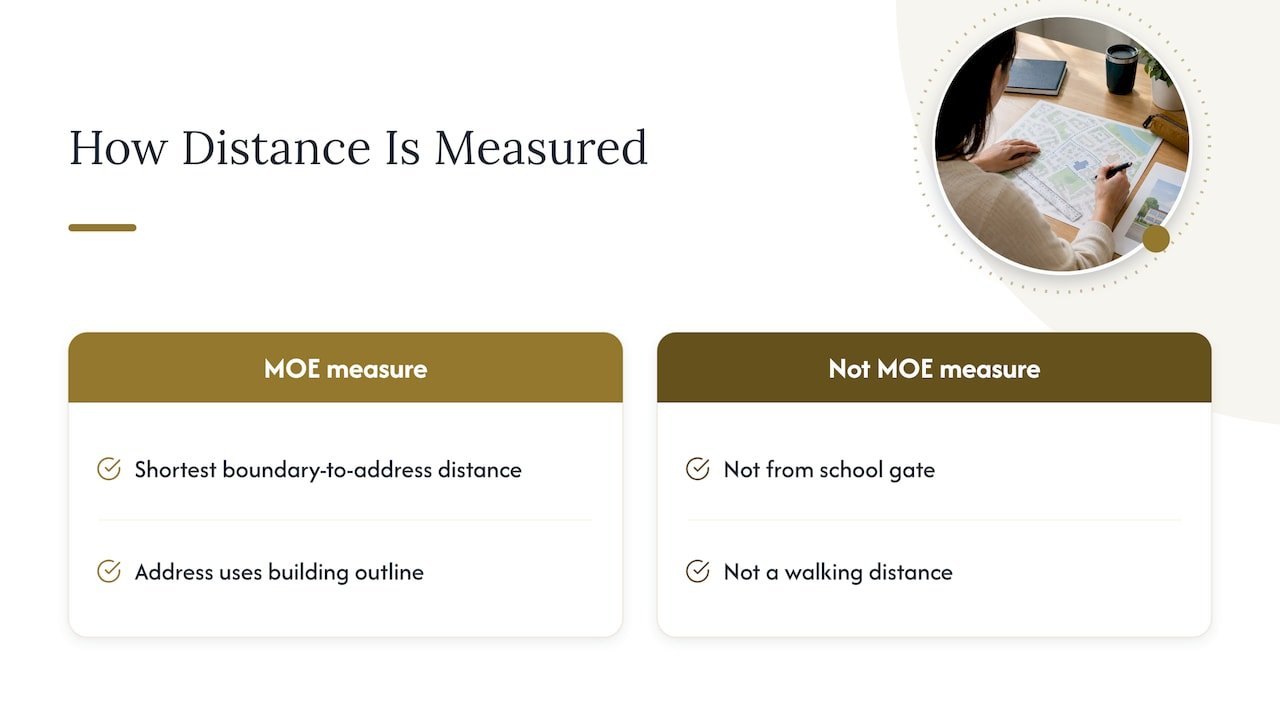
MOE defines Home-School Distance as the shortest distance from any point on the school’s boundary to your official residential address. For the address, MOE uses the building outline in the building plan submitted by the Qualified Person. It is not a walking distance and not the distance from the school gate, which is why a home that looks far on a road map can still fall within 1km.
How to check your address
Use the OneMap School Query service. Parents should check it in the year of their child’s P1 Registration Exercise, since this confirms the HSD category MOE will apply to your address. Search for your building and the tool lists the schools within 1km and those between 1km and 2km.
What if you are just over 1km?
Distance is categorised by band, and the official category on OneMap is what counts. A home that appears marginally over 1km on a map app may still be inside it using MOE’s boundary-based method, and the reverse can happen. Rely on the official tool and not on consumer map apps. If the tool places you between 1km and 2km, you are in that band, even when the difference is small. If you are unsure, contact the school or MOE during the registration period.
The address you register with
The address must be the parents’ official residential address as shown on their NRICs. MOE says that giving false information to a public officer is an offence, and that it takes a serious view of using an address only for P1 registration. MOE may transfer a child to another school if it finds abuse or if parents cannot prove the registration information was true and accurate.
Families who qualify through their address have a continuing obligation too, covered below.
The 30-month stay requirement
A child admitted through the distance category must reside at the registered address for at least 30 months from the start of the P1 Registration Exercise. If the requirement is not met, or parents cannot give satisfactory evidence, MOE may transfer the child to another school.
The starting point of the 30 months depends on the property:
| Property type | When the 30 months begin |
|---|---|
| New property | When the family moves in |
| Resale property | At the start of the child’s P1 school term |
For families buying with a school in mind, this affects timing and the choice of home. If you plan to buy, it helps to know the condition of the property before you commit, since you will be living there for a minimum period. A pre-purchase pest inspection in Singapore is one of the checks to consider before completing a purchase, because moving out early because of a problem could put the stay requirement at risk.
What is changing: the Two-Track Scheme from 2027
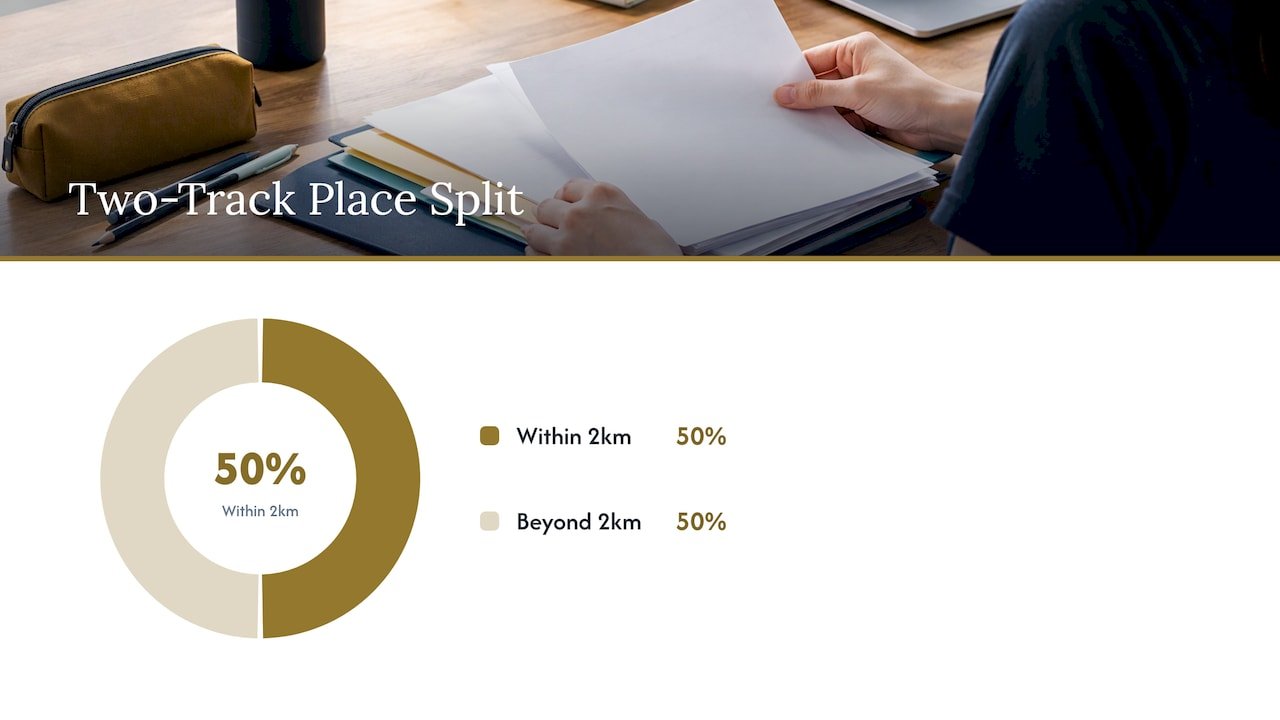
MOE has announced a change for the 2027 P1 Registration Exercise. Twelve schools in neighbourhoods with low public housing density will use a Two-Track Scheme for Phase 2C. Their places will be split equally between children living within 2km and children living beyond 2km, and within each track there will be no HSD priority.
Two details matter:
- Singapore Citizens are still admitted before Permanent Residents.
- If places remain in one track, they can go to Singapore Citizen applicants in the other track.
For families, this means the 1km band will carry no extra weight in Phase 2C at those 12 schools. Check MOE’s page for the list of schools before you decide on an address. At all other schools, the distance bands described above continue to apply.
What this means if you are buying or renting a home
Many families first meet the 1km rule when they search for a home. A few practical points help.
- Check the school list and the address first. Use OneMap School Query on the actual block or condo you are considering, and note which schools fall within 1km and 2km.
- Plan around the registration year. Registration happens in the year the child turns six, so the address needs to be in place and correct by then. Allow time for completion, which is where the stamp duty timeline and the option to purchase steps affect your schedule.
- Budget for the full cost of the move. Buyers who already own a home should consider the second property costs and, for foreign buyers, the ABSD rate. Those who upgrade from an HDB flat should look at the resale levy where it applies.
- Match your loan to your timeline. LTV limits shape how much cash you need up front.
- Remember the 30 months. The home must be your genuine residence for the stay period, so choose a property you can live in comfortably for that long.
Renting is a different case. The address must still be your official residential address on your NRIC, and the same stay requirement applies to children admitted on distance. Expat families should note that foreign nationals fall under the international student route and not the Phase 1 to 2C Supplementary phases for citizens and PRs. Foreign tenants can read about HDB rental rules for foreigners.
Our perspective
We speak with families every year who begin their property search with a school and end up with a shortlist that does not fit their budget or timeline. The 1km band is a real advantage, but it is one factor among several, and it works best when the home is also the right financial decision.
Our view is that the address should come first as a purchase decision: price against comparable sales, financing, and how the property is taxed. A detailed market evaluation shows where a listing sits against recent transactions, and that is where buyers find gaps and opportunities. With over $1 billion in sales behind our team, we use that evaluation to help clients negotiate with facts in hand.
We also help clients structure purchases to avoid the burden of Additional Buyer’s Stamp Duty (ABSD), which makes a family’s second property, or an investor’s purchase, more affordable. A school-centred search is easier when the cost of the move is clear from the start.
Anderson
Find a home near your school of choice
If you are weighing a purchase or a sale around the P1 timeline, we can help with listings, negotiation and a clear view of the numbers. Browse our residential listings or contact us through Register Today.
If you already own a home near a school and are thinking of selling, our free property valuation shows what the home could fetch before you decide.
FAQ
Is 1.02km counted as within 1km?
No. Distance is placed into bands, and a home measured at 1.02km falls in the 1km to 2km band. Use OneMap School Query to see which category MOE assigns to your address. If the result is unclear, contact the school or MOE during registration.
Does the 1km rule apply to Permanent Residents?
Yes, but Permanent Residents rank below Singapore Citizens. According to MOE, a PR living within 1km comes after Singapore Citizens in all three distance bands. This is why PR families may need to consider other schools even when they live very close to the one they prefer.
What happens if we move after our child is admitted?
A child admitted through a distance category must live at the registered address for at least 30 months from the start of the P1 Registration Exercise. If the requirement is not met, MOE may transfer the child to another school. Contact MOE before any move to understand your options.
Does the 1km priority apply to every school?
It applies under the standard framework. From the 2027 exercise, 12 schools in low public housing density neighbourhoods will use a Two-Track Scheme in Phase 2C with no HSD priority inside each track. Check MOE’s list for the schools involved.
Sources
- How distance affects priority admission for P1 registration, MOE
- Understand balloting in P1 registration, MOE
- Address used for P1 registration, MOE
- Changes to the Primary 1 (P1) Registration Framework, MOE
- Registration phases and key dates of P1 registration, MOE
- Primary 1 registration: 33 primary schools oversubscribed, CNA