

Stamp Duty Timeline: Singapore Buyers Have 14 or 30 Days
IRAS expects you to stamp a document within 14 days of signing it in Singapore, or within 30 days of receiving it in Singapore if you signed it overseas. That covers common instruments such as sale and purchase agreements and tenancy agreements, and each duty has its own timing rules. We publish this guide at Register Today so you can plan every date around your signing.
TL;DR:
- When parties sign on different dates, record the first signature; for overseas signing, keep a courier receipt or timestamp proving when the document arrived in Singapore.
- BSD is calculated on the purchase price or market value, whichever is higher, while ABSD depends on the buyer’s profile; budget for both before the deadline.
- Completion, possession, mortgage approval, and loan disbursement do not reset the stamping clock, so arrange duty funds separately from completion costs.
- PayNow QR provides immediate certificate access when payment is made within 15 minutes; GIRO can take up to three weeks to activate, making it unsuitable near a deadline.
- Late penalties are $10 or the duty, whichever is greater, for delays up to three months; afterward, they rise to $25 or four times the duty.
Table of Contents
- Quick timeline at a glance: when stamping is due
- How the 14 and 30 day rule works in practice
- When BSD, ABSD and SSD are payable and what that means for timing
- How to pay and get your stamp certificate
- Penalties, enforcement and what to do if you miss the deadline
- Remissions, refunds and appeals: timelines to expect
- Practical timeline checklist for buyers and signatories
- How stamp duty timelines interact with completion and possession dates
- Do deadlines differ for residential, commercial and industrial property?
- How mortgages and financing affect stamp duty deadlines
- What happens beyond penalties if you miss the stamping deadline
- Electronic stamping: validity and keeping your stamped status
- Why we say plan the stamping date before you sign
- Plan your Singapore property purchase with Register Today
- FAQ
- Sources
Quick timeline at a glance: when stamping is due
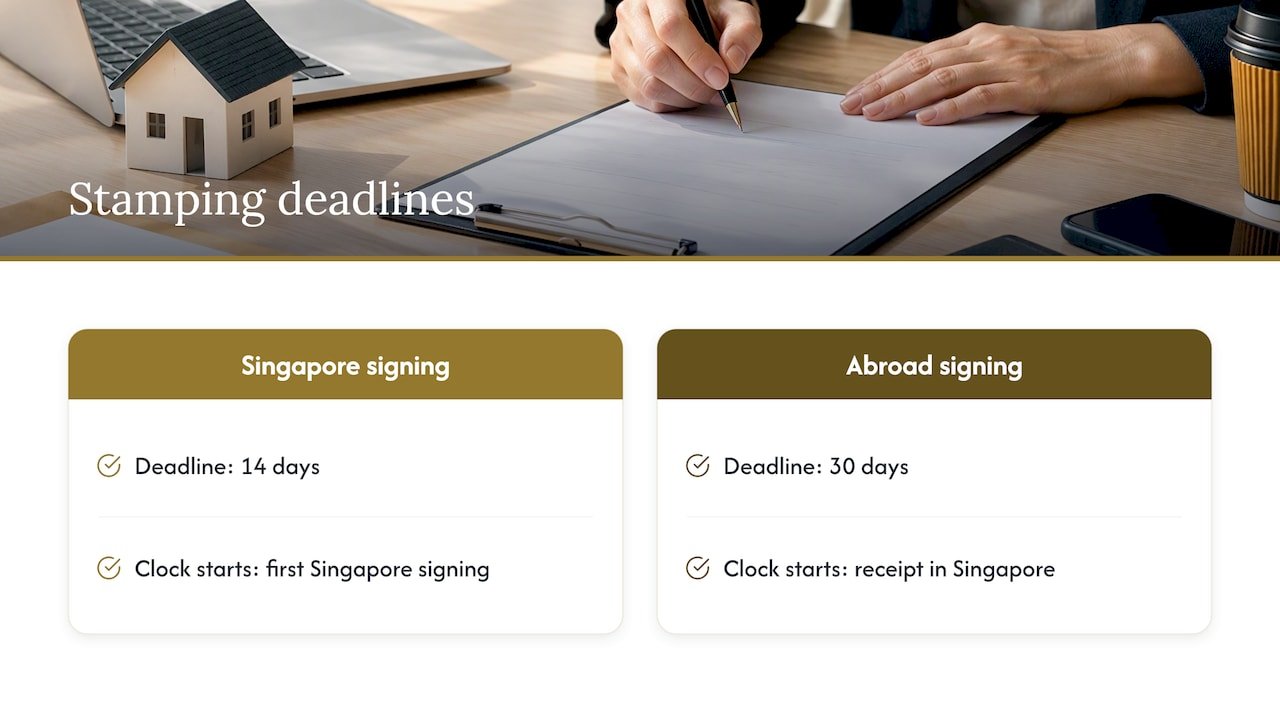
The 14 and 30 day deadlines are the backbone of the whole process. IRAS states that a document signed in Singapore must be stamped, with payment, within 14 days of signing to avoid a penalty. A document signed overseas must be stamped within 30 days of receiving it in Singapore. In both cases the countdown starts from a specific event, so the first job after signing is to write that date down.
Here is how the main milestones usually line up:
- Signed in Singapore: stamp within 14 days of the date the document was first signed.
- Signed overseas: stamp within 30 days of the day the document reaches you in Singapore.
- Sale and purchase agreement: stamping follows the execution of the agreement, and the buyer’s duty is paid through the same stamping record.
- Tenancy agreement: treated as a dutiable document, so the same 14 or 30 day logic applies once it is signed.
- Share transfers and other property related instruments: check the applicable stamping deadline with IRAS.
- Missing the window: a late payment penalty is added on top of the duty, and it grows the longer you wait.
The practical lesson is to check the applicable deadline and allow time to complete stamping, including around weekends and public holidays. If you want the full penalty picture before you read on, jump to the section on penalties and enforcement below.
For readers who want a wider view of how these dates sit inside a purchase, our guide to the progressive payment schedule for Singapore buyers shows how stamping fits next to the other cash calls in a transaction.
How the 14 and 30 day rule works in practice
The clock runs from the date the document is first signed, often called the execution date. IRAS treats this date as the start of the deadline, which is why accurate record keeping matters. If you cannot show when the document was signed, you cannot easily prove that you stamped on time.
A few real-world situations change how you apply the rule:
- Parties sign on different dates. The date first signed generally determines the start of the deadline. Keep a record of that date.
- Overseas signing. If any signing happens abroad, the 30 day window runs from receipt of the document in Singapore. Keep the courier slip, email timestamp or an official receipt that shows when it arrived.
- Trust instruments. Confirm the relevant date with whoever prepared the instrument before setting your reminder.
- Collective sale contracts. Many owners sign over a period of time. Agree early on who is responsible for stamping and which signing date triggers the deadline.
- Electronic signatures. Keep the signing platform’s audit trail and confirm the relevant date with IRAS or the document preparer.
IRAS also notes that you are required to stamp a document before you sign it, which is a point many people overlook. IRAS guidance says to stamp the document before signing. Check the applicable deadline and make sure stamping and payment are completed on time.
Pro Tip: Set two reminders the moment a document is signed: one at day 7 and one at day 12. That leaves room for a portal outage, a missing detail or a payment that needs a second attempt.
When BSD, ABSD and SSD are payable and what that means for timing
Singapore uses three main property related stamp duties, and each one arises at a different point in the transaction. The deadline mechanics are the same, but what triggers the duty is not.
- Buyer’s Stamp Duty (BSD). BSD is payable on the acquisition of property and is computed on the purchase price or market value, whichever is higher. It must be paid within the standard stamping deadline linked to the executed instrument. Because the market value can exceed your agreed price, a low valuation does not protect you from a higher bill. Our note on valuation risk and BSD explains this in more detail.
- Additional Buyer’s Stamp Duty (ABSD). ABSD applies to certain residential purchases and depends on the buyer’s profile, such as citizenship, number of properties owned or the type of buyer. Payment timing follows the same stamping deadline as the underlying instrument. IRAS publishes an ABSD page that explains the buyer categories and filing steps. If you are a foreign buyer, read our guide on what foreign buyers must budget for ABSD, and for cash planning see our ABSD planning steps for 2026.
- Seller’s Stamp Duty (SSD). SSD applies to residential properties disposed of within the SSD holding period. Check IRAS guidance for the applicable payment deadline. The Ministry of Finance announced on 3 July 2025 that the SSD holding period increases from three to four years, with higher SSD rates for properties purchased on or after 4 July 2025 and no transition period. Our article on avoiding a surprise Seller’s Stamp Duty bill covers how this affects sellers.
Rates and thresholds are set by IRAS and MOF and can change, sometimes without a transition period. The MOF newsroom describes these measures as dynamic tools that are updated to manage market demand. Always check the current IRAS stamp duty rate tables before you commit to a budget, because the tables are the authoritative source for calculating what you owe.
One timing point is worth stressing. Because all three duties share the same stamping window, a buyer who also has to find ABSD funds has a single deadline to meet for a much larger sum. Plan your cash so that the full duty amount is available well before day 14.
How to pay and get your stamp certificate
You pay through the myTax Portal, and the process is short once you know the sequence. IRAS sets it out in its Pay Stamp Duty guide.
- Log in to the myTax Portal and open Stamp Duty, signing in as an Individual or Business user.
- Select Records, then Search Records or Cases, to find your stamping record. If none exists, create one.
- Note the Document Ref No. shown on the record, since you will need it later.
- Choose your payment mode and complete payment, then download the stamp certificate.
PayNow QR is the quickest route. You generate the code in the portal, and IRAS confirms that the QR code is active for 15 minutes. If you pay inside that window, the stamp certificate is available straight away on the acknowledgement page. If you miss it, the QR stays valid until the end of the next day, and paying then still lets you retrieve the certificate.
15 minutes: the PayNow QR window for immediate certificate retrieval, with validity until the end of the next day if you pay later. IRAS PayNow QR guidance confirms both periods. Treat the 15 minutes as your target and the next-day validity as a safety net, not a plan.
GIRO suits people who stamp regularly, such as landlords with several tenancies. You manage it through the myTax Portal, but GIRO activation can take up to three weeks after bank approval, and some setup steps need a signed original form to be mailed. That makes GIRO a poor choice if your deadline is days away. For a one-off purchase, PayNow QR or another direct payment mode is usually the better fit.
Once payment succeeds, the stamp certificate appears in the portal for download. IRAS also publishes pages on how to retrieve and verify a stamp certificate, which is useful if your lawyer, bank or buyer asks you to prove the document is stamped.
Penalties, enforcement and what to do if you miss the deadline
Late stamping costs money, and the cost rises with the delay. IRAS sets out two tiers in its guidance on late payment or non-payment of stamp duty:
- Delay not exceeding 3 months: a penalty of $10 or an amount equal to the duty payable, whichever is greater.
- Delay exceeding 3 months: a penalty of $25 or four times the duty payable, whichever is greater.
- Enforcement: IRAS issues penalty notices and may impose travel restriction orders until payment is received. Paying what is owed clears the obligation and releases the restriction.
On a large property purchase, the difference between the two tiers is substantial, because the penalty scales with the duty itself. That is why a missed deadline should be dealt with immediately rather than left to resolve itself.
If you receive a penalty notice, log in to the myTax Portal, find the record using the Document Ref No., pay the duty and penalty through your chosen mode, and download the updated certificate. If you realise you made an error in an earlier filing, the Voluntary Disclosure Programme is the general route for correcting it before IRAS finds it, and it is worth raising with a tax adviser.
Pro Tip: If you are close to day 14 and something goes wrong, pay the duty first and sort out the paperwork afterwards. A short delay with full payment is far cheaper than a long one.
Remissions, refunds and appeals: timelines to expect
Sometimes duty is overpaid, assessed incorrectly or eligible for relief. You deal with all of this through the myTax Portal, and IRAS lists the common remissions and reliefs for property with the process for each.
- Applying: submit your request for assessment, remission or refund through the portal, with the supporting documents the relevant page asks for, such as the executed agreement and proof of payment.
- Timing: IRAS publishes processing expectations for simple amendments, refunds and more complex cases on its pages, so check the current figures there rather than relying on an old rule of thumb.
- Escalation: if IRAS disputes your assessment or your relief claim is complex, speak to a lawyer or tax professional before you respond, because an unsuccessful appeal can leave you short of time.
Do not treat a pending remission as a reason to delay stamping. File and pay within the standard window, then pursue the refund or relief afterwards, so that you are never exposed to late payment penalties while you wait.
Practical timeline checklist for buyers and signatories
Use this sequence from signing day to certificate storage:
- On signing day, record the execution date, collect the originals or an official receipt, and agree who will pay the stamp duty.
- Within 14 days, submit the stamping record in the myTax Portal, choose a payment route, pay and download the certificate.
- If the document was signed overseas, confirm when it reached Singapore, record that receipt date and stamp within 30 days of it.
- Set reminders at day 7 and day 12, or at the equivalent points of your 30 day window.
- Save the Document Ref No. and the downloaded certificate in two places, and note when to follow up on any amendment or refund.
Pro Tip: Email the stamp certificate to your lawyer and your lender on the day you download it. That way nobody has to chase you later.
How stamp duty timelines interact with completion and possession dates
Stamping and completion are separate events with separate clocks. The stamping deadline runs from the signing of the document, whereas completion and possession happen on the dates set in your agreement. Completion may be weeks or months after the option is exercised and the agreement signed, but your duty is still due within the standard window.
This catches buyers out. You might expect to pay duty when you collect the keys, yet IRAS expects payment shortly after signing. For a completed resale, completion is often a few weeks after signing, so the duty is usually due before you get possession. For a purchase with staged payments, the duty is tied to the signed agreement, not to the later cash calls.
Cash planning follows from this. Keep the stamp duty funds separate from your completion funds, because the two needs arise at different times. If you use a lawyer, ask them to confirm in writing who is stamping the document and by which date. Our guide to the progressive payment schedule shows how to line up these outflows so the early stamping payment does not strain the later ones.
Possession does not itself determine the stamping deadline. Check the applicable deadline for the document with IRAS, regardless of when you get access to the property.
Do deadlines differ for residential, commercial and industrial property?
The 14 and 30 day rule is a general rule for documents, not a rule that changes with the building type. A commercial office lease or an industrial sale agreement is stamped on the same basis as a residential one: from the date it is first signed in Singapore, or from receipt in Singapore if signed abroad.
What differs is the duty itself. IRAS publishes differentiated BSD rates for residential and non-residential acquisitions, and ABSD applies to residential purchases by buyer profile. ABSD applicability varies according to the buyer profile. Check the IRAS rate tables to establish whether it applies to your purchase.
SSD, meanwhile, is tied to residential disposals within the holding period, so a commercial seller is generally outside it. That changes the cash you need, not the date by which you need it.
If you are weighing the two categories, our comparison of financial metrics for choosing commercial or residential property helps you see how duty fits into returns. You can also browse our residential, commercial and commercial office listings to see what is on the market. For a specific instrument in an unusual category, confirm treatment on the IRAS pages or with your lawyer.
How mortgages and financing affect stamp duty deadlines
A mortgage does not move your stamping deadline. The bank’s approval, the loan disbursement date and the lender’s own conditions all run on their own timelines, but IRAS still expects the duty on the signed agreement within 14 or 30 days. If your loan has not been disbursed by then, you still need to pay the duty from your own funds.
This is a frequent pressure point. Many buyers assume the lender pays duty, when in fact duty is a buyer cost that comes from cash or CPF funds arranged separately from the loan. Check with your lender what they will and will not finance, and what documents they need as proof of stamping.
Ask your lender and lawyer whether they require evidence of stamping and which documents in the transaction are dutiable, then confirm the applicable deadlines with IRAS.
Practical advice: line up your stamp duty cash before you accept the option, ask your bank for its disbursement timetable, and send the downloaded certificate to your lender as soon as you have it. A free property valuation before you commit can also help you gauge the market value on which BSD is based.
What happens beyond penalties if you miss the stamping deadline
Penalties are only part of the cost. A document that is not stamped on time can run into practical and legal problems beyond the fine.
First, an unstamped or late-stamped document may raise legal or procedural questions. If you are concerned about relying on an agreement, seek legal advice and check IRAS guidance on stamping.
Second, ask your bank and lawyer whether they require proof of stamping before taking action, and whether an unstamped document could affect your transaction.
Third, as IRAS notes, enforcement can include travel restriction orders until payment is received, which affects you personally and not just the document.
Whether late stamping affects your ownership rights in a particular case depends on the facts and the instrument, so take legal advice if you are already past the deadline. The safest approach is to stamp first and deal with any other questions afterwards.
Electronic stamping: validity and keeping your stamped status
Once you pay, the document is e-stamped, and the certificate in the myTax Portal is your proof. IRAS explains how to retrieve a stamp certificate and verify its authenticity, which is useful if a third party wants to confirm the stamping is genuine.
To keep your stamped status reliable, look after three things:
- The Document Ref No. Keep it with your records, because it is the key to finding the record again.
- The certificate itself. Download it immediately after payment and store copies securely, rather than relying on being able to log in later.
- The details on the record. If the stamped document is later amended or the details were entered incorrectly, ask IRAS to correct the record through the portal instead of leaving a mismatch between the document and the certificate.
IRAS does not present stamping as something that lapses on a short timer, so the practical requirement is accuracy and retrievability rather than renewal. If you need a definitive answer about how long a particular certificate or record remains accessible, check the current IRAS guidance directly, because system rules can change.
Why we say plan the stamping date before you sign
Most late stamping is not caused by ignorance of the rule. It happens because stamp duty is the one cost that sits between two bigger events: the excitement of signing and the stress of completion. People forget it. A deadline of 14 days sounds generous until a lender asks for extra documents and a holiday week intervenes.
Our view is that the stamping date should go into your plan on the day you decide to buy, not the day you sign. Treat duty as a cash line with a date attached, and treat the execution date as the single most important fact to record. When you work out your budget with a free valuation and a clear negotiation plan, you also learn how much duty you will owe and when. That removes the surprise, which is where the expensive mistakes come from.
— Anderson
Plan your Singapore property purchase with Register Today

We help you buy, sell or rent property in Singapore, and we pair that with a free valuation and personalised negotiation support. Knowing your numbers early makes stamp duty timing far easier to manage.
- Buy, sell or rent: one team for the whole transaction, from the first viewing to the signed agreement.
- Free property valuation: a clear view of market value before you commit, which helps you estimate BSD and set aside funds.
- Negotiation support: terms and timing that leave room to stamp comfortably inside the deadline.
Ready to start? Request your free property valuation or contact our team and we will help you plan your timeline.
This article is general information, not a substitute for advice from a qualified financial advisor. Consult a qualified financial professional about your own circumstances before acting on anything here.
FAQ
How long do I have to pay stamp duty in Singapore?
If the document is signed in Singapore, the deadline is 14 days after signing. If it is signed overseas, the deadline is 30 days after receiving it in Singapore, as IRAS sets out on its stamp duty payment page.
What if I sign a property document overseas?
The deadline runs from the day the document arrives in Singapore, not the day it was signed. Keep proof of receipt, such as a courier slip or email timestamp, so you can show when your 30 day window began.
What is the penalty for paying stamp duty late?
IRAS applies a smaller penalty for delays of up to three months and a much larger one for longer delays, and it may also issue travel restriction orders. The exact amounts are on the IRAS late payment page.
How do I get my stamp certificate after paying?
Log in to the myTax Portal, find your record with the Document Ref No. and download the certificate once payment succeeds. With PayNow QR, paying within the 15 minute window gives you immediate access, as IRAS explains for PayNow QR.