
Residential Property Act in Singapore: What Buyers Need to Know
The Residential Property Act 1976 (RPA) decides who may own which kind of home in Singapore. In short, it restricts the purchase or transfer of residential property, including vacant land, to Singapore citizens and approved purchasers. Most buyers of condominium units, HDB flats and executive condominiums never need to think about it, but anyone looking at landed homes, or buying through a company or a trust, must get it right before signing. We work with buyers, sellers and tenants on Singapore residential and commercial property, and this guide sets out the rule, the exceptions and the points where deals go wrong.
TL;DR
- The RPA limits who can buy landed homes and vacant residential land. Singapore citizens need no approval; foreign persons, including permanent residents (PRs), generally do.
- Condominium units, HDB flats and executive condominium units are outside the approval requirement, so most first-time buyers are not affected.
- Approval is case by case, takes about 30 working days once documents are complete, and carries conditions such as owner-occupation and a five-year no-disposal period.
- A prohibited purchase is void, and breaches can mean fines and imprisonment.
- The RPA is separate from stamp duties such as Additional Buyer’s Stamp Duty (ABSD): you can be allowed to buy under the RPA and still owe stamp duty.
Table of Contents
- What the Residential Property Act does
- What counts as residential property
- Who is a foreign person
- Which properties need approval and which do not
- How the approval process works
- Conditions attached to approval
- Penalties for breaching the Act
- The RPA is not the same as stamp duty
- What this means for each type of reader
- How we help you stay on the right side of the rules
- Our view
- FAQ
- Sources
What the Residential Property Act does
The Act has one purpose: to keep Singapore’s limited supply of landed housing mainly for Singapore citizens. The Ministry of Law explains that selected foreigners who have shown social commitment and made significant economic contributions can still be allowed to own landed homes. The Singapore Land Authority (SLA) handles those applications through its Land Dealings Approval Unit.
Two rules in section 3 carry most of the weight. A person must not transfer residential property to a foreign person, and a foreign person must not buy or acquire residential property, except by way of mortgage, charge or reconveyance. Under section 3(2), a prohibited transfer, trust or purchase is void. Void means the contract has no legal effect, which is the worst outcome for a buyer who has already paid a deposit.
What counts as a transfer
The Act reads “transfer” broadly. It covers conveyance, sale, assignment, settlement, declaration of trust and other dispositions. It does not cover a mortgage, charge or reconveyance, so a bank can take security over a restricted property without breaching the Act (Singapore Statutes Online).
What counts as residential property
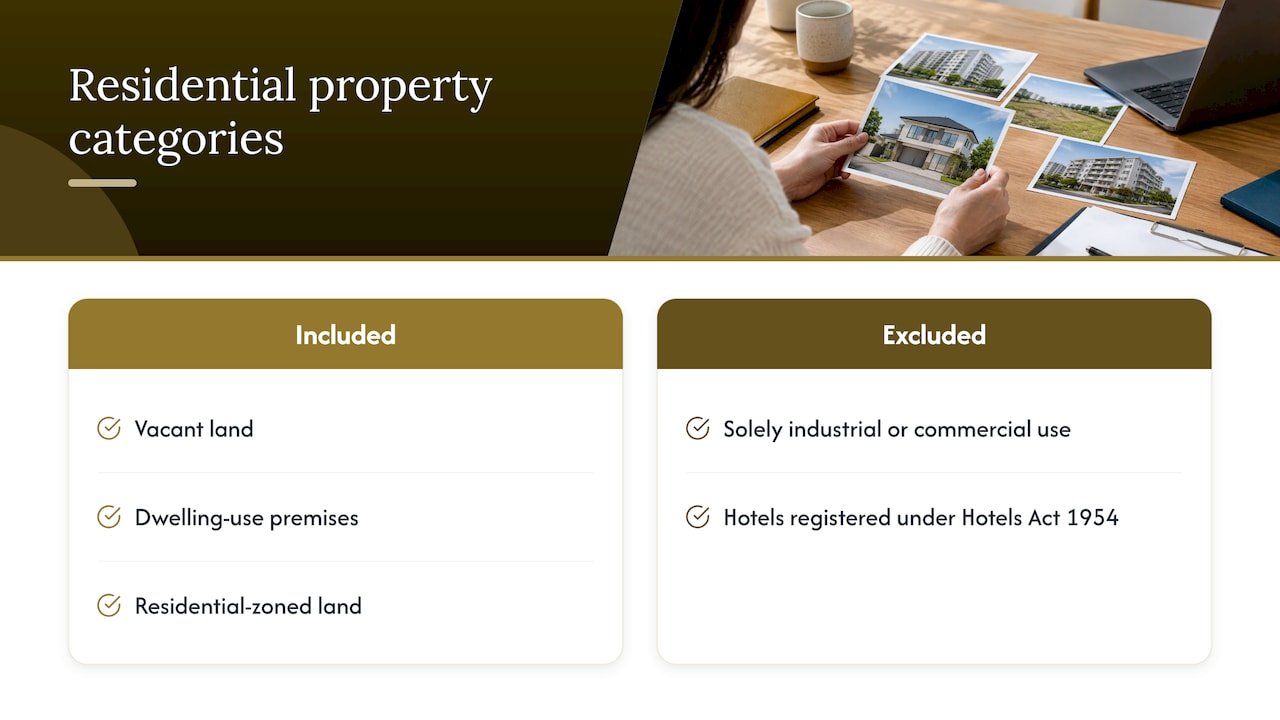
The definition in section 2 is wider than most people expect. Residential property includes vacant land, any house or premises permitted or lawfully used as a dwelling, and land zoned residential in the Master Plan. Land or premises used solely for industrial or commercial purposes are excluded, as are hotels registered under the Hotels Act 1954.
The Master Plan is the government’s land-use plan for Singapore. Because zoning is part of the test, a vacant plot zoned residential is caught even though no house stands on it. This is also why commercial buyers should check zoning before committing, a point we cover in our guide to zoning checks for commercial property.
Who is a foreign person
The Act’s definition is blunt. A foreign person is anyone who is not a Singapore citizen, Singapore company, Singapore limited liability partnership or Singapore society (Singapore Statutes Online). Two consequences follow:
- Permanent residents are foreign persons under the RPA. A PR who has lived and worked here for years still needs approval for restricted property.
- Singapore-incorporated companies are not foreign persons, but the Act has anti-avoidance rules. Nominee arrangements are void and carry penalties, which we return to below.
The Second Minister for Law confirmed in a written parliamentary answer of 14 October 2024 that foreign individuals, including PRs, and foreign entities must seek approval to acquire landed residential property whether they buy directly or through a vehicle such as a trust company. For trust-company holdings, no approval is needed if the beneficiaries are Singaporean. If you are planning to buy through an entity, read our guide to buying property under a company before you sign anything.
Which properties need approval and which do not
The SLA publishes two lists, last updated on 20 August 2025. The table below summarises them.
| Property type | Foreign person needs RPA approval? |
|---|---|
| Vacant residential land | Yes |
| Terrace, semi-detached, bungalow and detached houses | Yes |
| Strata landed houses outside an approved condominium development (townhouse, cluster house) | Yes |
| Landed property at Sentosa Cove | Yes |
| Shophouses for non-commercial use | Yes |
| Condominium units and flat units | No |
| Strata landed houses within an approved condominium development | No |
| Executive condominium units, HDB flats and HDB shophouses | No |
| Shophouses for commercial use, industrial and commercial properties, registered hotels | No |
| Leasehold landed estates of 7 years or less, including renewal options | No |
Source: SLA, Foreign ownership of property.
Section 4 of the Act gives the legal basis for the condominium exemption. It exempts qualifying flats in non-landed residential buildings, condominium units and executive condominium units. Two limits matter. Buying all the flats or units in an entire development still needs prior Ministerial approval, and a lease or assignment for a term not exceeding seven years is permitted.
The line between strata landed and conventional landed homes is where buyers most often misjudge. Whether a strata house sits inside an approved condominium development decides which column it falls in. Our article on strata landed versus conventional landed homes sets out the checks, and what a foreigner can buy: condo versus landed walks through the same divide from the buyer’s side.
Executive condominiums and HDB flats
Executive condominium units are on the SLA’s non-restricted list, but separate HDB and executive condominium eligibility and minimum occupation period rules apply, so the RPA is not the only test. Our note on which executive condominiums keep the five-year minimum occupation period after 2026 covers that side.
How the approval process works
A foreign person who wants to buy, acquire or retain restricted residential property must apply to the Minister through the Controller of Residential Property, under section 25. In practice, the SLA runs it as follows:
- Apply online. All applications go through the SLA’s e-services. You can apply for in-principle approval before you have found a property.
- Wait for assessment. The SLA says this generally takes about 30 working days from receipt of all required documents.
- Apply before you sign. The SLA’s FAQs advise applicants to obtain in-principle approval before signing any contract, to avoid forfeiting money paid if approval is refused.
- Submit the property details in time. Once approval is granted, the details of the property must be submitted within one year of the approval letter, or the approval lapses and a fresh application is needed.
What the SLA looks for
Approval is assessed case by case. The SLA states that the applicant should be a Singapore permanent resident for at least five years and make an exceptional economic contribution to Singapore, judged by factors such as employment income assessable for tax in Singapore. PRs are generally allowed to buy restricted residential property only if it does not exceed 15,000 square feet and is not in a Good Class Bungalow area, according to the SLA’s e-services FAQs.
The 2024 written answer adds a data point on how strict the policy is: per SLA records, no approvals have been given to any foreign purchaser to acquire a Good Class Bungalow since 2021. Anyone budgeting for a bungalow purchase as a foreigner should plan on that basis.
Conditions attached to approval
Approval is not a blanket right to do as you wish with the property. The SLA’s FAQs list conditions that include:
- Owner-occupation only. Renting out any part of the property is strictly prohibited.
- No disposal within five years from legal completion, or from the Temporary Occupation Permit or Certificate of Statutory Completion for a property under construction.
- No subdivision without prior written approval.
These come from the SLA’s e-services FAQs. The owner-occupation condition surprises buyers who assume a landed home can be let out while they work abroad. Plan your exit and your housing needs against these conditions before you apply.
Penalties for breaching the Act
The penalties are severe, which is why the rules deserve attention before a deal, not after. Under the Act as published on Singapore Statutes Online:
| Breach | Consequence |
|---|---|
| Prohibited transfer to, or purchase by, a foreign person | Void (s 3(2)) |
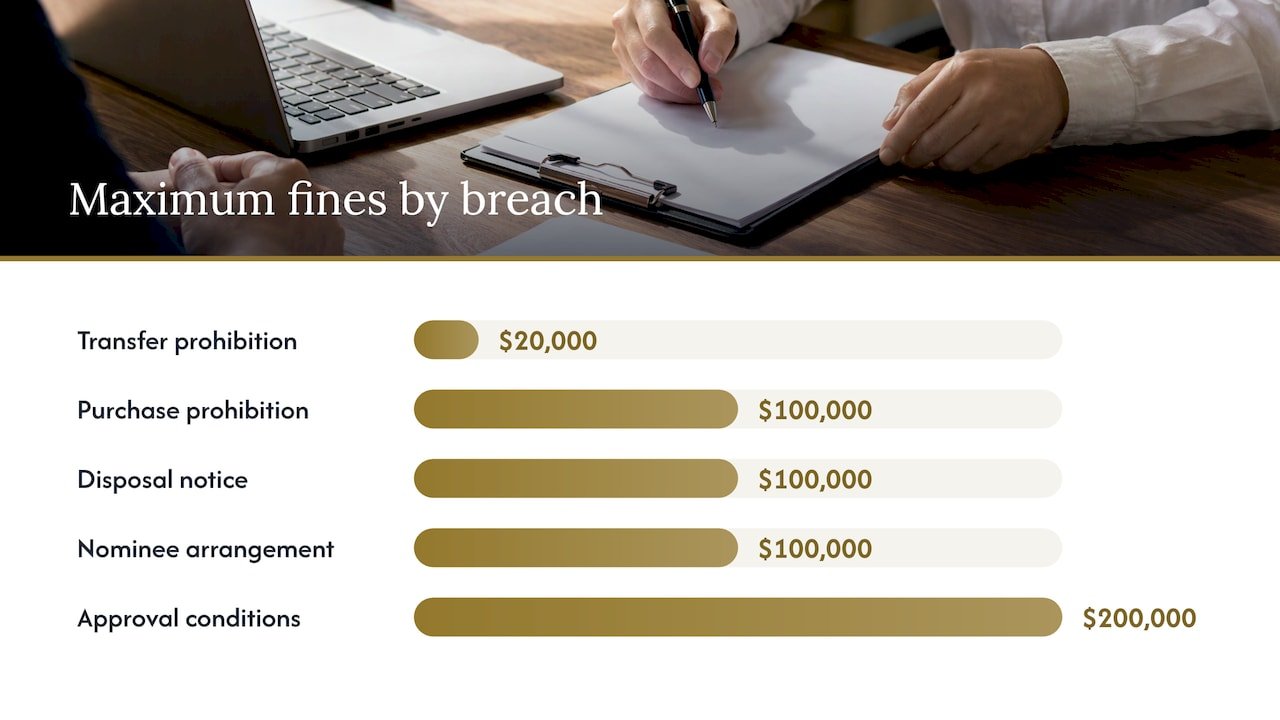
| Individual who contravenes the transfer prohibition | Fine up to $20,000, imprisonment up to 3 years, or both |
| Foreign person who contravenes the purchase prohibition | Fine up to $100,000 |
| Ignoring the Controller’s disposal notice | Fine up to $100,000, plus up to $500 a day, and $1,000 a day after conviction |
| Nominee arrangements (s 23) | Void, with fines up to $100,000 and/or up to 3 years’ imprisonment |
Breaching approval conditions is a separate offence under section 25C, punishable by a fine of up to $200,000, imprisonment of up to 3 years, or both. Breaching the owner-occupation condition can also bring a financial penalty under section 25B(1) of up to three times the rental income earned or $10,000, whichever is higher (both per the SLA’s FAQs).
If you are unsure whether a structure or a property type is caught, take legal advice from a Singapore lawyer before you sign an option to purchase. We can help you narrow the property search to homes that fit your status, but the legal interpretation of your own arrangement is a lawyer’s job.
The RPA is not the same as stamp duty
The RPA answers one question: are you allowed to own this property? Stamp duties answer a different one: what tax do you pay for buying or selling it? Passing the first test does not remove the second.
- ABSD is charged on buyers according to their residency status and the number of properties they own. Our guide to ABSD for foreign buyers shows what to budget.
- Seller’s Stamp Duty (SSD) applies when residential property is sold within a set holding period. IRAS states that on 3 July 2025 the Government raised the holding period from three to four years and raised SSD rates by four percentage points per tier, effective for purchases on and after 4 July 2025.
The two regimes touch in one place. IRAS lists as an SSD exemption the case where foreigners must sell residential property as required under the RPA. If you are selling, our walkthrough on selling a condo in Singapore, with steps, SSD and costs shows how the holding period feeds into timing, and the loan-to-value limits article covers how much a bank will lend against the purchase.
What this means for each type of reader
First-time homebuyers who are citizens. You need no RPA approval. The Act’s practical effect on you is indirect: the pool of landed homes is protected for citizens, and a seller cannot lawfully pass a landed home to a foreign buyer without approval.
Families choosing an area. If you are a PR family eyeing a landed house near a good school, approval is required and the five-year no-disposal and owner-occupation conditions will shape your plans. Condominium units sit outside the requirement.
Expats needing rental assistance. Renting is not a purchase, so the Act does not stop you leasing a home. Leasehold estates of seven years or less are also on the non-restricted list. For public housing, see HDB rental rules for foreigners.
Commercial property investors. Industrial and commercial premises, and shophouses used commercially, are outside the restricted list. The test is use and zoning, so confirm the permitted use before you commit.
Sellers. Selling landed property to a foreign buyer without approval produces a void transaction and exposure to the transfer penalties. Qualify your buyer first.
How we help you stay on the right side of the rules
Register Today is a Singapore property platform for buying, selling and renting, with residential and commercial listings. If you want to know what your own home could fetch before you plan a sale or a purchase, our free property valuation costs nothing. You can browse residential listings to see which condominium, apartment and other home types are on offer, or start from our home page to buy, sell or rent.
Our team has handled over $1 billion in sales, and we pair that with detailed market evaluations and personalised negotiation, so a decision on price rests on the gaps and opportunities in the market.
Our view
Most people meet the Residential Property Act late, usually when an offer is already on the table. We would rather you meet it first.
The rule is simple to state: landed homes and vacant residential land are restricted, condominiums, HDB flats and executive condominiums are not. The difficulty is in the details, such as strata landed houses, trusts and company purchases, and the conditions that follow an approval.
Our approach is to start from the buyer’s status and the property type, then build the search around homes that fit. We provide a free property evaluation, personalised negotiation, and market analysis that looks for gaps and opportunities. For expats we offer rental assistance, and for sellers and investors we focus on structuring decisions around stamp duty from the start, because we believe transparent guidance gives better outcomes than surprises at completion.
Check the rule first, then price the property, then negotiate.
Anderson
FAQ
Can a permanent resident buy a landed house in Singapore?
Only with approval under the RPA. The SLA assesses each case, and PRs are generally allowed to buy restricted residential property only if it is not larger than 15,000 square feet and not in a Good Class Bungalow area. The applicant should also have been a PR for at least five years and show an exceptional economic contribution.
Can a foreigner buy a condominium without RPA approval?
Yes. Condominium units, flat units and executive condominium units are on the SLA’s list of properties a foreign person can buy without RPA approval. Other rules still apply, including stamp duties and, for executive condominiums, eligibility and occupation period rules. Buying an entire development is the exception and needs prior Ministerial approval.
How long does RPA approval take?
The SLA says assessment generally takes about 30 working days from receipt of all required documents. You can apply for in-principle approval before you identify a property, and the SLA advises doing so before you sign any contract. Once granted, you must submit the property details within one year or the approval lapses.
Does the Residential Property Act affect ABSD?
They are separate. The RPA governs whether you may own a property, while ABSD is a tax on the purchase. Being approved or exempt under the RPA does not reduce stamp duty, so budget for both when you plan a purchase.
Can I rent out a landed home bought with RPA approval?
No. Owner-occupation is a standard approval condition and renting out any part of the property is strictly prohibited. Breaching it can lead to an offence under section 25C and a financial penalty under section 25B(1).
Sources
- Residential Property Act 1976, Singapore Statutes Online
- Residential Property Act 1976, sections 3 to 25 and penalties, Singapore Statutes Online
- Section 4, Residential Property Act 1976, laws.sg
- Section 25, Residential Property Act 1976, laws.sg
- Foreign ownership of property, Singapore Land Authority
- E-Services FAQs, Singapore Land Authority
- E-Services FAQs (approval timing), Singapore Land Authority
- Land Policy and Administration, Ministry of Law
- Written answer by Second Minister for Law on Good Class Bungalows, 14 October 2024
- Seller’s Stamp Duty for residential property, IRAS