

SORA vs Fixed Home Loans in Singapore: How to Choose
A fixed-rate loan gives you a known instalment for the first few years. A SORA-pegged loan lets your instalment move with the market. The better choice depends on how much movement your budget can absorb and how long you expect to keep the loan. This guide explains both in plain terms, shows what a rate move does to a monthly payment, and gives you a checklist to use before you sign. If you are still working out what you can afford, our free property valuation is a practical first step before you speak to a bank.
TL;DR
- A fixed-rate loan keeps its rate unchanged for an initial period, usually a few years. After that, the interest becomes variable.
- A SORA-pegged (floating) loan moves with the Singapore Overnight Rate Average, so your instalment can rise or fall.
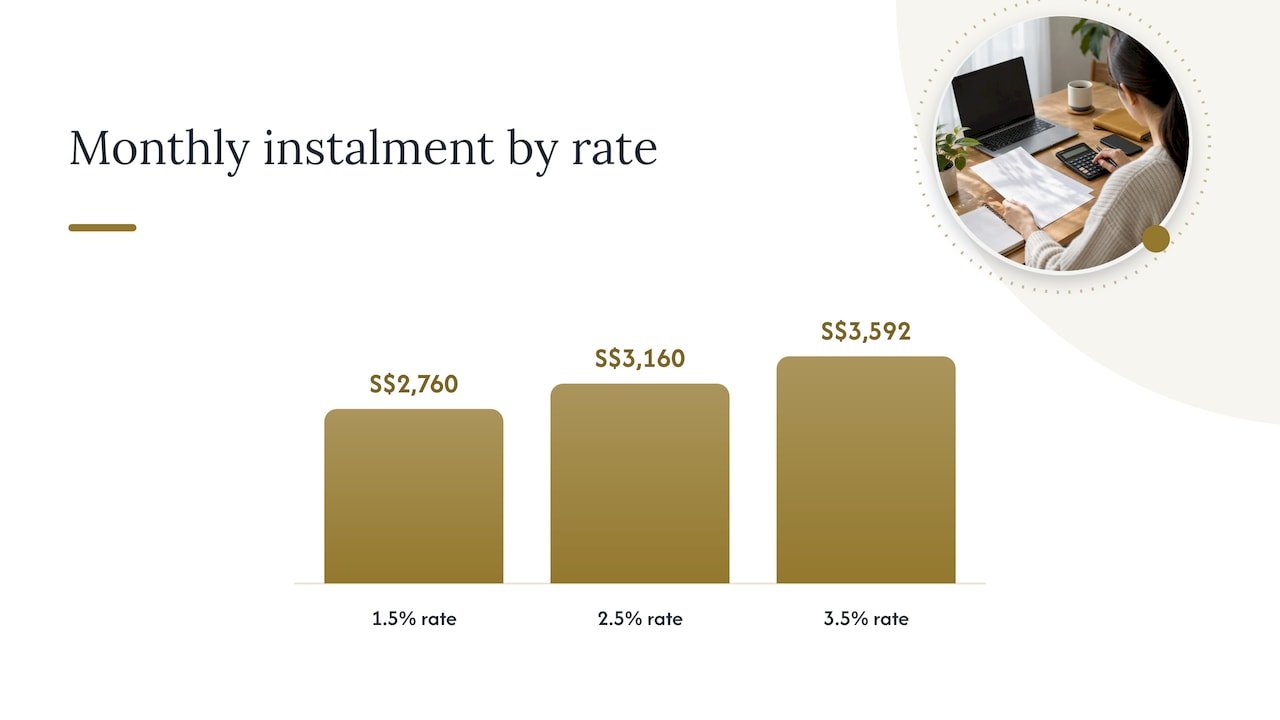
- On an S$800,000, 30-year loan, MoneySense shows the monthly instalment going from S$2,760 to S$3,160 to S$3,592 as the effective rate steps from 1.5% to 2.5% to 3.5%.
- SORA has replaced SIBOR for new Singapore dollar loans, and compounded SORA moves more smoothly than SIBOR did.
- Check the lock-in, the spread after year one, and your cash buffer before you pick.
Table of Contents
- What each loan type means
- What SORA is and how it reaches your instalment
- What a rate move does to your monthly payment
- SORA vs fixed: side-by-side
- SORA vs SIBOR: why the benchmark changed
- What to check before you choose
- Which choice fits which buyer
- Where rates may go, and what moves them
- How Register Today helps with the property side
- Our view
- FAQ
- Sources
What each loan type means
A home loan rate has two parts. The first is a reference rate, which is a market benchmark. The second is the bank’s spread, which is its margin on top. The Association of Banks in Singapore (ABS) describes variable-rate interest as a reference rate plus a spread, and notes that the spread for the first few years is often a promotional rate.
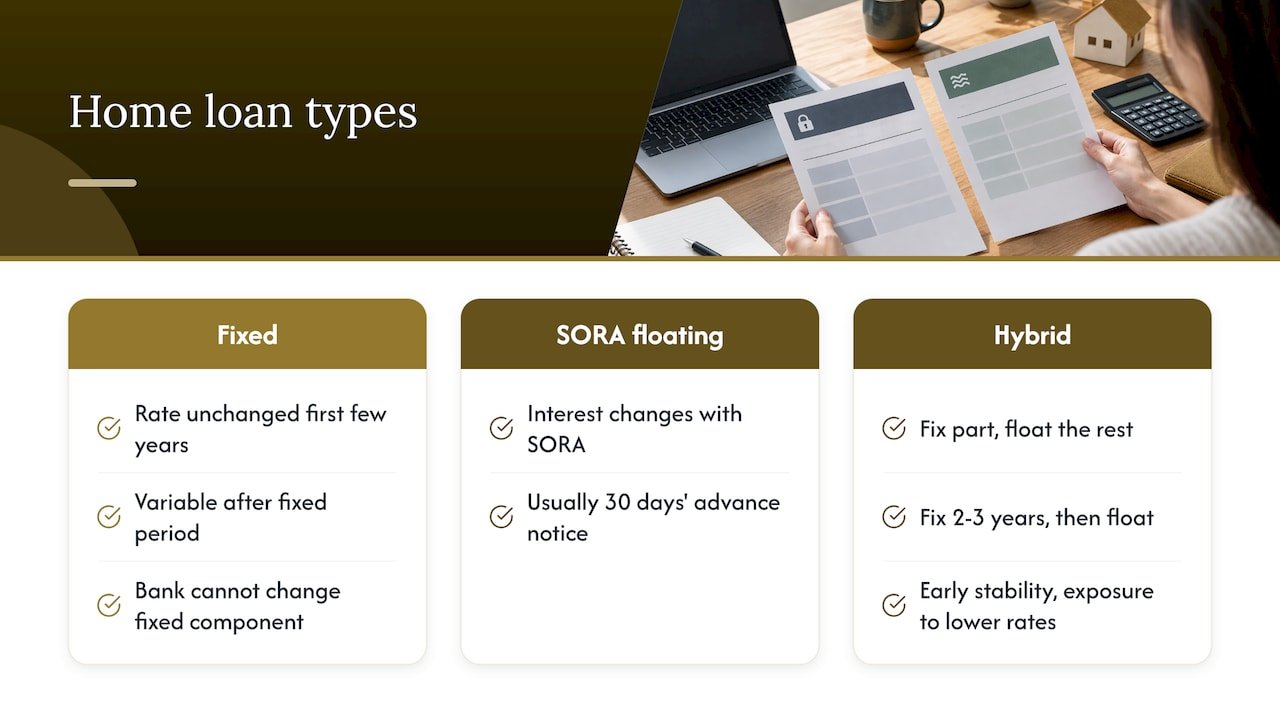
Fixed-rate loan. According to MoneySense, the financial education site run by the Monetary Authority of Singapore (MAS), a fixed-rate loan keeps its rate unchanged for the first few years, even when market rates fall. After the fixed period, the interest becomes variable. The ABS guide adds that during the fixed period the bank must not change the fixed component.
SORA-pegged floating loan. The interest varies with a reference rate such as SORA. When SORA rises or falls, the interest you pay changes with it. Banks must give advance notice, usually 30 days, before changing the interest rate on a housing loan, as MoneySense explains on the same page.
Hybrid (blended) packages. Some packages fix part of the loan and float the rest, or fix for two to three years and then float. They are a way to get some early stability with some exposure to lower rates.
What SORA is and how it reaches your instalment
SORA is the volume-weighted average rate of overnight borrowing between banks in Singapore dollars. MAS administers it and publishes it the next business day at 9am. It is built from actual transactions, not from banks’ quotes. MAS also publishes 1-month, 3-month and 6-month compounded SORA, which are averages of the daily rates over those periods.
Most floating packages are priced off compounded SORA. A typical package quotes 3-month compounded SORA plus a spread. The SORA part refreshes on a schedule, often every three months. The spread is set in your loan agreement. Rather than quoting a figure here that will be out of date by the time you read it, compare the live compounded SORA table on the MAS page with the rate sheet in any quote you receive. The compounded figure moves with local interbank liquidity and MAS’s exchange-rate-based monetary policy, and it is published every business day.
What a rate move does to your monthly payment
The clearest way to see the difference is to look at a worked example. MoneySense illustrates an S$800,000 loan over 30 years with monthly rests, meaning interest is recalculated each month on the outstanding balance:
| Effective interest rate | Monthly instalment |
|---|---|
| 1.5% | S$2,760 |
| 2.5% | S$3,160 |
| 3.5% | S$3,592 |
Source: MoneySense, How home loans work.
Two percentage points of movement adds S$832 a month on this loan, which is S$9,984 a year. A fixed rate protects you from that for the fixed period. A floating rate exposes you to it, but it also lets you benefit if rates fall.
If your loan is smaller, scale the figures down in proportion. The point is to know the gap before you commit, and to ask whether your household could carry the higher number comfortably. Banks also test your repayment capacity against the Total Debt Servicing Ratio, so your borrowing limit is set before the rate choice comes into play.
SORA vs fixed: side-by-side
| Feature | Fixed-rate loan | SORA-pegged floating loan |
|---|---|---|
| Monthly instalment | Stays the same during the fixed period | Can change when compounded SORA resets |
| Rate risk | Mostly carried by the bank during the fixed period | Carried by you |
| Starting rate | Typically set higher than floating, because the bank absorbs the rate risk | Often lower at the start |
| After the first years | Becomes variable, and the bank may revise the reference rate type or spread with at least 30 days’ disclosure | Continues to follow the reference rate plus the spread |
| Lock-in | Commonly at least two years | Commonly at least two years |
| Best for | Households that want a fixed budget | Households with a cash buffer and a view that rates will stay low or fall |
The general pattern, as Cashew’s mortgage guide puts it, is that fixed packages are priced above floating ones because the bank takes on the rate risk. The spread between the two changes from one period to the next, which is why a fresh quote matters more than any rule of thumb.
SORA vs SIBOR: why the benchmark changed
You will still see SIBOR (the Singapore Interbank Offered Rate) in older guides and in some existing loan documents. MoneySense says SORA has replaced SIBOR and SOR as the key benchmark for Singapore dollar loans. 1-month and 3-month SIBOR were scheduled to be discontinued after 31 December 2024, so borrowers on those packages needed to move to a SORA-based package or another package from their bank.
The practical difference is smoothness. SIBOR-based loans were set on a single day’s rate, so interest could jump on a reset date. Compounded SORA averages daily rates over one, three or six months, which makes it less volatile.
If you are buying now, you will almost certainly be quoted SORA packages. If you hold an older loan, ask the bank which benchmark it references and whether any conversion terms apply.
What to check before you choose
The loan comparison comes down to a handful of checks. Our own guide, 4 SORA fact sheet checks to pick fixed or floating loans, goes into more detail. The core questions are these.
- Read the Residential Property Loan Fact Sheet. ABS says it must show monthly and yearly repayments, the total repayment, the dollar cost per S$1 borrowed, and how your instalments change if rates change. Compare it side by side across banks.
- Find the spread and when it changes. The first-year spread is often promotional. Look at what the spread is in year two, year three and after.
- Check the lock-in. Home loan packages commonly carry a lock-in of at least two years. DBS notes that paying down or refinancing in that window can bring penalty fees. If you may sell or refinance early, a shorter lock-in matters.
- Test your budget at a higher rate. Use the MoneySense table as a model. If the 3.5% case would strain you, a fixed package for the first years is the safer fit.
- Hold a cash buffer on a floating loan. DBS suggests setting aside cash in case rates rise.
- Know the minimum loan size. Some packages set minimums, such as S$100,000 on certain floating packages, and may limit eligible property types.
Which choice fits which buyer
First-time buyers. Your income may be stretched by the down payment, renovation and furnishing. A fixed rate for the first two to three years gives you one number to plan around. Our first-time homebuyer guide sets out the rest of the process, including how loan-to-value limits affect how much cash you need.
Families. If you are planning around school fees and one income for a time, predictability tends to matter more than the last few basis points. A hybrid package can balance both.
Investors. If you hold several properties and can absorb movement, a floating loan with a short lock-in keeps you flexible to refinance or sell. Rental income is not guaranteed to move with your interest cost, so stress-test the numbers at a higher rate.
Sellers who will upgrade. If you may sell and buy within a few years, the lock-in matters more than the rate type. Think about the order of the two transactions as well, which we cover in Buy or sell first?.
Expats and renters. If you are renting rather than borrowing, SORA affects you indirectly, through the cost of financing for landlords and the wider market. It is worth following when you plan a purchase later.
Where rates may go, and what moves them
Nobody can tell you the path of SORA, and the safest approach is to choose a loan you could carry if rates went either way. What is useful is knowing what moves it. SORA is driven mainly by Singapore dollar interbank liquidity and by MAS’s exchange-rate-based monetary policy. It does not follow US Federal Reserve decisions in lockstep, although the two are linked through capital flows. Because compounded SORA looks backward over an averaging window, it moves gradually, not in jumps.
For our reading of the wider outlook, see Interest Rate Outlook for Singapore in 2026. If you already hold a loan and want to see whether switching makes sense, the refinancing break-even checklist shows how to weigh penalties and legal costs against savings. To understand the different loan structures and the affordability limits attached to them, read Singapore mortgage types: MSR, TDSR and LTV.
How Register Today helps with the property side
The loan is one half of the decision. The other is the price you pay or receive. Register Today lists residential and commercial properties in Singapore for buyers, sellers and renters, and offers free property valuations, detailed market evaluations and personalised negotiation. A tighter purchase price means a smaller loan, and a smaller loan means a smaller exposure to any rate move.
You can start with the free property valuation, or browse residential listings and commercial listings.

Our view
We think the fixed-or-floating question gets more attention than it deserves, and the purchase price gets less. A loan rate moves your instalment by a few hundred dollars. A price that is out of line with the market moves it by tens of thousands over the life of the loan.
That is why our approach starts with a detailed market evaluation, to find where a property sits against comparable homes and where the gaps and opportunities are. Buyers who know that number negotiate from a stronger place, and sellers who know it price with more confidence.
Pick the loan after you know the price. Choose fixed if a predictable budget matters most for the first years. Choose floating only if you hold a cash buffer and a short lock-in suits your plans. In either case, work out the instalment at a higher rate before you sign, and let our team handle the negotiation on the property itself.
Anderson
FAQ
Is a fixed or a SORA-pegged loan cheaper?
Floating packages often start cheaper, because the bank carries less rate risk. Fixed packages are usually priced higher at the start in return for certainty. Which one costs less overall depends on where SORA goes during the period, so compare the full fact sheets rather than the headline rate.
What is the difference between SORA and SIBOR?
SORA is based on actual overnight interbank transactions and is published by MAS, with 1-, 3- and 6-month compounded versions. SIBOR was based on a single day’s rate and was more prone to sudden jumps. MoneySense says 1-month and 3-month SIBOR were scheduled to be discontinued after 31 December 2024, so new loans reference SORA.
Can I switch from floating to fixed later?
Yes, through repricing or refinancing, but the lock-in period usually applies. Paying down or refinancing inside it can bring penalty fees. Weigh any fees and legal costs against the monthly saving before you act.
How often does my floating rate change?
It depends on the package. Many reset the SORA component every three months, while the spread stays as stated in your agreement. Banks must give advance notice, usually 30 days, before changing the interest rate on a housing loan, according to MoneySense.
Does the fixed rate last for the whole loan?
No. A fixed rate holds for the first few years. After that the loan works like a variable-rate loan, and the bank may revise the reference rate type or spread with at least 30 days’ disclosure, as set out in the ABS guide.
Sources
- How home loans work, MoneySense
- Switching to SORA: What you need to know, MoneySense
- SORA Interest Rate Benchmark, Monetary Authority of Singapore
- Housing Loans guide, Association of Banks in Singapore
- Fixed or floating home loan, DBS
- Should I choose a fixed-rate or floating-rate home loan, Cashew