

Singapore Mortgage Types: Check MSR, TDSR and LTV Before Applying
In Singapore you choose between an HDB concessionary loan, open to eligible HDB buyers, and a bank home loan, which comes as fixed, SORA-pegged floating, board-rate or hybrid packages. Fixed rates buy predictability, floating rates can cost less or more as markets move, and the HDB loan offers a policy-pegged rate. Request your HDB Flat Eligibility letter and In-Principle Approval early so you know your borrowing range.
TL;DR:
- Apply for an HFE letter and bank preapproval before choosing a flat; refinancing an HDB loan into a bank loan is irreversible.
- Compare effective interest rates and repayment schedules, including benchmarks, spreads, lock in periods, fees, and penalties; a lower introductory rate may cost more overall.
- MSR caps eligible HDB and Executive Condominium payments at 30% of gross income; TDSR is usually capped at 55%, and first loan LTV reaches 75%.
- Fixed packages usually hold rates for two to three years, while SORA floating repayments move with markets; stress test higher payments against income and debts.
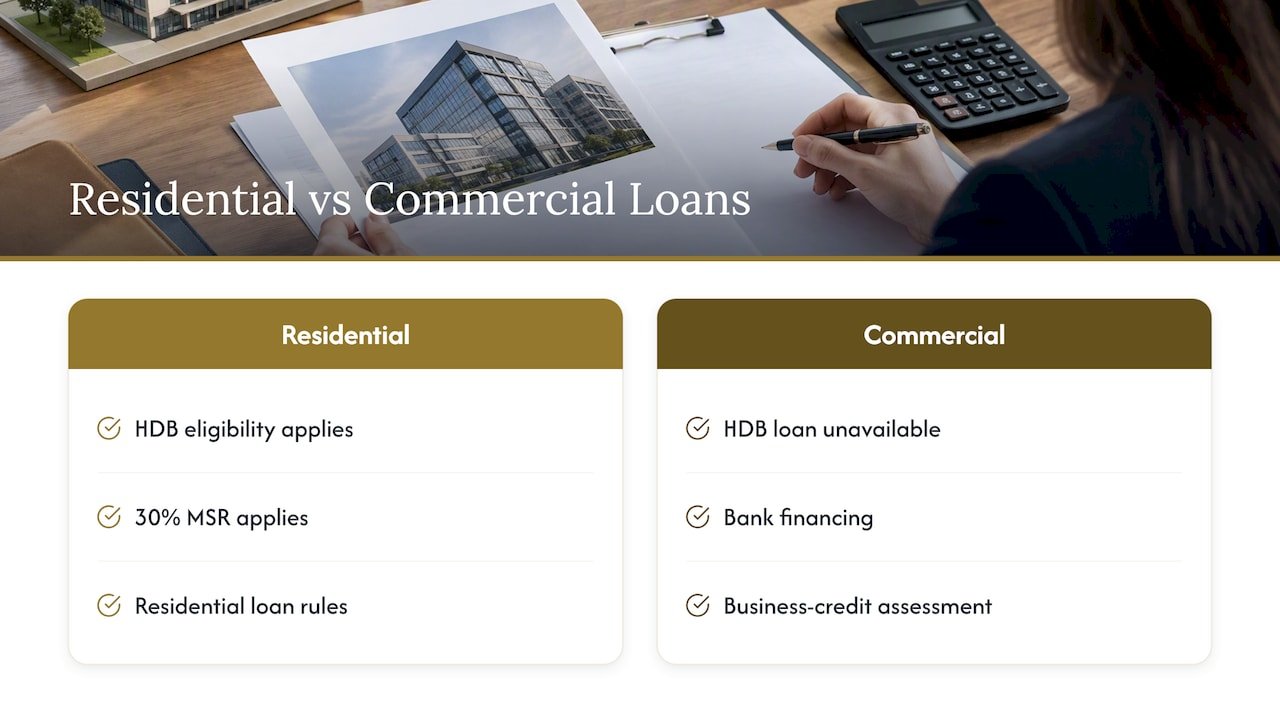
- Commercial mortgages exclude HDB financing and use underwriting based on borrower and property details; request written lender quotes because no single standard rate applies.
Table of Contents
- What are the main mortgage types in Singapore?
- How does the HDB concessionary loan work?
- How are bank home loan packages priced?
- Fixed, floating or hybrid: which fits your situation?
- What rules cap how much you can borrow?
- How do you apply and compare offers?
- Refinancing and repricing: what to expect
- How we help you prepare for a mortgage
- Mortgage types for commercial property in Singapore
- What criteria do you need to qualify for a commercial mortgage?
- How do commercial loan rates compare with residential rates?
- What fees make up the total cost of a commercial mortgage?
- What is the timeline for a commercial mortgage application?
- How does a commercial mortgage fit your investment strategy?
- Our view: the rate matters less than the order you do things in
- Start with a valuation before you apply for a loan
- FAQ
- Sources
What are the main mortgage types in Singapore?
Residential financing here splits into two families. The first is the HDB concessionary loan, available to buyers who qualify for it on an HDB flat. The second is the bank home loan, which HDB notes you may take from financial institutions regulated by the Monetary Authority of Singapore (MAS), subject to eligibility and credit assessment. Private homes and many resale HDB purchases go through banks.
Bank packages you will meet most often:
- Fixed promotional packages: the rate is set for a lock-in period, then moves to a floating basis.
- SORA-pegged floating packages: the rate follows compounded SORA, plus a bank spread.
- Board-rate or bank proprietary floating packages: the bank sets the rate itself, so you rely on its pricing decisions.
- Hybrid packages: a fixed stretch followed by a floating stretch, or a blend of the two structures.
SORA, the Singapore Overnight Rate Average, became the main benchmark after the industry moved away from SIBOR and SOR. MoneySense describes how existing SOR loans were converted into SORA conversion packages with an adjustment spread, and how SIBOR-based loans were scheduled for discontinuation with conversion options provided.
Every one of these loans is secured against the property itself, and tenure limits differ between public and private housing. If you want a plain-language comparison of the floating-versus-fixed decision, our guide to SORA fact checks for fixed or floating loans goes into it.
How does the HDB concessionary loan work?
The HDB loan is the simplest product on the market, and it is only available for HDB flats. Eligibility is decided before you commit to a purchase, which is why the paperwork comes first.
You apply for an HDB Flat Eligibility (HFE) letter by logging in with SingPass on the HDB Flat Portal. HDB’s HFE page states you need a valid HFE when applying for a new flat or an option to purchase on a resale flat. The same portal lets you request an In-Principle Approval (IPA) from participating financial institutions, and the CPF Board confirms the integrated service is free of charge.
The rate follows a formula rather than a quote. HDB states the concessionary rate is pegged at 0.1% above the prevailing CPF Ordinary Account interest rate, which currently gives 2.6% a year, fixed. HDB’s financing guidance also sets out how downpayment, loan-to-value (LTV) and tenure differ between its loan and a bank loan.
A sensible order of work:
- Log in to the HDB Flat Portal with SingPass and apply for your HFE letter.
- Request an IPA from participating financial institutions at the same time, so you can see both loan routes.
- Compare the HDB loan quantum with the best bank offers you receive.
- Check your downpayment, tenure and monthly repayment against your cash and CPF position.
- Decide, knowing that the choice of an HDB loan is not freely reversible.
That last point matters. HDB’s refinancing guidance says that once you refinance an HDB concessionary loan into a bank loan, you cannot return to the HDB loan.
Pro Tip: Ask for the HFE and IPA together. Seeing the HDB loan and bank loan ceilings side by side before you view flats stops you falling for a unit you cannot finance.
Buyers who value a stable, formula-set rate and are comfortable with the HDB loan terms often keep it. Buyers who chase a lower package rate, or whose plans may change within a few years, tend to look at bank loans first. Our guide to condo downpayments in Singapore shows the cash and CPF split on the bank side.
How are bank home loan packages priced?
Bank loans are built from a benchmark, a spread and a set of conditions, so reading an advertised rate means reading all three.
Fixed packages. The bank holds the rate for a lock-in period. MoneySense notes that fixed rates give predictability during that lock-in, usually two to three years. When it ends, the loan typically reverts to a floating rate, so the true cost depends on what comes after the headline.
SORA-pegged floating packages. These track compounded SORA, commonly the one-month or three-month figure, with the bank adding a margin on top. Your rate moves as the benchmark moves, and your repayment can change with it.
Board-rate or proprietary floating packages. Here the bank sets the reference itself. It can be less transparent than a published benchmark, because you depend on the bank’s own pricing policy rather than a market rate you can track.
Legacy loans. Older SOR and SIBOR loans were moved to SORA conversion packages, each carrying an adjustment spread meant to keep the switch fair.
Effective interest rate (EIR), not nominal rate, is the figure to compare. MoneySense advises comparing EIR and full repayment schedules rather than advertised rates, because fees and compounding change the true cost.
What belongs inside an advertised package:
- The benchmark it follows, and which tenor of it.
- The spread or margin added to that benchmark.
- The lock-in period and what the rate becomes afterwards.
- Early-repayment and partial-repayment penalties.
- Legal, valuation and processing fees, and any subsidies that offset them.
When two offers look close, ask each bank for the repayment schedule and EIR in writing. A package with a lower first-year rate and a heavier lock-in penalty can cost more overall than a plainer one.
Fixed, floating or hybrid: which fits your situation?
Pick the structure by asking how much repayment movement your budget can absorb, not by chasing the lowest headline number.
Fixed rates give you certainty during the lock-in. Floating SORA-pegged rates follow the market, so MoneySense explains they can be cheaper when market rates fall but raise your repayments when benchmarks rise. Hybrids sit between the two, trading some certainty for some flexibility.
Before choosing floating, stress-test your plan:
- Take your current repayment and recalculate it at a noticeably higher rate.
- Check that the new figure still fits inside your income after other debts.
- Confirm you could still cover it if one income paused for a few months.
- Ask whether you would have to sell, or cut other spending, if repayments climbed.
- Keep an emergency buffer separate from your downpayment.
Three typical situations:
- First-time buyer on a tight budget. Predictability usually matters most. A fixed package, or the HDB loan for a flat, keeps repayments steady while income is still growing.
- Long-term owner treating the property as an investment. A floating or hybrid package can suit someone who holds through rate cycles and has cash flow to absorb swings.
- Buyer refinancing to cut cost. Compare the new package EIR with your current one, and weigh any lock-in penalty before moving. Our breakeven checklist for refinancing shows how.
Pro Tip: If certainty matters over the next few years, lock a fixed rate for that window, or split the decision across a hybrid so one part of your repayment stays predictable while the other can fall with the market.
What rules cap how much you can borrow?
Three official limits shape your loan more than any marketing does: the Mortgage Servicing Ratio (MSR), the Total Debt Servicing Ratio (TDSR) and loan-to-value (LTV).
- MSR caps the share of gross monthly income that may go to mortgage repayments, at 30% for HDB and Executive Condominium loans where it applies.
- TDSR caps total monthly debt obligations against gross income, normally at 55%. MAS guidance requires institutions to compute TDSR and to apply a medium-term interest rate floor when assessing whether you can repay.
- LTV limits how much of the price a loan may cover. It is tiered by the number of outstanding housing loans, and is up to 75% for a first loan.
Your first housing loan can reach 75% LTV. HDB’s financing guidance sets out the limit, and later loans face lower ceilings.
MoneySense stresses that TDSR applies as a proportion of gross monthly income and that LTV limits step down with each outstanding loan. Tenure and borrower age can reduce the allowable LTV, and maximum tenures differ between public and private property, which in turn changes monthly repayments.
Documents banks typically use when computing these limits:
- Recent payslips, or income tax assessments if self-employed.
- Statements for existing loans, cards and other commitments.
- Identification and employment details.
- Property details such as price and valuation.
Our explainers on how TDSR sets your price band and on LTV limits walk through worked cases.
How do you apply and compare offers?
Follow the steps in order, and compare offers on the same footing.
- Apply for your HFE letter with SingPass on the HDB Flat Portal, and request IPA from participating financial institutions.
- Gather the Letters of Offer you receive.
- Compare EIR, lock-in terms, adjustment spreads, fees and the full repayment schedule.
- Ask each lender for the exact benchmark, the spread, the repricing policy and early-repayment penalty details.
- Choose by total cost over your holding period, your need for flexibility, and whether you are likely to refinance later.
The aim is a decision you can defend on paper. A lower rate with a substantial lock-in penalty is not always cheaper than a slightly higher rate that lets you leave freely.
Refinancing and repricing: what to expect
The two words mean different things. Refinancing moves your loan to a different lender. Repricing keeps the same bank but switches you to a new package. Both usually involve fees, so check them before you act.
Remember the HDB rule: you cannot return to the HDB concessionary loan after refinancing into a bank loan, as HDB states.
A simple breakeven check:
- Add up any remaining lock-in penalty, legal costs and valuation fees.
- Estimate the interest you would save under the new package.
- Divide the costs by the monthly saving to see how many months it takes to break even.
- Switch only if you plan to hold the loan well beyond that point.
Collect written quotes and your current loan statement before committing. Our refinancing breakeven checklist covers the paperwork.
How we help you prepare for a mortgage
We run a marketplace for buyers, sellers and renters in Singapore, and we see the same pattern often: borrowers who arrive prepared make faster, calmer decisions. Our services include a free property valuation, curated residential and commercial listings, personalised negotiation assistance and detailed market evaluations.
A realistic valuation and a well-negotiated price both shape how much you need to borrow, and so which loan structure suits you. We do not lend and we do not speak for any bank; our role is to help you walk into a loan application knowing the numbers.
Mortgage types for commercial property in Singapore
Commercial property sits outside the HDB loan entirely, and it is financed through banks. The home-loan rules most buyers know, such as HDB eligibility and the 30% MSR, belong to residential and public housing. Commercial buyers deal with lenders who treat the loan as a business credit decision.
Structures you will encounter mirror the residential ones: fixed, floating and hybrid pricing, each with a lock-in and its own penalty terms. What changes is the underwriting. Banks look at the property type, the borrower’s income or company accounts, and how the asset will be used, whether as an owner-occupied office or an investment unit.
Because terms differ by lender and by property, ask for a written proposal rather than relying on a general rate. We list commercial properties and commercial offices if you want to see what is on the market before you speak to a bank.
What criteria do you need to qualify for a commercial mortgage?
Lenders weigh repayment ability first. For an individual buyer, that means income, existing debts and the debt-servicing checks banks apply under MAS guidance. For a company buyer, it means financial statements, trading history and cash flow.
Expect lenders to ask about:
- The borrower’s identity, ownership structure and track record.
- Recent income documents or company accounts.
- Existing loans and other financial commitments.
- The property itself: its location, use, lease position and valuation.
- The size of your own contribution towards the purchase.
Underwriting is individual, so two buyers looking at similar units can receive different offers. Prepare documents before you approach a bank, and expect the valuation to influence the amount a lender will release against the price.
How do commercial loan rates compare with residential rates?
Published, standard rates are easiest to find for residential loans: the HDB concessionary rate is 2.6% fixed, and bank packages follow SORA or board rates. Commercial loan pricing is generally quoted per borrower and per property, so no single published figure applies across the market.
What we can say with confidence is how to compare. Ask each lender for the benchmark, the spread, the lock-in and the effective interest rate, exactly as you would for a home loan. The same advice from MoneySense on effective interest rates applies: nominal rates alone mislead.
Treat any commercial rate as a quote you must verify in writing, and compare it with a residential package only on the basis of total cost over the period you plan to hold the loan.
What fees make up the total cost of a commercial mortgage?
The interest rate is only part of the bill. Commercial borrowers should budget for several recurring and one-off items, and ask the lender for each in writing.
- Valuation fees: the bank commissions a valuation of the property.
- Legal fees: conveyancing and loan documentation.
- Processing or arrangement fees: some lenders charge for setting up the facility.
- Early or partial repayment penalties: often tied to the lock-in period.
- Insurance: property cover is commonly required as a loan condition.
- Ongoing costs: property tax, maintenance and any management charges that affect your cash flow.
To compare lenders honestly, add every fee to the interest over your expected holding period. A lower rate with higher fees can cost more than a plainer offer, which is the same logic as the EIR check for home loans.
What is the timeline for a commercial mortgage application?
Exact durations depend on the lender and the complexity of the deal, so treat the stages below as an order of work rather than a promise of speed.
- Preparation: collect income documents, company accounts and details of existing loans.
- Property selection: agree a price and secure an option or equivalent commitment.
- Application: submit documents to one or more lenders and request proposals.
- Valuation and credit assessment: the bank values the property and reviews your repayment ability.
- Letter of Offer: compare terms, and negotiate on rate, lock-in and fees.
- Acceptance and legal documentation: your lawyer reviews and the loan is documented.
- Completion: funds are released against the purchase.
Building in time for the valuation and for negotiation prevents rushed decisions. Starting conversations with lenders before you commit to a unit gives you a realistic ceiling to work within.
How does a commercial mortgage fit your investment strategy?
Financing shapes returns as much as the property does. Borrowing lets you control a larger asset with less of your own cash, but it also fixes a repayment obligation that continues whether or not the unit is leased.
Questions worth settling before you sign:
- Can rental income, or business income, comfortably cover repayments in a weak year?
- How would a rise in a floating rate change your cash flow?
- Does a lock-in limit your freedom to sell or refinance?
- How does this loan affect your capacity to borrow for the next purchase?
Debt-servicing rules apply to your overall position, so a commercial loan can reduce what you may borrow elsewhere. Matching the loan structure to your holding period, whether a short flip or a long hold, is the central decision. We can help you size up the asset side through our free property valuation.
Our view: the rate matters less than the order you do things in
Most borrowers fixate on the headline rate and treat eligibility paperwork as an afterthought. That is backwards. The rate you can obtain depends on your income, your debts and the valuation, and those are fixed long before you compare packages. The buyer who gets the HFE letter and IPA early, knows the TDSR ceiling and has a realistic valuation negotiates from strength; the buyer who falls for a unit first negotiates from desperation.
Conventional advice also over-rewards the cheapest first-year rate. A promotional rate that expires into a worse floating margin, or that comes with a heavy lock-in penalty, can lose to a plainer package over the real holding period. Compare effective rates and total cost, not the banner number.
Prioritise three things in order: know your borrowing ceiling, stress-test your repayments at a higher rate, and only then pick a structure. Rates will move; a plan that survives movement is what protects you.
— Anderson
Start with a valuation before you apply for a loan
We help you see the numbers before a lender does. A clear valuation and a shortlist of properties make your HFE and IPA applications far more focused.
- Get a free property valuation to estimate the loan you will need.
- Browse residential listings to match properties to your borrowing range.

Start with the valuation today and walk into your loan application prepared.
This article is general information, not a substitute for advice from a qualified financial advisor. Consult a qualified financial professional about your own circumstances before acting on anything here.
FAQ
What are the main types of mortgages in Singapore?
Singapore home financing is mainly the HDB concessionary loan and bank home loans. Bank loans come as fixed, floating (often SORA-pegged), board-rate and hybrid packages, as HDB’s financing guidance explains.
Is a fixed or floating mortgage better in Singapore?
Neither wins in every case. Fixed rates give predictability during the lock-in, while floating rates can cost less when market rates fall but raise repayments when they rise, according to MoneySense. Stress-test your budget before choosing floating.
Can I go back to an HDB loan after refinancing to a bank?
No. HDB states that refinancing an HDB concessionary loan into a bank loan is irreversible, so weigh the switch carefully before you commit.
How much can I borrow for a home in Singapore?
It depends on income, existing debts and the property. The main limits are the 30% MSR for HDB and Executive Condominium loans where it applies, the usual 55% TDSR, and tiered LTV limits, up to 75% for a first loan, as MoneySense explains.
Sources
- GUIDELINES ON THE APPLICATION OF TOTAL DEBT SERVICING RATIO FOR PROPERTY LOANS UNDER MAS NOTICES 645, 1115, 831 AND 128
- Switching to SORA: What you need to know | MoneySense