

Diplomatic Clause in Singapore: How It Works and When You Can Use It
A diplomatic clause is a term in a Singapore tenancy agreement that lets a tenant end the lease early, after a minimum stay and with written notice, if a defined event forces them to leave the country, such as a transfer abroad or the end of their employment. It is a contract term, not a legal right. If your agreement does not contain one, or your reason does not fit its wording, you have no automatic way out. Check the clause before you sign, not when your employer sends the relocation email.
TL;DR
- A diplomatic clause is optional and contractual. The government’s tenancy template has a tick box for it, and the minimum stay, notice and rent in lieu are blank for you and the landlord to fill in.
- The common market pattern is “12+2” on a two-year lease: 12 months’ stay, then two months’ written notice, backed by proof such as an employer letter.
- It covers involuntary departure from Singapore. Resigning, buying a home or moving within Singapore usually needs a separate break clause.
- Without a usable clause, leaving early is a breach: you may owe rent, lose the deposit and pay a pro-rated agent commission, unless you agree a surrender with the landlord.
- Landlords cannot lock tenants out or remove belongings to end a tenancy. Eviction goes through a formal notice and the courts.
Table of Contents
- What a diplomatic clause actually is
- The usual terms: 12+2 and what it means
- Who can use it
- What counts as proof
- Diplomatic clause or break clause
- Early termination without a usable clause
- For landlords: how to deal with an early exit and when eviction applies
- Negotiating the clause before you sign
- Our view
- Renting with the terms sorted from day one
- FAQ
- Sources
What a diplomatic clause actually is
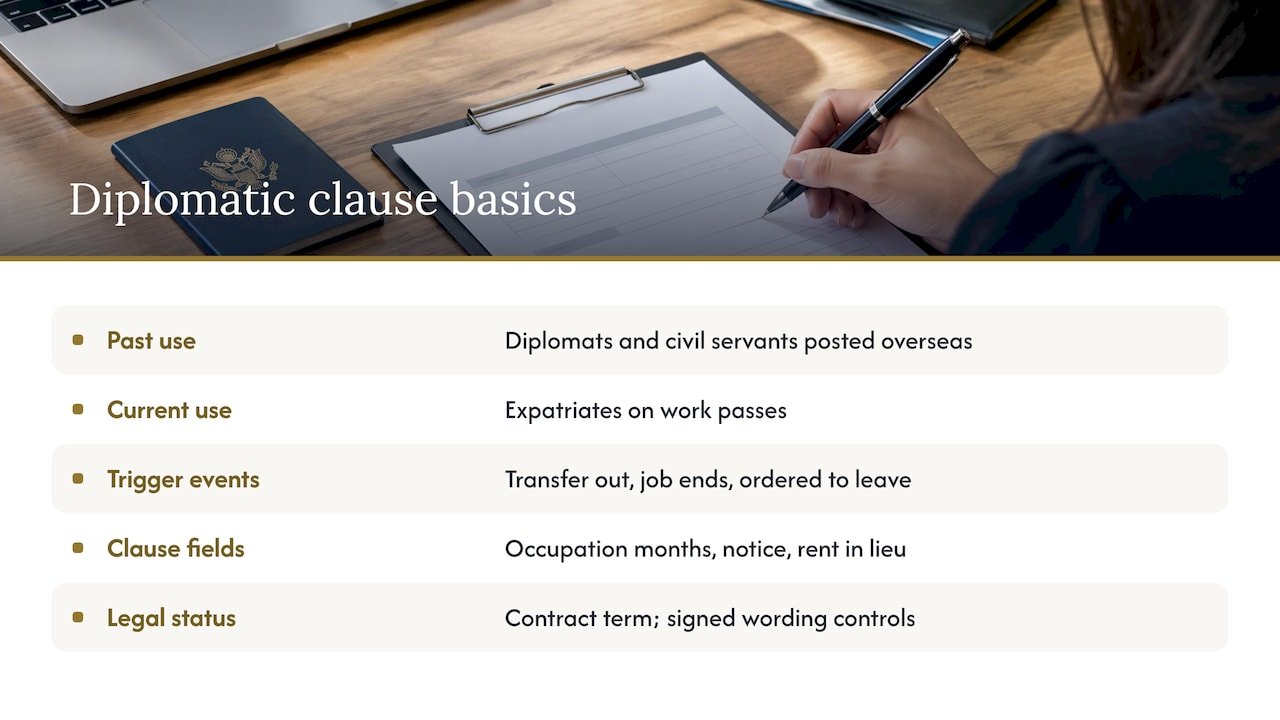
The name is a holdover. It first covered diplomats and civil servants posted overseas, but today it is standard wording for expatriates on work passes. The government-published tenancy agreement template for private residential property lists a “Diplomatic / Break Clause” as an item you mark applicable or not applicable. If it applies, you fill in the number of months of minimum occupation, the notice period and the rent payable in lieu of notice. The template names the triggering events: the named tenant is permanently transferred out of Singapore by their firm, stops being employed, or is ordered to leave Singapore.
Because it is a contract term, the wording decides everything. Singapore has no statute that lets a tenant end a fixed-term private residential lease at will. The clause is whatever you and the landlord signed.
The usual terms: 12+2 and what it means
On a two-year lease the most common arrangement is called “12+2”. You must stay at least 12 months, and you can then end the tenancy by giving two months’ written notice. Some landlords accept a shorter minimum, for example six months on a one-year lease, and some tenants negotiate to activate the clause earlier, but both are matters for negotiation, not defaults.
| Term | What it usually looks like | Where to check |
|---|---|---|
| Minimum stay | About 12 months on a 24-month lease | The months blank in the clause |
| Notice | Two months, in writing | The notice blank |
| Rent in lieu | Rent for any shorter notice you give | The rent-in-lieu blank |
| Trigger | Transfer out of Singapore, end of employment, ordered to leave | The named events |
| Proof | Employer letter, pass cancellation notice | Clause wording, “to the landlord’s satisfaction” |
| Agent commission | Some landlords add a pro-rated reimbursement | Extra clauses in the agreement |
Two details trip people up. First, notice served before the minimum stay has run can be treated as an ordinary breach, so count months from the tenancy start date in the agreement, not from when you arrived. Second, check whether the agreement requires you to reimburse the landlord’s agent commission for the unused part of the term. Courts have enforced such clauses: in one Magistrate’s Court case a pro-rated commission of S$3,500 was deducted from a S$5,600 deposit under the agreement’s terms. Our guide to agent commission in Singapore explains who normally pays and how to negotiate it.
Who can use it
The clause is triggered by being forced out of Singapore, so it suits people whose right to stay depends on a job or a pass:
- Employment Pass and S Pass holders: the typical users, for example after a transfer or non-renewal.
- Work Permit holders: if the permit is cancelled and the agreement lists that event.
- Dependants: where the clause covers the main pass holder’s departure and the agreement names it.
- Singaporeans and permanent residents: these tenants are rarely covered, because they cannot be compelled to leave the country. They can ask for a break clause with agreed reasons instead.
The clause is not restricted to foreigners by law. Whether it is offered to anyone is a negotiation. Note also that the template ties the clause to a named person identified by their FIN. If the person who loses the job is not the named tenant, the clause may not respond. Expats comparing areas and terms can read our guide to renting in Singapore as an expat, and those considering public housing should see the HDB rental rules for foreigners.
What counts as proof
A clause often says the tenant must provide documentary or other evidence to the landlord’s satisfaction. The High Court looked at such wording in a 2004 case, involving a two-year tenancy at $8,000 a month where the tenant’s employee could end the lease after 12 months on two months’ notice if deported, refused residence, transferred abroad or no longer employed. The court construed the evidence requirement objectively: a landlord cannot reject proof capriciously unless the clause clearly allows it.
In practice, prepare:
- A letter from your employer’s HR confirming the transfer, retrenchment or end of employment, with dates.
- A pass cancellation or non-renewal notice, or an immigration rejection letter, where relevant.
- Your written notice, delivered the way the agreement requires, with the date it takes effect.
Keep originals and give copies. A personal decision to resign to take a job elsewhere, or a move to another address in Singapore, does not fit the usual triggers.
Diplomatic clause or break clause
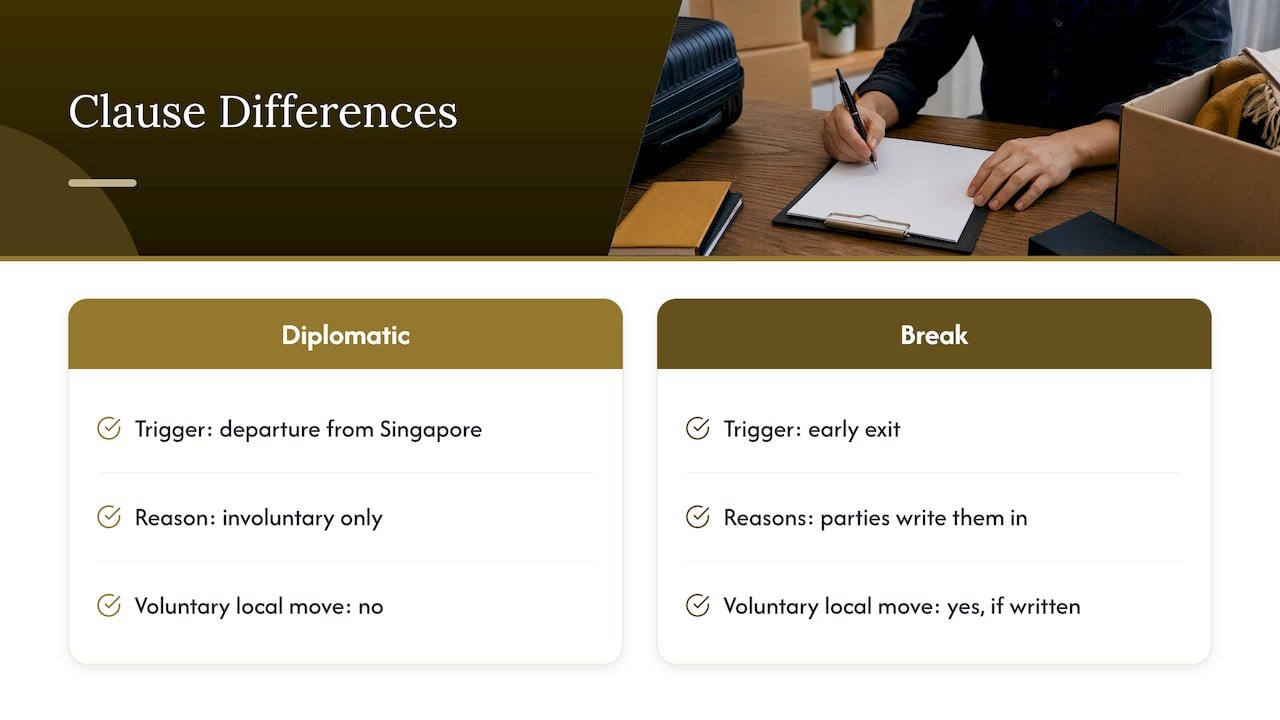
The two are often confused, and the tenancy template groups them on one line. A diplomatic clause responds to involuntary departure from Singapore. A break clause allows early exit for reasons the parties write in, such as buying a home or changing jobs locally. If your plans include buying, ask for a break clause that says so, and run the numbers first with our rent versus buy model.
A landlord may reasonably refuse a diplomatic-clause notice for a voluntary move and treat the departure as a breach. Match your reason to the wording before you send notice.
Early termination without a usable clause
If there is no clause, or it does not cover your reason, you are in breach once you leave before the term ends. Bird & Bird’s guide to terminating a tenancy early explains that a landlord can claim damages equal to the rent for the rest of the term and usually keeps the deposit, subject to a duty to mitigate loss, meaning the landlord must make reasonable efforts to re-let. It also recommends closing a negotiated exit with a Deed of Surrender and Release recording the end date, how the keys and premises are handed back, and any compensation.
Your realistic options, in order of cost:
- Find a replacement tenant the landlord will accept, on similar terms, so the landlord loses no rent.
- Negotiate a surrender, often by offering to cover the re-letting costs and a pro-rated commission.
- Leave and negotiate afterwards, which is the most expensive option and the one most likely to end in a dispute.
What courts have allowed landlords to keep
Courts look at proof of loss. In a 2026 Magistrate’s Court decision the landlord was entitled only to a pro-rated agent commission of $3,042.02 and $400 for rectification from a $29,000 deposit. The loss-of-rent counterclaim failed for lack of proof and failure to mitigate, and the balance of $25,557.98 was returned with interest at 5.33% per annum. That outcome depends on its own facts, but it shows why a landlord’s claim and the deposit are not the same thing. Our pages on getting your full deposit back and tenant rights and Small Claims Tribunal preparation cover how deductions and disputes are handled.
For landlords: how to deal with an early exit and when eviction applies
If a tenant serves a valid diplomatic-clause notice, you should accept it. You can verify the event, ask for documents, hold the deposit until handover and inspect the unit before releasing the balance. Treating a valid notice as a breach invites a dispute.
Eviction is a different matter and applies when the tenant breaches the agreement, for example by not paying rent. The general sequence is:
- Serve a written notice stating the breach and what the tenant must do to remedy it.
- If the tenant does not comply, go to the Small Claims Tribunals or the courts, depending on the claim size and lease.
- Obtain a judgment and an order for possession, which court officers enforce.
Do not change locks, cut utilities or remove a tenant’s belongings. Those actions can expose you to criminal liability and civil claims. Our landlord rights guide sets out what the law lets you do, and the tenancy agreement you sign at the start is where the best protection sits. See how to stamp a tenancy agreement and use the CEA and HDB templates, and check the rental stamp duty rules so the document is enforceable.
Negotiating the clause before you sign
The time to protect yourself is the offer stage. Ask for these points in writing, before the letter of intent turns into a signed agreement (our letter of intent checklist shows what to confirm):
- Tick “Applicable” on the diplomatic or break clause line.
- Fill every blank with specific numbers: minimum stay, notice, rent in lieu.
- List the events in full: transfer, end of employment, pass cancellation, order to leave.
- Name the proof and who decides if it is enough.
- Settle the commission question: is any reimbursement pro-rated, and capped?
- Check the named tenant if more than one person lives in the unit.
A landlord who sees a fully specified clause knows exactly what to expect, so both sides are better protected.
Our view
Most early-exit disputes start from a blank or vague clause, not from bad faith. Tenants assume a work pass makes them covered, and landlords assume “diplomatic” means anything.
We would rather the numbers and events be written down at the offer stage. For tenants, that means reading the clause line by line against the job and pass situation. For landlords, it means a clause they can apply without argument.
Our team handles rentals and property sales across Singapore, including rental assistance for expats, so negotiating these terms is part of getting the tenancy right from the start.
Anderson
Renting with the terms sorted from day one
If you are searching for a home and want the diplomatic or break clause settled before you commit, Register Today’s rental service covers rentals across residential and commercial listings in Singapore, and we help expats with rental assistance. Landlords weighing a rental against a sale can request our free property valuation.

FAQ
Can I use a diplomatic clause if I resign?
Usually not. The clause responds to events outside your control, such as a transfer out of Singapore, the end of your employment or an order to leave. A voluntary resignation or a move to another place in Singapore generally needs a break clause that lists it.
How much notice do I need to give?
Check your agreement, because the notice is a number you and the landlord filled in. Two months’ written notice after a 12-month minimum is the common arrangement on two-year leases. If you give less, the clause may require rent in lieu.
Is a diplomatic clause a legal right in Singapore?
No. Private residential tenancies run on contract, and no statute lets a tenant end a fixed term at will. The government’s template treats the clause as optional, so it only exists if it is in your signed agreement.
What if my lease has no clause and I must leave?
Talk to the landlord early and offer a solution: a replacement tenant, or a negotiated surrender recorded in a deed. Leaving without agreement is a breach, and the landlord may claim rent and keep the deposit, subject to the duty to mitigate.
Can a landlord evict a tenant who stays after notice?
Only through the proper legal process. A landlord must establish a breach, serve notice and obtain a court order, not change locks or remove belongings.
Sources
- Tenancy agreement template for private residential property
- 2004 SGHC 31, High Court judgment on diplomatic clause evidence
- 2026 SGMC 11, Magistrate’s Court judgment on pro-rated agent commission
- 2026 SGMC 36, Magistrate’s Court judgment on deposit deductions
- Bird & Bird: Terminating a tenancy early in Singapore