

Singapore En Bloc: 4 Year SSD, 70% Thresholds and What Owners Must Do
An en bloc, or collective sale, is a majority-led sale of an entire strata development to a single buyer, usually a developer. If your building may qualify, the first move is practical: ask the management corporation or sales committee for a recent valuation and consider raising the matter at an extraordinary general meeting.
TL;DR:
- A successful en bloc sale requires at least 90% owner consent for developments under ten years old, or 80% for older ones, with proposed reforms lowering thresholds to 70% and 65%.
- The process typically takes 12 to 18 months from committee formation to approval, risking delays from disputes, objections, or appeals, especially if paperwork like valuation or distribution details are incomplete.
- Early, accurate valuation reports and clear communication about distribution and reserve prices are crucial, as delays or objections often stem from valuation disputes or late documentation.
- Seller’s Stamp Duty increases to 16% for units bought within four years before sale, directly affecting net proceeds for owners who purchased recently.
- Owners must prepare for extensive costs beyond SSD, including legal fees, marketing commissions, and administrative expenses, which can significantly reduce final returns.
Table of Contents
- What an en bloc (collective sale) is and who qualifies in Singapore
- Step-by-step process owners will follow, with realistic timing
- Consent thresholds now and the proposed 2026 changes: what owners must know
- Valuation, payout mechanics and Seller’s Stamp Duty implications
- Objections, STB mediation and legal risks that can stall or stop a sale
- Owner checklist: documents to request and questions to ask advisers
- How Register Today can support owners preparing for an en bloc attempt
- Detailed cost breakdown beyond Seller’s Stamp Duty
- Comparison of returns from en bloc sales versus alternative exit strategies
- Overview of tax implications beyond SSD
- Guidance on choosing and working with en bloc sales committees and advisers
- Practitioner view: what matters more than the mandate
- Get a valuation before you commit to a collective sale
- Sources
- FAQ
What an en bloc (collective sale) is and who qualifies in Singapore
An en bloc sale happens when owners in a strata development agree, by the required majority, to sell the entire property as one site rather than as individual units. The framework sits under the Land Titles (Strata) Act, and the Strata Titles Boards oversee applications where owners cannot reach unanimous agreement. Most attempts involve older condominiums where redevelopment value exceeds the sum of individual resale prices, though some landed estates and long-lease developments can also qualify.
Eligibility depends on the development being a strata title scheme registered under the Act, with consent measured by both share value and strata area, known as notional shares. A pro-tem committee, later formalised into a collective sale committee, usually leads the process on behalf of all owners.
Typical scenarios that trigger an attempt include:
- Ageing developments nearing the end of their design life, where repair costs are rising.
- Low-density sites with unused development potential under current planning guidelines.
- Developer interest signalled informally, prompting owners to test the market.
Step-by-step process owners will follow, with realistic timing
The process has a fixed sequence, though the time each stage takes varies with the size of the development and how organised owners are.
- Owners requisition an extraordinary general meeting and form a collective sale committee, usually needing signatures from a minimum proportion of owners to convene the meeting.
- The committee appoints a marketing agent, lawyer and valuer, then drafts the Collective Sale Agreement (CSA) setting out the sale method, reserve price basis and distribution method.
- Owners sign the CSA within the collection window; once the required consent threshold is reached, the committee can proceed.
- The property is marketed by tender or auction, and the committee selects a purchaser subject to the agreed terms.
- The committee applies to the Strata Titles Boards using Form 21, triggering a statutory advertising period and a window for objections.
- The STB mediates or holds a hearing, weighing factors such as sale price and distribution method before approving or rejecting the sale; a rejected application can be appealed to the High Court.
- On completion, proceeds are distributed, tenancies are settled, and owners vacate within the agreed timeframe.
From the first committee meeting to STB approval, a straightforward case can take 12 to 18 months; disputes or appeals extend that considerably.
Pro Tip: Start collecting mortgage redemption figures and tenancy details early, since missing paperwork is one of the most common causes of delay at the STB stage.
Consent thresholds now and the proposed 2026 changes: what owners must know
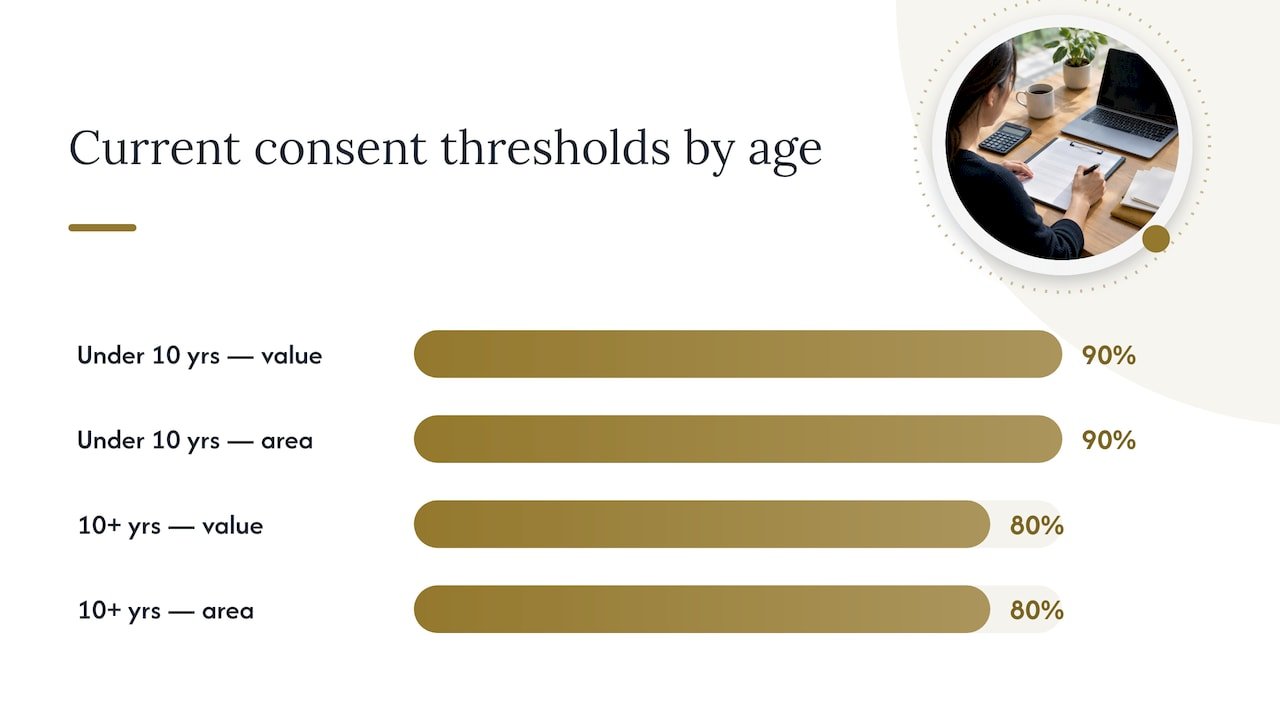
Under the current rules, a collective sale needs consent from owners holding at least 90% of share value and strata area for developments under ten years old, and at least 80% for developments ten years or older.
The Ministry of Law has proposed recalibrated thresholds of 70% and 65% for older developments, alongside a shorter signature collection window and a higher requisition threshold to start an attempt. These changes would apply mainly to new attempts, not those already past their first CSA signature.
Practical consequences for owners include:
- A shorter window for gathering signatures, which stakeholders have warned may be too tight for large or mixed developments with many absentee owners.
- A need to engage overseas or absentee owners earlier, since outreach can no longer be spread across a longer timeline.
- Reserve pricing that reflects realistic market conditions early, since a lower threshold means less room to renegotiate once consent is secured.
Valuation, payout mechanics and Seller’s Stamp Duty implications
An independent valuer’s report underpins both the reserve price and the STB application, and the valuation needs to be recent enough to satisfy the Board at filing. Distribution of proceeds typically follows methods set out by the Singapore Institute of Surveyors and Valuers, apportioning value by share value, floor area, or a blend adjusted for factors such as unit orientation and level.
Under IRAS rules effective from 4 July 2025-for-residential-property), the Seller’s Stamp Duty holding period increased to four years, with rates rising by four percentage points at each tier, up to 16% for a disposal within the first year. This matters directly for en bloc sellers whose units were bought within that holding period, since SSD reduces net proceeds significantly.
Key points for owners to check:
- Confirm when your unit was acquired, since SSD applies only to purchases made on or after 4 July 2025 within the four-year window.
- Ask the committee which distribution method applies and how it was derived, since apportionment disputes are a frequent source of objection.
- Factor SSD into your expected net payout before agreeing to a reserve price, rather than after.
Objections, STB mediation and legal risks that can stall or stop a sale
High consent does not guarantee approval. Dissenting owners have a 21-day window to object once the notice of proposed application is advertised, and the Strata Titles Boards will examine whether the sale was negotiated in good faith, whether the price reflects market value, whether the distribution method is fair, and whether the purchaser has undisclosed links to the committee.
Where the Board finds problems, it can issue a Stop Order, halting the sale until the issues are resolved, or reject the application outright. A rejected or stopped sale can be appealed to the High Court, extending the timeline by months.
Common pitfalls include:
- Reserve prices set without reference to comparable redevelopment economics, inviting objections on valuation grounds.
- Distribution schedules published late, leaving little time for owners to query apportionment before signatures are collected.
- Weak documentation of how the purchaser was selected, which can raise good-faith concerns at a hearing.
Owner checklist: documents to request and questions to ask advisers
Before committing to anything, request the following from the committee: the latest valuation report, the draft Collective Sale Agreement, the proposed distribution schedule, and minutes from previous committee meetings.
Questions worth asking advisers before signing:
- How was the reserve price set, and does it account for redevelopment potential rather than just resale comparables?
- Does the distribution method reflect share value, floor area, or a blended approach, and who calculated it?
- Does the committee or its agents have any financial relationship with the prospective purchaser?
- What is each owner’s likely Seller’s Stamp Duty exposure under the current holding period rules?
- What is the communication plan for absentee or overseas owners during the signature window?
Pro Tip: Verify your outstanding mortgage redemption figure with your bank early, since this directly affects the net proceeds you will actually receive on completion.
How Register Today can support owners preparing for an en bloc attempt
Owners weighing a collective sale often need an independent read on value before committing to a reserve price. Register Today offers a free property valuation that gives a current market view, alongside personalised negotiation support during tender or private treaty discussions.
- A fresh valuation that can support the timing requirements for an STB filing.
- Market evaluation that weighs redevelopment potential against comparable transactions.
- Listing exposure through advanced search tools for owners exploring a sale outside a formal en bloc attempt.
Detailed cost breakdown beyond Seller’s Stamp Duty
Seller’s Stamp Duty is only one line item. A collective sale carries professional and administrative costs that reduce net proceeds and should be budgeted for from the outset.
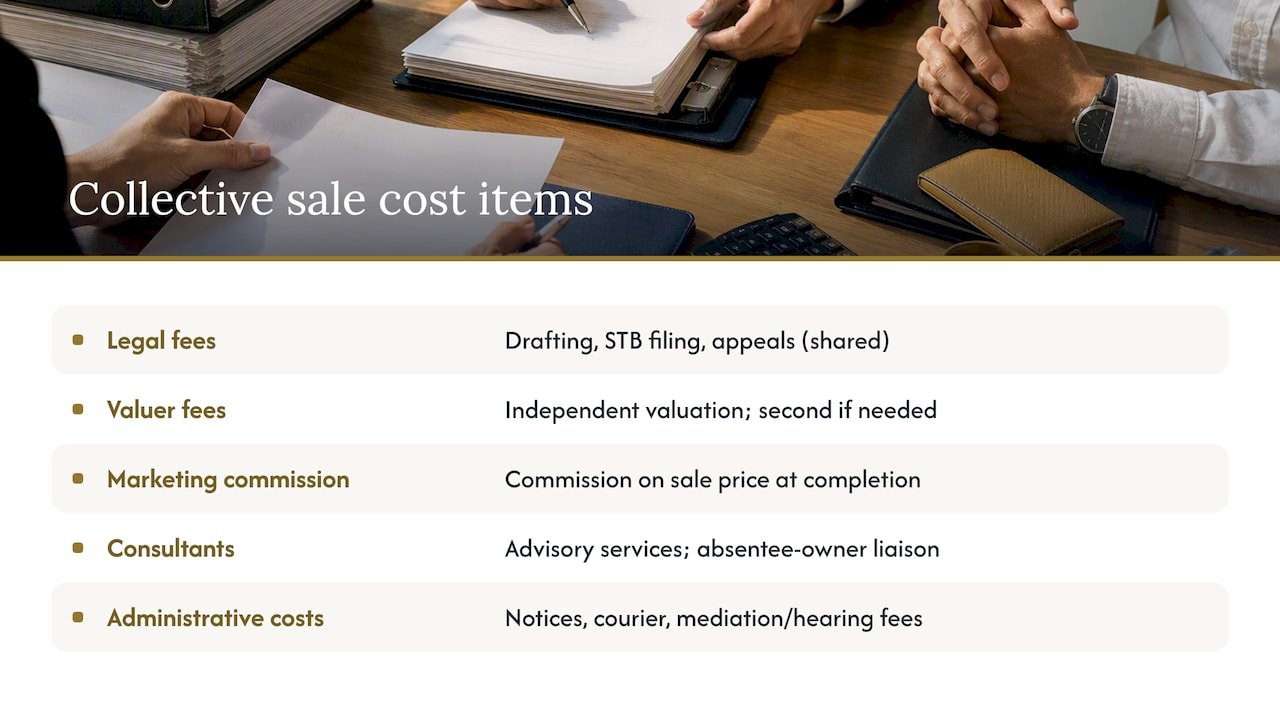
Legal fees cover drafting the Collective Sale Agreement, preparing the STB application and handling any objections or appeals; these are usually shared across all owners in proportion to their notional share. Valuer fees cover the independent valuation report required for both the reserve price and the STB filing, and a second valuation is sometimes needed if the first becomes outdated during a long signature collection period.
Marketing agents typically charge a commission on the eventual sale price, payable once the transaction completes. Consultants, where engaged, may advise on distribution methodology or liaise with absentee owners, adding a further administrative layer.
Owners should also expect smaller costs: advertising fees for the mandatory notices in the four official languages, courier or registered mail costs for reaching absentee owners, and incidental costs tied to mediation or hearings before the Strata Titles Boards. None of these are large individually, but together they can meaningfully affect what each owner actually receives after completion.
Comparison of returns from en bloc sales versus alternative exit strategies
An en bloc sale typically delivers a premium over individual resale value, since developers are paying for redevelopment potential rather than the existing building. That premium is not guaranteed, though, and depends heavily on construction costs, land demand and new-launch pricing at the time of sale.
Resale offers a faster, more predictable exit: an owner can sell a single unit on their own timeline without waiting for consent thresholds, committee formation or STB approval. The trade-off is that resale value reflects the existing building only, missing out on any redevelopment premium.
Rental offers a different calculation entirely. Instead of a lump sum, owners receive ongoing income while retaining the asset, which suits those uncertain about reinvestment options or expecting rents to rise. The downside is exposure to the building’s ageing condition and ongoing maintenance costs, which a sale avoids entirely.
The right choice depends on an owner’s time horizon, cash needs and view on whether the development’s redevelopment story is strong enough to justify the wait an en bloc attempt requires.
Overview of tax implications beyond SSD
Seller’s Stamp Duty is the tax most owners think about first, but it is not the only consideration. Singapore does not impose a general capital gains tax, so profit from a property sale is not taxed as a capital gain in most cases.
Income tax can apply, however, if the property was held for trading purposes rather than long-term investment, such as where an owner has a pattern of buying and selling units frequently. In that scenario, gains from an en bloc sale could be treated as income rather than capital, and taxed accordingly. Most owner-occupiers and long-term investors fall outside this category, but it is worth confirming your own position with a tax adviser before assuming a sale is entirely tax-free beyond SSD.
Owners who have rented out their unit should also account for any outstanding property tax liabilities at the point of sale, since these are typically settled as part of completion.
Guidance on choosing and working with en bloc sales committees and advisers
The collective sale committee carries significant responsibility, negotiating on behalf of every owner, so its composition matters. Owners should look for committee members with some grasp of property valuation or legal process, and a track record of communicating clearly with the wider ownership group.
When appointing a lawyer, choose one with specific experience in collective sale applications rather than general conveyancing, since the Strata Titles Boards process has its own procedural requirements. A valuer should be asked to explain their methodology plainly, particularly how they have modelled redevelopment potential against comparable new-launch pricing.
Owners should expect the committee to publish the distribution schedule and reserve price rationale well before the signature collection period closes, giving time to raise questions. A committee that resists sharing this information early is often a signal to ask more questions, not fewer.
Practitioner view: what matters more than the mandate
Owners often focus on crossing the consent threshold and treat approval as the finish line. The sharper lesson from watching these sales unfold is that a mandate secured on a shaky reserve price or a rushed distribution schedule tends to unravel at the Strata Titles Board stage. Realistic pricing, early communication with absentee owners and proper legal preparation matter more than speed.
— Anderson
Get a valuation before you commit to a collective sale
Before signing a Collective Sale Agreement, it helps to know what your unit is worth on its own, not just as part of a committee’s reserve price. Register Today offers a free property valuation alongside personalised negotiation support, so owners can weigh an en bloc offer against a clear independent figure rather than guesswork from the committee alone.
Whether you are preparing documents for a committee or considering whether to sell on your own terms, start with a valuation and a conversation about your options at Register Today.
Sources
- Proposed amendments to the collective sale regime — MinLaw
- En bloc reforms welcomed, but concerns raised over timeline | The Straits Times
FAQ
What are the new en bloc rules in Singapore?
The Ministry of Law has proposed lowering consent thresholds to 70% and 65% for older developments, shortening the signature collection window and raising the requisition threshold needed to start an attempt. Most changes would apply to new attempts rather than those already past their first signature stage.
What are the disadvantages of selling en bloc?
Owners lose control over timing and price once a committee takes over negotiations, and the process can take well over a year from committee formation to completion. Minority owners who object may still see the sale proceed if the Strata Titles Board approves it, and Seller’s Stamp Duty can reduce net proceeds for anyone who bought within the current holding period.
How long does en bloc take?
A straightforward collective sale, from forming the committee to Strata Titles Board approval, typically takes 12 to 18 months. Disputes, objections or a High Court appeal can extend that significantly.
What are the potential en bloc developments in Singapore for 2026?
No published list of specific sites names confirmed en bloc candidates for 2026. Owners in ageing developments with strong redevelopment potential are best placed to assess their own building’s prospects with an independent valuation rather than relying on market speculation.


