
Property Trust in Singapore: ABSD, Remission and Buying Steps
Buying a home under a trust in Singapore means a trustee holds legal title for named beneficiaries, and since 27 April 2023 the buyer pays Additional Buyer’s Stamp Duty (ABSD) of 65% upfront, then applies for a refund. Whether that refund comes back in full depends on how the trust deed is written, not on how the family sees the arrangement. This guide explains the structure, the money, the sequence of steps and the drafting traps, so that you can decide before you sign an option to purchase. If you are weighing a trust against other ways to plan around ABSD, we at Register Today can run the numbers on a specific property with you, starting with a free valuation.
TL;DR
- A trustee holds legal title to the property for beneficiaries. For residential property, ABSD (Trust) of 65% is payable upfront.
- A refund is possible only if the trust is for identifiable individual beneficiaries, and the application must reach IRAS within six months.
- Deeds that vest ownership later (for example at age 21), allow revocation or name unborn beneficiaries do not qualify for remission.
- Plan to pay in cash: lenders rarely finance a trust purchase with a sole minor beneficiary.
- Get the deed reviewed and the conveyancing solicitor engaged before the option to purchase is issued.
Table of Contents
- What a property trust is, in plain terms
- Why families buy residential property under a trust
- The ABSD rule that decides everything
- The six-month remission and who qualifies
- Financing: plan on cash
- Buying under a trust: the sequence
- Risks once the property is in trust
- Our view
- Start with a valuation, then the structure
- FAQ
- Sources
What a property trust is, in plain terms
A trust is a legal arrangement in which one person holds property for the benefit of others. The Ministry of Law describes an express trust as one formed when a settlor intentionally transfers property to a trustee to hold for beneficiaries. Three roles matter:
- Settlor: the person who creates the trust and puts the property or funds in. A settlor may also declare himself the trustee.
- Trustee: the legal owner, who manages the property and distributes income and capital according to the trust terms.
- Beneficiary: the person entitled to benefit from the property. The beneficiary holds the beneficial interest, not the legal title.
The Ministry of Law adds that a settlor may appoint a protector to supervise the trustee, and that a trust must meet three certainties: of intention, of subject matter and of objects. If these are not met, the trust is invalid and ownership stays with the settlor.
For property, there are formal requirements as well. The same page states that a trust over immovable property must be proved in writing and signed, and that the property must be conveyed to the trustee by a deed in English. In practice this is why a solicitor is involved from the start.
Why families buy residential property under a trust
The most common reason is buying for a child. MoneySense notes that buying a property for a child with a specified transfer age is a typical use, and that assets in a trust do not form part of a deceased person’s estate, so probate is not required for them.
A second reason is that a person under 21 cannot hold land in Singapore in their own name, so property meant for a minor has to sit with a trustee. Parents with children, and sellers or investors planning to pass assets on, therefore meet trusts often.
If you are choosing a neighbourhood for children first, settle the area and the budget before you choose the structure. A trust changes who owns the home, not what the home costs to buy.
The ABSD rule that decides everything
Until 9 May 2022, a transfer into a living trust with no identifiable beneficial owner attracted no ABSD, as a 2023 tax report from a Singapore law firm explains. That changed. The charge began at 35% and, from 27 April 2023, was raised to 65%, matching the rate for entities.
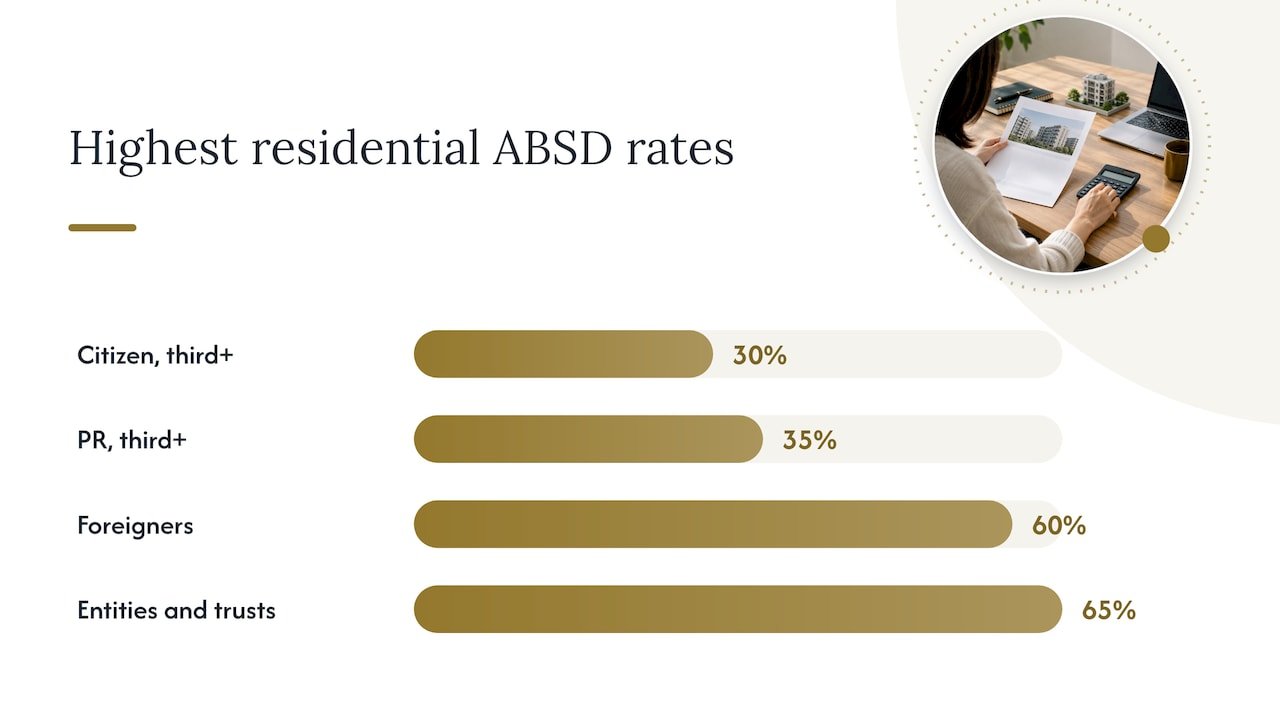
IRAS states that any conveyance, assignment or transfer on sale of residential property to a trustee is subject to ABSD (Trust) at 65%, calculated on the higher of the purchase price or market value. It must be paid upfront. For comparison, the residential ABSD rates in force from 27 April 2023 are, per a summary of IRAS’s rules:
| Buyer | ABSD rate |
|---|---|
| Singapore citizens | 0% on first, 20% on second, 30% on third and later |
| Permanent residents | 5% on first, 30% on second, 35% on third and later |
| Foreigners | 60% |
| Entities and trusts | 65% |
The trust rate is deliberately the highest. The refund is what brings the cost back down for families who qualify, and our guide on ABSD rates and the myTax steps shows cash examples for each buyer profile.
The six-month remission and who qualifies
IRAS allows remission of ABSD (Trust) when the residential property is held on trust for identifiable individual beneficiaries only, and an application is made within six months of the instrument being executed. The refund is the difference between the 65% paid and the ABSD that would apply based on the highest profile among the beneficial owners.
The application is made through the myTax Portal, with the trust instrument and the option or agreement attached, as summarised here. The six-month window is not extended for a late deed, so diarise it on the day of signing. Our page on the six-month ABSD remission sets out the process.
What “identifiable” means
IRAS defines an identifiable individual beneficiary as someone named in the declaration of trust whose beneficial ownership is not revocable, not variable and not subject to any condition subsequent. It excludes:
- individuals not yet born on the date of the declaration;
- individuals entitled only to income;
- individuals with contingent or discretionary interests.
This is a legal test applied to the wording of the deed. A close family relationship does not satisfy it.
The “vests at 21” trap
A common child trust says the child receives the home at 21. Law firm Withers notes that no remission is available where ownership is contingent (for instance on graduation), deferred (for instance until age 21), revocable or variable, or where a beneficiary is unborn at the date of the deed. A deed with that wording keeps the full 65% with no refund.
The fix is drafting, and it has to happen before the transfer, because the test looks at the position when the instrument is executed.
A worked example
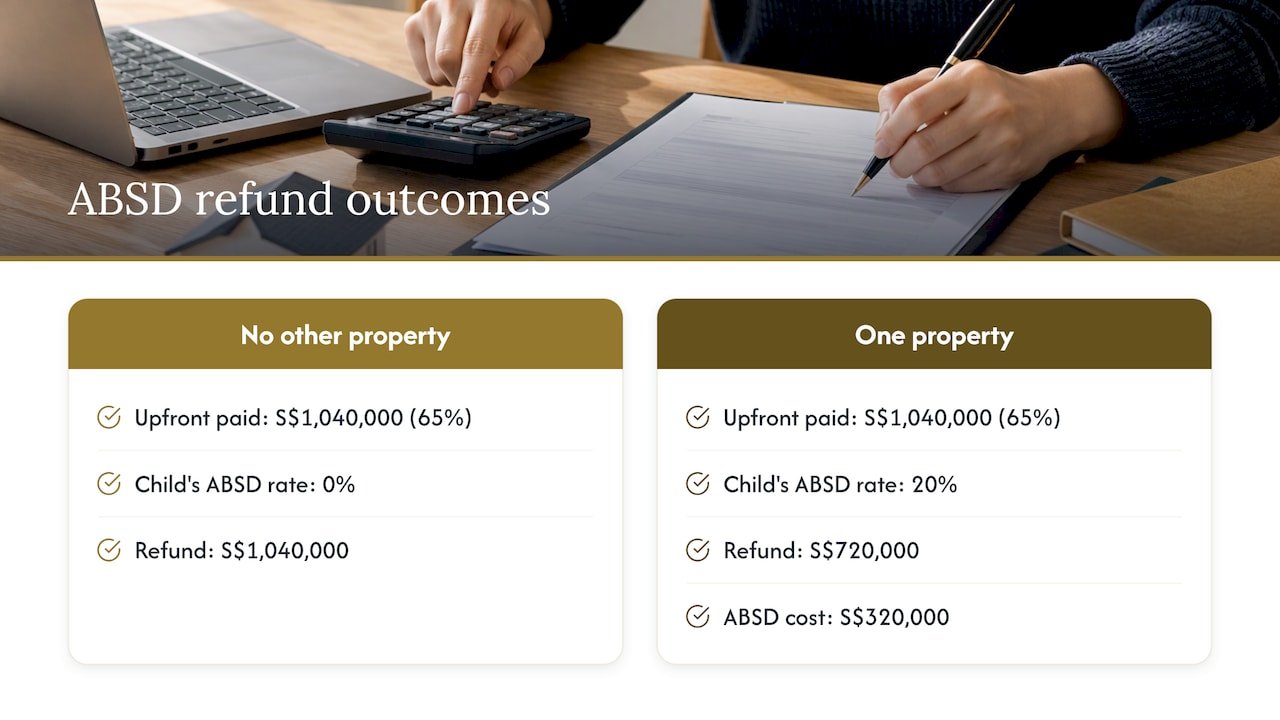
Take a S$1.6 million condominium placed in trust for one identifiable Singapore citizen child with a properly vested interest. The ABSD (Trust) paid upfront is 65%, or S$1,040,000. The refund is the gap between 65% and the child’s own ABSD rate. If the child owns no other residential property, that rate is 0% and the refund is S$1,040,000. If the child already owns one property, the child’s second-property rate of 20% applies and the refund is S$720,000, leaving S$320,000 as the ABSD cost.
The arithmetic is straightforward. The cash flow is the hard part: S$1,040,000 sits with IRAS until the refund is processed.
Financing: plan on cash
Because the 65% is paid first and recovered later, a trust buyer needs liquidity far above the usual down payment. A Singapore lawyer quoted by Lianhe Zaobao said trust buyers must be cash-rich enough to pay the 65% upfront and seek remission later, and that with a sole minor beneficiary a loan is usually unavailable, so the purchase is made in cash.
If a loan is part of your plan, check the loan-to-value rules before you commit. Our summary of Singapore LTV limits covers the 75% first-loan and 45% second-loan ceilings.
Buying under a trust: the sequence
The order matters more than any single step. A mistake in an early step often cannot be fixed later.
- Check the trust deed. It should give the trustee explicit power to acquire, hold, mortgage and sell real property. A silent or vague deed is the usual source of later disputes. The deed must also meet the three certainties and be in writing.
- Fix the beneficiaries’ wording. Name each beneficiary, give each an immediate and unconditional beneficial interest, and remove revocation and variation powers if you want remission.
- Appoint the trustee. Document the appointment formally. A protector, if you want one, is appointed at this stage.
- Engage a conveyancing solicitor before the option to purchase is issued. The solicitor is a legal necessity for the transfer and the deed.
- Sign the option in the trustee’s name. Signing as an individual and nominating the trust afterwards can lead to stamp duty being paid twice.
- Pay the ABSD (Trust) upfront. IRAS’s own guidance is that it falls due when the instrument is executed.
- File the remission application. Do it as soon as the instrument is stamped, and never later than six months.
- Register title in the trustee’s name at the Singapore Land Authority.
This is why a good property search starts with the price and the ABSD exposure together. We list homes across residential and apartment categories, and negotiating the purchase price matters here because ABSD is calculated on the higher of price or market value, so every dollar off the price lowers the upfront cash too.
Risks once the property is in trust
Selling is not a parent’s decision alone
The trustee holds the title, but selling a home held for a minor can still be contested. In a High Court case reported by Rajah & Tann, a mother’s application to sell a S$1.8 million condominium held for her minor son was dismissed. A buyer had offered S$2.28 million, but the court held that capital appreciation alone was not enough, and she had not fully disclosed her finances.
The lesson for the deed is to give the trustee a clear power of sale and to say in what circumstances it can be used.
Terms are hard to change later
An academic commentary in the Singapore Academy of Law Journal explains that under section 56(1) of the Trustees Act 1967 a court can give trustees a power to sell where it is expedient, but this covers management only. It cannot reshape beneficial interests, as Singapore has no Variation of Trusts Act. Decide the beneficial terms carefully at the start.
Other points to settle early
- A beneficiary can lodge a caveat on the title to stop the trustee selling, according to a property-law summary.
- Spouses who want to move a home between them should read the rules on spousal transfers and ABSD before choosing a trust at all.
- A company is a different structure with its own duties; see buying property under a company.
Our view
A trust is a sound tool when the purpose is clear: a home for a child, held properly, with a deed written so the remission test is met on the day of signing. The structure does not make property cheaper by itself. Cost control comes from three things done together: choosing the right property at the right price, knowing the ABSD position of every person involved before the option is signed, and keeping cash available for the period before a refund arrives.
At Register Today we focus on property transactions in Singapore, and we help clients invest without carrying the full burden of ABSD. We do that through detailed market evaluations, which identify gaps and opportunities, and through personalised negotiation, which is what lowers the figure ABSD is calculated on. Our free property valuation gives a buyer or seller a reference point before any structure is chosen.
Buyers who plan ahead rarely need to rush. Buyers who sign first and structure later often pay more than they had to.
Anderson
Start with a valuation, then the structure
We handle buying, selling and renting across residential and commercial listings in Singapore, and our free property valuation gives you the market value that ABSD may be calculated on, at no cost. Families, first-time buyers, investors and sellers can then compare options with real numbers. If you want to discuss a purchase, start from our main page.
Sellers weighing the tax side of an exit can also read about capital gains tax on sales within four years.
FAQ
Can I buy property under a trust in Singapore without paying ABSD?
You pay ABSD (Trust) of 65% upfront. If the trust is for identifiable individual beneficiaries only and you apply to IRAS within six months, you can be refunded the difference between 65% and the ABSD based on the beneficiaries’ own profile. A Singapore citizen beneficiary with no other property can receive the full amount back.
Does a trust for my child work if the child gets the home at 21?
Not for remission. A deferred or contingent interest does not meet IRAS’s test of an identifiable beneficiary with unconditional beneficial ownership, so the 65% is kept. A deed that gives the child an immediate, unconditional beneficial interest is the structure that can qualify.
Can I use a loan to buy property under a trust?
It is usually difficult when the sole beneficiary is a minor, and a Singapore lawyer has said that such purchases are generally made in cash. Because 65% is paid upfront, plan the liquidity first and check the LTV limits that apply to your own situation.
Who does the paperwork?
A conveyancing solicitor prepares the deed and the transfer, and the application for remission is filed with IRAS through the myTax Portal. We can help you value the property and negotiate the price so that you know the figures before the solicitor is instructed.
Sources
- Express Trusts, Ministry of Law
- What is a trust?, MoneySense
- Additional Buyer’s Stamp Duty (ABSD), IRAS
- Remission of ABSD (Trust), IRAS
- Singapore: Additional Buyer Stamp Duty on transfers into trusts, Withers
- International Bar Association Annual Conference 2023, Singapore tax report
- Singapore property rules, Propwise.sg
- ABSD rates 2026 Singapore, Numbers.sg
- Wealthy Chinese may face tax on Singapore property held in trusts, Lianhe Zaobao
- Duties and Disclosures, Rajah & Tann
- Why does Singapore not have a Variation of Trusts Act?, Singapore Academy of Law Journal
- Real Estate in SG, Real Estate Insights SG