

Hold 10 Years? Run This Rent vs Buy Model for Singapore
If you expect to stay in your home under five years, renting almost always wins financially once you factor in stamp duties and agent fees. If you plan to hold for a decade or more, buying tends to build wealth faster, though ABSD, BSD and CPF rules change the maths considerably for permanent residents, foreigners, and anyone owning multiple properties.
TL;DR:
- Buying a property generally becomes financially viable after at least five years of holding, especially considering transaction costs and market appreciation trends.
- Singaporean citizens face lower ABSD rates, making property ownership more accessible initially, while PRs and foreigners encounter higher taxes that impact liquidity.
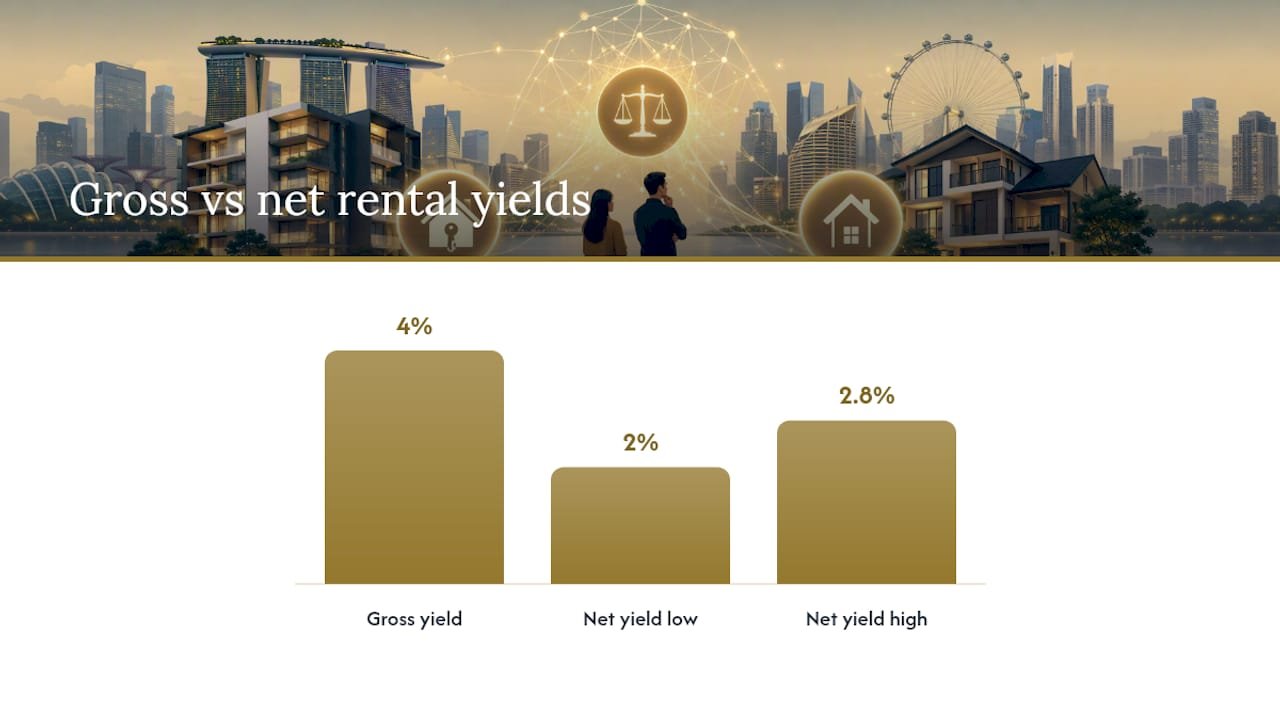
- Estimated net rental yields are typically below gross yields, with private condos realistically delivering 2 to 2.8 percent net after expenses, influencing long-term investment returns.
- A comprehensive model requires precise inputs, including purchase price, taxes, mortgage costs, rental income, and alternative investment returns, to determine if buying outperforms renting.
- Policy changes such as ABSD adjustments, loan-to-value limits, and current rental trends can significantly affect the cost-effectiveness and timing of property purchases.
Table of Contents
- Who benefits from renting and who benefits from buying?
- Full cost comparison: buying versus renting in Singapore
- How long must you hold a property to make buying worthwhile?
- Stamp duties, financing rules and eligibility that change everything
- What do current rental trends and market data show?
- Lifestyle factors that matter as much as the numbers
- How do you build your own rent-vs-buy model?
- How Registertoday helps you act on this decision
- Why there’s rarely one “right” answer
- Sources
- FAQ
Who benefits from renting and who benefits from buying?
The rent vs buy Singapore decision rarely comes down to a single number. It comes down to who you are, how long you plan to stay put, and what happens if your circumstances change.
Renting suits a specific set of profiles. Short-term expats on two or three-year work assignments gain little from buying, since Additional Buyer’s Stamp Duty alone can erase years of potential capital gains if they sell early. People who expect to relocate within Singapore, perhaps for a new job closer to a different district or a growing family needing more space soon, also do better renting until their plans settle. Anyone who prioritises liquidity, keeping cash accessible rather than locked into a downpayment and stamp duties, tends to sleep better as a tenant.
Buying makes more sense for settled families who have already chosen their neighbourhood and school zone. Long-term residents with stable income, an emergency cash buffer beyond the downpayment, and a horizon of ten years or more are the profile most likely to benefit from ownership. DBS notes that career stability is often as decisive as the financial spreadsheet: buying fits people whose income and location are unlikely to change, while renting suits those needing flexibility.
There are trade-offs that don’t show up in any cost table.
- Renters usually cannot renovate freely and face tenancy uncertainty every one or two years at lease renewal.
- Owners gain control over their space but absorb every maintenance bill and repair decision themselves.
- Families with children often value the community and school continuity that ownership provides, even when the numbers are close.
- Landlords selling a rented unit can force a tenant to move with as little as two months’ notice in many leases.
None of these profiles is fixed. A tenant today building savings and career stability can easily become a buyer in three years. The point of sorting yourself into a profile isn’t to lock in a decision, it’s to know which set of numbers actually applies to you right now.
Full cost comparison: buying versus renting in Singapore
The upfront cash required to buy in Singapore is where most first-time buyers underestimate the commitment. A private property purchase typically needs a minimum 25% cash and CPF downpayment, with at least 5% payable in cash. On top of that comes Buyer’s Stamp Duty, calculated on a progressive scale that rises with purchase price, plus legal conveyancing fees, a valuation report, and renovation costs that can range from modest touch-ups to a full refit.
Then there’s ABSD, and this is where the calculation diverges sharply by buyer profile. A Singapore Citizen buying a second property, a Permanent Resident on their first purchase, or a foreigner buying any residential property at all, faces a materially different bill. These rates are set by policy and revised periodically, so anyone modelling a purchase should check the current schedule before committing rather than relying on a figure from a previous year.
A number worth sitting with: net rental yields typically run meaningfully below the advertised gross yield once vacancy periods, MCST maintenance fees, property tax, and agent commissions on eventual sale are deducted. A unit advertised at a 4% gross yield may realistically deliver closer to 2 to 2.8% net, before financing costs are even considered.
Ongoing ownership costs don’t stop after the keys are handed over. Monthly mortgage repayments are the obvious one, but owners also carry:
- Maintenance and MCST fees, which vary by development but often run several hundred dollars a month for condominiums.
- Annual property tax, calculated on the property’s annual value and higher for non-owner-occupied units.
- Fire and mortgage insurance premiums.
- Vacancy risk if the unit is rented out and sits empty between tenants.
- Agent’s commission when the property eventually sells, typically borne by the seller.
Renting carries a lighter but real set of costs. Tenants usually pay a security deposit equivalent to one or two months’ rent, the first month’s rent upfront, and in some arrangements, a co-broke commission if a tenant’s agent sourced the unit. Renter’s insurance for contents is optional but inexpensive relative to the risks it covers.
One structural point trips up a lot of buyers: CPF Ordinary Account savings can be used towards the downpayment, monthly instalments, and even some stamp duty components for HDB purchases, but ABSD must be paid in cash. It cannot be drawn from CPF. For a Permanent Resident or foreign buyer facing a substantial ABSD bill, this is often the single biggest liquidity shock in the entire transaction, and it’s the cost most likely to be missed in a back-of-envelope calculation.
How long must you hold a property to make buying worthwhile?
The breakeven question boils down to one comparison: does your adjusted annualised return from owning beat what you’d earn investing the same capital elsewhere while renting? Everything else is detail feeding into that single number.
Start with round-trip costs, the expenses you pay once at purchase and once again at sale. These include BSD, any applicable ABSD, legal and agent fees, renovation, and potentially Seller’s Stamp Duty if you sell within the holding period that triggers it. Sellers are commonly advised to hold for at least five years to clear SSD exposure and recoup transaction friction. Add to that the opportunity cost of your downpayment, the return you forgo by having that cash locked into equity instead of invested in a diversified portfolio.
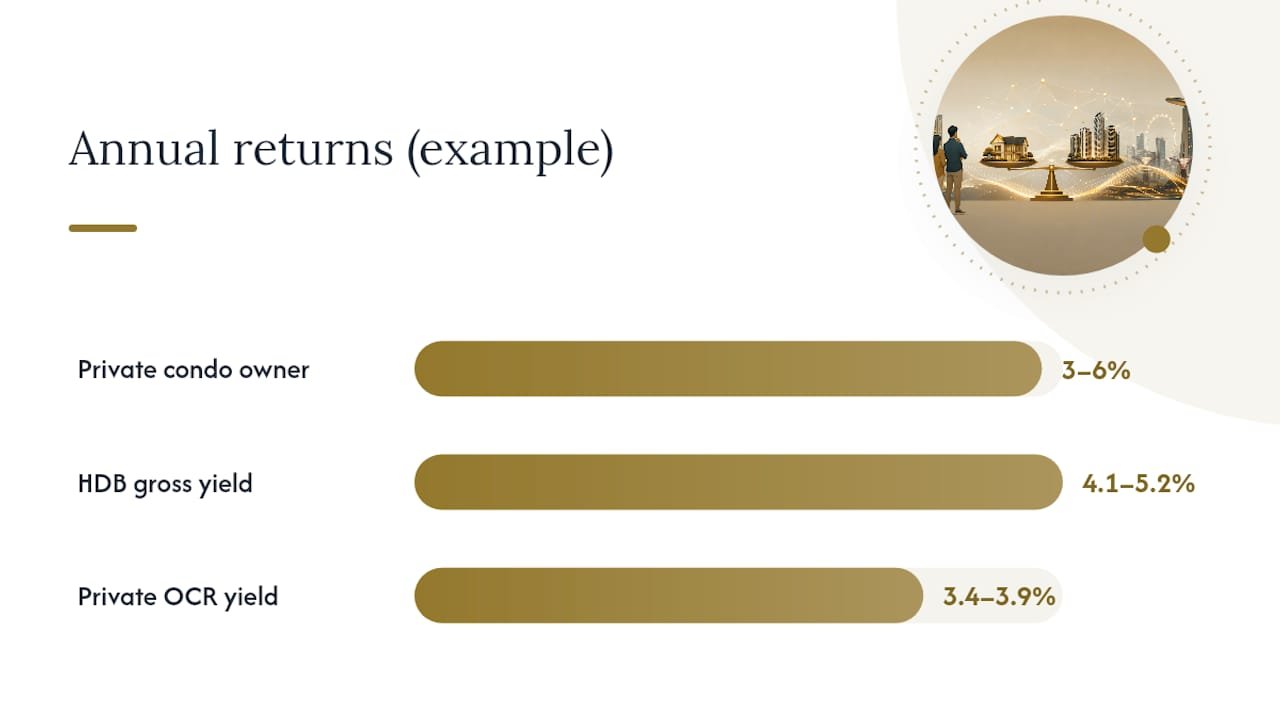
Here’s a simplified worked example for a $1.2 million private condo. Assume a 25%) downpayment ($300,000), BSD of roughly $33,600, no ABSD (Singapore Citizen, first property), and $40,000 in legal fees and renovation combined. Total upfront cash outlay: approximately $373,600. Over a ten-year hold with modest 2% annual price appreciation and rental income covering most of the mortgage interest, SmartCalculator’s modelling suggests post-cost annualised returns in the region of 3 to 6%, a range that reflects how much transaction friction eats into headline capital gains.
Now compare that to renting an equivalent unit at roughly $4,500 a month ($54,000 a year) while investing the $373,600 you would otherwise have committed as a downpayment and stamp duty. If that capital earns even a moderate long-term equity return, the rent-and-invest scenario can match or beat the ownership scenario over a shorter holding period, though it rarely beats it over ten-plus years once compounding on the property’s leveraged capital appreciation kicks in.
For an HDB resale flat, the maths shifts. Lower entry prices, no ABSD for most citizen buyers, and typically higher net rental yields on public housing (often 4.1 to 5.2% gross, against roughly 3.4 to 3.9% for Outside Central Region private condos) mean HDB buyers often reach breakeven faster than private property buyers, even accounting for the Minimum Occupation Period restricting resale for five years.
To run this model on your own numbers, collect these inputs before you start:
- Purchase price and your exact BSD/ABSD liability based on citizenship and property count.
- Cash downpayment required and how much of it comes from CPF versus cash.
- Mortgage interest rate and loan tenure.
- Monthly maintenance, property tax, and insurance costs.
- Expected market rent for an equivalent unit, plus a realistic vacancy allowance.
- The return you’d reasonably expect from investing your downpayment elsewhere instead.
The rule that ties it together: compare your adjusted annualised return from ownership, after every cost above, against the annualised return of the alternative investment. Whichever number is higher, over your realistic holding period, is your answer.
Stamp duties, financing rules and eligibility that change everything
Singapore’s property rules aren’t background noise, they’re often the deciding factor in whether buying beats renting for a given individual.
Buyer’s Stamp Duty is progressive. On a $1.2 million property, the calculation works through tiers: 1% on the first $180,000, 2% on the next $180,000, 3% on the next $640,000, and higher marginal rates above that, landing at roughly $33,600 in this example. Every buyer pays BSD, regardless of citizenship.
ABSD is where profiles diverge sharply:
- Singapore Citizens pay 0% ABSD on their first residential property.
- Singapore Citizens buying a second property face a meaningfully higher rate; a third or subsequent property is higher still.
- Permanent Residents pay ABSD even on a first purchase, and a steeper rate on subsequent ones.
- Foreigners face the highest ABSD tier on any residential purchase, first property or not.
These rates change with policy, so treat any specific percentage as time-sensitive and confirm the current schedule before signing an Option to Purchase.
Financing adds another layer. The Total Debt Servicing Ratio (TDSR) caps all your monthly debt obligations, including the new mortgage, at a percentage of your gross monthly income. For HDB flats and executive condominiums, the Mortgage Servicing Ratio (MSR) applies a tighter cap specifically on housing debt. Loan-to-Value (LTV) limits then determine your maximum loan quantum, which is why most buyers need a healthy cash buffer well beyond the legal minimum, because banks won’t lend past these ceilings regardless of how much you want to borrow.
CPF rules add a final wrinkle. Ordinary Account savings can fund the downpayment, monthly instalments, and some stamp duty for HDB purchases, subject to valuation limits and the CPF withdrawal cap. For private property, CPF usage is similarly permitted for the purchase and mortgage servicing. What CPF cannot touch, in any scenario, is ABSD. That bill must be settled in cash, which is precisely why PRs and foreign buyers often need far larger liquid reserves than a first-time citizen buyer, even at an identical purchase price.
What do current rental trends and market data show?
Rents are still climbing, just more gently than during the sharp post-pandemic surge. URA’s data shows the private rental index rose 1.8% year-on-year in the first quarter of 2026, a modest increase that signals the rental market has cooled from its earlier spike without turning downward.
For tenants, that figure is reassuring. It means rents are unlikely to jump sharply within a single lease renewal cycle, giving renters more negotiating room than they had a couple of years ago. For prospective buyers weighing the rent side of the equation, it also means the “cost of waiting” while saving for a downpayment has become more predictable rather than a moving target.
Yield patterns across market segments remain fairly consistent. HDB resale flats tend to deliver the highest gross rental yields, often in the 4.1 to 5.2% range, reflecting their lower purchase prices relative to rent achievable.
What to watch going forward: new private housing launches entering the market can soften rents in specific districts as supply catches up with demand. Any adjustment to ABSD rates or cooling measures would immediately change the buying calculation for PRs and foreigners, as it has done in previous policy cycles. And because gross yields overstate what owners actually pocket once fees and vacancy are stripped out, any yield figure quoted in a listing should be treated as a starting point, not the answer.
Lifestyle factors that matter as much as the numbers
Career mobility often decides this before any spreadsheet gets opened. If your job involves regular transfers, a short-term contract, or genuine uncertainty about whether you’ll still be in Singapore in three years. Renting protects you from a forced sale at a bad moment.
Space and control questions matter too. Owners can renovate, keep pets without a landlord’s approval, and avoid the disruption of a lease non-renewal. Renters trade that control for flexibility, but repeatedly moving disrupts school continuity for children and unsettles the informal community ties, the neighbours, the regular hawker stall, the walking routes, that make a place feel like home.
There’s also a psychological dimension worth naming honestly.
- Some people find landlord uncertainty (a sudden sale, a steep rent increase at renewal) genuinely stressful and are willing to pay a premium in ownership costs to avoid it.
- Others find the maintenance burden of ownership, arranging repairs, managing MCST disputes, budgeting for a new aircon, more draining than any rent increase.
- Neither preference is wrong, but pretending you don’t have one and forcing yourself into the “financially optimal” choice usually backfires within a year or two.
Pro Tip: Before running any numbers, write down honestly whether you’d rather deal with a bad landlord or a broken water heater. Your answer says more about which choice will actually make you happy than any breakeven calculation.
How do you build your own rent-vs-buy model?
A reliable model needs real inputs, not rough guesses, and a sensitivity check that stops you overcommitting on optimistic assumptions.
Start by gathering these figures in order:
- Purchase price for the property type you’re considering, benchmarked against recent transactions in that development or estate.
- BSD and ABSD calculated precisely for your citizenship and property-count status, not a rough percentage.
- Cash downpayment required, split between the minimum cash portion and what CPF can cover.
- Loan rate and tenure quoted by your bank or mortgage broker, since TDSR and MSR limits will shape what you can actually borrow.
- Monthly maintenance, property tax and insurance, sourced from the development’s MCST or a similar unit’s listing.
- Expected market rent for an equivalent unit in the same area, plus a realistic vacancy allowance of at least one month a year.
- Your alternative investment return, a conservative long-term estimate for what idle capital would otherwise earn.
Once you have those seven numbers, build a simple sensitivity check rather than trusting a single scenario. Run the model at 1%, 2%, and 3% annual price appreciation, and test rent growth at both the recent 1.8% URA trend and a flatter 0% assumption. If buying still comes out ahead under the conservative end of that range, and your life circumstances support a long hold, that’s a genuinely strong signal.
Before you act on the numbers, work through this checklist:
- Get an In-Principle Approval (IPA) from a bank so you know your actual borrowing limit before making an offer.
- Confirm your CPF Ordinary Account balance and withdrawal limits with the CPF Board.
- Request a free property valuation to sanity-check the asking price against recent comparable transactions.
- Consult a conveyancing lawyer before signing the Option to Purchase, since the legal terms lock in obligations that are expensive to unwind.
- Recalculate ABSD one more time immediately before exercising the option, in case your property count or eligibility has changed.
How Registertoday helps you act on this decision
A practical route for turning this analysis into an actual transaction involves options such as buying, selling, or finding a rental that fits your timeline. One core strength in the Singapore market is helping investors structure purchases that avoid unnecessary ABSD exposure, which is often the single largest cash outlay in the entire decision.

Registertoday’s services cover the full decision, not just one side of it:
- ABSD-aware guidance for structuring purchases that reduce or avoid Additional Buyer’s Stamp Duty exposure where legally possible.
- Free property evaluations and personalised negotiation support for buyers and sellers.
- Detailed market gap analysis to identify undervalued opportunities before you commit cash.
- Listings spanning residential and commercial property, plus rental assistance for expats weighing the rent side of this article’s model.
- A track record built on over $1 billion in completed sales, evidence of a platform that has run this calculation for a large number of real transactions, not just in theory.
If the worked example above has you leaning towards ownership, start with a free home valuation to see what your budget actually stretches to, or browse current listings through property search to compare real prices against the numbers you’ve just modelled.
Why there’s rarely one “right” answer
The rent vs buy Singapore question gets asked as though it has a universal answer, and the most honest response is that it doesn’t. The decisive variables, holding period, ABSD exposure, and what you’d do with your capital instead, are different for every reader, which is precisely why cookie-cutter advice on this topic tends to age badly.
What I’d push back on is the instinct to treat five years as a magic number rather than a rough guideline shaped by SSD windows and transaction friction. Your real breakeven point depends on your specific ABSD tier, your financing rate, and how that capital would otherwise perform, not a rule of thumb borrowed from a forum thread. Run your own numbers before you trust anyone’s headline figure, including this article’s worked example, which is illustrative rather than a forecast for your exact property.
For anything touching CPF withdrawal limits, current ABSD schedules, or tax treatment specific to your citizenship status, speak to a licensed financial adviser or conveyancing lawyer before you commit. The framework here gets you asking the right questions. The final numbers need to be yours.
— Anderson
Sources
- URA media release (Q1 2026 rental index)
- Should you buy or rent? | DBS articles
- Singapore property investment returns 2026 | SmartCalculator
- Should You Buy or Rent Property in Singapore? | POSB
FAQ
Is it a good idea to buy or rent in Singapore?
Neither is universally better. Buying tends to make more financial sense over a longer holding period with stable finances, while renting suits shorter time horizons, career mobility, or a preference for liquidity over commitment.
Is $3,000 a month good in Singapore?
A modest monthly income can cover renting a room or a smaller unit outside the city centre, but it often falls short of typical mortgage servicing thresholds once TDSR limits are applied to a private property purchase. Whether it’s “good” depends heavily on household size, existing debt, and whether you’re renting alone or splitting costs.
Will rental prices go down in 2026 in Singapore?
Rental prices are still rising, though modestly. URA reported 1.8% year-on-year growth in the private rental index for the first quarter of 2026, suggesting rents are stabilising rather than falling, though new housing supply entering specific districts could soften rents locally.