
Stop Rental Scams in Singapore: Verify Numbers, Use Trusted Platforms
Rental scams are active in Singapore and have already cost victims millions of dollars. Before you transfer a single dollar for a deposit or rent, verify the phone number in the advertisement on the CEA Public Register or call the ScamShield helpline on 1799. The Council for Estate Agencies (CEA), the Singapore Police Force (SPF), and ScamShield are the three authorities you need on your side before you view a flat, meet an agent, or hand over any money.
TL;DR:
- More than 430 rental scam reports and at least S$2.7 million in losses occurred in Singapore between January and October 2024, largely through phone number impersonation.
- Fake listings often reuse photos, copy genuine agent details, and shift communication to WhatsApp to evade platform monitoring and facilitate quick payment.
- Verifying the phone number on the CEA Public Register before engaging is the most reliable way to detect impersonation, as scammers rarely control genuine registered contacts.
- Always view properties in person with certified agents and pay via traceable methods, avoiding cash, gift cards, or cryptocurrencies to reduce scam risk.
- Promptly reporting suspicious listings and payment incidents to police, banks, and ScamShield improves chances of recovering lost funds and stopping scams early.
Table of Contents
- How rental scams work in Singapore
- Common rental scam red flags to watch for
- How to verify listings and agents before you commit
- Safe viewing and payment practices
- What to do if you suspect a scam or have already paid
- The scale of rental scams in Singapore
- Legal recourse and tenant rights for scam victims
- How rental scams affect the wider Singapore housing market
- Community resources and support for scam victims
- Publisher perspective: what platforms owe renters
- A safer way to search for your next rental
- Sources
- FAQ
How rental scams work in Singapore
Most rental scams follow a familiar script. A scammer copies a real CEA-registered agent’s name, photograph, and registration number from a genuine listing, then posts it under a different phone number that leads back to them, not the actual agent. The listing looks legitimate because the details check out on a quick glance, but the contact number is the giveaway.
Fake or hijacked listings on Facebook groups, Carousell, and property classifieds are the most common entry point. Once a victim expresses interest, pressure tactics kick in fast: a deposit “to reserve the unit,” a claim that other tenants are viewing it the same day, or an insistence on paying before any viewing takes place.
Some scammers go further, arranging for a stand-in to meet victims at the property and pose as a “personal assistant” while the real agent is supposedly overseas, according to police. Common tricks include:
- Copied agent passes, headshots, and registration numbers pasted onto a fake listing.
- Video walkthroughs recycled from a different, genuine listing.
- Communication shifted quickly to WhatsApp to avoid platform monitoring.
- Sudden silence once payment clears, which is often how victims first realise something is wrong.
Common rental scam red flags to watch for
Certain warning signs appear again and again across reported cases. Learning to spot them in seconds can save you thousands of dollars.
- A price that looks too good. If a unit is priced well below comparable listings in the same building or area, treat it as suspicious rather than lucky.
- Urgency and pressure. Phrases like “pay now to secure it” or “another tenant is viewing tonight” are designed to short-circuit your judgement.
- A mismatched phone number. The number in the ad does not match what comes up when you search the agent on the CEA Public Register.
- Unusual payment requests. Cash, gift cards, or cryptocurrency for a deposit are almost never used by legitimate landlords or agents in Singapore.
- An agent who is conveniently unavailable. Claims that the agent is overseas and cannot conduct a viewing in person are a classic stalling tactic.
- Recycled photos. Reverse-image searching a listing’s photos sometimes reveals the same unit advertised elsewhere at a different price or address.
Pro Tip: Screenshot the listing and the agent’s WhatsApp profile the moment something feels off. If you do need to report it later, timestamped evidence makes the police and your bank’s investigation far quicker.
How to verify listings and agents before you commit
Verification takes minutes and it is the single most effective habit you can build as a renter in Singapore. CEA is blunt about this: searching an agent by name or registration number is not enough, because scammers copy both. The phone number in the ad has to match the number on file, or the listing should be treated as fraudulent regardless of how convincing everything else looks.
Work through this sequence before you engage further:
- Search the exact phone number used in the advertisement on the CEA Public Register, not just the agent’s name.
- For HDB flats, cross-check publicly available ownership information through HDB or INLIS where relevant to the unit.
- Run the phone number or any suspicious link through ScamShield (helpline 1799 or the app) before replying further.
- Where possible, confirm the landlord’s bank account name matches the property’s ownership records before you pay anything.
This four-step check catches the overwhelming majority of impersonation attempts, because scammers rarely control a phone number that is genuinely tied to the CEA register.
Safe viewing and payment practices
Insist on viewing the property in person with the actual CEA-registered agent, or send a trusted proxy if you cannot attend yourself. A legitimate agent has no reason to charge you simply to arrange a viewing, and any request for payment before you have seen the unit should end the conversation.
When it comes to money, stick to methods that leave a trail:
- Pay the property owner directly by bank transfer or crossed cheque, never cash, gift cards, or cryptocurrency, as CEA advises.
- Keep every receipt, transfer confirmation, and chat log related to the transaction.
- Ask to see a draft tenancy agreement and the owner’s identification before any payment changes hands.
- Cross-check the name on the bank account against the ownership details you have already verified.
A landlord’s guide to furnished rental arrangements in Singapore covers similar traceable-payment principles worth reading if you are renting a furnished unit for the first time.
What to do if you suspect a scam or have already paid
Speed matters once you suspect fraud. Follow these steps in order:
- Contact your bank immediately to attempt to recall or block the transfer, and keep every payment receipt.
- Call ScamShield on 1799, then report the incident to the Singapore Police Force on 1800‑255‑0000 or through the online iWitness portal.
- Report the listing itself to the platform it appeared on, whether that is Facebook or Carousell, so it can be taken down.
- If a real agent’s identity was impersonated, notify CEA directly so it can investigate and warn other consumers.
- Gather every piece of evidence, messages, the listing URL, screenshots, and payment records, to support both the police report and your bank’s enquiry.
Rapid bank contact and thorough documentation genuinely improve the odds of recovering funds or at least helping investigators trace the scammer.
The scale of rental scams in Singapore
Between January and October 2024, police recorded more than 430 reported cases of rental scams involving impersonation of CEA-registered agents, with victims losing at least S$2.7 million. Press reporting from the same period corroborates the pattern: scammers listing contact numbers on social media, presenting fake agent passes, and collecting payment through bank transfers or PayNow before victims realise anything is wrong.
Between January and October 2024, more than 430 rental scam reports and at least S$2.7 million in losses were recorded in Singapore.
A newer variant emerged in late 2025: a fraudulent “Johor–Singapore housing subsidy” scheme that used the language of a government initiative to appear credible. It generated at least 21 reported cases and over S$1 million in losses in a matter of months, a reminder that scammers adapt their cover story faster than most renters update their guard.
Legal recourse and tenant rights for scam victims
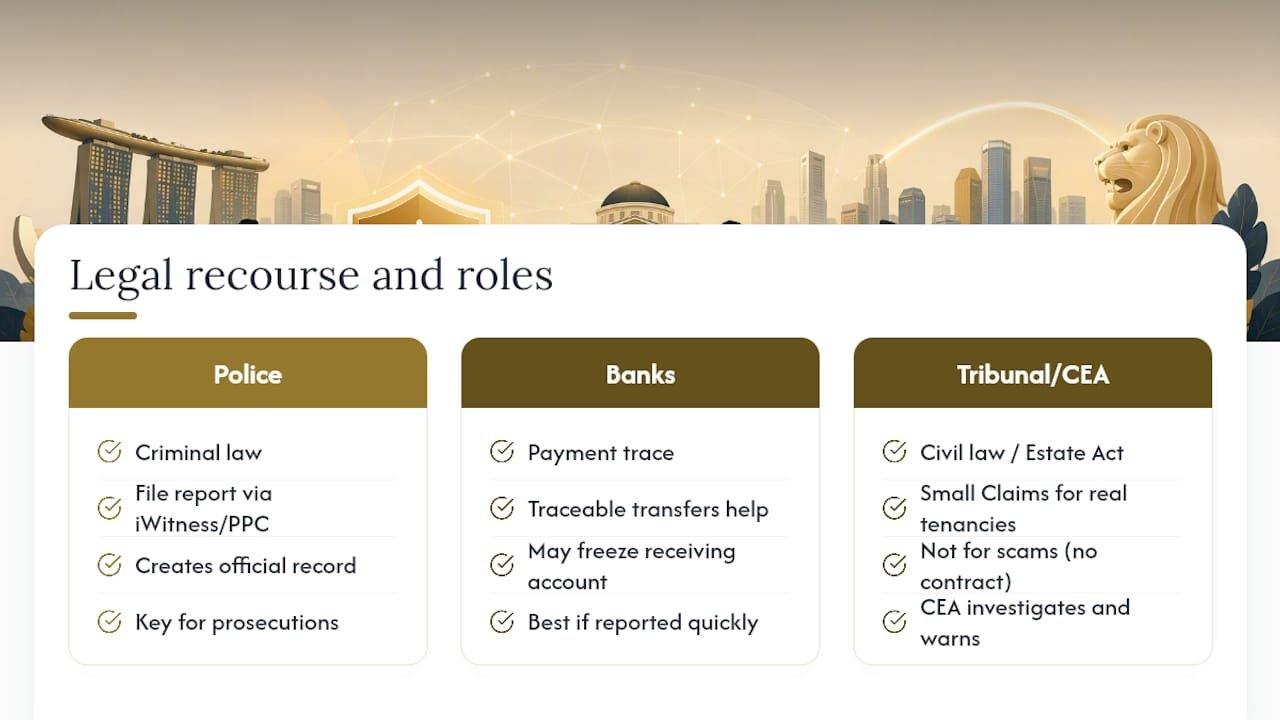
Rental scam victims in Singapore are victims of criminal deception under the Penal Code, and a police report is the formal starting point for any investigation or eventual prosecution. Filing through iWitness or at a neighbourhood police centre creates an official record, which matters both for a potential recovery of funds and for any insurance or bank dispute you later raise.
Recovering money after a scam is genuinely difficult once funds have left your account, particularly if they were transferred overseas quickly, which is why the police and CEA both frame prevention as far more reliable than aftercare. That said, tenants who paid through traceable bank transfers stand a better chance of at least partial recovery, because banks can sometimes freeze a receiving account before funds are fully dispersed, especially when reported within hours.
Genuine tenancy disputes, as opposed to scams, sit under contract law rather than criminal law. If you have signed a tenancy agreement with a real landlord and a dispute arises over deposits, repairs, or early termination, the Small Claims Tribunal can hear claims up to a set monetary limit without needing a lawyer. That route does not apply to scam cases, since there is no genuine landlord or contract to enforce, only a fraudulent transaction to report.
CEA’s own enforcement powers extend to disciplining registered agents who breach the Estate Agents Act, but a scammer impersonating an agent is not actually registered, so CEA’s role in these cases is largely investigative support and public warning rather than direct sanction against the fraudster. That distinction is worth understanding before you assume CEA can penalise the person who scammed you directly.
How rental scams affect the wider Singapore housing market
Every scam that goes unreported chips away at trust in online listings generally, which pushes cautious renters toward slower, more expensive search methods and makes the rental market feel more opaque than it needs to be. Genuine landlords and CEA-registered agents also carry reputational damage when their names and photographs are stolen for fake ads, sometimes fielding confused calls from victims who believed they were dealing with the real agent.
The financial losses are concentrated but real: over S$3.7 million combined across the two advisories covered above in less than two years. That figure understates the true cost, because many victims likely never report smaller losses, and each unreported case removes a data point that could otherwise sharpen police and CEA warnings.
There is also a knock-on effect on legitimate rental supply. When renters grow wary of unfamiliar listings, they gravitate toward a smaller pool of agents and platforms they already trust, which can tighten competition for genuinely good units and, in some pockets of the market, push up what tenants are willing to pay for the reassurance of a known name. A market where verification is quick and routine keeps that friction to a minimum, which benefits honest landlords as much as it protects tenants.
Community resources and support for scam victims
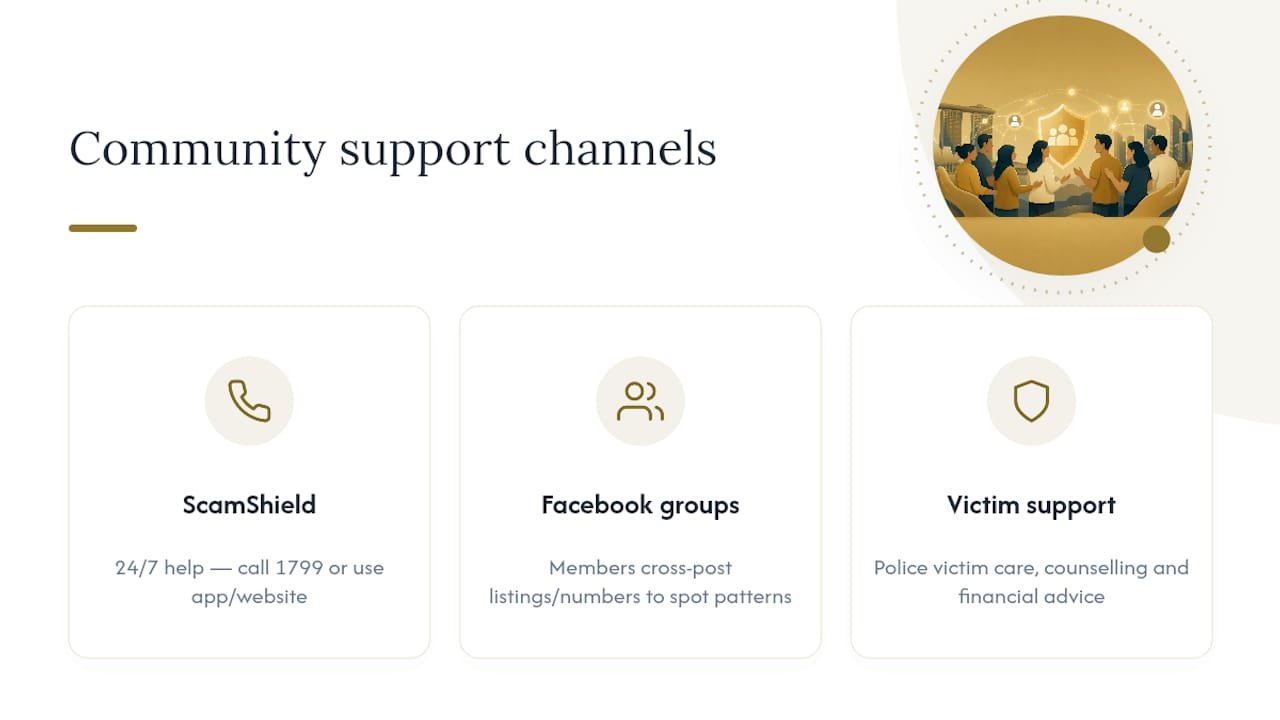
Beyond the police and CEA, several channels exist specifically to help renters check a suspicious contact before money changes hands or to get support afterwards. ScamShield remains the fastest first stop, available around the clock on 1799 or through its app and website, and it is designed precisely for the moment of doubt before you pay, not just after you have lost money.
Community-driven warnings also travel quickly through Facebook groups dedicated to Singapore renters and expats, where members frequently cross-post suspicious listings and phone numbers they have already flagged. These groups will not replace an official check, but they often surface a pattern faster than any single renter would notice alone, since a scammer typically reuses the same script across multiple victims within days.
For anyone who has lost money and is dealing with the emotional aftermath as much as the financial one, victim support services under organisations like the Singapore Police Force’s own victim care units can offer guidance on next steps beyond simply filing a report. Local counselling and financial-advisory services can also help renters recovering from a significant loss plan their next move without repeating the same vulnerability, particularly newcomers unfamiliar with how Singapore’s rental market normally operates.
Publisher perspective: what platforms owe renters
Platforms that list rental properties have a direct role in reducing scam exposure, not just a duty to react after the fact. Verified agent workflows, active listing moderation, and clear guidance steering renters toward traceable payments all reduce the surface area scammers exploit. Registertoday’s own agent submission process and advanced search filters are built with that same logic: making it easier to see who is actually behind a listing before you engage.
None of that replaces your own checks. Even on a platform with verified listings, running the phone number through the CEA Public Register costs you two minutes and closes off almost every impersonation attempt going. Treat platform safeguards and personal verification as complementary, not substitutes for each other.
— Anderson
A safer way to search for your next rental
Some platforms offer a more transparent alternative to scrolling classifieds and social media groups for your next home, addressing issues with copied listings and impersonated agents. Searching verified listings directly with agent details laid out clearly can be more efficient than chasing a phone number across many platforms.

The platform’s property search lets you filter by location, price, and property type while keeping listing details consistent and checkable, and its free home valuation service is useful if you are weighing whether renting or buying makes more sense at current market prices. None of this removes the need to verify a phone number on the CEA Public Register before you pay anyone. It simply means you are starting your search from a smaller, more accountable pool of listings rather than an open, unmoderated feed. Browse current listings on Registertoday’s property page to see what a verified search actually looks like.
Sources
- SPF | Police Advisory On Rental Scams Involving The Impersonation Of Property Agents
- Rental scams | Council for Estate Agencies
- At least $2.7 million lost to property rental scams so far in 2024 | The Straits Times
FAQ
What are the most common rental scams in Singapore right now?
The most common pattern is impersonation of a CEA-registered agent, where a scammer copies a real agent’s name and registration number but lists a different contact number. A newer variant involves a fake “housing subsidy” scheme that borrowed the language of a government initiative to appear legitimate.
How do rental scams typically work?
A scammer posts a fake or hijacked listing, often with stolen photos and a copied agent identity, then pressures the victim to pay a deposit quickly before any in-person viewing. Communication usually moves to WhatsApp, and the scammer disappears once payment clears, which is often how victims first realise they have been defrauded.
What is the single best way to avoid a rental scam in Singapore?
Search the exact phone number used in the advertisement on the CEA Public Register rather than searching by the agent’s name, since names and registration numbers are the parts scammers most often copy. If the number does not match, treat the listing as fraudulent regardless of how convincing the rest of it looks.
How do I report a rental scam in Singapore?
Call ScamShield on 1799 first if you are unsure or have already paid, then report the incident to the Singapore Police Force on 1800‑255‑0000 or via the online iWitness portal. Contact your bank immediately as well, since prompt reporting improves the small chance of recalling a transfer.
Does Registertoday verify its rental listings?
Registertoday runs listings through an agent submission process designed to keep contact and agent details consistent and checkable, and its advanced search tools let you filter by verified criteria. You should still confirm any agent’s phone number on the CEA Public Register before paying, regardless of which platform you use.