

S$60M Clawback Risk: Prove a Genuine 99-1 Split in Singapore
A 99-1 arrangement is not automatically illegal in Singapore, but when it is entered into mainly to avoid Additional Buyer’s Stamp Duty, the Inland Revenue Authority of Singapore) can treat it as tax avoidance and claw back the duty owed. Recent court guidance confirms the split will only stand if evidence from the time of purchase shows it reflected the parties’ genuine intentions. If you are weighing up or already locked into a 99-1 split, assume scrutiny is possible and get proper legal advice before you act.
TL;DR:
- The 99-1 ownership split is often scrutinized if structured mainly to reduce ABSD, especially when the transfer occurs shortly after purchase.
- Courts prioritize contemporaneous evidence showing the parties’ true intentions at the time of purchase over later explanations that suggest an avoidance scheme.
- IRAS has already clawed back around S$60 million from 187 suspicious cases, with no statutory limit on review periods for stamp duty filings.
- Genuine decoupling transfers are treated more leniently than staged 99-1 arrangements, provided they are properly documented and not timed to mimic avoidance.
- Agents promoting 99-1 splits as avoidance tools risk disciplinary action, and thorough documentation with legal advice is essential to reduce legal and tax risks.
Table of Contents
- What a 99-1 arrangement is and how it usually works
- Legal and tax stance: IRAS, Section 33A and ABSD mechanics
- Court decisions and precedents: what the Court of Appeal ruling means
- Risks and enforcement: what actually happens if things go wrong
- Decoupling and safer alternatives to a staged 99-1 split
- Practical checklist for co-owners and buyers
- Historical context and origin of the 99-1 arrangement
- Examples and typical use cases in practice
- Tax implications beyond ABSD
- How a 99-1 arrangement compares with other ownership structures
- Negotiating and documenting agreements to reduce risk
- Impact on future transactions and refinancing
- A practitioner’s view on where clients go wrong
- Get compliant advice and a clear valuation with Register Today
- FAQ
- Sources
What a 99-1 arrangement is and how it usually works
A 99-1 arrangement splits ownership of a property so one buyer holds 99% and the other holds 1%. In a Singapore property purchase, this is usually structured in one of two ways:
- A couple or co-buyers register the purchase from the outset with a 99:1 split, naming the lower-ABSD-profile buyer with the larger share.
- Shortly after completion, the 1% owner transfers their stake to the 99% owner, or vice versa, often within weeks or months of the original purchase.
The second pattern is the one that draws attention from the Ministry of Finance, because it suggests the original 99:1 split was a step towards a single joint acquisition rather than a genuine reflection of how the parties wanted to own the property.
This differs from legitimate decoupling, where an existing owner later transfers part of their share in a property they have held for some time, typically to free up one party’s name for a separate purchase. Consider a flat bought for S$1.5 million: if structured as one joint purchase by two Singapore citizens who each already own property, ABSD could apply to the full amount. Split deliberately into a 99:1 purchase followed by a quick transfer, the intention is the same but the paper trail looks staged, which is exactly what MOF’s policy targets.
Legal and tax stance: IRAS, Section 33A and ABSD mechanics
Section 33A of the Stamp Duties Act gives the Commissioner of Stamp Duties the power to disregard artificial or contrived steps and assess stamp duty as though the parties had made a single, direct acquisition. MOF’s policy statement confirms this power extends to 99-to-1 arrangements where the facts show the split was designed to reduce ABSD rather than reflect genuine co-ownership.
ABSD mechanics matter here because of how the duty is calculated:
- For joint acquisitions, IRAS applies the ABSD rate tied to the buyer with the highest ABSD profile, not an average or the lower rate.
- A 99-1 split that puts almost the entire share in the name of a buyer with no existing property, while the higher-profile buyer holds only 1%, is designed to sidestep that rule.
- Where IRAS or the Commissioner finds the split was artificial, the full ABSD becomes payable as if the purchase were made jointly from the start.
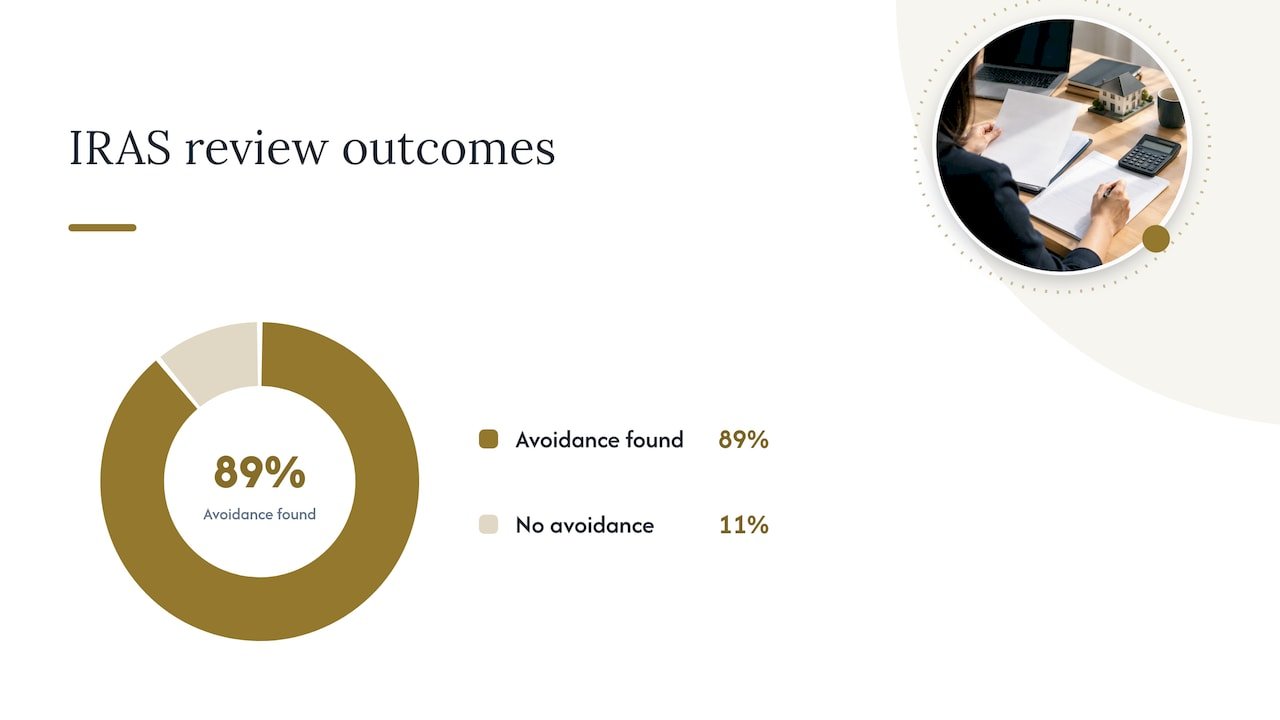
IRAS reviewed 187 suspicious cases and found that 166 involved tax avoidance, leading to a clawback of around S$60 million in ABSD and surcharges. That scale of enforcement shows this is not a theoretical risk. On top of the clawed-back ABSD, MOF’s policy confirms a 50% surcharge applies, and crucially there is no statutory time limit on when IRAS can review a stamp duty filing.
Court decisions and precedents: what the Court of Appeal ruling means
The Court of Appeal’s 2026 decision in the widely reported Hillcrest Arcadia dispute, Ngor v Wong, gave the clearest guidance yet on how courts treat 99-1 splits when co-owners fall out. The judgment turned on whether the registered 99% and 1% shares reflected what the parties actually intended at the time of purchase.
- Where contemporaneous evidence, such as financial records and communications from around the time of purchase, supports the registered split, courts are willing to uphold it even years later.
- Where the split appears to have been structured mainly to reduce ABSD, an illegal purpose can bar a party from later claiming a different beneficial share, even if the avoidance scheme was never actually detected or acted on by IRAS.
- Courts place weight on consistency: a party who gave one account of their intentions at the time of purchase and a different, more convenient account once the relationship broke down is unlikely to be believed.
Channel NewsAsia’s reporting on the case notes the Court of Appeal specifically rejected the High Court’s earlier finding of a resulting trust, favouring the registered proportions because the contemporaneous evidence supported them.
Risks and enforcement: what actually happens if things go wrong
The consequences of a 99-1 arrangement found to be tax avoidance go well beyond a corrected tax bill.
- IRAS can claw back the full ABSD that should have applied to a single joint acquisition, plus a 50% surcharge on top.
- There is no statutory limit on when IRAS can open or reopen a review of a stamp duty filing, so exposure does not simply expire after a few years.
- Agents who structured or promoted the arrangement risk referral to the Council for Estate Agencies for disciplinary action.
- Co-owners who fall out over a contrived split can find themselves in costly litigation, with no guarantee the court will accept their preferred version of events.
Pro Tip: Keep every document from the time of purchase, financial contribution records, emails, and any written statement of intention, even if the deal seems straightforward at the time.
Criminal exposure is less common but not impossible where there is clear deliberate fraud rather than an honest misjudgement, which is why intention and documentation matter so much.
Decoupling and safer alternatives to a staged 99-1 split
Legitimate decoupling, where an existing owner transfers part of their share in a property they already hold, is treated differently from a 99-to-1 purchase structured from day one. Wolters Kluwer’s analysis draws this distinction clearly: decoupling an existing title, done for reasons unconnected to a fresh purchase, is far less likely to attract Section 33A scrutiny than a split engineered at the point of acquisition.
If you are considering restructuring ownership, these steps reduce risk materially:
- Get independent legal advice before any transfer, not after a dispute arises.
- Put the reasons for the split in writing at the time, not reconstructed later.
- Keep a documented record of who paid what, including loan repayments and renovation costs.
- Allow a reasonable gap between purchase and any transfer, rather than a rapid flip that mirrors a staged scheme.
Pro Tip: If you suspect an existing arrangement may look like avoidance, voluntary disclosure to IRAS is often treated more favourably than waiting to be audited.
Practical checklist for co-owners and buyers
Before agreeing to any split, ask for a written explanation of why the proportions were chosen and insist both parties get independent legal advice. Confirm each buyer’s ABSD profile with a conveyancing solicitor before signing the option to purchase.
- Preserve every document, text message and email relating to the decision from day one.
- Record financial contributions as they happen, not from memory after the fact.
- Avoid any transfer soon after purchase that could resemble a staged scheme.
- If you are already in a 99-1 arrangement that concerns you, gather your evidence and speak to a property lawyer promptly.
| Stage | Key action |
|---|---|
| Before purchase | Written rationale, independent legal advice, ABSD profile check |
| At purchase | Document intentions and contributions contemporaneously |
| After purchase | Avoid rapid transfers; retain records |
| If exposed | Consider voluntary disclosure; instruct a lawyer |
Historical context and origin of the 99-1 arrangement
The 99-1 structure grew out of successive rounds of ABSD tightening. As ABSD rates rose for second and subsequent properties, some buyers and their advisers began splitting ownership shares to keep the paper trail inside a lower ABSD bracket, while in practice treating the purchase as a shared family asset. MOF’s policy statement notes that from 2018 to 2021, roughly 0.5% of private residential transactions involved 99-to-1 or similar arrangements, a small but persistent slice of the market.
What changed the picture was enforcement. For several years, 99-1 splits operated in something of a grey zone, discussed openly by some agents as a workaround rather than a red flag. The 2023 MOF policy announcement made clear that Section 33A applied to these arrangements and that IRAS would actively review past transactions, not just police new ones. That shift turned a quiet planning technique into a named enforcement priority, with IRAS’s review of 187 cases and the resulting clawback bringing the issue into mainstream property reporting. The 2026 Court of Appeal decision added a further layer, showing that even where IRAS does not pursue a case, a 99-1 split can still be tested in civil disputes between the co-owners themselves, with courts willing to probe the same question of genuine intention versus engineered appearance.
Examples and typical use cases in practice
The clearest illustration is a married couple buying their second property. One spouse already owns a flat; the other does not. Structured as a joint purchase, the higher ABSD profile of the property-owning spouse would apply to the full price.
Another common scenario involves parents and adult children. Where this reflects the real economic arrangement, documented from the outset, it sits closer to legitimate co-ownership. Where it is reversed shortly after purchase so the parent ends up with full ownership, it starts to look like the staged pattern IRAS has flagged.
A third scenario involves unmarried couples or business partners pooling funds for a property, with one party’s name kept at 1% for reasons unrelated to tax, such as credit history or immigration status. These cases show why intention and the surrounding paper trail matter so much: the same 99:1 numbers can be entirely legitimate or clearly contrived, depending on what the parties actually agreed and documented at the time.
Tax implications beyond ABSD
ABSD is the headline risk, but a 99-1 arrangement can touch other taxes too. Buyer’s Stamp Duty applies to the full purchase price regardless of how ownership is split between the parties, so restructuring the proportions does not reduce this baseline duty. Where a later transfer of a share takes place, that transfer itself can attract stamp duty on the value of the share being transferred, calculated separately from the original purchase.
This creates a secondary complication: if the registered split does not match the parties’ real financial arrangement, their income tax filings may not match the economic reality either, adding another layer of inconsistency that could surface under review.
If a property is later sold, there is no capital gains tax in Singapore for individuals making occasional property sales, though frequent transactions can be treated as trading income and taxed accordingly. None of these secondary tax points override the core ABSD risk, but they are worth factoring in before treating a 99-1 split as a one-off decision with no further tax consequences.
How a 99-1 arrangement compares with other ownership structures
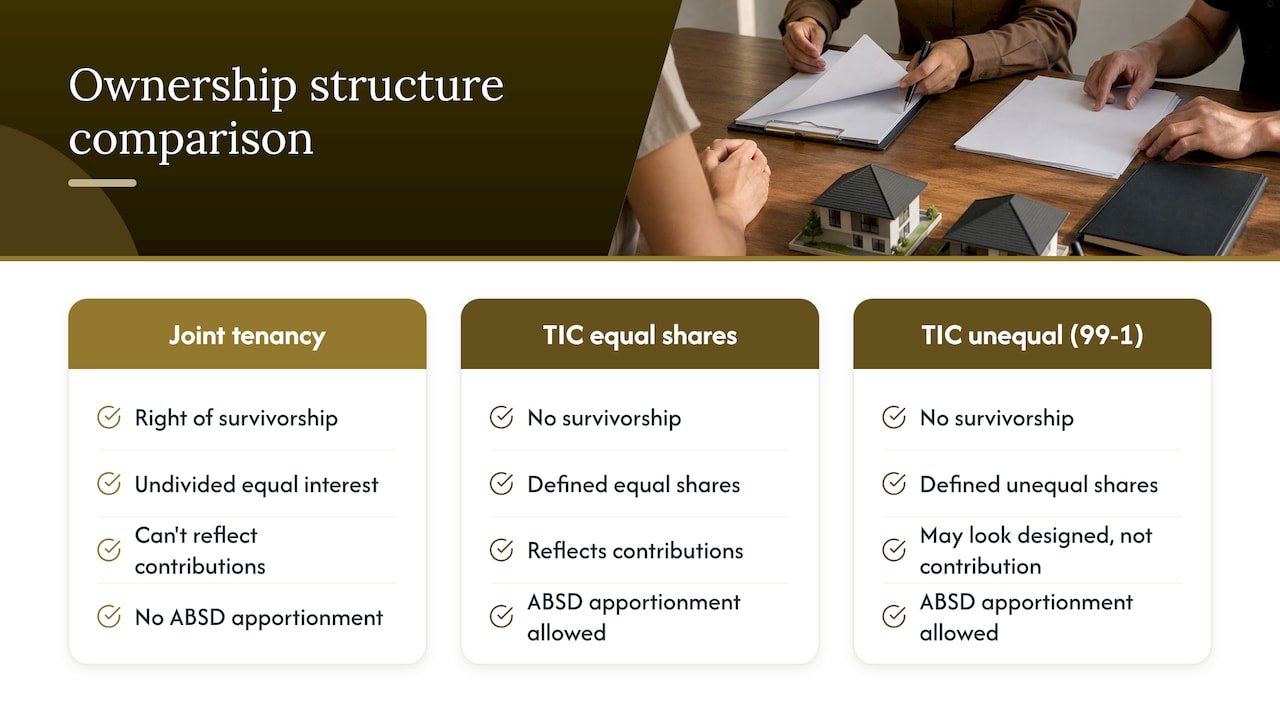
Singapore property buyers typically choose between joint tenancy, tenancy-in-common with equal shares, and tenancy-in-common with unequal shares, of which 99-1 is an extreme version. Joint tenancy gives both owners an equal, undivided interest with a right of survivorship, meaning a deceased owner’s share passes automatically to the surviving owner rather than through a will. It offers no flexibility on ABSD apportionment since both parties are treated as having equal profiles for assessment purposes.
Tenancy-in-common allows owners to hold defined, unequal shares, which is what makes 99-1 possible in the first place. A 50-50 or 70-30 split under tenancy-in-common raises far less suspicion than 99-1 precisely because the proportions look like a genuine reflection of financial contribution rather than an attempt to concentrate almost the entire interest in the lower-ABSD party. Where a split is lopsided enough to look designed around stamp duty bands rather than actual contributions, it draws more scrutiny, which is the core reason 99-1 specifically attracts attention from IRAS while a 60-40 split between genuine co-contributors generally does not.
Negotiating and documenting agreements to reduce risk
Whatever split co-owners choose, the agreement needs to be negotiated and written down properly, not settled informally and left undocumented. Each party should set out, in writing and before completion, why the chosen proportions reflect their actual contributions, whether in cash, loan repayments or other financial input. Vague or after-the-fact justifications are the weakest point in any arrangement that later faces scrutiny.
Independent legal advice for each party, rather than a single solicitor acting for both, helps establish that the proportions were genuinely negotiated rather than dictated by one party’s tax position. A written declaration of intention, signed at the time of purchase and kept with the sale and purchase agreement, gives later evidence of what was actually agreed, rather than relying on memory. For readers who want background on how decoupling agreements are typically drafted and reviewed, independent explainers on decoupling set out common clauses worth discussing with a lawyer. Avoid any clause or side letter that references reducing stamp duty as a purpose of the split: that kind of language is exactly what turns a legitimate commercial negotiation into evidence of avoidance intent.
Impact on future transactions and refinancing
A 99-1 split does not just carry risk at the point of purchase. It can complicate later transactions too.
Selling the property later also means both owners’ shares need to be accounted for in the sale proceeds, and any unresolved questions about whether the registered split reflects reality can surface at that point, especially if the relationship between co-owners has broken down. Using an independent tool such as Haio to check current market valuations and affordability before refinancing or selling can help both parties see where they stand, separate from any dispute over the original ownership split. Because there is no time limit on IRAS reviews, a 99-1 arrangement from years earlier can still be flagged during a later refinancing or resale if the original structure draws attention, which is one more reason to resolve any doubts about the arrangement sooner rather than later.
A practitioner’s view on where clients go wrong
The clients who run into trouble are rarely the ones acting in bad faith from the outset. They are usually the ones who treated the split as an administrative detail rather than a decision with legal weight, and only produced an explanation once a dispute or audit forced the question. Documentation written at the time of purchase is worth far more than a convincing story written years later. Prioritise proper advice over a clever workaround.
— Anderson
Get compliant advice and a clear valuation with Register Today
If you are weighing up ownership structures before a purchase, or already holding a 99-1 split and wondering where you stand, a clear picture of the property’s value and your options is the sensible starting point. We offer a free property valuation to help you understand what the property is actually worth before you make any decision about ownership shares, financing or a sale.

Alongside valuations, we provide negotiation support and transaction facilitation across residential, commercial and apartment listings. Where a purchase or restructuring raises ABSD questions, we recommend pairing any market evaluation with independent legal advice so the commercial and compliance sides of the decision are both covered. Visit our homepage to arrange a consultation or browse current listings before you commit to a structure.
This article is general information, not a substitute for advice from a qualified lawyer. Consult a qualified legal professional about your own circumstances before acting on anything here.
FAQ
Is a 99-1 arrangement always illegal in Singapore?
No. A 99-1 split is not automatically illegal, but MOF’s policy confirms that where the arrangement is structured mainly to avoid ABSD, Section 33A allows the Commissioner to disregard it and assess duty on the real transaction. The outcome depends on the evidence of intention at the time of purchase.
How much has IRAS clawed back from 99-1 arrangements?
IRAS reviewed 187 suspicious cases, found 166 involved tax avoidance, and clawed back around S$60 million in ABSD and surcharges. This figure covers past transactions reviewed under the current enforcement drive, not an ongoing annual total.
Did the Court of Appeal rule that 99-1 splits are safe?
Not entirely. The Court of Appeal’s 2026 decision upheld a 99% stake because contemporaneous evidence showed it reflected the parties’ true intentions, but the court also confirmed that an arrangement tainted by an ABSD-avoidance purpose can still be barred from recovery.
What is the difference between decoupling and a 99-1 purchase?
Decoupling involves an existing owner transferring part of their share in a property already held, while a 99-1 purchase sets the split from the moment of acquisition. Legal analysis treats genuine decoupling as lower risk, provided it is properly documented and not timed to mimic a staged purchase.
Can agents get in trouble for promoting 99-1 arrangements?
Yes. Agents found to have structured or promoted 99-1 arrangements as a tax avoidance tool can be referred to the Council for Estate Agencies for disciplinary action, separate from any stamp duty consequences the buyers themselves face.


