

Avoid ABSD and CPF Traps: Decoupling Property in Singapore in 7 Steps
Decoupling is a lawful option for private residential property in Singapore, provided it happens genuinely at market value, and it can restore the exiting owner to first time Additional Buyer’s Stamp Duty status. It does not apply to HDB flats. The Inland Revenue Authority of Singapore and the courts actively challenge arrangements that exist only to dodge duty, the legal outcome depends heavily on how the transaction is structured and evidenced.
TL;DR:
- Decoupling is only lawful for private residential properties at market value and does not apply to HDB flats or those within their Minimum Occupation Period.
- The process involves severing joint tenancy into tenancy-in-common, with proper valuation, legal transfer, and registration before exercising any new property option to avoid triggering ABSD or penalties.
- Transferring property shares attracts Buyer’s Stamp Duty based on market value, with IRAS scrutinizing undervaluation, and the timing of registration is critical to prevent additional ABSD liabilities.
- Costs include BSD, valuation fees, legal fees, CPF refunds with accrued interest, refinancing costs, and possible Seller’s Stamp Duty, which can offset expected tax savings.
- The risk of tax avoidance scrutiny is high if the deal’s substance does not match its form, especially if the exiting owner retains control or if transactions are rushed or poorly documented.
Table of Contents
- What is decoupling property in Singapore?
- How do stamp duty and ABSD apply to decoupling?
- What does decoupling actually cost?
- How do you execute a decoupling transaction step by step?
- What are the legal and tax risks of decoupling?
- What does a worked decoupling example look like?
- Should you go ahead with decoupling?
- How Registertoday supports Singapore owners through decoupling
- What the numbers don’t tell you about decoupling
- Get a free decoupling cost assessment from Registertoday
- Where to verify the rules on decoupling
- Sources
What is decoupling property in Singapore?
Decoupling means one co-owner sells or transfers their share of a property to the other co-owner, leaving a single sole owner on the title. In practice, it is an internal sale between spouses or co-owners rather than a sale to a third party, and it is usually done so the exiting owner becomes eligible to buy a second property without triggering Additional Buyer’s Stamp Duty on that purchase.
The mechanics depend on how the property is currently held. Singapore recognises two main ownership structures:
- Joint tenancy, where co-owners hold the whole property together with a right of survivorship and no defined individual share.
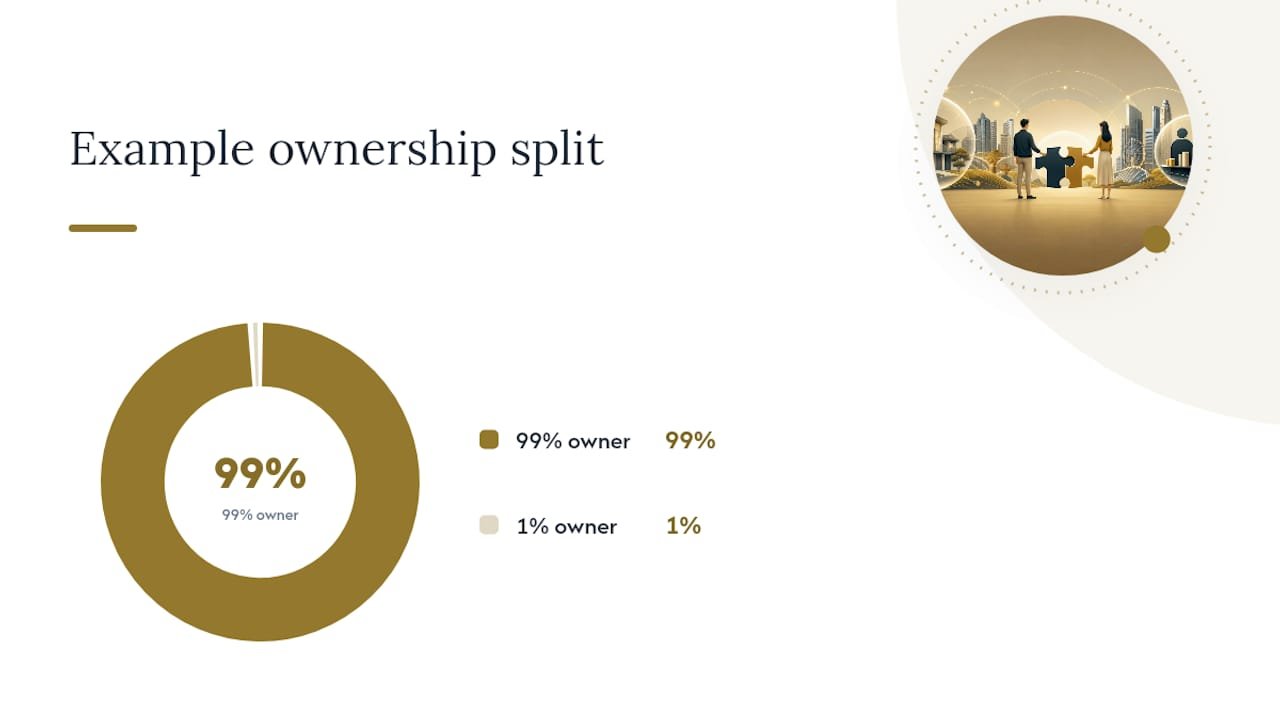
- Tenancy-in-common, where each owner holds a specific percentage share (commonly 99/1 or 50/50) that can be sold or transferred independently.
A joint tenancy must first be severed into a tenancy-in-common before a partial transfer can happen, because you cannot sell an undivided share that isn’t legally defined. This severance is a straightforward conveyancing step, but it must be done properly and lodged before the actual share transfer proceeds.
Decoupling only works for private residential property. It is not available for HDB flats or executive condominiums still within their Minimum Occupation Period. The Housing and Development Board does not permit part-share transfers between co-owners as a route around Additional Buyer’s Stamp Duty. Ownership changes on an HDB flat are allowed only in narrow, genuine circumstances, such as divorce, death of an owner, or documented financial hardship, and each case is assessed individually by HDB. If you own an HDB flat and hoped to decouple your way into a second property purchase, that door has been closed since HDB tightened this policy, and no amount of legal structuring around it changes the outcome.
For private property, decoupling is a real and commonly used strategy, but “commonly used” doesn’t mean “automatically accepted.” The transaction still has to appear, both on paper and in substance, as a genuine sale.
How do stamp duty and ABSD apply to decoupling?
Every internal transfer of a property share attracts Buyer’s Stamp Duty, calculated on the value of the share being transferred, and this is where many owners underestimate the true cost of decoupling. BSD is not optional and it is not a token fee. It follows the standard progressive slab structure that applies to any Singapore property purchase, just applied to the fractional share changing hands rather than the whole property.
IRAS requires BSD to be paid on the higher of the actual consideration or the market value) of the share being transferred. This means you cannot simply agree a low transfer price between spouses to shrink the duty bill. IRAS expects a valuation from a licensed valuer to support the figure declared, and it reserves the right to substitute its own valuation if the declared price looks suspiciously low.
Why this matters: IRAS doesn’t just check that BSD was paid, it checks that it was paid on a credible number. A transfer priced well under market value is one of the fastest ways to trigger a query, and a query on a decoupling transaction rarely ends well for the owner.
Once decoupling completes and the exiting owner holds no residential property, ABSD rates apply according to that owner’s buyer profile at the time of their next purchase. If they genuinely own nothing else, they can qualify for first time buyer ABSD treatment on their next acquisition, which is the entire point of the exercise for most couples.
Sequencing is critical here, and this is where deals go wrong:
- The share transfer must be completed and registered with the Singapore Land Authority before the exiting owner exercises an Option to Purchase on any new property.
- Exercising an OTP before the transfer is registered can mean the exiting owner is still treated as a co-owner of the first property at the point of the new purchase, triggering ABSD on the new deal regardless of intent.
- IRAS assesses the transaction based on ownership records at the time of the OTP, not at the time the parties intended the decoupling to happen.
Undervaluation and rushed sequencing are the two most common ways an otherwise legitimate decoupling ends up costing more than it saves.
What does decoupling actually cost?
The headline saving from decoupling, avoiding ABSD on a second property, has to be weighed against a real set of upfront costs that many owners only discover partway through the process. Model these before committing, not after signing anything.
- Buyer’s Stamp Duty on the transferred share, calculated on the higher of consideration or market value using the standard BSD slabs.
- Licensed valuation fee, needed to establish a defensible market value for the share being transferred.
- Legal fees for the transfer, typically covering the conveyancing work, severance of tenancy where required, and preparation of the transfer instrument.
- CPF refund, comprising the exiting owner’s principal CPF withdrawal used for the original purchase plus accrued interest that CPF calculates as if that money had stayed in the account.
- Refinancing costs on the remaining owner’s mortgage, since the loan typically needs to be restructured or reassessed once one party is removed from the title.
- Potential Seller’s Stamp Duty, if the property was bought within the last few years and the holding period hasn’t yet cleared SSD thresholds.
The CPF refund is usually the item that catches people out. It isn’t a paper adjustment, it’s cash that must be returned to the exiting owner’s CPF Ordinary Account (and, where applicable, Special Account) in full, including accrued interest calculated at the CPF ordinary account rate from the date of withdrawal. For a property bought a decade ago, that accrued interest component can be a meaningful five figure sum on its own, on top of the principal.
Pro Tip: Ask CPF Board for a refund computation early in the process. Couples routinely underestimate the accrued interest figure by tens of thousands of dollars because they only remember the original withdrawal amount, not the compounding since.
Refinancing brings its own friction. If the remaining owner’s existing mortgage is still within its lock-in period, expect an early repayment penalty, typically a percentage of the outstanding loan. The remaining owner also needs to qualify for the full loan solo, which brings us to the financing test that quietly kills more decoupling plans than any tax rule.
How do you execute a decoupling transaction step by step?
Getting from decision to registered transfer usually takes between six and ten weeks, assuming no complications with financing or valuation disputes. Here’s the practical sequence.
- Run the numbers with your bank first. Confirm the remaining owner can service the existing mortgage solo under the Total Debt Servicing Ratio framework. This is the single most common reason a decoupling attempt stalls, so it belongs at the very start, not the end.
- Sever the joint tenancy, if applicable. This converts the ownership structure to tenancy-in-common so an individual share can be legally sold.
- Commission a licensed valuation of the property to establish a defensible market value for the share being transferred.
- Instruct a conveyancing lawyer to prepare the transfer instrument, calculate the BSD payable, and liaise with CPF Board on the refund computation for the exiting owner.
- Settle the CPF refund and pay BSD. The exiting owner’s CPF principal and accrued interest must be repaid, and BSD must be paid on the transfer before it can proceed to registration.
- Lodge and register the transfer with the Singapore Land Authority. The transaction is only legally complete once SLA registers the new sole ownership.
- Wait for registration confirmation before exercising any OTP on a new property. This single step, done out of order, is what most often turns a legitimate decoupling into an ABSD liability.
Pro Tip: Build a two week buffer between SLA registration and exercising your next OTP. Registration timelines can slip, and exercising an option even a few days early can undo months of planning.
Delays typically come from valuation disagreements, slow CPF refund processing, or a bank taking longer than expected to confirm the remaining owner’s solo loan eligibility. None of these are unusual, but all of them push the timeline out if you haven’t budgeted for them.
What are the legal and tax risks of decoupling?
The single biggest risk in decoupling isn’t the cost, it’s getting caught structuring the deal purely to avoid tax. Recent High Court findings confirm that decoupling done solely to avoid ABSD can be treated as tax avoidance, and courts apply a substance-over-form test under Section 33A of the Stamp Duties Act. That test asks a simple question: did the exiting owner genuinely give up their beneficial interest in the property, or did they keep control of it through a side arrangement while the paperwork said otherwise?
The Ministry of Finance has documented cases where 99-to-1 ownership arrangements were found to be avoidance schemes rather than genuine ownership restructuring, resulting in clawed back duties plus a 50% surcharge on the amount avoided. That surcharge is not a slap on the wrist. On a substantial property, it can turn a saving into a five or six figure loss.
The courts and IRAS look past the transfer document to the actual behaviour of the parties. If the “exiting” owner still pays the mortgage, still lives in the property rent free with no formal arrangement, or has a private side agreement to share proceeds on a future sale, the transfer’s substance doesn’t match its form.
Behaviours that reliably attract scrutiny include:
- A secret understanding that the exiting owner retains a beneficial interest despite the title change.
- Funding for the transfer or CPF refund that traces back to the same household account with no independent paper trail.
- A subsequent purchase and OTP exercised suspiciously close to the transfer date, suggesting the plan was tax driven from the outset.
- No independent legal advice for the exiting owner, which courts read as a sign the transaction wasn’t treated as a genuine arm’s length sale.
To withstand scrutiny, practitioners generally recommend that both parties instruct independent lawyers, that funding for the transfer and CPF refund comes through clearly documented, traceable channels, and that there’s a real gap between transfer registration and any new OTP. None of this guarantees immunity from an IRAS review, but it builds the kind of paper trail that supports a genuine transaction rather than a contrived one.
What does a worked decoupling example look like?
Numbers make the trade-off concrete. Take a private condominium currently valued at $1,800,000, held 50/50 by a married couple, where one partner wants to exit so the other can buy a second property solo.
Now compare that to the ABSD the exiting owner would face buying a second property without decoupling. At current ABSD rates for Singapore Citizens owning a second property, that duty can be substantially higher than the costs of decoupling.
The arithmetic favours decoupling in most cases where the second purchase price is substantial, but the break-even point shifts sharply depending on two variables: how much CPF principal and interest sits in the property (a decade-old purchase means far more accrued interest than one bought two years ago), and whether the remaining owner can actually refinance without a large early repayment penalty. Run your own numbers with an actual CPF refund computation and a real bank quote before assuming the saving holds. A couple with a small CPF stake and a mortgage close to the end of its lock-in period will see a far better return than a couple ten years into a loan with most of the purchase price funded by CPF.
Should you go ahead with decoupling?
Before instructing a lawyer, run through this checklist honestly.
- Can the remaining owner pass TDSR solo? If the bank won’t approve the loan on one income, the entire plan collapses regardless of the tax saving.
- Do you have the CPF refund amount in cash, or accessible funds? The refund, including accrued interest, is due at completion, not staggered over time.
- Is there a genuine reason beyond tax? Divorce, estate planning, or a real change in each party’s financial position are the kinds of substance that support a decoupling. “We wanted to avoid ABSD” stated as the sole reason is precisely what invites scrutiny.
- Have both parties taken independent legal advice? Shared representation is a red flag that courts and IRAS have specifically pointed to in past rulings.
- Have you modelled the worst case? If IRAS challenged this transaction, could you evidence a genuine transfer of beneficial interest, with a documented funding trail and no side agreement?
Pro Tip: If you can’t answer all five questions with confidence, pause. Get a tax adviser’s view before you commit, not after.
If any single test fails, the sensible move is to pause and get professional advice rather than proceeding on hope that IRAS won’t look closely.
How Registertoday supports Singapore owners through decoupling
Assessing whether decoupling makes financial sense starts with an accurate valuation, and Registertoday provides licensed home valuations as part of its property assessment service, alongside personalised negotiation support and detailed market gap analysis for owners weighing up their next move. With over $1 billion in completed sales, the team has handled a wide range of ownership restructuring and purchase scenarios across Singapore’s private residential market, and coordinates closely with conveyancing lawyers during the transfer and registration process.
For a transaction with this much riding on correct sequencing and documentation, Registertoday recommends assembling a minimum advisory team before signing anything: an independent conveyancing lawyer for each party, a licensed valuer, and a tax adviser who can stress test the arrangement against IRAS’s substance-over-form standard. A typical engagement starts with a valuation and rough cost model, moves to legal instruction once the numbers are confirmed, and only proceeds to a new property search once the transfer is registered with SLA.
What the numbers don’t tell you about decoupling
The maths in this guide will convince most owners that decoupling is worth doing. What it won’t tell you is that the biggest failure point has nothing to do with tax law and everything to do with financing. Banks reassessing TDSR on a single income is the quiet reason so many decoupling plans fall over after the couple has already paid for a valuation and started legal work.
The conventional advice treats decoupling as primarily a tax decision. It isn’t. It’s a financing decision first, a cashflow decision second (the CPF refund catches almost everyone off guard), and only then a tax decision. Owners who start with “can my spouse’s income alone service this mortgage” before they start with “how much ABSD will this save” make better decisions and waste less money on aborted transactions.
The other gap in most advice is timing discipline. The rule about registering the transfer before exercising a new OTP sounds obvious on paper. In practice, excitement about a new property makes people careless about exactly this sequencing, and that’s the mistake that turns a legal strategy into an IRAS enforcement case.
— Anderson
Get a free decoupling cost assessment from Registertoday
Registertoday gives you a real number to work from, not a rule of thumb, before you commit to legal fees and a CPF refund you can’t undo. The free assessment covers a licensed market valuation of the property, a rough stamp duty and CPF refund model based on your actual purchase history, and a financing pre-check to flag whether the remaining owner is likely to pass TDSR solo.

This isn’t a substitute for independent legal or tax advice, particularly where a decoupling case might attract IRAS scrutiny. Registertoday’s role is to give you accurate figures and coordinate the valuation and negotiation side, so your lawyer and tax adviser have solid numbers to work from rather than estimates. If you’re weighing up whether decoupling will actually save you money on your next purchase, request a personalised cost model through Registertoday’s home valuation service and get the conversation started with real figures instead of guesswork.
Where to verify the rules on decoupling
For the current BSD and ABSD rates and calculation tools, go directly to IRAS’s official stamp duty pages, which set out the progressive slabs and buyer profile rules referenced throughout this guide. HDB’s change of flat ownership rules confirm the exclusions that apply to HDB flats and executive condominiums.
Transfer registration is handled by the Singapore Land Authority, where any share transfer must be lodged before it takes legal effect. For enforcement context, the Ministry of Finance has published details of clawback cases under 99-to-1 arrangements, and The Straits Times has reported on the High Court ruling on decoupling and tax avoidance that now shapes how these transactions are assessed.
This article is general information, not a substitute for advice from a qualified financial advisor. Consult a qualified financial professional about your own circumstances before acting on anything here.