

EC Buyers in Singapore: Is DPS’s 3% Premium Worth It After EDP/EDP+?
A deferred payment scheme (DPS) lets an Executive Condominium buyer pay a larger initial deposit and push most of the remaining balance to Temporary Occupation Permit (TOP) or Certificate of Statutory Completion (CSC). It eases cashflow in the years before completion, but it usually carries a price premium and shifts interest-rate risk onto the buyer. The Ministry of National Development and URA both set conditions on when DPS can be offered, and Registertoday sees the scheme come up most often with EC launches and completed stock developers are clearing.
TL;DR:
- Buyers should only consider a deferred payment scheme if they cannot sustain two simultaneous loans during the transition period and must model higher future interest rates realistically.
- The scheme generally applies to new EC launches aiming to boost early sales or clear existing stock, not to all projects, and must be disclosed clearly by developers.
- Units sold under DPS tend to be priced about 3% higher than those with standard progressive payments, and interest rate risk shifts to the buyer at TOP.
- The government strictly regulates DPS for uncompleted private residential properties, requiring Controller approval and clear disclosure to buyers.
- Buyers must carefully review the contract’s payment clauses, interest risk provisions, sub-sale transfer clauses, and confirm lender approval before signing.
Table of Contents
- How does a deferred payment scheme work?
- Which EC projects typically offer a deferred payment scheme?
- What are the pros and cons of choosing DPS?
- What are the current rules on deferred payment schemes in Singapore?
- What should buyers check before signing a DPS contract?
- Who actually benefits from a deferred payment scheme?
- How Registertoday helps you weigh a deferred payment offer
- Sources
- FAQ
How does a deferred payment scheme work?
Under DPS, a buyer typically pays a larger initial deposit around one-fifth of the purchase price at booking and signing of the Sale & Purchase Agreement, then defers the bulk of the remaining sum until TOP or CSC. That is standard industry practice on the projects where it appears, not a fixed legal formula, and the exact split varies by developer and by launch.
Compare that with the normal progressive payment scheme, where money leaves your account in stages tied to construction milestones:
- Booking fee and signing of S&P, typically around 25% combined.
- Foundation works, roughly 10%.
- Reinforced concrete framework stages, spread across several payments totalling around 30–35%.
- Roofing, brickwall and ceiling works, around 10–15%.
- TOP and CSC, the final 15–20% combined.
CPF savings and bank loan drawdown normally follow whichever stage a payment falls due, so under DPS your loan servicing effectively starts later. That is the whole appeal for buyers juggling an existing HDB mortgage, but it also means you are committing to a much larger single payment at TOP, when interest rates may look nothing like they did at booking.
Which EC projects typically offer a deferred payment scheme?
DPS is not universal. It tends to surface in specific commercial situations rather than across every new launch:
- New EC launches where the developer wants to accelerate early sales momentum.
- Developers sitting on completed or near-completed stock they need to clear before a new launch.
- “Stay-then-pay” style promotions bundled with a show-flat campaign to differentiate a project from nearby competitors.
Developers offer DPS because it manages their own cashflow and inventory risk while giving them a pricing lever. A unit sold under DPS is frequently priced higher than an equivalent unit on the standard progressive scheme, so the scheme doubles as a marketing tool as much as a financing convenience. If you are checking whether a specific EC has DPS, the launch brochure and price list should state it plainly, and you can cross-check against Controller notices and URA circular guidance on what developers must disclose.
What are the pros and cons of choosing DPS?
The appeal is straightforward: you keep more cash on hand during construction, which matters if you are an HDB upgrader still waiting on your resale flat to complete, or if you want a window to collect rental income before your new loan kicks in.
The costs are just as real. Units sold under DPS are commonly priced around 3% higher than equivalent progressive-payment units, and because you are borrowing a larger sum later rather than smaller sums throughout, you are exposed to whatever interest rate prevails at TOP rather than today’s rate. Sub-sales add another layer of complication, since DPS terms may not transfer to a buyer further down the chain.
Three decision rules are worth following before you sign anything:
- Only consider DPS if you genuinely cannot service two loans simultaneously during the transition period.
- Model your post-TOP mortgage cost at a meaningfully higher interest rate than today’s, not just the current one.
- Verify the exact DPS wording in the Option to Purchase and S&P before assuming it applies to your unit.
Pro Tip: Ask your bank for an in-principle approval scenario at both today’s rate and a rate two percentage points higher. If the higher scenario still works comfortably, DPS is doing its job. If it doesn’t, the premium you’re paying for deferred payment isn’t worth the risk.
What are the current rules on deferred payment schemes in Singapore?
Deferred payment schemes for uncompleted private residential property have been disallowed since October 2007, and the Ministry of National Development confirmed that any developer still offering DPS must operate within existing rules and secure Controller approval. That single fact catches a lot of buyers off guard, because DPS is often marketed as though it were a standard feature rather than a scheme subject to specific approval.
Since October 2007, the Government has not permitted deferred payment schemes for uncompleted private residential properties as a matter of general practice; any DPS offered still requires Controller approval under existing housing rules.
A few things to check before assuming a DPS offer is straightforward:
- URA circular guidance requires developers to disclose that DPS terms may not apply, or may be varied, if you later sub-sell the unit.
- MAS’s loan-to-value and loan tenure limits still cap how much you can borrow. DPS changes when you borrow, not how much.
- Recent EC policy discussion, including Minimum Occupation Period considerations, means the regulatory backdrop can shift between launches. Always confirm current Controller approvals rather than relying on last year’s brochure.
What should buyers check before signing a DPS contract?
The Option to Purchase and Sale & Purchase Agreement carry the actual terms, not the marketing deck. Read them with the same scrutiny you’d give a loan contract.
- Check the exact clause describing when the deferred balance falls due and whether it references TOP, CSC, or a specific calendar date.
- Confirm who bears interest-rate risk if rates move between booking and TOP, and how refunds are handled if the transaction falls through.
- Establish in writing whether the DPS terms pass to a sub-purchaser if you plan to sell before completion, since developers can reserve discretion here.
- Understand your payment method options. EDP and EDP+, launched from 28 July 2025, are electronic alternatives to cheques for deferred payments: EDP debits funds only when presented, while EDP+ debits immediately on issuance. Several banks, including DBS, now support these alongside PayNow and traditional cheques.
Pro Tip: Get your lender’s in-principle approval before you sign, not after. A post-TOP financing model built on assumptions is worthless if the bank later assesses your income differently. For a broader look at financing structures available to Singapore buyers, the Property Financing Guide from KAPVOY Advisory is a useful companion read.
Who actually benefits from a deferred payment scheme?
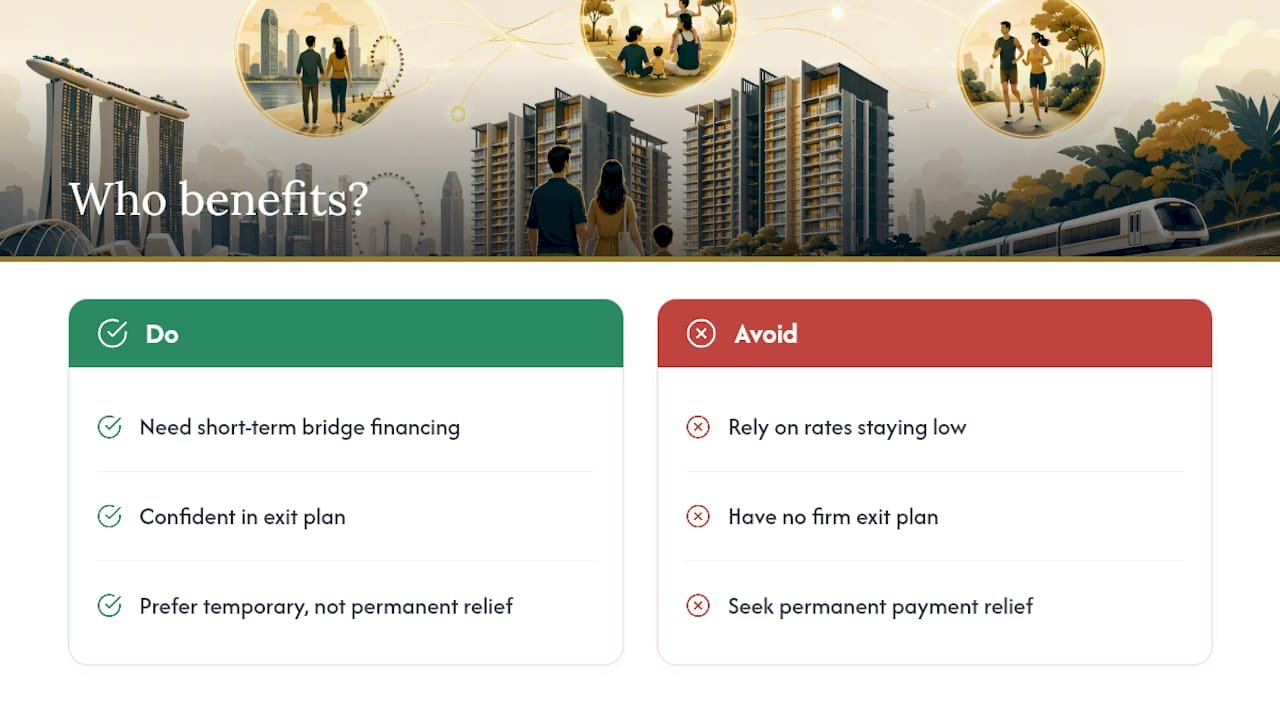
DPS suits a narrow profile better than it suits everyone. It works best for an HDB upgrader mid-way through selling their existing flat, confident in their exit plan, who needs a bridge rather than permanent relief. It works less well for anyone banking on rates staying low, or anyone without a firm plan for how the eventual lump sum gets funded.
One should exercise caution in a higher-rate environment or where the exit strategy is still uncertain. If you’re weighing a DPS-enabled EC against a standard progressive-payment unit, get an independent read on pricing and terms before you commit.
— Anderson
How Registertoday helps you weigh a deferred payment offer
A practical alternative to guessing your way through a developer’s DPS pitch involves getting a market valuation, negotiation support, and a second set of eyes on the numbers before signing anything.

Some services may include property evaluations to check whether a DPS unit’s asking price reflects a typical premium, personalised negotiation support to address developer terms, and transaction assistance through to completion. That said, a marketplace can only take you so far. Pair our support with independent legal review of your S&P and a proper affordability check with your lender before committing. If you’re ready to see what’s currently available, browse ECs and completed stock on Registertoday or start with a home valuation to benchmark any offer you’re considering.
Sources
- Written answer by Ministry of National Development on developers offering deferred payment schemes
- Developer guidance: sub-sale and deferred payment scheme clauses (URA circular COH02-04)
- Loan tenure and loan-to-value limits (MAS)
FAQ
What happens to an EC after 5 years?
After the five-year Minimum Occupation Period, EC owners can sell to Singapore Citizens and Permanent Residents on the open market, and after ten years the unit is fully privatised and can be sold to foreigners as well.
What are the disadvantages of deferred payment?
DPS units commonly carry a price premium of around 3% over equivalent progressive-payment units, expose the buyer to whatever interest rate applies at TOP rather than today’s rate, and can complicate a sub-sale if the DPS terms don’t transfer.
What are the disadvantages of buying an EC?
Beyond DPS-specific risks, ECs carry the five-year Minimum Occupation Period restriction, income ceiling eligibility at purchase, and generally slower initial capital appreciation compared with private condominiums until privatisation at year ten.