

Net Yield Is 1.5–2.0pp Lower: Singapore Rental Yield 2026 Snapshot
Neither number tells you what lands in your account. Net yield, which strips out property tax, maintenance and vacancy, typically runs 1.5 to 2.0 percentage points below the headline figure, and that lower number is the one worth basing a decision on.
TL;DR:
- Most investors should expect net rental yields in Singapore to be 1.5 to 2 percentage points lower than gross figures after deducting costs like property tax, maintenance, vacancy, and agent fees.
- Small units such as one-bedrooms and studios generally produce higher gross yields than larger units, especially in districts outside the Central Region, with some HDB flats exceeding 4.5 percent gross yield.
- Calculating net yield requires subtracting recurring costs from annual rent and can drop the initial gross yield by around 1.1 to 2 percentage points, affecting cash flow projections.
- Yield differences between districts are significant, with OCR and certain outside-central areas posting higher yields than prime districts like Districts 9 and 10, which rely more on capital appreciation.
- Buyers should run both gross and net yield calculations, check property tax estimates, and ensure rental legality before making offers, especially considering Singapore’s cooling measures and regulations.
Table of Contents
- What is a good rental yield in Singapore right now?
- How do you calculate rental yield in Singapore?
- Which property types and districts pay the best yields?
- What costs turn gross yield into net yield?
- Should you prioritise yield or capital growth?
- How can you improve your net rental yield?
- What should you check before you commit to a property?
- How do cooling measures and rental rules affect yield?
- How do interest rates and the economy affect yields?
- How does rental yield compare to REITs and stocks?
- Why numbers‑first modelling beats headline yield claims
- Get a numbers-first valuation before you commit to a yield claim
- Sources
- FAQ
What is a good rental yield in Singapore right now?
Singapore’s rental yield picture in 2026 splits cleanly along tenure lines. Private condos average close to 3.06% gross, a figure that has held fairly steady across recent quarters despite swings in transaction volumes. HDB resale flats sit meaningfully higher on paper, with some towns and flat types touching 5% or beyond, largely because purchase prices remain lower relative to achievable rents.
None of that means every unit performs the same. A useful rule of thumb for benchmarking a Singapore listing against the broader market:
- Below 2.5% gross — weak, usually found in prime districts where capital growth is the actual investment case, not rent.
- 2.5% to 3.5% gross — average, the range most private condos across the island fall into.
- 3.5% to 4.5% gross — strong, often smaller units or well‑located OCR projects.
- Above 4.5% gross — exceptional for private property, more typical of HDB flats or older, lower‑quantum units.
Geography drives a lot of this variance. Outside Central Region (OCR) developments generally out‑yield Rest of Central Region (RCR) and Core Central Region (CCR) properties, simply because entry prices per square foot are lower while rents don’t fall by the same proportion. Districts like Woodlands and Jurong East regularly appear near the top of yield tables, while prime postcodes such as District 9 and District 10 sit at the bottom, propped up by capital appreciation rather than rental income. If your priority is cash flow rather than prestige, the map matters more than the postcode’s reputation.
How do you calculate rental yield in Singapore?
Two formulas do the entire job, and confusing them is the single most common mistake first‑time landlords make.
- Gross yield = (Monthly rent × 12) ÷ Purchase price × 100. This is the screening number agents quote, and it ignores every cost of ownership.
- Net yield = (Annual rent − Recurring annual costs) ÷ Purchase price × 100. This is what actually determines whether the investment is worth holding.
Gross vs net rental yield is not a technicality. Investopedia’s definition frames gross yield as a quick screening metric and net yield as the number that reflects real investor return, once running costs are deducted. Treat gross as the first filter and net as the final answer.
The recurring costs that matter most in Singapore include:
- Property tax — IRAS taxes non‑owner‑occupied residential property as a percentage of Annual Value (AV), and landlords should model AV conservatively rather than assuming it stays flat.
- Maintenance and MCST fees for condos, or town council fees for HDB flats.
- Agent commission, typically amortised across the lease term.
- Vacancy allowance, even for well‑located units.
- Fire and contents insurance, a smaller but recurring line.
- Mortgage interest, if you’re calculating cash‑on‑cash return rather than pure yield.
Resident and non‑resident owners face the same AV‑based property tax mechanism, though rate tiers differ, so check current IRAS schedules before you finalise a purchase decision rather than relying on last year’s figures.
Which property types and districts pay the best yields?
Unit size changes the maths more than most buyers expect. Smaller units, particularly one‑bedders and studios, consistently post higher gross yields than three and four‑bedroom units in the same building, because purchase quantum falls faster than rent per square foot as unit size shrinks. A 500 square foot one‑bedder renting at a modest per‑square‑foot rate can out‑yield a 1,200 square foot three‑bedder in the same postcode, even though the larger unit commands more absolute rent.
District‑level data backs this up. Samples across Singapore’s condo market show District 14 and several OCR pockets, including parts of Woodlands and Jurong, among the stronger headline performers in 2026, while prime districts trail on yield despite commanding higher absolute rents.
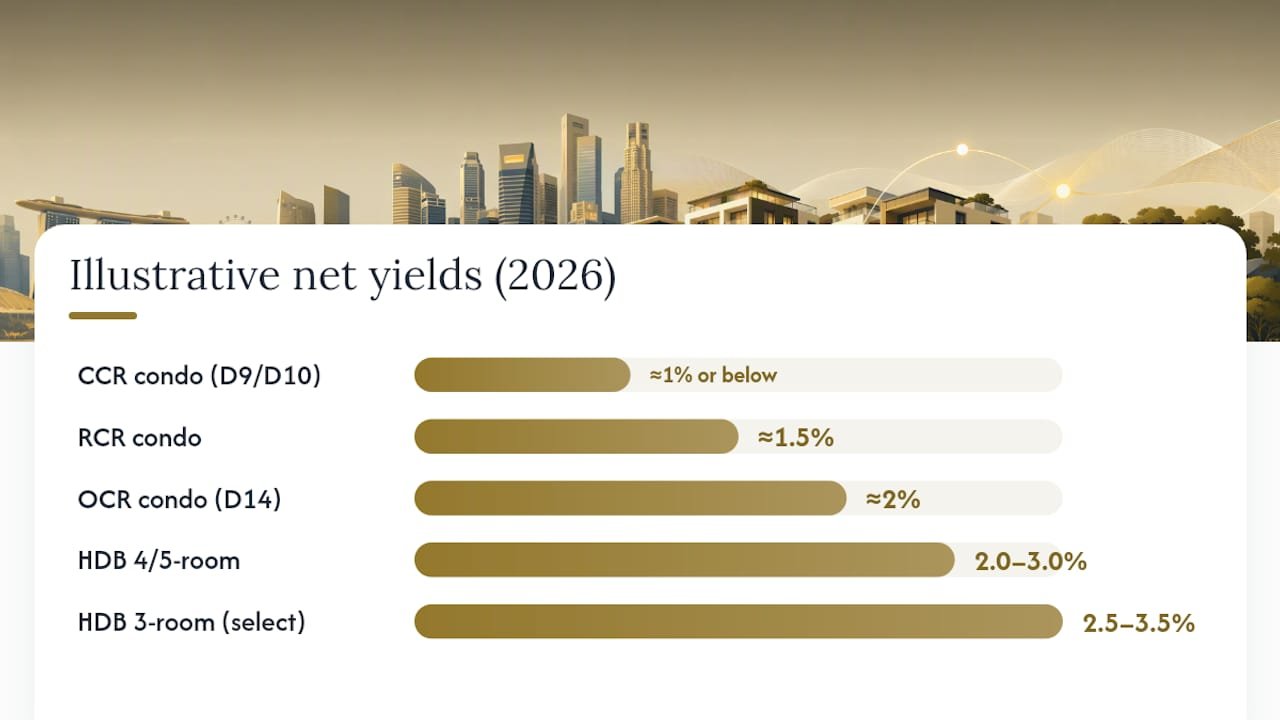
| Segment | Typical gross rental yield (2026) | Illustrative net yield |
|---|---|---|
| CCR condo (D9, D10) | around 2.0% | roughly 1% or below |
| RCR condo | around 3.0% | around 1.5% |
| OCR condo (D14) | around 3.5% to 4.0% | about 2.0% |
| HDB 3-room (select towns) | often above 4.5% | generally 2.5% to 3.5% |
| HDB 4/5-room | in the range of 3.5% to 4.5% | typically between 2.0% and 3.0% |
Net figures here assume the standard 1.5 to 2.0 percentage point deduction for property tax, maintenance, agent fees and vacancy that applies broadly across Singapore’s rental market. Individual units will vary depending on actual AV, lease structure and building age.
HDB numbers look tempting on paper, but they come with structural caveats. Subletting rules require the flat to clear its Minimum Occupation Period, and whole‑flat rental is subject to HDB approval conditions that don’t apply to private condos. A high headline yield on an HDB flat is only useful if you can legally rent it out in the way your model assumes.
What costs turn gross yield into net yield?
This is where paper returns meet reality, and where most rental yield comparisons in Singapore fall apart under scrutiny.
Typical annual cost impacts, expressed as a rough share of property value:
| Cost item | Typical annual impact |
|---|---|
| Property tax (non‑owner‑occupied) | around 1% of value (AV-based) |
| MCST / maintenance fees | around 0.5% of value |
| Agent commission | ~1 month’s rent per 2‑year lease |
| Vacancy allowance | ~1 month per year |
| Insurance | Small, below 0.1% |
A worked example makes this concrete. Take a $1,200,000 OCR condo renting at $3,600 a month.
- Gross yield: ($3,600 × 12) ÷ $1,200,000 × 100 = 3.6%.
- Annual rent: $43,200.
- Property tax: roughly $2,400, assuming a conservative AV estimate.
- MCST fees: roughly $4,800 a year.
- Agent commission: half a month’s rent per year, amortised, roughly $1,800.
- Vacancy allowance: one month’s rent, $3,600.
- Insurance: roughly $300.
- Total deductions: approximately $12,900.
- Net annual return: $43,200 minus $12,900 equals $30,300.
- Net yield: $30,300 ÷ $1,200,000 × 100 = 2.5%.
That’s a drop of 1.1 percentage points from gross to net, close to the 1.5–2.0 point range typical across the market, with the exact gap depending on financing and building age. If you’re servicing a mortgage, cash‑on‑cash return (which nets out interest payments too) will sit lower still, and that’s the figure that actually determines monthly cash flow rather than paper return.
Should you prioritise yield or capital growth?
The answer depends entirely on what you’re trying to achieve, and conflating the two goals is how investors end up disappointed with a technically correct purchase.
Investors chasing cash flow should benchmark against net yield and treat anything below 2% as marginal once financing costs are added. Investors chasing capital growth can accept a lower yield, often below 2%, in exchange for location quality and appreciation potential, which is exactly why CCR properties persist despite unimpressive yield numbers.
Watch for yield traps: older units with high headline yields that mask lease decay, rising maintenance costs, or a thin tenant pool. A practitioner view from Singapore’s condo market warns that cheap, ageing stock can post attractive gross numbers while carrying real risk in resale value and upkeep.
- Cash flow focus → weight net yield heavily, accept lower growth.
- Growth focus → accept lower yield, weight location and future supply.
- Balanced approach → target OCR or RCR stock with a healthy lease remaining and manageable MCST fees.
Pro Tip: Run both a gross and a net yield calculation before you make an offer, then ask yourself which number you’d be comfortable defending to a bank if you needed to refinance in five years.
How can you improve your net rental yield?
A handful of decisions, made before and after purchase, move the needle more than most buyers realise.
At the buying stage, timing and negotiation matter as much as the unit itself. Ask for a price reduction where a seller shows urgency, and weigh leasehold decay carefully. A 99‑year lease with 60 years remaining behaves very differently from one with 30 years left, both for financing and for eventual resale.
Once you own the unit, several levers protect or lift net yield:
- Offer slightly longer leases to reduce vacancy and turnover costs.
- Make targeted, low‑cost renovations, fresh paint and updated fixtures, rather than full overhauls.
- Screen tenants carefully rather than accepting the first applicant.
- Compare self‑management against a professional agent, factoring in your own time cost.
- Structure financing conservatively, keeping a cash buffer for vacancy periods or unexpected repairs.
Small decisions compound. A unit leased for two years instead of one halves your exposure to agent commission and vacancy risk over that period, which shows up directly in net yield.
What should you check before you commit to a property?
Run this sequence before any offer goes in.
- Calculate the listing’s gross yield using asking price and comparable market rent.
- Apply a conservative net yield estimate, using the 1.5 to 2.0 point deduction as a baseline.
- Build in a one‑month vacancy buffer, even for popular districts.
- For HDB flats, confirm Minimum Occupation Period status and subletting eligibility.
- Request recent MCST minutes and check for upcoming special levies.
- Check the property’s most recent Annual Value for a realistic property tax estimate.
- Ask the seller or agent three direct questions: why they’re selling, what comparable units recently achieved in rent, and whether any major MCST projects are planned.
How do cooling measures and rental rules affect yield?
Singapore’s regulatory framework shapes rental yield more directly than most first‑time investors expect. Additional Buyer’s Stamp Duty pushes up the effective purchase cost for many buyers, which mechanically compresses gross yield since the yield formula divides rent by total acquisition cost. That’s precisely why structuring a purchase to manage ABSD exposure has such an outsized effect on the yield an investor actually achieves.
HDB rules add a separate layer. Minimum Occupation Period restrictions delay when a flat can be sublet, and whole‑flat rental requires HDB approval with conditions on tenant eligibility and household size. A flat with an attractive headline yield is worthless as an income asset if it can’t legally be rented under your intended structure yet.
Private property carries its own constraints too. Minimum lease durations, currently three months for most private residential units, limit short‑term rental strategies that might otherwise chase higher effective yields through platforms like short‑stay letting. Cooling measures also periodically adjust loan‑to‑value limits, which changes how much leverage an investor can bring to a purchase and therefore how cash‑on‑cash returns compare to unlevered net yield.
None of these rules are static. Cooling measures have shifted several times over the past decade in response to price growth, and an investor modelling yield five years out should assume some further regulatory adjustment rather than treating today’s framework as permanent.
How do interest rates and the economy affect yields?
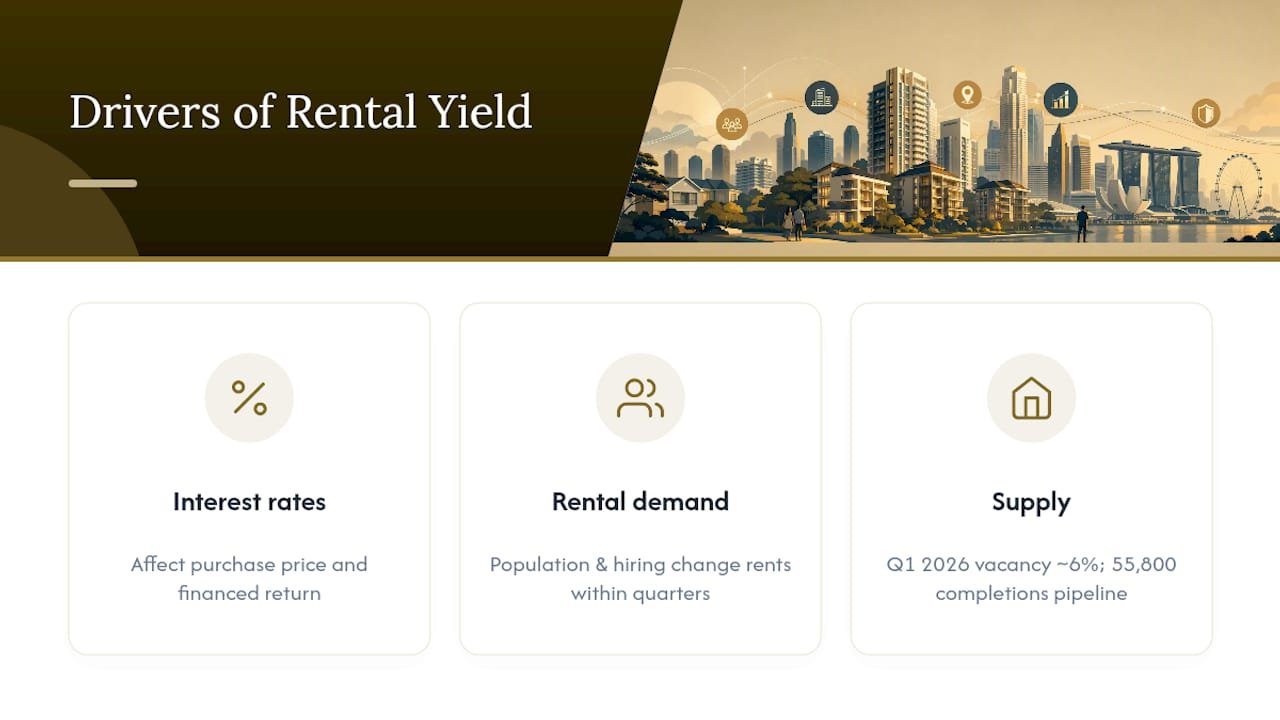
Interest rates influence rental yield through two separate channels, and conflating them leads to muddled decisions. First, rates affect purchase price, since higher borrowing costs typically cool buyer demand and moderate price growth, which can support yield by keeping the denominator in check. Second, rates affect the investor’s actual return once financed, since mortgage interest is the single largest deduction separating net yield from cash‑on‑cash return.
Economic growth and population trends shape the other side of the equation: rental demand. Singapore’s population, including its resident foreign workforce, drives occupier demand for both HDB and private rental stock, and shifts in work pass policy or corporate hiring activity feed through into rental rates within a few quarters. A tightening labour market for foreign professionals, for instance, reduces the tenant pool for higher‑quantum private rentals faster than it affects HDB demand.
Supply is the third factor, and it’s currently the most consequential one. Recent data show a rising private residential vacancy rate, near 6% in Q1 2026, alongside a completion pipeline of roughly 55,800 private homes including executive condominiums. That volume of incoming stock puts downward pressure on achievable rents in districts where completions cluster, which directly compresses gross yield even before costs are deducted. An investor evaluating a project today should check the nearby completion schedule as carefully as the current rent roll.
How does rental yield compare to REITs and stocks?
Rental yield sits alongside two other income‑generating asset classes Singapore investors regularly compare it against: Singapore‑listed REITs and dividend‑paying equities. Each behaves differently enough that a direct yield‑to‑yield comparison misses the point.
REITs typically distribute higher headline yields than direct residential property, often in the mid‑single digits to high single digits depending on the sector, and they require no tenant management, no MCST dealings, and no vacancy risk borne individually. What they trade away is control: an investor can’t select a specific unit, negotiate a specific lease, or force a renovation that lifts income. REIT prices also move with interest rate expectations, often more sharply than physical property values do, which introduces a different flavour of volatility.
Dividend equities offer liquidity that neither REITs nor physical property can match. Shares can be sold within a day, versus the weeks or months a property sale typically takes in Singapore. But equity income is far more exposed to company‑specific and market‑wide swings than rental income from a leased flat, where the income stream is contractually fixed for the lease term.
Direct residential property, by contrast, gives an investor leverage through mortgage financing, a lever unavailable to most retail REIT or stock investors at comparable terms, and it carries the added possibility of owner‑occupation or family use that a paper asset never offers. The trade‑off is illiquidity and hands‑on management, which is precisely why net yield, not gross, is the number that determines whether that trade‑off is worth making.
Why numbers‑first modelling beats headline yield claims
Most yield claims circulating in Singapore’s property market are gross figures dressed up as returns, and that gap between gross and net is where investor expectations most often go wrong. Registertoday’s approach starts from the opposite direction: a free property valuation and market evaluation that models realistic net yield before a client commits to anything, backed by personalised negotiation support once a target property is identified. With over $1 billion in completed sales, the team has seen enough transactions to know where headline numbers and actual returns diverge. If you’re weighing a property against its stated yield, request a numbers‑first review before the offer stage, not after.
— Anderson
Get a numbers-first valuation before you commit to a yield claim
Registertoday’s edge for rental yield decisions in Singapore is straightforward: every valuation starts from realistic net numbers, not the gross figure an agent quotes to make a listing look attractive. That matters more than ever with ABSD structuring options on the table, since the right purchase structure can materially change the yield an investor actually pockets.

The platform’s free home valuation walks through property tax, maintenance and vacancy assumptions specific to the unit you’re considering, rather than a generic market average. Beyond valuation, Registertoday’s property listings let you filter by district and unit type to compare candidates against the yield benchmarks covered above, and the team’s personalised negotiation support has underpinned over $1 billion in completed transactions. If a listing’s advertised yield doesn’t match what your own maths produces, get a second set of numbers before you sign anything.
This article is general information, not a substitute for advice from a qualified financial advisor. Consult a qualified financial professional about your own circumstances before acting on anything here.
Sources
- Gross yield definition — Investopedia
- Gross rental yields in Singapore: Newton/Novena and 5 …
- Guide To Condo Rental Yields In Singapore 2026 Edition — DollarsAndSense
- Propertynet
FAQ
What is Singapore’s average rental yield?
Net yield typically sits 1.5 to 2.0 percentage points below these gross figures once costs are deducted.
Will rental prices go down in 2026 in Singapore?
That combination points toward flatter or softer rents in districts with heavy new supply rather than a market‑wide collapse.
Which area in Singapore has the highest rental yield?
Outside Central Region districts, including parts of Woodlands, Jurong East and District 14, tend to post the strongest headline gross yields, generally outperforming Core Central Region postcodes like District 9 and District 10. HDB flats in select towns can post even higher headline yields, subject to Minimum Occupation Period and subletting rules.
How do you calculate net rental yield accurately?
Subtract annual property tax, MCST or maintenance fees, agent commission, a vacancy allowance and insurance from annual rent, then divide by purchase price and multiply by 100.