

Sell within 4 years? Capital gains tax on Singapore property explained
Singapore does not charge capital gains tax on property sales, and it never has. The only exception is when the Inland Revenue Authority of Singapore (IRAS) decides your activity amounts to trading in properties, in which case the gain becomes taxable income. The sections below cover IRAS’s own position, the badges of trade it uses to judge you, and the related taxes sellers often confuse with capital gains.
TL;DR:
- Gains from property sales are generally not taxable unless IRAS considers the activity as trading, in which case they are taxed as ordinary income at the standard rates.
- The badges of trade, including transaction frequency, holding period, and marketing activity, help IRAS distinguish between an investor and a trader, especially if multiple sales occur in quick succession.
- Seller’s Stamp Duty applies to residential property sales within the holding period regardless of whether gains are capital or revenue, and the period has been extended to four years for properties bought after July 2025.
- Rental income from property is taxable separately from sale gains, and property tax is charged on ownership, not on the sale profit.
- Proper documentation of purchase reasons, sale intent, and transaction details is crucial to support a claim of capital gain and avoid misclassification as trading income.
Table of Contents
- What IRAS says about capital gains tax on Singapore property
- How IRAS decides: the badges of trade
- Other taxes to watch when you sell: SSD, BSD/ABSD and rental income
- Reporting and compliance: how to declare a taxable gain
- Common scenarios and worked examples
- Practical checklist: preparing to sell with IRAS in mind
- Author perspective: practical risks for active sellers
- Sources
- FAQ
What IRAS says about capital gains tax on Singapore property
IRAS is explicit on this point: gains from selling a residential or commercial property are generally not taxable, because Singapore does not impose a capital gains tax at all. That applies whether you are an owner-occupier cashing in on a condo bought fifteen years ago or an investor exiting a single rental unit after a decade.
The exception sits in how IRAS defines income. If your main source of income is derived from buying and selling property, IRAS treats the gains as trading income and taxes them at your normal income tax rate. This is not a separate “property gains tax.” It is ordinary income tax applied to what IRAS considers revenue, not capital.
Where to check the official position yourself:
- IRAS’s core statement on gains from sale of property, which confirms capital gains are not taxable unless the activity is deemed trading.
- “Selling my property” guidance, aimed at individual sellers, covering when a gain shifts from capital to revenue in nature.
- PwC’s independent tax summary, which reiterates that Singapore has no capital gains tax and that the revenue-versus-capital distinction is what determines tax exposure.
Reading these together removes most of the uncertainty. The harder question, and the one IRAS spends more guidance on, is how it distinguishes an investor from a trader.
How IRAS decides: the badges of trade
IRAS does not rely on one test. It weighs a set of factors known as the “badges of trade,” and no single factor settles the question on its own. The badges IRAS lists explicitly include:
- Frequency of transactions — repeated buying and selling looks more like a business than a one-off sale.
- Reason for the purchase — buying with the stated intention of resale for profit points towards trading.
- Reason for the sale — a forced or circumstantial sale (relocation, financial need) reads differently to an opportunistic flip.
- Holding period — a short gap between purchase and sale is one of the strongest indicators IRAS looks at.
- Financing method and capacity to hold — someone who cannot service a mortgage long term looks like they bought to flip, not to hold.
- Improvements or renovations made before sale, particularly if done purely to boost resale value.
- Marketing activity, such as aggressive advertising or engaging multiple agents simultaneously.
This is a holistic assessment. A short holding period alone will not automatically trigger income tax, but it becomes a red flag when combined with active marketing, cosmetic renovations done purely to flip, or a pattern of several similar sales within a few years.
Pro Tip: If you have sold more than one property within a short window, keep a written note of your reason for each sale at the time it happens. Reconstructing intent years later, after IRAS asks questions, is far harder than documenting it as you go.
Other taxes to watch when you sell: SSD, BSD/ABSD and rental income
Capital gains tax and stamp duty are two different things, and conflating them is one of the most common mistakes sellers make. Seller’s Stamp Duty (SSD) applies to residential property sold within the SSD holding period, regardless of whether the gain is capital or revenue in nature.
- SSD applies even on a sale that IRAS would treat as a pure capital gain, because it is a transaction tax, not an income tax.
- For properties acquired on or after 4 July 2025, the SSD holding period was extended to four years, with rates increased by four percentage points at each tier.
- Buyer’s Stamp Duty (BSD) and Additional Buyer’s Stamp Duty (ABSD) are acquisition taxes paid by the buyer, not the seller, and sit entirely outside the capital gains question.
Rental income sits in a third, separate category. If you rent out a property before selling it, that rental income is taxable and must be declared annually, quite apart from any gain on eventual sale. Property tax, charged on ownership rather than income, is a fourth and entirely distinct obligation.
Reporting and compliance: how to declare a taxable gain
If IRAS would view your situation as trading in properties, the gain gets declared as “Other Income” in your annual Income Tax Return, not as a capital gain. Getting this right depends on keeping the right paperwork from the start.
- Gather your sale and purchase agreements for the property in question, alongside any prior transactions relevant to establishing a pattern.
- Keep valuation reports and receipts for renovations or improvements made before sale.
- Retain loan and financing records showing your original mortgage tenor and repayment capacity.
- Document your stated intent at purchase, such as correspondence showing you bought for owner-occupation or long-term rental.
- File within the standard tax season, typically by 15 April for paper filing or 18 April for e-filing, and disclose taxable trading gains proactively rather than waiting for IRAS to query them.
Late or incorrect declarations can attract penalties, and IRAS has the power to reassess prior years if it later concludes your activity was trading all along. Where your circumstances sit near the line, particularly if you have sold more than one property in quick succession, a conversation with a qualified tax adviser before you file is far cheaper than a dispute after the fact.
Common scenarios and worked examples
The rules read more clearly against real situations.
- Owner-occupier, long hold: you buy a flat, live in it for eight years, then sell because you are upgrading. This is a textbook capital gain and normally falls entirely outside income tax.
- Short-term flip with renovation and marketing: you buy, renovate cosmetically within months, list aggressively, and sell within a year. This pattern sits squarely within IRAS’s badges of trade and risks being taxed as trading income.
- Developer stock and conversions: when investment property is converted to trading stock, IRAS treats it as a deemed disposal at open market value, and the resulting gain is revenue in nature from that point forward.
- Foreign property disposals: local property sales are unaffected, but gains from selling foreign assets can be taxed on remittance to Singapore under the foreign-sourced disposal gains regime for certain covered entities lacking economic substance, effective for disposals from 1 January 2024.
Practical checklist: preparing to sell with IRAS in mind
Sellers worried about how IRAS might view a sale can take concrete steps to strengthen the capital character of the transaction well before listing.
- Keep your original sale and purchase agreement, mortgage documents, and any correspondence showing long-term intent at the point of purchase.
- Avoid engaging multiple agents simultaneously or running an aggressive, developer-style marketing campaign.
- Favour ordinary maintenance over cosmetic upgrades made purely to boost resale value.
- Get an independent property valuation before listing, which supports an arm’s-length, ordinary sale process rather than an opportunistic flip.
Pro Tip: If you have sold two or more properties in the last five years, or you are unsure whether a planned sale could look like trading, get a written opinion from a tax specialist before you list. It is far cheaper than a retrospective IRAS query.
Sellers ready to move forward can start with a free property valuation or explore current listings through Registertoday, which also helps buyers and investors structure purchases without the burden of Additional Buyer’s Stamp Duty.
Author perspective: practical risks for active sellers
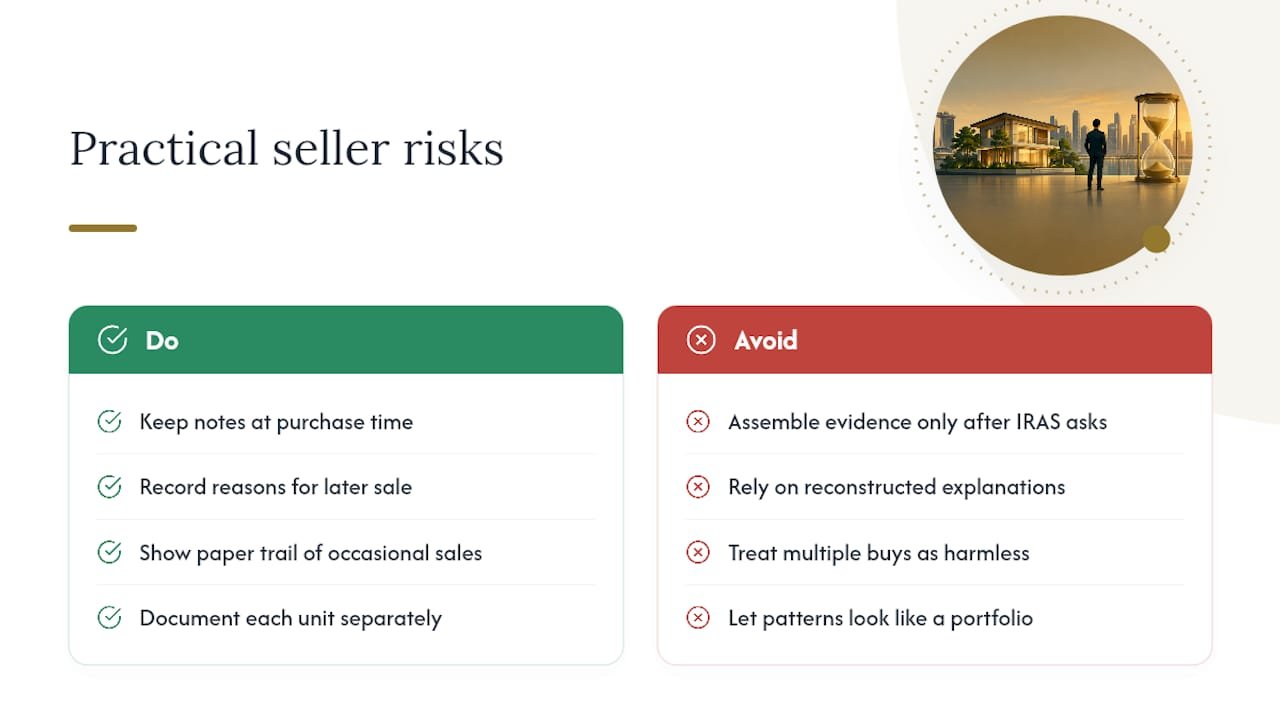
The cases that cause genuine trouble are rarely the obvious ones. Nobody disputes that a family selling the flat they lived in for a decade owes no capital gains tax. The disputes happen with people who bought two or three units over several years, each with a plausible personal reason, and only in hindsight does the pattern look like a portfolio strategy.
The mistake I see repeatedly is treating documentation as something to assemble after IRAS asks, rather than as you go. A note written at the time of purchase explaining why you bought, and why you later sold, carries far more weight than a reconstructed explanation years later. If your selling activity is genuinely occasional, the paper trail should say so before anyone questions it.
— Anderson
Sources
For readers who want to verify any point directly, start with IRAS’s gains from sale of property page, its selling my property guidance, and the SSD rates and holding period rules. For a broader glossary-level definition, see this capital gains tax explainer.
This article is general information, not a substitute for advice from a qualified financial advisor. Consult a qualified financial professional about your own circumstances before acting on anything here.
- Gains from sale of property, shares and financial instruments
- Recent changes to the tax treatment of gains or losses from the sale of foreign assets
FAQ
How do you calculate a capital gain on a property sale?
In Singapore, you generally don’t need to, because there is no capital gains tax to apply against the profit from a sale. If IRAS deems your sale trading income instead, the taxable amount is the sale price minus your original cost and allowable expenses, taxed at your normal income tax rate rather than a separate capital gains formula.
How much capital gains tax do I pay on a $100,000 gain?
None, because Singapore does not levy capital gains tax on property sales at all. If the gain is instead classed as trading income under the badges of trade, it gets added to your other income and taxed at your marginal income tax rate for the year.
How can I legally avoid capital gains tax exposure?
Most sellers already avoid it simply by holding property for personal use or long-term investment rather than short-term resale. Keeping evidence of long-term intent, such as your original mortgage tenor, occupancy records, and avoiding repeated quick flips, supports a capital-character sale rather than one IRAS could treat as trading.
Is Singapore’s property tax rate 20% or 24%?
Neither figure relates to capital gains, since Singapore has no capital gains tax on property. Owner-occupied and non-owner-occupied residential properties are charged annual property tax on a separate progressive scale tied to their annual value, which is unrelated to any gain made on eventual sale.
Do I need to pay Seller’s Stamp Duty even if my gain isn’t taxable?
Yes. SSD applies to residential property sold within the holding period regardless of whether the underlying gain is capital or trading in nature. For properties acquired on or after 4 July 2025, that holding period runs up to four years, with rates rising at each tier the sooner you sell.


