
Avoid Illegal Bookings: 4 Checks for Short Term Rentals in Singapore
Airbnb style stays under three months in private homes are generally unlawful in Singapore, and the same restriction applies more strictly to HDB flats, which require a six month minimum. Guests who need a stay shorter than that should book a hotel, a serviced apartment or a licensed aparthotel instead. Before booking or listing anything, check the relevant guidance from the Urban Redevelopment Authority (URA) or Housing & Development Board (HDB) and confirm any licence number quoted by the host.
TL;DR:
- Short term stays under three months at private properties are illegal under URA rules, with enforcement fines reaching over one million dollars for large operations.
- HDB flats require a minimum six-month rental period, with tighter restrictions on quotas and occupancy, and prohibit short-term tourism or filming uses.
- Licensed serviced apartments and aparthotels offer lawful short stay options, but private condo listings claiming shorter stays without licences are likely illegal.
- Owners and hosts should verify licence numbers through URA or HDB and document approval letters to avoid liability and fines.
- Renting for periods less than six months on HDB flats or three months on private homes increases legal risk and may lead to penalties or flat confiscation.
Table of Contents
- URA rules for private residential properties
- HDB rules: six month minimum and rental quotas
- Legal short stay options for visits under three months
- Penalties and enforcement against unauthorised operators
- Step by step checks before you book or list a property
- Practical tips for hosts and guests to manage risk
- How these rules affect landlords’ rights and responsibilities
- Comparing rules across different property types
- Insurance considerations for short term rentals
- Legal disputes and enforcement cases to know
- Why this legal picture matters more than it looks
- How Register Today can help with lawful rentals and valuations
- Sources
- FAQ
URA rules for private residential properties
The URA sets the baseline rule for private homes: short term accommodation, defined as any stay under three consecutive months, is not allowed at private residential properties under the Planning Act. This applies to condominiums, landed houses and any other private dwelling, regardless of how the listing is worded on a booking platform.
Short term accommodation under three months at private residential properties is illegal, and enforcement follows the Planning Act. The rule exists to preserve the residential character of neighbourhoods and limit the disruption that comes with high guest turnover.
Occupancy caps sit alongside the minimum stay rule and matter even for lawful, longer term rentals:
- A private residential unit is normally capped at six unrelated occupants at any one time.
- A temporary relaxation, running from 22 January 2024 to 31 December 2028, lets eligible units of at least 90 square metres register for a higher cap of up to eight occupants for a $20 registration fee.
- Owners in a strata development should check their MCST by‑laws separately, since a management corporation can prohibit transient occupants even where URA rules would otherwise allow a longer tenancy.
For owners, the practical implication is that any lease under three months is a compliance risk, not just a grey area. Because neighbours and MCSTs are common sources of complaints that trigger URA investigations, an owner remains liable even when a tenant is the one running an unauthorised sublet, so tenancy agreements should state the minimum term clearly and be checked periodically.
HDB rules: six month minimum and rental quotas
HDB flats carry their own, stricter regime. Under HDB’s published rules, the minimum rental period for a whole flat or a bedroom is six months per application, and there is no shorter lawful option within this housing type.
- The minimum tenancy is six months per application, whether the owner is letting the whole flat or a single bedroom.
- Maximum approval periods differ by tenant nationality: up to three years where all tenants are Singaporean or Malaysian, and up to two years where any tenant is a non‑Malaysian non‑citizen, with reapplication required at the end of each term.
- HDB applies quota limits at the neighbourhood and block level for non‑Malaysian tenants, which owners should check through HDB’s e‑services before assuming a rental will be approved.
- Owners renting out individual bedrooms must continue to occupy the flat themselves, and letting a flat out for tourism, filming or storage purposes is Gov and can lead to fines or compulsory acquisition of the flat.
Legal short stay options for visits under three months
Anyone needing accommodation for a shorter visit has three lawful routes, each with its own licensing basis.
- Hotels operate under standard hotel licensing, with no statutory minimum stay, making them the simplest compliant option for a night or a week.
- Serviced apartments must be developed and managed under a single ownership, with a minimum letting period of seven days and no strata subdivision permitted.
- Licensed aparthotels and other authorised short stay operators are distinct from ordinary condo units listed informally online: they hold specific approvals tied to the building’s use, not to an individual owner’s unit.
A mislabelled listing is easy to spot once you know what to check. A private condo advertised for a weekend stay, with no licence number and a host who describes the unit as their own residence, is very unlikely to be lawful, regardless of how the listing markets itself as a “serviced apartment” or “aparthotel”.
Penalties and enforcement against unauthorised operators
Enforcement under the Planning Act is active, not theoretical. URA has prosecuted operators running unauthorised short term accommodation, with penalties scaling to the size of the operation.
Six individuals running an illegal short term accommodation operation were found guilty and fined over one million dollars. That case illustrates how quickly penalties escalate once an operation spans multiple units.
- URA has charged both companies and individuals for unauthorised short term accommodation across multiple units and developments, resulting in large aggregate fines and court action.
- Large scale operations have drawn multi count charges against company directors and facilitators, not only the unit owner listed online.
- Liability extends beyond the operator: owners, agents facilitating the letting and, in some circumstances, guests can face exposure, so it pays to check a listing rather than assume the platform has already vetted it.
Step by step checks before you book or list a property
A few minutes of checking can save a guest from an unlawful booking and save an owner from an unintended breach.
- Look for a licence number or approval reference in the listing description, and treat its absence as a warning sign.
- Check the minimum nights field on the booking platform: Airbnb’s own guidance tells hosts in Singapore to set at least 92 consecutive nights for private residential units and not to list HDB flats without HDB approval.
- Verify the unit’s status directly through URA or HDB e‑services rather than relying on the platform’s listing fields.
- Ask the host for written proof of approval, and for a condo, contact the MCST or managing agent to confirm the unit is not flagged for unauthorised use.
Pro Tip: When a listing cannot produce a licence number or written proof within a day, book a hotel or a verified serviced apartment instead of chasing the paperwork.
Practical tips for hosts and guests to manage risk
Owners thinking about letting a property, and guests booking one, both benefit from a short compliance habit.
- Hosts should never advertise a stay below the statutory minimum, and should keep copies of HDB approval letters or URA registration confirmations on file.
- Hosts in strata developments should check MCST by‑laws before listing, since these can be stricter than the statutory minimum.
- Guests should ask for proof of licensing, keep booking receipts and avoid any listing that cannot state its minimum stay clearly.
- A listing that mixes short stay language with residential photos, or refuses to name a licence, is a common red flag worth walking away from.
Pro Tip: If a property deal seems to hinge on an unusually short lease with no paperwork, that is the moment to bring in a property professional rather than proceed on trust.
How these rules affect landlords’ rights and responsibilities
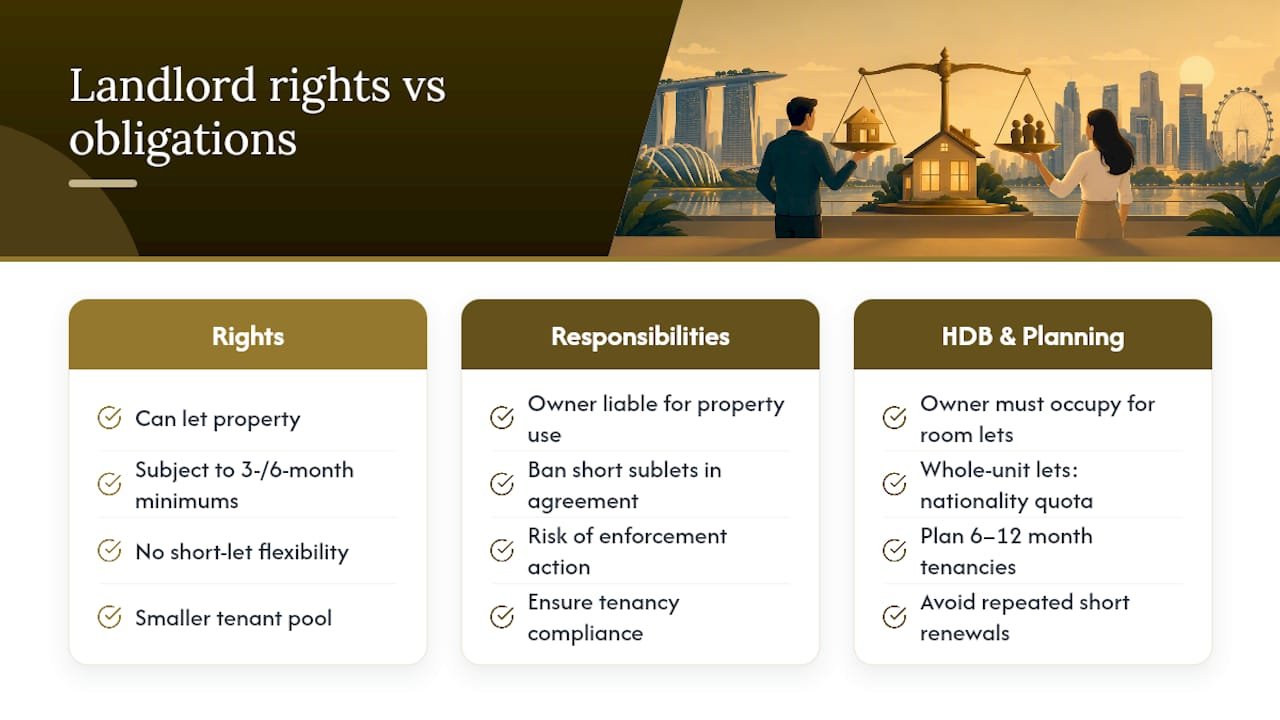
Landlords retain the right to let their property, but the three month and six month minimums shape how that right can be exercised. A private residential owner who wants flexibility to let for shorter periods simply does not have that option under current URA guidance, which limits the pool of tenants to those willing to commit to a genuine mid to long term stay.
The responsibility side is heavier than many owners expect. An owner is not automatically shielded from enforcement action just because a tenant, rather than the owner, arranged an unauthorised sublet: URA guidance makes clear that responsibility for the property’s use sits with the owner, which means tenancy agreements should explicitly prohibit further subletting below the statutory minimum. HDB owners carry an added constraint, since letting out bedrooms requires the owner to continue occupying the flat, and letting the whole unit requires staying within nationality based quotas that can change the pool of eligible tenants at short notice.
For landlords weighing whether a unit is worth letting at all, the practical answer is usually to plan around a tenancy of at least six months to a year, which keeps the arrangement clearly inside HDB and URA rules and avoids the administrative burden of repeated short renewals.
Comparing rules across different property types
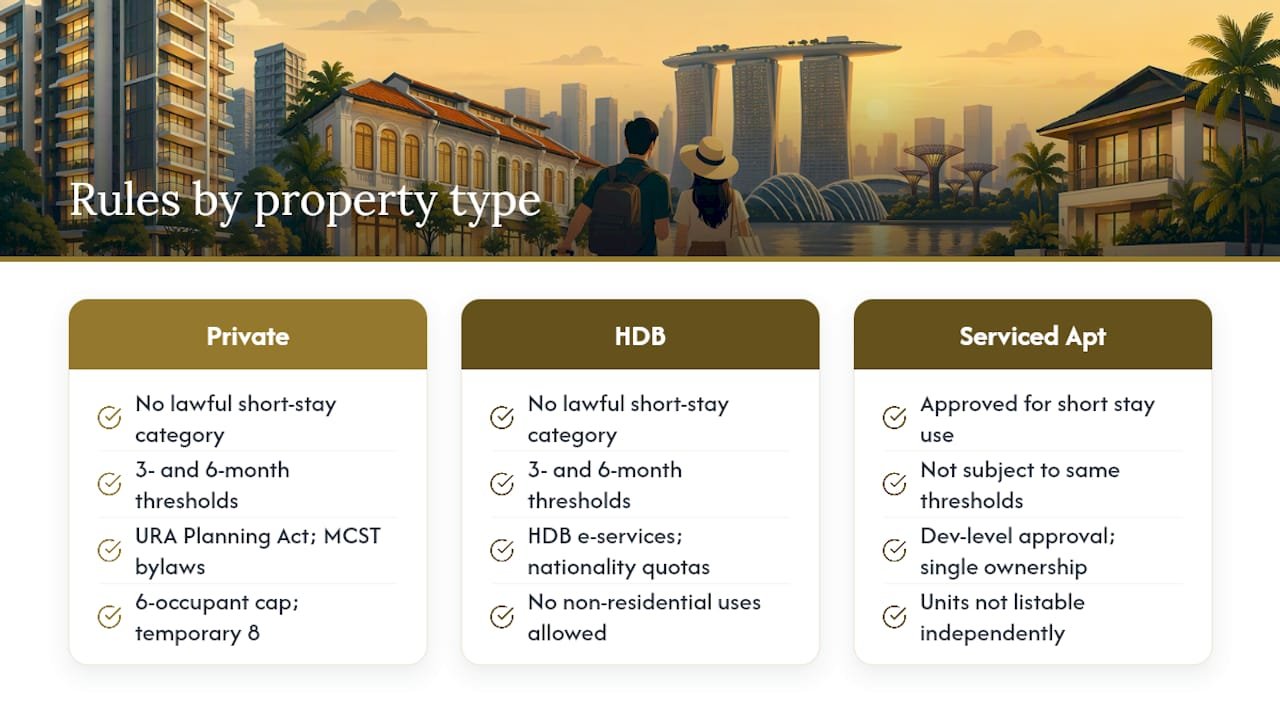
The three month and six month figures are the two headline thresholds, but the housing type in question changes what else applies. Private landed houses and condominium units sit under URA’s Planning Act framework, with the six occupant cap, the temporary eight occupant relaxation for larger units, and MCST by‑laws layered on top for strata developments.
HDB flats sit under a separate statutory scheme altogether, with HDB e‑services controlling approvals, nationality based quotas at the block and neighbourhood level, and a hard rule against non‑residential uses such as tourism or filming.
Serviced apartments and licensed aparthotels form a third category, distinct from both: these buildings are approved for short stay use at the development level, under single ownership, so an individual unit within one cannot be listed independently the way a condo unit can. There is no equivalent lawful “short stay” category within ordinary private residential or HDB stock, which is precisely why unauthorised listings in condos and flats attract enforcement while a serviced apartment booking does not.
Insurance considerations for short term rentals
Insurance is often the detail that gets skipped until something goes wrong. A standard home or landlord insurance policy is written around a defined use of the property, and letting a private residential unit or HDB flat for an unauthorised short stay can fall outside what that policy actually covers, since the use itself is unlawful.
Owners letting a property on a compliant, longer term basis should still check that their policy names rental use explicitly, rather than assuming a standard homeowner policy extends automatically to a paying tenant. Guests booking a hotel or a licensed serviced apartment benefit from the operator’s own commercial insurance, which is one of the practical reasons those options carry less personal risk than an informal booking.
For anyone renting out a property through a proper tenancy, it is worth asking the insurer directly whether the policy covers tenant occupation, accidental damage during a tenancy and liability if a guest is injured on the property. These questions are straightforward for an insurer to answer but easy for an owner to overlook until a claim is disputed.
Legal disputes and enforcement cases to know
The prosecution of six individuals for running an illegal short term accommodation operation is the clearest recent example of how these disputes play out: multiple units, coordinated management and fines running past one million dollars once the court totalled the charges.
Disputes at the smaller end tend to involve a single owner or tenant who sublet a unit for short stays without realising the tenancy agreement or MCST rules prohibited it, only to be reported by a neighbour and investigated by URA. Other disputes arise between owners and management corporations over whether a particular listing breaches the building’s by‑laws, even when the owner believed the letting fell within URA’s statutory minimum.
The pattern across these cases is consistent: enforcement follows complaints, investigations focus on actual occupancy rather than what a listing claims, and penalties scale sharply once multiple units or a commercial operation are involved rather than a single flat let informally.
Why this legal picture matters more than it looks
Most people searching for short stay options in Singapore are not trying to break the law. They are comparing listings that all look plausible, and the difference between a legal booking and an illegal one is often a single field on a page: the minimum nights setting, or the presence of a licence number. This article draws on URA and HDB primary guidance because that is the only reliable way to answer the question properly.
Some real estate platforms focus on helping people find and transact on lawful, longer term rentals and provide straightforward valuations, rather than facilitating short stay lets of any kind.
— Anderson
How Register Today can help with lawful rentals and valuations
Once you have ruled out short stay lets, the practical question becomes finding a compliant tenancy or working out what a property is actually worth to rent or sell. Register Today handles both: the platform lists residential, commercial and apartment properties for rent, and offers a free property valuation for owners deciding between a longer term let and a sale.
This is a service built around lawful, long term rental transactions and professional guidance, not a workaround for short stay bookings. If you are an owner unsure whether your unit is better let on a proper HDB or URA compliant tenancy or sold outright, a free valuation gives you a concrete figure to work from before you commit either way. For tenants who need a genuine six month or longer lease rather than a short stay, browsing current listings is the faster route to something that will not attract a knock from URA or HDB.
Owners weighing financing options alongside a sale or a longer let can also find background in this property financing guide from KAPVOY Advisory Singapore. Request a valuation or browse current listings on Register Today to start the process properly.
Sources
Check URA’s short term accommodation guidance, HDB’s rental rules, and IRAS for rental income tax questions. Agents preparing listings should also review CEA advertising disclosure guidance.
- Short‑Term Accommodation | Urban Redevelopment Authority (URA)
- Responsible hosting in Singapore – Airbnb Help Centre
FAQ
What is the 80/20 rule for Airbnb?
This term is not an official Singapore regulation and definitions vary depending on the market being discussed. In Singapore, the only figures that matter legally are URA’s three month minimum for private residential units and HDB’s six month minimum for flats.
What counts as a short term rental in Singapore?
Under URA’s framework, any stay under three consecutive months at a private residential property counts as short term accommodation and is not permitted. HDB flats use a different threshold, with anything under six months falling outside the permitted rental period.
What is the shortest time you can legally rent a property in Singapore?
If you want a fully lawful option with no statutory minimum stay, a hotel is the simplest choice, since hotel licensing does not impose the residential minimums that apply to condos and flats. A licensed serviced apartment is the next shortest lawful option, at a minimum of seven days.


