


Avoid $120 Valuation Shock When Negotiating Singapore Property Price
In Singapore, the most successful buyers anchor offers to URA and HDB evidence, avoid valuation gaps and use the Option to Purchase window tactically. This means pulling recent comparables, checking seller motivation and structuring an offer that a valuer, and not just a seller, would accept. Register Today, the Council for Estate Agencies, and official transaction portals all play a part in that process.
TL;DR:
- Buyers should prioritize recent transactions within the same project, focusing on those from the last four to 18 months to determine a fair offer range.
- Seller signals such as extended days on market, price reductions, flexible terms, or vague reasons for selling indicate higher negotiation leverage.
- Structuring offers with price backed by comparables and including non-price concessions like faster completion can improve chances of success.
- Confirming the outcome of the HDB Request for Value before finalizing financing is crucial to avoid exceeding the valuation gap and facing cash-over-valuation costs.
- Using independent property valuations and understanding agent disclosure rules help buyers negotiate confidently while staying within their financial limits.
Table of Contents
- Research comparables and set your negotiation range
- Read the seller: signals that change your stance
- Build an offer: price anchoring and non-price terms
- OTP, HDB Request for Value and valuation gaps
- Working with agents: commission, disclosure and agreements
- Scripts, phrases and short templates that work
- Timing, walk-away limits and closing tactics
- How Register Today can help you execute this playbook
- Author’s perspective and printable checklist
- Register Today: a practical next step
- Sources
- FAQ
Research comparables and set your negotiation range
Before making an offer, gather the transaction evidence that will support it. For private condominiums, the URA property transaction search provides up to 60 months of caveats and price data, though lodging a caveat is not mandatory, so some transactions may not appear. For HDB resale flats, the HDB resale portal and recent Requests for Value serve the same purpose.
Not every comparable carries equal weight. Prioritise transactions in the same project or stack, similar size, a comparable floor band, similar lease remaining and, above all, recency. A sale from 18 months ago tells you less than one from last month, particularly in a market moving quickly.
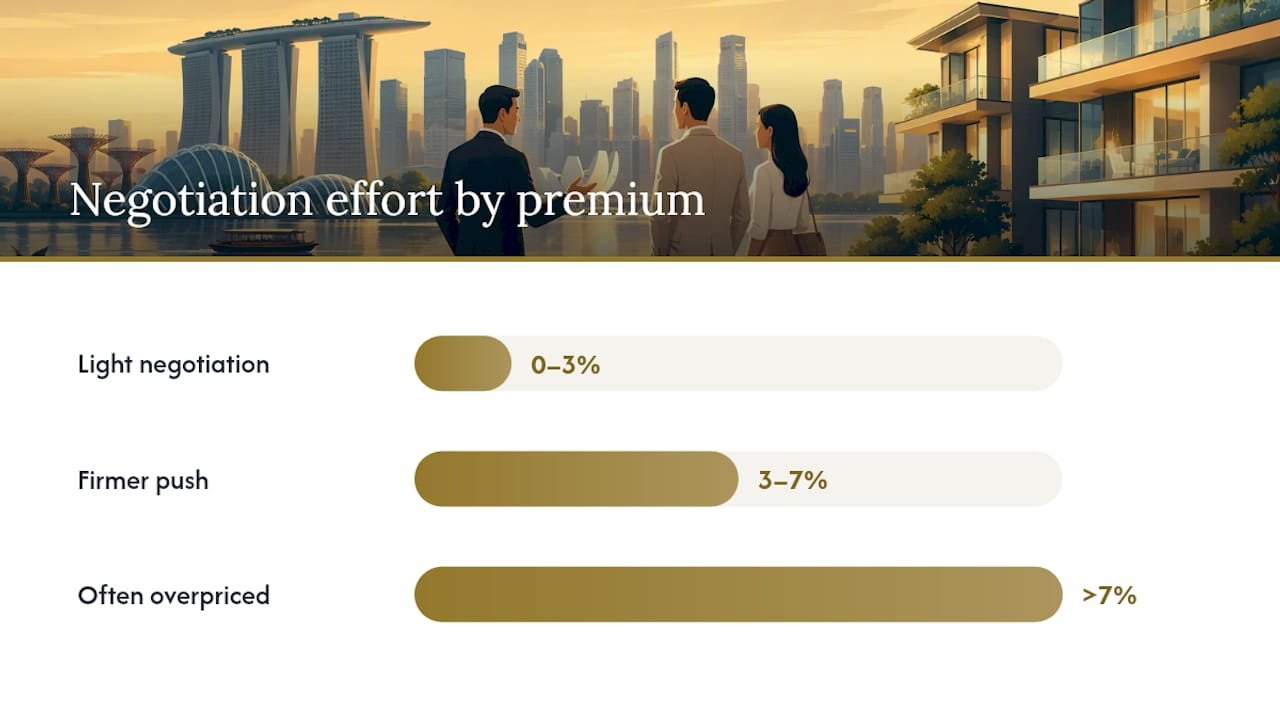
Local negotiation frameworks suggest treating the closest three to ten adjusted comparables as the core evidence set, then stress-testing your financing against that range before you commit to a number. As a rough guide from the same analysis, an asking price sitting 0 to 3% above your comparables usually only needs a light negotiation, 3 to 7% above calls for a firmer, evidence-based push, and anything beyond 7% is often overpriced unless the unit has a genuine premium trait such as a rare stack or an unusually high floor.
Before you make an offer, capture:
- The last three to five transactions in the same project or block, with date, size and floor.
- The unit’s lease remaining and how it compares with your shortlisted comparables.
- Any renovation, view or corner-unit premium the seller might cite.
- Your own financing limit, so the range you negotiate within is one you can actually close.
Read the seller: signals that change your stance
Price evidence tells you what a unit is worth. Seller behaviour tells you how hard you can push. Days on market is the simplest signal: a flat or condo that has sat listed for months, especially with one or two price reductions already recorded, points to a seller who is more open to a lower offer than the asking price suggests.
Other signals are softer but still useful. A listing that mentions flexible moving dates, includes furniture at no extra cost, or gives a vague reason for selling often indicates a seller without urgent leverage. Harder signals work the other way: a seller who has already secured their next home, or who mentions competing offers, has less reason to move on price.
Market direction matters too. In a rising market, sellers hold firmer and comparables age quickly in your favour, so you may need to move faster on a fair price rather than push too hard. In a softer or more balanced market, the same days-on-market signal carries more weight, and there is more room to negotiate using stale asking prices as leverage.
Pro Tip: Ask the agent directly how long the unit has been listed and whether the price has changed. A straight answer, or a dodge, tells you almost as much as the number itself.
- Rising days on market with price cuts signals a seller open to negotiation.
- Vague reasons for selling or unusually flexible terms suggest low urgency on the seller’s side.
- A confirmed onward purchase or multiple offers signals reduced room to negotiate.
Build an offer: price anchoring and non-price terms
An opening offer works best when it sits below your ceiling but is still defensible against specific comparables, not simply “10% under asking” with no reasoning behind it. State the number, then reference the two or three transactions that justify it.
Price is not the only lever. Deposit size, completion timeline, vacant possession date, repair allowances and which fixtures stay or go are all negotiable terms that can make a lower headline price more attractive to a seller, or let you hold your price while still winning concessions elsewhere.
- Open with a price backed by named comparables, not a round number pulled from instinct.
- Offer one non-price concession upfront, such as a faster completion or a larger deposit, if it helps your case.
- Reserve a second concession, like flexibility on vacant possession date, for your counter-move rather than giving everything away at once.
- Keep each counter focused on one or two changes at a time so the seller can respond clearly rather than facing a wall of demands.
For a private condo, an adaptable opening line might read: “Based on the last three transactions in this stack, all within the past four months, we’d like to offer $X, with completion in ten weeks.” For an HDB resale flat, where the Request for Value process governs valuation, a workable version is: “We’re offering $X, subject to the Request for Value outcome, with a two-week option period.”
OTP, HDB Request for Value and valuation gaps
The Option to Purchase is the document that locks in your negotiated price once a seller accepts it, and it typically comes with an option period lasting several weeks during which you must exercise it or lose your option fee. That window is also when HDB buyers submit their Request for Value.
The HDB Request for Value costs $120 including GST, typically comes back within around 10 working days and remains valid for three months. It directly determines how much CPF you can use and your loan limit, so the outcome matters as much as the negotiated price itself.
A $120 fee decides your financing ceiling. The Request for Value process sets the valuation HDB and your bank will lend against, so a gap between your agreed price and that valuation becomes cash you must find yourself.
When the agreed price exceeds the HDB valuation, that difference is Cash Over Valuation, and it must be paid in cash rather than through CPF or a loan. Buyers should:
- Confirm the Request for Value outcome before finalising financing plans, not after.
- Build a cash buffer into their offer ceiling for any possible valuation gap.
- Use the 21-day option period to arrange financing and confirm the valuation rather than letting it lapse unused.
Working with agents: commission, disclosure and agreements
The Council for Estate Agencies requires agents to disclose any conflicts of interest and prohibits an agent from collecting commission from more than one party in the same transaction. Agreements must use a prescribed estate agency agreement, and commission should be paid to the agency, not handed to the individual agent.
Commission itself is negotiable, whether structured as a flat fee or a percentage, and the terms should be written into the agreement before any viewing takes place, not agreed verbally afterwards. In co-broke deals, where a buyer’s agent and a seller’s agent both work the transaction, confirm exactly who represents whom and whether either has any relationship with the other party beyond this deal.
Before signing anything, run through:
- Who the agent legally represents, and whether that has been disclosed in writing.
- What commission structure applies and whether it is negotiable.
- Whether the agreement is the CEA’s prescribed format.
- Who else, if anyone, is co-broking the deal.
Scripts, phrases and short templates that work
The right question at a viewing often reveals more than a spreadsheet of comparables. Asking a seller directly, “How come you’re selling?” or “What made you set the price at this level?” tends to surface either a solid justification or an opening.
- Lead with a question about motivation before discussing numbers.
- Present your comparables plainly: “These three units in the same block sold for less in the past few months,” rather than arguing the seller’s price is wrong.
- Make a polite, time-limited offer: “We can offer $X, valid until Friday,” which gives the seller a reason to decide rather than sit on it.
- Use silence deliberately after stating your number. Resist the urge to immediately justify or soften it.
Pro Tip: Objection-handling techniques used by agents, such as structured response scripts, translate well to buyer-side negotiation: acknowledge the seller’s position before restating your evidence.
A short HDB message might read: “Thank you for the viewing. Based on recent Request for Value outcomes in the block, we’d like to offer $X with a two-week option period.” A condo version: “We’ve reviewed the last few transactions in this stack and would like to offer $X, with completion in eight weeks.”
Timing, walk-away limits and closing tactics
Set a walk-away ceiling before you start negotiating, not during. That ceiling should combine the likely valuation outcome, your CPF and loan limits, and the full acquisition cost, including Buyer’s Stamp Duty and, where applicable, Additional Buyer’s Stamp Duty. Register Today’s positioning centres on helping investors structure purchases without the ABSD burden, which is worth factoring into that ceiling for eligible buyers.
Timing pressure cuts both ways. A seller facing a genuine deadline, such as an end-of-month completion on their own onward purchase, gives you real leverage. A seller with no such pressure will simply wait you out, so treat urgency as a factor to verify, not assume.
Some closing moves protect your price without you having to move on the headline number:
- Offering a larger deposit to signal certainty rather than cutting price further.
- Proposing a flexible completion timetable that suits the seller’s own moving plans.
- Agreeing to take the unit with existing fixtures rather than negotiating removal costs.
Before you commit, run through: does this price sit within your ceiling, has the Request for Value outcome (for HDB) confirmed there is no unmanageable gap, and does the completion timeline actually work for your own finances.
How Register Today can help you execute this playbook
A real estate platform operates across residential and commercial listings in Singapore, offering detailed market evaluations to identify pricing gaps and opportunities before a client commits to an offer. The platform offers services including free property valuations and personalised negotiation support.
In practice, a buyer following this playbook could use the platform at each stage:
- Start with a free property valuation to get an independent read on a unit before setting your offer range.
- Use the advanced search tool to pull comparable listings while building your comparables set.
- Review the sold properties record for a sense of completed transactions.
- Submit details through the property evaluation process once you are ready to move from research to an actual offer.
The platform’s positioning includes structuring investment purchases to address Additional Buyer’s Stamp Duty considerations, which is relevant to buyers weighing acquisition cost alongside negotiated price.
Author’s perspective and printable checklist
Negotiation in Singapore rewards buyers who treat evidence as leverage, not just decoration. A price is only as strong as the comparables behind it, and a valuation gap ignored today becomes a cash problem at completion.
Checklist: pull comparables, read seller signals, structure the offer, check the Request for Value outcome, confirm agent terms, set your walk-away ceiling.
— Anderson
Register Today: a practical next step
If you have worked through the research and read on seller motivation but want a second, independent view before you commit to a number, a free property valuation from Register Today gives you that check without cost. It maps directly onto the research stage of this guide and feeds into the offer you eventually put in writing.

Register Today also offers personalised negotiation support alongside its valuation service, and its listings cover residential, commercial and commercial office categories for buyers weighing more than one type of property. For an investor specifically trying to structure a purchase around Additional Buyer’s Stamp Duty exposure, that is the one contrast worth acting on rather than working it out alone.
Start at the Register Today homepage to browse current listings or go straight to the valuation request if you already have a unit in mind.
Sources
- URA press release (Q1 2026 resale transaction data)
- HDB: Request for value (resale flats)
- Council for Estate Agencies: engaging a property agent
- URA property transaction search (private residential)
- SGInfoProperty: asking price vs last 12 months transactions (negotiation framework)
FAQ
Will Singapore property prices drop in 2026?
Resale transactions made up 59.6% of private residential sales in Q1 2026, with 3,225 resale transactions recorded in that quarter. That figure reflects one data point rather than a forecast, and future price movements depend on financing conditions and supply that vary by segment and location.
How do you politely ask for a lower price?
Lead with a question about the seller’s motivation for selling, then present two or three recent comparable transactions calmly rather than arguing that the asking price is wrong. Stating a specific offer with a short validity window, such as “valid until Friday,” tends to prompt a clearer response than an open-ended low offer.
What is the best way to negotiate a house price?
The most defensible approach anchors your offer to recent comparables from the URA transaction search or HDB resale records, then adjusts for seller motivation signals such as days on market. Pairing a fair price with useful non-price terms, like a flexible completion date, often closes a deal faster than chasing the lowest possible number.
What are the four golden rules of negotiation?
There is no single official framework for this in the Singapore property context, and definitions vary across sources. A workable practical version for buyers here is: negotiate with comparable evidence, understand the seller’s real motivation, separate price from other negotiable terms, and set a walk-away ceiling before you start.
What is Cash Over Valuation and why does it matter?
Cash Over Valuation is the gap between an agreed price and the HDB Request for Value outcome, and it must be paid in cash since it cannot be covered by CPF or a housing loan. Confirming the Request for Value result before completing financing plans helps buyers avoid an unexpected cash shortfall at completion.


