
6.4% Vacancy: Singapore 2026 Rental Outlook, Data for Owners & Renters
Singapore’s rental market is stabilising rather than surging in 2026. The private residential rental index reached 162.5 in the second quarter, a 1.7% year on year rise, while vacancy in completed private homes climbed to 6.4%. HDB rents told a similar story, up 1.6% year on year in August, with a wave of Shorter Waiting Time flats and MOP completions adding to supply.
TL;DR:
- Rising vacancy rates and increased supply from government land sales are limiting the potential for sharp rent or price increases in 2026.
- Landed homes and prime city-fringe properties continue to command stronger rents due to limited availability and higher scarcity.
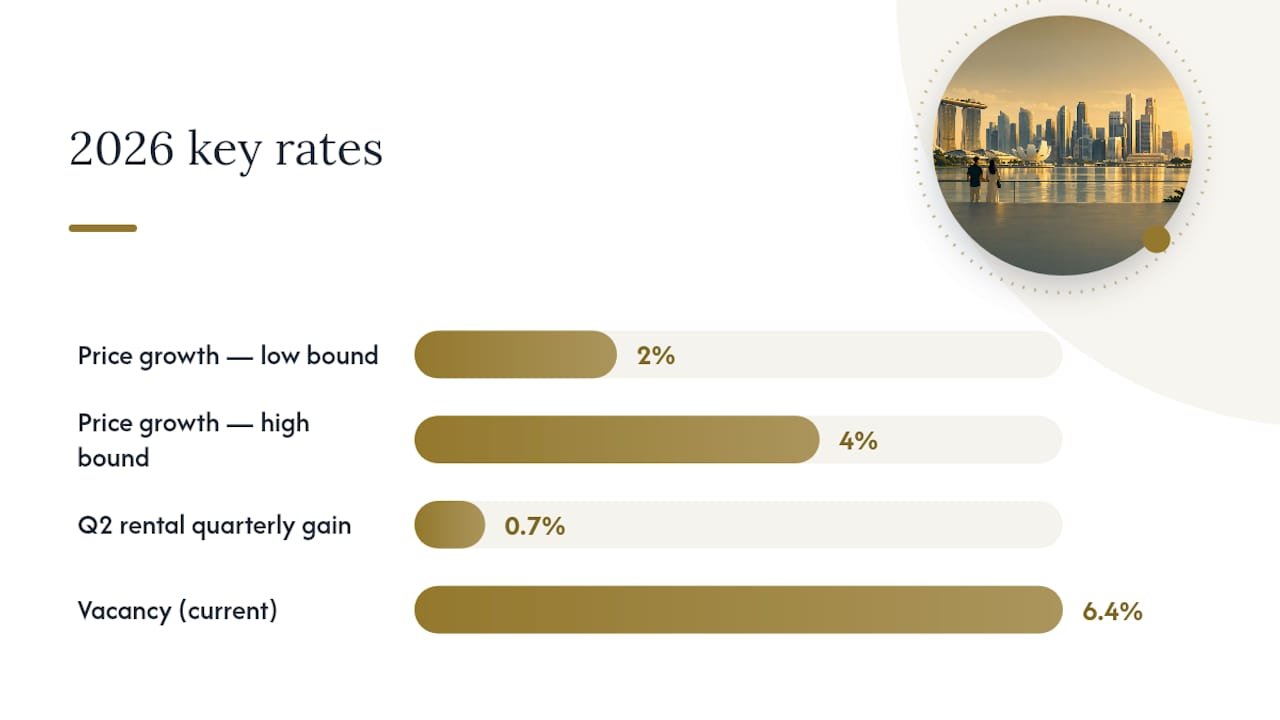
- The rental market is stabilizing with expected full-year growth between 2% and 4%, while vacancy may remain in the mid-single digits, affecting landlords’ expectations.
- Demand persists from expatriates, household formations, and the aging resale stock, supporting rental resilience despite slowing overall market momentum.
- Investors should focus on locally comparable rents and estate maturity, while tenants gain negotiating leverage, especially outside prime and landed segments.
Table of Contents
- Q2 2026 snapshot: headline data and immediate trends
- Supply pipeline and policy levers shaping rents
- Demand drivers: employment, migration and interest rates
- Price and rent outlook for 2026: what to expect by segment
- Implications for landlords and investors
- What renters should expect in 2026 and practical tips
- A practitioner analysis and service note
- Comparing rental demand with home ownership trends
- Rental market risks and challenges for tenants
- How I would act now
- How Register Today can help with listings, valuations and negotiations
- Official data and authoritative reporting used
- Sources
- FAQ
Q2 2026 snapshot: headline data and immediate trends
The second quarter of 2026 gave the clearest read yet on where rents are heading. The private residential rental index rose to 162.5, up 0.7% quarter on quarter after a softer 0.3% gain in Q1. That is measured growth, not the sharp increases tenants faced through 2022 and 2023.
Vacancy is the number worth watching most closely. It rose to 6.4% at the end of Q2, a level that gives tenants more room to negotiate and eases pressure on landlords to chase every last dollar in rent.
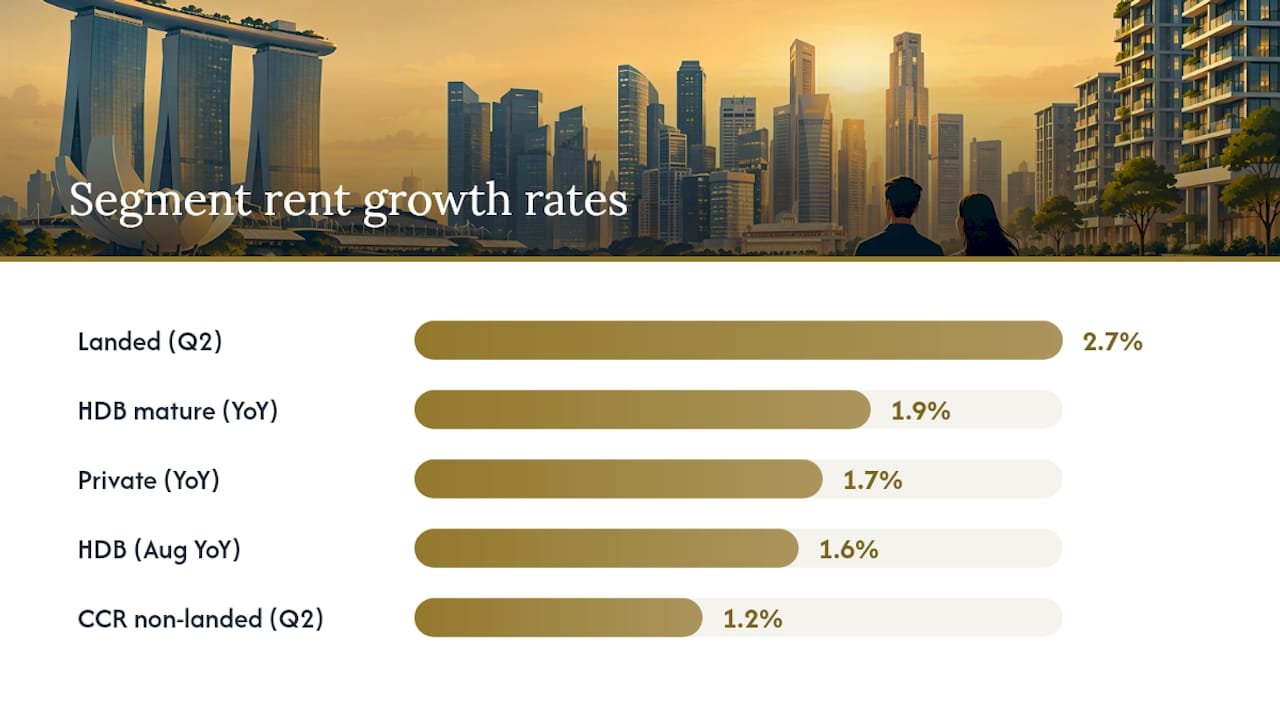
The private residential rental index sits at 162.5 as of Q2 2026, up 1.7% year on year, while vacancy has climbed to 6.4%. Rising vacancy alongside positive but slowing rental growth points to a market where landlords can no longer assume automatic rent increases at renewal.
HDB told a parallel but distinct story. Rents there rose 1.6% year on year in August, even as monthly rental transaction volumes slipped, with mature estates posting slightly stronger gains than non-mature ones.
Segment performance varied noticeably within the private market:
- Landed property rents rose 2.7% in Q2, the strongest gain of any segment, according to The Straits Times.
- Non-landed properties in the Core Central Region rose 1.2%, outperforming the broader private market.
- Suburban (Outside Central Region) rental growth lagged both landed and prime segments.
- HDB mature estates recorded roughly 1.9% year on year rental growth, ahead of non-mature estates.
The pattern is consistent: scarcer, harder-to-replace stock such as landed homes and prime addresses commanded firmer rents, while mass-market and suburban segments felt the effect of rising vacancy first.
Supply pipeline and policy levers shaping rents
Government land supply is the biggest structural force working against runaway rents in 2026. The Confirmed List under the Government Land Sales programme for the second half of 2026 carries 4,745 private residential units, bringing the full-year Confirmed List total to 9,320 units, more than 50% above the ten-year annual average.
That is a deliberate policy choice. A related URA release frames the elevated supply as an effort to prevent a repeat of the price volatility seen in 2022 and 2023, effectively capping the scope for aggressive rent increases as new units complete and enter the market.
On the public housing side, HDB has moved on two fronts at once:
- HDB launched 1,316 Shorter Waiting Time flats with waiting periods under three years, aimed at easing interim housing pressure for young households.
- More than 50,000 flats are due to reach their Minimum Occupation Period over the next three years, a pool of potential new rental supply as owners upgrade or relocate.
- The 2H2026 Confirmed List alone adds 4,745 private units to a pipeline already running well above historical norms.
- Completions scheduled through 2026 to 2029 will progressively lift vacancy further if demand growth stays moderate.
The combined effect is a market being deliberately loosened from the supply side. Landlords who benefited from the tight conditions of recent years should expect that cushion to thin as these units complete and MOP flats free up for rent or resale.
Demand drivers: employment, migration and interest rates
Supply explains only half the 2026 picture. Demand has held up better than the vacancy numbers might suggest, and that is largely down to the labour market. Commentary from academics at the National University of Singapore, cited by the Business Times, pointed to a rebound in property market sentiment during the second quarter, linked to firmer economic performance.
Interest rates remain a factor in the rent versus buy decision. When mortgage rates sit high relative to rental yields, more households and expatriates choose to rent rather than commit to a purchase, which supports rental demand even as home sales slow. That dynamic has kept rental demand more resilient than the headline vacancy figure implies.
A few demand patterns stand out for 2026:
- Corporate relocations and expatriate inflows tend to produce short-term spikes in demand for prime and city-fringe units rather than broad-based structural growth.
- Household formation, including adult children moving out and smaller family units forming, continues to add steady background demand across HDB and mass-market private segments.
- Landed and CCR segments have shown less sensitivity to demand shocks, partly because supply of comparable units is inherently limited.
- Suburban private and non-mature HDB estates are more exposed to swings in tenant demand, given the larger volume of comparable stock coming online.
The net effect is a market where headline vacancy is rising, yet pockets of genuine scarcity, particularly landed housing and well-located resale flats, continue to see firmer rents than the averages suggest.
Price and rent outlook for 2026: what to expect by segment
Analyst consensus points to full-year price growth in the 2% to 4% range for 2026, with rental growth expected to track modestly below that. This is a base case built on the data already in hand: slowing quarterly momentum, rising vacancy, and a substantial confirmed supply pipeline working against sharp increases in either prices or rents.
Three scenarios are worth planning around:
- Base case: Prices grow within the 2% to 4% range for the year, rents continue rising at a pace similar to the 0.7% quarterly gain seen in Q2, and vacancy stabilises in the mid single digits as new supply is gradually absorbed.
- Downside case: A weaker global economic backdrop dampens hiring and expatriate inflows, vacancy pushes higher than 6.4%, and rental growth flattens or turns marginally negative in suburban and mass-market segments.
- Upside case: Stronger than expected economic growth and talent inflows absorb the new supply faster than forecast, keeping rents firmer across prime and landed segments even as mass-market rents stay subdued.
Segment by segment, the picture for 2026 is uneven rather than uniform. HDB resale prices and rents in mature estates look best placed to hold gains, supported by limited replacement stock and steady demand. HDB rentals in non-mature estates face more competition as MOP flats and Shorter Waiting Time units add supply. Private non-landed housing outside the central areas carries the most vacancy risk given the scale of the confirmed pipeline, while landed housing and Core Central Region addresses are positioned to outperform on relative scarcity, echoing the segment gains already recorded in Q2.
For anyone timing a purchase, a rent reset or a lease renewal, the practical read is straightforward: the window for opportunistic entry is widening in suburban and mass-market segments, while prime and landed stock is likely to stay comparatively firm through the year.
Implications for landlords and investors
Landlords who bought at the top of the recent cycle need to recalibrate expectations around yield. Initial rental yields on new launches often understate long-run returns because launch pricing reflects forward expectations rather than current market conditions, a point the Straits Times notes is frequently misread by first-time investors. The more useful question is not this year’s yield but the property’s position over a multi-year holding period.
Setting the right asking rent in 2026 means benchmarking against real comparables, not last year’s rent roll:
- Check recent transacted rents for similar units in the same estate, not just asking prices on portals.
- Weigh estate maturity: mature HDB estates and established private enclaves are holding rents better than newer, supply-heavy districts.
- Account for unit size and layout, since smaller, efficiently laid out units are attracting more consistent tenant interest as budgets tighten.
- Factor in the competing supply due to complete nearby over the next one to two years.
A basic landlord checklist for the year ahead should include thorough tenant screening, a willingness to offer shorter initial leases with renewal options rather than rigid multi-year terms, staged rent adjustments instead of one large jump at renewal, and a vacancy buffer of at least one to two months built into cashflow projections.
Pro Tip: Stress-test your rental cashflow against a scenario where the unit sits vacant for two months and rent comes in 5% below your current asking price, before deciding whether the numbers still work.
Financing decisions deserve the same caution. Anyone leveraging a purchase for rental income should run the numbers assuming a higher vacancy rate and flatter rent growth than the current base case, rather than extrapolating the tight conditions of 2022 and 2023 forward.
What renters should expect in 2026 and practical tips
Tenants are entering 2026 with more leverage than they have had in several years. Rising vacancy across most segments means landlords are generally more open to negotiation, particularly outside prime and landed housing where competition for tenants is firmer.
A short approach for renters searching in 2026:
- Time viewings for periods when new completions are handing over nearby, since landlords racing to fill units are more likely to negotiate.
- Ask about lease length flexibility. Some landlords now prefer shorter initial terms with an extension option rather than locking into a rigid two-year lease.
- Weigh location against amenities carefully. With more suburban and mass-market stock available, it is often possible to secure a larger unit or better facilities for a similar budget.
- Compare recent transacted rents, not just asking prices, before making an offer.
A practitioner analysis and service note
Register Today has tracked over $1 billion in completed property sales across Singapore, and the platform’s day-to-day signals, from listing enquiry volumes to negotiation outcomes, echo the official data: tenants have more choice, and landlords who price realistically close deals faster. For investors and landlords navigating this shift, the platform offers a free property valuation, personalised negotiation support, and access to residential and commercial listings drawn from detailed market gap analysis.
Comparing rental demand with home ownership trends
Rental demand and home ownership intentions move together in Singapore, and 2026 is a clear example of that link. When mortgage rates stay elevated relative to rental yields, more households delay a purchase and rent for longer, which keeps rental demand firmer than headline price growth alone would suggest. The 2% to 4% consensus price growth for 2026 sits alongside rental growth that, while positive, is not accelerating at the same pace, a gap that typically widens the pool of would-be buyers choosing to rent instead.
HDB resale volumes and MOP flat completions also shape this balance. As more flats reach their Minimum Occupation Period, some owners choose to sell into the resale market while others rent out their flats, adding to rental stock rather than ownership transactions. That flow tends to soften rents in non-mature estates faster than in mature ones, where resale demand remains firmer.
For younger households and newly arrived professionals, renting is often the practical default while they assess job stability, family plans or eligibility for a Build-To-Order flat. That structural pattern, rather than any single quarter’s price movement, is what keeps rental demand resilient even as ownership intentions fluctuate with rates and sentiment.
Rental market risks and challenges for tenants
Rising vacancy does not mean renting has become easy for everyone. Affordability remains a genuine concern, particularly for households competing for smaller HDB flats in mature estates, where rents have grown faster than in non-mature areas even as citywide vacancy climbs.
Availability is uneven rather than uniformly loosening.
Timing risk is another factor. Tenants who need to secure a lease immediately, without room to wait for new completions to hand over, lose much of the negotiating leverage that rising vacancy is supposed to hand them. Lease flexibility also cuts both ways: while some landlords now offer shorter initial terms, others use that same flexibility to reprice more frequently at renewal, so a tenant’s apparent bargaining power can narrow again within a year if local supply tightens. Reading the estate-level data, rather than citywide averages, remains the safer basis for any rental decision in 2026.
How I would act now
If you are holding a rental property, focus on tenant quality and cashflow resilience over chasing the last few dollars in rent. If you are considering a purchase, landed housing and select Core Central Region addresses look better placed to hold value given the scarcity shown in the data. Renters have genuine leverage this year, particularly outside prime and landed segments, and should use it. For a second opinion grounded in local transaction data, this platform can be a useful place to start.
— Anderson
How Register Today can help with listings, valuations and negotiations

Whether you are pricing a rental for the first time or deciding whether 2026’s slower price growth is your window to buy, an approach can focus on avoiding unnecessary Additional Buyer’s Stamp Duty exposure while getting a realistic read on a property’s worth in today’s market.
- Free property valuation to benchmark your asking rent or sale price against current transacted data.
- Rent a Property support for tenants and landlords navigating lease terms in a shifting market.
- Browse current listings across residential and commercial categories before making a decision.
Reach out through Registertoday when you are ready to price, list or negotiate your next move.
Official data and authoritative reporting used
- URA Q2 2026 real estate statistics release
- The Straits Times, rental and price index analysis
- Singapore Business Review, HDB rental data
- HDB upgrader’s guide, Hougang
Sources
- Release of 2nd Quarter 2026 real estate statistics | Urban Redevelopment Authority (URA)
- Private residential rents rise 0.7% in Q2 as home prices inch up 0.5%: URA | The Straits Times
- HDB rents rise 1.6% YoY in August as monthly volumes slip | Singapore Business Review
FAQ
What is the property market outlook for Singapore in 2026?
The outlook is for a stabilising market rather than a booming or crashing one. Analysts expect full-year price growth in the 2% to 4% range, supported by elevated Government land supply and rising vacancy that together limit sharp increases in either prices or rents.
Will property prices drop in 2026?
Prices are not expected to fall outright in 2026, based on the current consensus. Quarterly growth has slowed, with the price index up 0.5% in Q2 2026 compared with 0.9% in Q1, pointing to easing momentum rather than a decline.
What is the current state of the Singapore rental market?
Rents are still rising but at a measured pace, with the private residential rental index at 162.5 in Q2 2026, up 1.7% year on year, while vacancy has climbed to 6.4%. HDB rents rose 1.6% year on year in August, with mature estates outperforming non-mature ones.
Are property prices expected to double in Singapore by 2030?
There is no data or forecast supporting a doubling of property prices in the near future. Current analyst consensus points to moderate annual growth in the 2% to 4% range for 2026, and no source in this article projects growth anywhere near that scale.


