
4.7% of Singapore homes: Strata vs conventional landed, checks buyers need
Conventional landed homes are owned under a land title, giving the owner exclusive rights to the land itself. Strata landed homes carry a strata title plus an undivided share of common property, which means a management corporation governs shared spaces and by-laws limit what an individual owner can change. That single distinction decides who pays for what, who approves exterior alterations, and which authorities, the Urban Redevelopment Authority and the Singapore Land Authority, which a buyer should check before committing.
TL;DR:
- Strata landed housing includes shared common property and managed by a management corporation, which requires owners to pay management fees and adhere to by-laws.
- Conventional landed homes are owned outright with a land title, giving owners full control but no shared reserves or collective maintenance obligations.
- Renovation restrictions are stricter in strata developments, requiring approval for external changes and shared facility modifications, unlike landowning owners.
- Foreign buyers need approval from the Singapore Land Authority to purchase strata landed properties unless the development is within an approved condominium.
- Reviewing sinking fund history and MCST documents before buying helps anticipate potential special levies and hidden management issues.
Table of Contents
- What you actually own: land title versus strata title in Singapore
- Who maintains, pays and insures what: MCST, fees and reserve funds
- What you can and can’t do: rules on renovations, facades and rebuilding
- A Singapore due diligence checklist: documents and checks before you buy
- Which suits you: quick guidance for owner-occupiers, investors and foreign buyers
- Author perspective: market and transactional implications
- How Register Today can help you proceed
- Sources
- FAQ
What you actually own: land title versus strata title in Singapore
The ownership structure is the starting point for every other difference between the two property types. A conventional landed home comes with a land title: the buyer owns the plot outright, along with everything built on it. There is no management corporation, no shared common property and no collective decision-making about the exterior or the garden.
Strata landed housing works differently. According to URA’s development control guidelines, it consists of strata-titled land units sitting on a common development site. Each owner holds strata title to their individual unit and an undivided share of the common property, which typically includes internal roads, guardhouses, landscaping and sometimes recreational facilities. That undivided share is not a separate asset to sell or subdivide. It is a proportionate interest that comes bundled with the unit and carries ongoing obligations alongside it.
URA also sets out the physical forms this housing can take and the minimum footprint each unit must have. Common types include:
- Strata bungalows, which resemble detached landed homes but sit within a shared strata development.
- Strata semi-detached units, built in pairs on a common site.
- Strata terraces, laid out in rows similar to conventional terrace houses.
Each strata landed unit must have a minimum ground contact of 50 square metres, and URA guidelines forbid strata landed development within designated landed housing areas, where only conventional landed forms are permitted. A single strata landed site can mix these forms and include shared communal facilities that a conventional landed estate simply does not have. Pricing tends to follow the strata floor area and share value rather than a straightforward land area calculation, which is worth clarifying with the developer or agent before comparing two properties on a per-square-foot basis.
Who maintains, pays and insures what: MCST, fees and reserve funds
Ownership type determines who is on the hook for repairs, insurance and the upkeep of shared spaces, and the financial gap between the two can be wider than buyers expect.
Strata landed developments are run by a management corporation strata title, or MCST, in which every unit owner becomes a subsidiary proprietor. The Building and Construction Authority confirms that subsidiary proprietors are bound by MCST by-laws covering shared facilities, common property upkeep and dispute resolution. Monthly management fees usually cover:
- Cleaning, security and landscaping for common areas.
- Repairs to shared infrastructure such as internal roads and lighting.
- Building insurance for common property and administrative costs of running the MCST.
Conventional landed owners carry none of that collective cost, but they also carry the entire burden alone. There is no MCST to call when the roof leaks or the boundary wall needs repair. The owner arranges and pays for maintenance, insures the house and land privately, and bears any structural risk without a shared reserve to draw on.
Strata developments address that risk through a sinking fund, a reserve built up from management fees to cover large, infrequent expenses such as repainting or lift replacement. When the sinking fund falls short, the MCST can raise a special levy, an additional one-off charge on all subsidiary proprietors. Reviewing a development’s sinking fund history before buying is one of the more reliable ways to gauge whether special levies are likely.
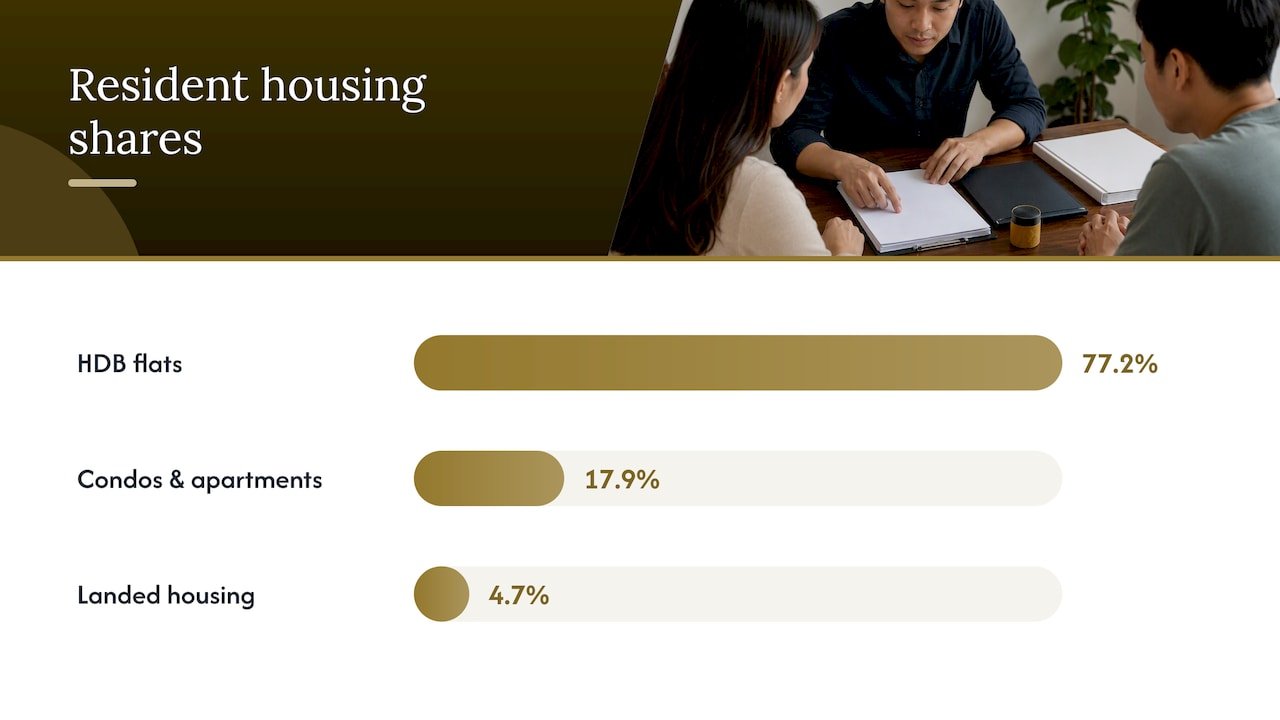
Landed housing made up a small minority of resident households in Singapore in recent years, according to SingStat, against 77.2% in HDB flats and 17.9% in condominiums and other apartments. That scarcity underpins much of the price premium landed property commands, strata or otherwise.
What you can and can’t do: rules on renovations, facades and rebuilding
Renovation freedom is where the two ownership types diverge most sharply in day-to-day practice, and it is often the difference buyers discover too late.
Under an MCST, external works are rarely a unilateral decision. Typical by-law restrictions include:
- Approval requirements for changes to the building’s external appearance, including paint colour, window replacement or extensions.
- Restrictions on altering shared services such as drainage, common driveways or utility connections without MCST consent.
- Limits on structural changes that could affect neighbouring units on the same strata site.
Conventional landed owners have far more latitude over their own structure and land, subject to Singapore’s planning and building rules rather than a private by-law. Rebuilding, extending or substantially altering a conventional landed home still requires approval from URA and the Building and Construction Authority, but the owner is not answerable to a management corporation for cosmetic or structural changes within their boundary.
Where an MCST dispute cannot be resolved directly, subsidiary proprietors can raise the matter at the next general meeting, seek mediation through providers such as the Community Mediation Centre or the Singapore Mediation Centre, or apply to the Strata Titles Boards for a formal ruling.
Pro Tip: Before signing an option to purchase on a strata landed unit, ask the seller’s agent for the MCST’s most recent AGM minutes: they usually reveal any pending disputes over renovations or alterations.
A Singapore due diligence checklist: documents and checks before you buy
Buying either property type well means confirming the same categories of information, even though the answers differ depending on the title.
Start with the legal basics:
- Verify title type, tenure and any encumbrances or caveats lodged against the property.
- Confirm the exact strata lot boundaries if buying strata landed, since garden or courtyard space may or may not fall within the unit’s exclusive use.
For strata landed purchases specifically, request:
- The current MCST by-laws and any recent amendments.
- Minutes from the last two or three AGMs.
- Service contracts for security, cleaning and landscaping.
- Sinking fund statements and any record of special levies raised.
- Copies of the building’s insurance policy for common property.
Regulatory checks matter for every buyer, but especially foreigners. The Singapore Land Authority confirms that foreign buyers generally need approval to purchase most landed property, including strata landed houses, unless the development is within an approved condominium development. Confirming that status early avoids a wasted option fee. It is also worth checking URA’s development controls for any planning permissions tied to the specific site.
Finally, budget for the ongoing numbers: expected monthly management fees, the sinking fund’s health, and, for foreign or permanent resident buyers, potential Additional Buyer’s Stamp Duty exposure on top of the purchase price.
Which suits you: quick guidance for owner-occupiers, investors and foreign buyers
The right choice depends less on prestige and more on how much control, convenience or flexibility a buyer actually needs.
Owner-occupiers who want full control over their home’s appearance, room to extend over time and no monthly management fee tend to prefer conventional landed property. The trade-off is direct responsibility for every repair and no shared reserve to fall back on.
Investors often lean towards strata landed housing because it behaves more like a condominium from a management standpoint. Predictable monthly fees, professional upkeep of common areas and facilities that can appeal to tenants make it easier to manage from a distance, particularly for an owner who does not live nearby.
Foreign buyers face a narrower path either way. Approval from the Singapore Land Authority is generally required for landed property, strata or conventional, unless the strata landed unit sits within an approved condominium development, in which case that specific exemption may apply.
A few quick questions help narrow the decision:
- Do you want to renovate or extend without asking anyone’s permission? Conventional landed suits that better.
- Do you want facilities and upkeep handled for you, even at a monthly cost? Strata landed fits that profile.
- Are you a foreign buyer relying on the condominium exemption? Confirm the development’s approved status with SLA before making an offer.
Author perspective: market and transactional implications
Pricing between the two often narrows faster than buyers expect. Strata landed units can carry a premium that assumes landed-style exclusivity, when in practice the owner is bound by MCST by-laws much like a condominium resident, a gap the Home & Decor coverage of cluster housing has flagged as a recurring blind spot. Buyers frequently skip the sinking fund review and only discover a looming special levy after they have moved in.
In real estate transactions, title documents and MCST records are reviewed as part of due diligence, checking by-laws, AGM history and reserve fund positions before an offer is made. That step has repeatedly surfaced issues, from pending facade disputes to underfunded sinking funds, that would otherwise only appear after purchase.
— Anderson
How Register Today can help you proceed

Whether you are weighing a conventional landed home against a strata landed unit, expert teams assist in working through the paperwork so the decision rests on facts rather than assumptions. Services may include:
- Property search across residential and commercial listings, including landed and strata landed options.
- A free property valuation to establish a realistic market price before you negotiate.
- Personalised negotiation support once you have shortlisted a property.
- Title and MCST document review, covering by-laws, sinking fund statements and AGM minutes, as part of preparing an offer.
If you are weighing up ABSD exposure as a foreign or repeat buyer, our approach is built around structuring purchases that avoid that additional duty where legally possible, which can materially change the maths on a strata landed or conventional landed purchase. Start with a free valuation or browse current listings on the Register Today platform to see what fits your budget and ownership priorities.
Sources
For strata landed definitions and permitted forms, see URA’s development control handbook. For foreign ownership rules, check the Singapore Land Authority. For household statistics, refer to SingStat. For deeper detail on foreign buyer tax considerations, this ABSD guide for foreign buyers offers further context. For unresolved MCST disputes, consult the management corporation’s own documents or a qualified property adviser.
- Latest News & Data – Resident Households
- Foreign ownership of property | Singapore Land Authority
- Strata landed housing | Urban Redevelopment Authority (URA)
- What to know as a condo owner | Building and Construction Authority
FAQ
What are the disadvantages of strata living?
Strata living generally means monthly management fees, restrictions on external alterations under MCST by-laws, and shared decision-making over common property that individual owners cannot bypass. Buyers also risk special levies if the sinking fund is underfunded, so reviewing MCST financial records before purchase is worthwhile.
How many Singaporeans live in landed housing?
Landed properties accounted for 4.7% of resident households in Singapore, according to SingStat data, against 77.2% living in HDB flats and 17.9% in condominiums and other apartments. That makes landed housing, strata or conventional, a comparatively scarce category of home.
Can foreigners buy strata landed property in Singapore?
Foreigners generally need approval from the Singapore Land Authority to buy strata landed housing, unless the development is within an approved condominium development, which is exempt from that requirement. Checking a specific development’s approved status before making an offer avoids delays or a rejected application.
Is an HDB flat landed or non-landed property?
HDB flats are non-landed property, built as multi-storey blocks rather than individual land parcels or strata landed units. They made up 77.2% of resident households in Singapore, according to SingStat, making them the most common housing type in the country.


