
60% ABSD in Singapore: What Foreign Buyers Must Budget
Foreign buyers currently pay ABSD of 60% on residential property purchases) in Singapore, on top of Buyer’s Stamp Duty. Both are calculated on whichever is higher: the purchase price or the property’s market value. A small number of foreigners may qualify for remission through free trade agreements, marriage to a Singapore Citizen, or specific trust arrangements, but these routes are narrow and conditional.
TL;DR:
- Foreigners face a 60% ABSD rate on any residential property purchase, regardless of whether it is their first, second, or subsequent buy.
- Eligibility for ABSD remission is limited to specific cases such as free trade agreement benefits, married couples with one citizen spouse, or certain trust structures, all requiring early planning.
- Property tax on non-owner-occupied properties can reach 36% of Annual Value annually, adding significant ongoing costs beyond initial duties.
- All stamp duties and remission applications must be completed within strict deadlines, typically 14 days for Singapore-based signing and 30 days for overseas signing, with penalties for late payments.
Table of Contents
- Current ABSD rates and buyer profiles
- How ABSD and BSD are calculated together
- Remissions and exemptions worth checking early
- Payment, stamping deadlines and penalties
- Buying through companies, trusts and other entities
- Holding costs and the broader tax picture
- Practical checklist for foreign buyers
- How Register Today helps foreigners navigate ABSD
- Weighing policy intent against your own numbers
- Get ABSD-aware support for your Singapore purchase
- Sources
- FAQ
Current ABSD rates and buyer profiles
Singapore’s ABSD framework treats buyers differently depending on citizenship, residency status and whether the purchaser is an individual or an entity. Since 27 April 2023, the rates have sat at levels designed to separate genuine owner-occupiers from investors, and foreigners from citizens and permanent residents.
Under the current schedule, a Singapore Citizen buying a first residential property pays no ABSD at all. A second property brings a 20% charge, and a third or subsequent property is taxed at 30%.
Foreigners sit in a different bracket entirely. Regardless of whether it is a first, second or subsequent purchase, a foreigner buying any residential property in Singapore pays ABSD at 60% of the purchase price or market value, whichever figure is higher. Entities, including companies and property developers, face an even higher rate of 65%, and the same 65% applies to trusts purchasing residential property, referred to as ABSD (Trust).
The rate structure, by buyer profile, looks like this:
- Singapore Citizens: 0% on the first property, 20% on the second, 30% on the third and beyond.
- Permanent Residents: 5% on the first property, 30% on the second, 35% on the third and beyond.
- Foreigners: 60% on any residential property purchase, from the first onward.
- Entities (companies) and trusts: 65% on any residential property purchase.
These rates apply specifically to residential property. HDB flats carry their own eligibility restrictions under the Housing & Development Board, and most foreigners are not eligible to purchase HDB resale flats at all, which pushes the vast majority of foreign buyers toward private condominiums, apartments and landed housing where eligibility rules allow it. Executive condominiums and certain restricted property types also carry their own approval requirements that sit alongside, not instead of, the ABSD calculation.
There is no discount for a first purchase, no allowance for buying a smaller unit, and no exemption tied to length of residence in Singapore unless a specific remission applies. The rate is a flat, deliberate cost of entry, and it needs to be treated as such from the earliest stage of budgeting.
How ABSD and BSD are calculated together
ABSD is never the only duty on a residential purchase. It sits alongside Buyer’s Stamp Duty, which applies to every buyer regardless of nationality and is calculated on a progressive scale. Both duties use the same base: typically the purchase price stated in the contract or a value the authorities determine to be fair, whichever is higher. If a buyer agrees a price below market valuation, IRAS will use the higher market value figure for the calculation, not the discounted contract price.
BSD is charged progressively.
Worked example, illustrative figures: say a foreign buyer purchases a condominium unit for $1,000,000.
- BSD is calculated on a progressive scale across the price tiers, landing at roughly $24,600 for a $1,000,000 purchase.
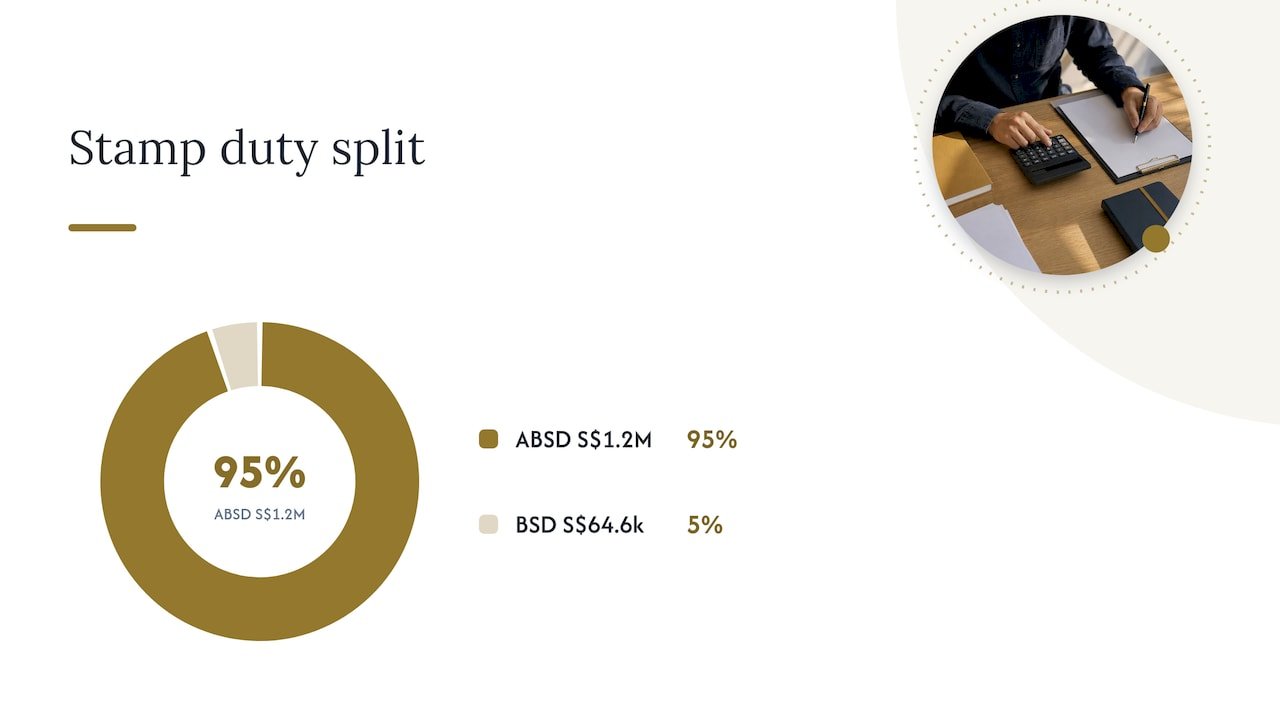
- ABSD is calculated separately at 60% of $1,000,000, which comes to $600,000.
- The combined stamp duty bill is approximately $624,600, payable in addition to the purchase price itself.
Scale that up to a $2,000,000 purchase and the arithmetic shifts sharply. The combined duty bill lands near $1,264,600, meaning the buyer needs well over $3.2 million in total funds to complete the purchase once the property price itself is included.
A foreign buyer purchasing a $2,000,000 Singapore condominium faces a combined stamp duty bill of roughly $1,264,600, driven almost entirely by the 60% ABSD component. That figure changes how much cash a buyer needs upfront, since ABSD is due in cash or CPF (where applicable) rather than being financeable through a standard mortgage in the same way as the property price. Most foreign buyers find their financing conversations start earlier and involve larger cash reserves than they initially expect, precisely because the duty bill sits outside the loan-to-value calculation banks use for the property itself.
Remissions and exemptions worth checking early
A small number of foreigners can reduce or eliminate ABSD, but the qualifying conditions are specific and unforgiving of late planning.
The first route is remission under Free Trade Agreements. Nationals and permanent residents of Iceland, Liechtenstein, Norway, Switzerland, and nationals of the United States may be treated as Singapore Citizens for stamp duty purposes, provided they meet the specified conditions. This is a national-treatment mechanism rather than a blanket exemption: it reduces the gap between what a foreigner and a citizen would pay, and the effect can differ for joint purchases or later acquisitions involving the same buyer.
The second route is the married-couple remission. Where a couple buys their first residential property jointly and one spouse is a Singapore Citizen, ABSD may be fully remitted, subject to strict conditions including disposal of any other residential property within a set timeframe. Refunds may be processed automatically for eligible cases, but the conditions around timing and prior property ownership are easy to misjudge without checking the exact requirements in advance.
The third route concerns trusts. Remission of ABSD (Trust) requires the trustee to pay the full 65% ABSD (Trust) rate upfront, with a refund available only if the remission conditions are met and the application is lodged within six months. This is not a workaround: the cash outlay happens regardless, and the refund is discretionary rather than guaranteed.
Application routes and documents typically include:
- Proof of nationality or permanent residency status, for FTA remission claims.
- The signed Option to Purchase or Sale and Purchase Agreement.
- A marriage certificate, for married-couple remission applications.
- Trust instruments and beneficiary declarations, for trust remission claims.
- Submission through myTax Portal, where stamping and remission applications are both lodged.
Pro Tip: Check remission eligibility before signing the Option to Purchase, not after, since some conditions depend on ownership status at the point of purchase rather than afterwards.
Payment, stamping deadlines and penalties
Stamp duty is time-sensitive, and the clock starts the moment a contract is signed. For documents executed in Singapore, ABSD and BSD must be paid within 14 days of signing. If the document is executed overseas, the deadline extends to 30 days after the document is received in Singapore.
Payment and stamping both happen through myTax Portal, IRAS’s e-stamping service, where buyers or their appointed representatives upload the signed document, calculate the duty owed, and pay online.
- Documents signed in Singapore: stamp and pay within 14 days.
- Documents signed overseas: stamp and pay within 30 days of receipt in Singapore.
- Late or unpaid duty can attract penalties of up to four times the amount owed.
- Payment and remission applications are both processed through myTax Portal.
Missing the deadline is costly and avoidable. If a payment date is at risk, the most practical step is to contact IRAS directly before the deadline passes rather than after, since penalty calculations are based on the length of the delay and early contact can sometimes affect how a case is handled.
Buying through companies, trusts and other entities
Structuring a purchase through a company or trust does not lower ABSD exposure for most buyers, and in practice it raises the rate.
The mechanics catch out buyers who assume a trust structure offers automatic relief. There is no discount at the point of stamping itself.
- Entities and trusts both pay ABSD at 65%, higher than the 60% rate for individual foreign buyers.
- Trust remission requires full payment first and a refund application within six months, not an upfront reduction.
- Beneficial ownership must be clearly documented, since contested or unclear beneficial interests are a common reason remission applications are queried or delayed.
Pro Tip: If a trust or corporate structure is being considered for reasons unrelated to ABSD, model the 65% cash outlay as a certainty and treat any refund as a bonus rather than a plan.
Holding costs and the broader tax picture
ABSD is a one-time cost at the point of purchase, but it is not the only tax a foreign owner needs to budget for. Property tax is charged annually based on the property’s Annual Value, and the rate depends heavily on whether the property is owner-occupied or not.
For non-owner-occupied residential properties, which covers most properties bought by foreigners who do not live in Singapore full-time or who rent the unit out, property tax is charged on a progressive scale starting at 12% on the first $30,000 of Annual Value and rising to 36% above $60,000 of Annual Value. Owner-occupied properties are taxed at substantially lower rates, which makes occupancy status a meaningful factor in long-term cost planning, not just a formality on a form.
Property tax on a non-owner-occupied unit can reach 36% of Annual Value above $60,000, a recurring cost that sits alongside, not instead of, the one-time ABSD charge. Modelling a purchase properly means adding this annual figure to mortgage repayments, maintenance and any rental income, rather than treating ABSD as the final number in the budget.
Practical points to model before committing to a purchase:
- Annual Value is not the same as market value or rental income; it is assessed by IRAS and can change over time.
- A property intended for rental income needs its yield calculated after property tax, not before.
- Financing costs, ABSD, BSD and property tax together determine the real return, and skipping any one of them distorts the picture.
Foreign buyers who model only the purchase price and mortgage often underestimate their total cost of ownership by a wide margin once ABSD and ongoing property tax are both included.
Practical checklist for foreign buyers
Getting the paperwork right matters as much as understanding the rates. The following steps cover what most foreign buyers need to act on, in order.
- Confirm your buyer profile status (foreigner, PR or FTA-eligible national) before signing the Option to Purchase, since this determines the rate applied.
- Sign the Option to Purchase or Sale and Purchase Agreement and note the exact signing date, which starts the stamping deadline clock.
- Stamp the document and pay ABSD and BSD through myTax Portal within 14 days if signed in Singapore, or 30 days if signed overseas.
- Retain the ABSD Declaration Form and all supporting documents for at least five years, in case of a later IRAS audit.
- If claiming a remission, gather the required documents (nationality proof, marriage certificate, trust instrument) and lodge the application through myTax Portal within the specified timeline.
Pro Tip: Keep a single folder, physical or digital, with every document from Option to Purchase through to stamping confirmation. Remission applications and audits both move faster when the paper trail is complete.
How Register Today helps foreigners navigate ABSD
Register Today works with foreign buyers across residential and commercial property in Singapore, and ABSD sits at the centre of most of those conversations. The platform offers listings across residential, commercial and commercial office categories, alongside a free property valuation service that gives buyers a realistic starting figure for their ABSD and BSD calculations before they commit.
The platform has facilitated many property sales, and part of that track record comes from helping clients understand the true cost of a purchase before they sign, not after.
- Free property valuations that factor in the price base used for ABSD and BSD calculations.
- Personalised negotiation support aimed at structuring purchases sensibly around a buyer’s actual budget.
- Detailed market evaluations that help identify where the numbers work despite the 60% duty.
- Guidance on transaction sequencing so buyers understand which documents and deadlines matter at each stage.
Weighing policy intent against your own numbers
It was set as a deliberate barrier to cool overseas investment demand at a time when authorities were concerned about the effect of foreign capital on housing prices for residents. Treating it as a structural cost, rather than a negotiable line item, is the right starting point for any foreign buyer weighing a Singapore purchase.
My advice is straightforward: model the full cost, including BSD and ongoing property tax, before falling in love with a specific unit. Check remission eligibility early, since FTA status, marital status and trust arrangements all need to be in place before signing, not adjusted afterwards. Avoid structuring a purchase at the last minute purely to chase a lower rate. IRAS scrutinises beneficial ownership closely, and a structure built to dodge ABSD rather than to serve a genuine purpose invites exactly the kind of audit attention that delays refunds and raises costs. Always check the primary IRAS pages directly, and keep every document from Option to Purchase onward.
— Anderson
Get ABSD-aware support for your Singapore purchase
Working out the real cost of a Singapore property, once ABSD, BSD and property tax are all accounted for, is where most foreign buyers need the most help.
If you are weighing a residential purchase, a commercial unit, or simply want to understand what a property is really worth before the duty is added on top, get a free property valuation or browse current listings on Register Today to see what fits your budget once ABSD is priced in.
FAQ
What are the ABSD rates for 2026?
The rates set on 27 April 2023 remain in force: foreigners pay 60%, entities and trusts pay 65%, Permanent Residents pay between 5% and 35% depending on how many properties they own, and Singapore Citizens pay between 0% and 30%. These figures apply to the purchase price or market value, whichever is higher.
What are the rules for foreigners buying property in Singapore?
Foreigners can generally buy private condominiums, apartments and some landed property types, but are not eligible to buy HDB resale flats under standard rules set by the Housing & Development Board. Any residential purchase attracts ABSD at 60%, on top of standard Buyer’s Stamp Duty.
What are the tax rates for foreigners who purchase property in Singapore?
Foreigners pay ABSD at 60% of the purchase price or market value, plus Buyer’s Stamp Duty on a progressive scale up to 6% at the top tier. After purchase, annual property tax applies, reaching up to 36% of Annual Value above $60,000 for non-owner-occupied properties.
How is ABSD calculated?
This figure is calculated separately from Buyer’s Stamp Duty, and both amounts are due within 14 days of signing if the document is executed in Singapore, or 30 days if executed overseas.


