

Avoid ABSD Surprises in Singapore Spousal Transfers: Check CPF, Bank Consent
A spousal transfer does not automatically trigger Additional Buyer’s Stamp Duty: the deciding factor is how many residential properties the receiving spouse will hold once the transfer completes, and whether a married-couple remission applies. HDB flats and private property follow different rules, and CPF refunds or lender consent can derail a transfer even when ABSD is not the main concern. Before committing, we always recommend checking the receiving spouse’s property count with IRAS, confirming HDB eligibility where relevant, and speaking to the mortgagee bank and the CPF Board.
TL;DR:
- A spousal transfer usually does not trigger ABSD if the total number of properties held by the receiving spouse remains below the relevant thresholds.
- For HDB flats, transfers between spouses generally do not involve ABSD but require eligibility checks, documentation, and settlement of CPF refunds and loans.
- Private property transfers are assessed based on the higher of actual consideration paid or market value, with ABSD applying if property counts increase beyond the buyer’s limit.
- CPF refund obligations and lender consent are common hurdles that can delay or complicate transfers, often more than ABSD considerations.
- Married couples may qualify for ABSD remission if they sell their first property within six months of purchasing the second and meet strict timing and ownership conditions.
Table of Contents
- What a spousal transfer means and how ABSD and BSD apply
- HDB transfers: eligibility rules, paperwork, and when ABSD is irrelevant
- Private-property share transfers: how IRAS assesses duty and value
- CPF refunds and financing: the practical blockers
- ABSD remission for married couples: conditions and the strict sale deadline
- Practical checklist: documents, contacts, and costs to budget
- Common misconceptions that cause surprise bills or delays
- Tax implications beyond ABSD: income tax and GST considerations
- Impact on future housing grants and subsidies
- How advisers weigh the real risks in a spousal transfer
- How we can support your spousal transfer or sale
- FAQ
- Sources
What a spousal transfer means and how ABSD and BSD apply
A spousal transfer, often called decoupling, happens when one spouse’s share of a jointly owned property is acquired by the other, either as a part-share sale or a transfer not involving a sale. HDB flats follow a distinct “change in flat ownership not through a sale” process, while private property transfers are handled through conveyancing and stamping like any other acquisition of interest.
Buyer’s Stamp Duty (BSD) applies to every property acquisition in Singapore, calculated on the higher of the purchase price or market value. ABSD sits on top of BSD and depends on the buyer’s profile, whether Singapore Citizen, Permanent Resident or foreigner, and the number of residential properties they already hold once the new interest is added, as set out by IRAS.
A few quick scenarios illustrate how the count shifts:
- A spouse who owns no property and acquires half of the marital home for the first time is typically treated as a first-time buyer for that transaction.
- A spouse who already owns another private property and then acquires a share in the marital home is usually treated as acquiring an additional property, which can trigger ABSD.
- Acquiring a smaller percentage share (such as moving from 1% to 50% ownership) still counts as acquiring an additional interest, not a fresh purchase from zero.
The percentage acquired does not change the principle: any addition to an existing interest is assessed as if a new property interest were being bought.
HDB transfers: eligibility rules, paperwork, and when ABSD is irrelevant
For HDB flats, a change of ownership between spouses that does not involve a sale falls outside standard resale transactions, and ABSD generally does not apply because no money changes hands under a sale and purchase agreement. HDB treats a married couple as a single family unit, which shapes who can be added or removed as an owner or occupier.
The practical steps generally run in this order:
- Confirm eligibility: HDB checks citizenship, existing property ownership, and the minimum occupation period before approving a change.
- Submit the application: HDB requires the relevant forms, NRICs, and marriage certificate, and reviews whether the remaining or incoming owner meets ownership criteria.
- Appoint a conveyancing lawyer where money is involved, since outstanding mortgage amounts and CPF refunds must be settled before HDB approves the transfer.
- Settle valuation and fees: HDB offers valuation options and charges administrative fees for processing the change.
CPF monies used to pay for the flat must be refunded, with accrued interest, when a share changes hands, even without a cash sale. Special cases such as divorce, the resale levy, or an incomplete Minimum Occupation Period can add further restrictions, so it is worth checking HDB’s own guidance before assuming a straightforward approval.
Private-property share transfers: how IRAS assesses duty and value
Private property transfers between spouses are assessed on the higher of the actual consideration paid or the market value of the share being transferred, which means a professional valuation often matters more than the price written into the transfer document. Where the declared value looks low against comparable transactions, IRAS can query the figure and recover any shortfall in duty, plus penalties.
Key mechanics to understand before transferring a private property share:
- BSD is payable on the value of the share being acquired, calculated against the usual BSD rate bands.
- ABSD applies if the acquisition pushes the receiving spouse’s total residential property count above the threshold tied to their buyer profile.
- Acquiring an additional slice of a property you already partly own still counts as acquiring an interest in another residential property for ABSD purposes, not a continuation of existing ownership.
- Where a spouse already holds a partial interest and is acquiring the remaining share, specific remission provisions may reduce the ABSD otherwise payable, though these are conditional rather than automatic.
The married-couple remission rules set out the specific conditions under which ABSD on an additional interest can be remitted, and they are worth reading in full rather than relying on general assumptions, since eligibility depends on ownership history and the structure of the transfer itself. A valuation report from a licensed valuer or an estate agency familiar with the specific district helps support the declared value and reduces the chance of a dispute with IRAS later.
CPF refunds and financing: the practical blockers
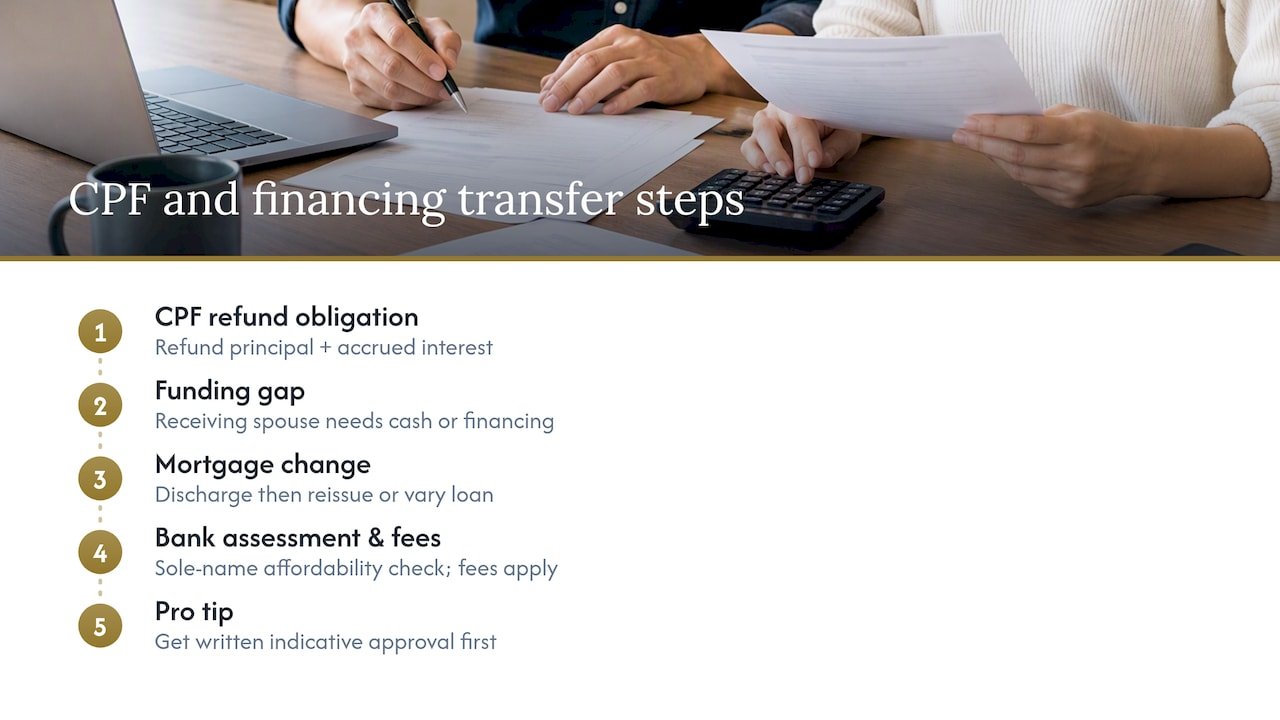
Before anything else, work out the CPF and loan arithmetic, because these two factors derail more spousal transfers than ABSD itself. Under CPF Board rules, when a property or a share in it is sold or transferred, the CPF principal amount used for that share must be refunded to the selling spouse’s CPF account, together with the accrued interest that would otherwise have been earned.
This refund obligation applies even when no cash actually changes hands between spouses, which often surprises couples who assume a transfer “within the family” avoids CPF implications entirely. The receiving spouse may need to find cash or arrange fresh financing to cover both the refund and the share being acquired, since IRAS and CPF treat the transaction much like an open-market sale for refund purposes.
Lenders add a second layer of complexity. The mortgage must usually be discharged and reissued, or varied, in the sole name of the remaining owner, and the bank will assess whether that spouse can service the loan independently. Banks typically need weeks rather than days to process this, and may charge valuation, legal or restructuring fees along the way.
Pro Tip: Get a written indicative approval from your bank on sole-name financing before signing any transfer agreement, since a declined loan after the fact can leave the transfer half-completed.
ABSD remission for married couples: conditions and the strict sale deadline
Married couples who jointly purchase a residential property may qualify for ABSD remission, which effectively refunds the ABSD paid on a second property, provided several conditions are met together, not individually.
The core conditions include:
- The property must be jointly purchased by a married couple, with at least one spouse a Singapore Citizen.
- The couple must dispose of their first residential property within a strict time window after acquiring the second, or within a similar period based on property completion dates for uncompleted properties.
- The couple must remain married at the time the remission is claimed.
- Ownership of the second property must remain unchanged from purchase until the first property is sold.
Remission eligibility is strict and time-bound: the sale window applies strictly regardless of how difficult market conditions make a sale, and missing it typically means the ABSD becomes payable in full, with no extensions.
Where the conditions are met, the refund mechanism returns the ABSD already paid rather than waiving it upfront, so couples still need to fund the initial stamp duty. Timing slips are the most common reason remission is lost: a buyer pulling out late, a valuation dispute delaying completion, or a change in ownership structure on the second property before the first is sold can all disqualify the claim. Securing a firm buyer, or at least a realistic sale timeline backed by a credible valuation, before committing to the second purchase reduces this risk considerably.
Practical checklist: documents, contacts, and costs to budget
A spousal transfer runs more smoothly when the groundwork is done before any paperwork is signed.
- Check the receiving spouse’s current property count with IRAS guidance, and confirm HDB eligibility if the property is a flat.
- Speak to the mortgagee bank about sole-name refinancing, approval timelines and any restructuring fees.
- Contact the CPF Board to calculate the refund amount, including accrued interest, due on the transferring spouse’s share.
- Assemble the document pack: marriage certificate, NRICs, the property title or HDB lease, loan statements, valuation report, and the relevant HDB or Singapore Land Authority application forms.
- Instruct a conveyancing lawyer to handle stamping, registration and settlement of any outstanding amounts.
Costs vary by property type and value, but the broad categories to budget for are consistent:
| Cost item | What it covers |
|---|---|
| Valuation fee | Professional opinion of market value for the share being transferred |
| Conveyancing/legal fees | Lawyer’s work on the transfer, stamping and registration |
| BSD on the share acquired | Calculated on the higher of consideration or market value |
| ABSD (if applicable) | Payable where the transfer pushes the receiving spouse over their threshold |
| Bank fees | Mortgage discharge, variation or refinancing administration |
Rates and fee schedules change from time to time, so it is worth confirming current figures directly with IRAS, HDB, your bank and your conveyancing lawyer before finalising a budget.
Common misconceptions that cause surprise bills or delays
Several assumptions trip couples up repeatedly. Treating a spousal transfer as purely administrative overlooks CPF refunds, valuation requirements and lender consent, all of which can take weeks to resolve. A 99:1 ownership split does not reliably avoid ABSD either: the Ministry of Finance has tightened scrutiny of arrangements designed mainly to minimise duty. Relying on “the market will sell quickly” to meet the six-month remission deadline is another common misstep.
Stop and seek advice if there is no written lender consent, no independent valuation, an assumption that CPF refund timing will simply align with the transfer date, or any doubt about HDB eligibility. A conveyancing lawyer or tax adviser should be brought in early rather than once a deadline is close.
Tax implications beyond ABSD: income tax and GST considerations
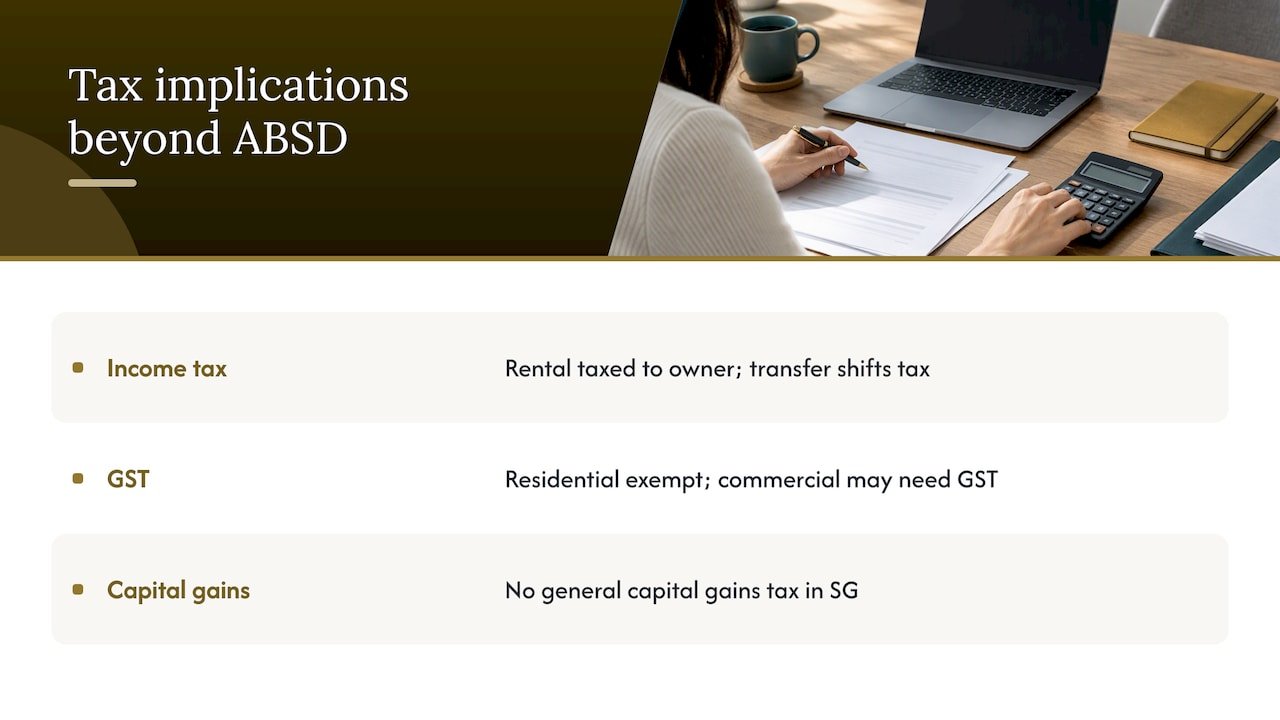
ABSD and BSD are not the only tax questions a spousal transfer can raise. Where a property has been rented out, rental income is taxed on whoever holds legal and beneficial ownership, so transferring a share shifts part of that income tax liability to the receiving spouse from the transfer date onward. Couples who had been splitting rental income in a particular ratio should check that the new ownership split matches how they intend to report income to the Inland Revenue Authority of Singapore going forward.
GST is generally not a concern for residential property transfers between individuals, since GST applies to commercial property transactions involving GST-registered entities rather than private residential dealings between spouses. Couples transferring a commercial property or an office unit, however, should check whether GST registration or treatment applies to the transaction, since commercial assets follow different rules from residential ones.
There is also a broader question of capital gains. Singapore does not impose a general capital gains tax on property sales, which is one reason spousal transfers are often used as part of wider financial planning rather than purely tax avoidance. Readers wanting a plain-language grounding in how capital gains concepts work more broadly, including in markets that do tax them, can find a general explanation in this capital gains tax glossary entry, useful background rather than a statement of Singapore law. None of this removes the need to check current income tax treatment with a qualified adviser where rental income or commercial property is involved.
Impact on future housing grants and subsidies
A spousal transfer can affect eligibility for CPF housing grants and HDB subsidies down the line, because many of these schemes count prior property ownership against applicants. A spouse who has previously held a share in a private property or an HDB flat, even one later transferred away, may still be assessed as a prior property owner for certain grant conditions, which can affect eligibility for first-timer grants on a future HDB purchase.
The Minimum Occupation Period attached to an HDB flat also follows the property rather than resetting on a change of ownership between spouses, so a transfer does not shorten or restart that clock. Couples planning to upgrade, downgrade or apply for a Build-To-Order flat in future should check how a past transfer might be viewed under HDB’s ownership history rules before assuming a clean slate. This is another reason to treat a spousal transfer as a decision with consequences beyond the immediate stamp duty bill, rather than a simple internal reshuffle.
How advisers weigh the real risks in a spousal transfer
In our experience guiding clients through property decisions, the order of checks matters more than the ABSD calculation itself. Bank consent and CPF refund arithmetic should be confirmed before anything else, because a transfer that looks attractive on paper can stall entirely if financing falls through. When the combined cost of conveyancing, CPF refunds and financing exceeds the ABSD saving, we would advise against proceeding. Independent valuation and genuine market exposure, rather than assumptions about value, make this judgement sound.
— Anderson
How we can support your spousal transfer or sale
Meeting the six-month remission deadline, or simply understanding what your share is worth before a transfer, depends on having a credible, current valuation and real market exposure if a sale is needed. We offer a free property valuation to help you establish a defensible market figure for stamping or remission purposes, alongside listing support if your first property needs to sell within the window.

- A free valuation gives you a figure IRAS and your lawyer can work with, rather than a guess.
- Our listings and negotiation support help you secure a genuine buyer faster if you are racing a remission deadline.
- We can connect you with the right next step, whether that is selling, buying or simply understanding your numbers before you commit.
If you are weighing a spousal transfer and need to sell, value or buy with confidence, get in touch with our team to start with a valuation.
FAQ
What are the ABSD rates for 2026?
ABSD rates depend on the buyer’s profile, Singapore Citizen, Permanent Resident or foreigner, and how many residential properties they already own, as set out by IRAS. The current rate framework has applied since the measures announced by the Monetary Authority of Singapore in 2023, so always check the live IRAS rate table before budgeting for a purchase or transfer.
Can a husband transfer an HDB flat to his wife?
Yes, provided the couple meets HDB’s eligibility rules for a change in flat ownership not through a sale, including citizenship and occupation period requirements. Any outstanding mortgage and CPF monies used for the flat must still be settled or refunded as part of the process.
How can I avoid ABSD on a second property?
The main route for married couples is the ABSD remission scheme, which refunds ABSD on a second property if the first is sold within six months and other conditions are met. There is no guaranteed way to avoid ABSD outside recognised remissions, and arrangements designed purely to sidestep it, such as certain 99:1 structures, face increased scrutiny from the Ministry of Finance.
What happens when two single HDB owners marry?
Each may continue holding their own flat initially, but HDB rules generally require the couple to decide within a set period which flat to keep and to dispose of the other, since HDB treats a married couple as a single family unit for ownership purposes. The specific options and timeframes depend on each flat’s lease and occupation history, so checking directly with HDB is the reliable next step.


