

Comparative Market Analysis in Singapore: How to Do One
A comparative market analysis (CMA) estimates what a property is likely to sell or rent for by comparing it with similar properties that have recently transacted nearby. In Singapore, a sound CMA uses caveat-based transaction data, adjusts each comparable for tenure, size, floor level and condition, and ends with a price range rather than a single figure. This guide shows the steps, the data sources and the common mistakes, for buyers, sellers, landlords and investors.
TL;DR
- A CMA compares your property with recent, similar transactions in the same area and adjusts for the differences, giving you a price or rent range.
- Use official transaction data first. URA’s REALIS compiles private residential and commercial transactions from caveats lodged at the Singapore Land Authority.
- Comparable evidence rarely matches exactly, so adjustments and judgement matter more than the average.
- A CMA is a negotiating tool, not a bank or court valuation. Check the price against a formal valuation before you commit to a loan.
- Add transaction costs, including stamp duties, to the CMA result before you decide what a deal really costs.
Table of Contents
- What a CMA tells you in Singapore
- Where to find reliable Singapore transaction and rental data
- Step-by-step: building a CMA
- How to choose and adjust comparables
- Residential versus commercial CMAs
- How recent should the evidence be?
- CMA versus a formal valuation
- Using a CMA to negotiate and budget
- Common CMA mistakes
- Our perspective
- Get a CMA-style view of your property
- FAQ
- Sources
What a CMA tells you in Singapore
A CMA answers one question: what have buyers or tenants actually paid for properties like this one, and what does that suggest for this one? It rests on a principle set out in the RICS standard on comparable evidence: a buyer would not pay more for an asset than the cost of acquiring a satisfactory substitute. RICS describes the market approach as comparing a property with similar transactions, and notes it is widely used for both residential and commercial real estate.
What each reader gets from it:
- Buyers see whether an asking price sits within the range of recent deals, and how much room there is to negotiate.
- Sellers can set a listing price that attracts viewings without leaving money on the table.
- Landlords and tenants can test a rent against what similar units in the same building or street have leased for.
- Investors can compare yield and price per square foot across several locations before shortlisting.
A CMA is not a valuation certificate. It does not replace the bank’s valuation, and it cannot see inside a unit. Think of it as an evidence-based opinion that you can test and challenge.
Where to find reliable Singapore transaction and rental data
The quality of a CMA depends on the quality of the data. Start with official sources and use listing sites only to see what is currently on offer.
Private residential and commercial transactions
URA’s REALIS system compiles private residential and commercial transaction data from caveats lodged at the Singapore Land Authority, supplemented with IRAS stamp duty data. That makes it a record of prices actually agreed, not hoped for. For each transaction you can typically see the project or street, area, price, price per square foot, tenure and sale type, which are the fields a CMA needs.
Rents
Rents are harder to source than sale prices. Official rental records exist, but the public view is less granular. IRAS offers a useful clue about how rents are used in valuation: it sets a property’s Annual Value for tax from market rentals of similar or comparable properties in the vicinity, taking into account size, location, condition and other physical attributes. Those are the same factors you should compare in a rental CMA. For a wider view of vacancy and rents, our Singapore rental market outlook covers the data owners and renters watch.
Listings and sold records
Asking prices are not evidence of value, but they show competition. Sold records are far more useful. You can browse properties we have sold for a feel of how asking and closing prices relate in practice.
Step-by-step: building a CMA
- Define the subject property. Write down address, tenure (freehold or leasehold, and remaining years), floor area, floor level, facing, condition, and whether it is residential, commercial or mixed use.
- Set the search area. Start with the same building or project. If there are too few deals, widen to the same street, planning area or MRT catchment.
- Set the time window. Use the most recent transactions first. In a quiet month there may be only two or three, so extend the window but flag the older deals.
- Pull 5 to 10 comparables. Record price, size, price per square foot, date, floor, tenure and any special terms.
- Adjust for differences. This is the real work, covered in the next section.
- Reconcile into a range. Weight the closest, most recent and most similar comparables more heavily, and state a low, central and high figure.
- Test the range against current conditions. Check for price direction, new launches nearby and interest rates.
How to choose and adjust comparables
No two properties are identical, and RICS is direct about it: comparable evidence rarely matches exactly, so valuers need skill and judgement to analyse it, especially where properties differ significantly. A simple average of nearby prices hides those differences.
What to adjust
| Factor | Why it moves the price | Typical question to ask |
|---|---|---|
| Tenure | A 99-year leasehold with 60 years left is not equal to a freehold | How many years remain on each lease? |
| Size | Smaller units often carry a higher price per square foot | Is the comparable within roughly 10 to 15% of the subject’s area? |
| Floor and view | Higher floors and unblocked views usually price higher | Is the comparable on a similar level and facing? |
| Condition | A renovated unit sells faster than one needing work | Was the comparable renovated or original? |
| Date of sale | The market moves between deals | Was the deal before or after a recent price shift? |
| Terms | Incentives, extended completion or bundled items change the real price | Did the price include furniture or special terms? |
The RICS standard also points out that valuers should include incentives such as rent-free periods or capital payments when analysing comparable evidence. For a commercial lease, the headline rent can differ greatly from the effective rent once such incentives are counted.
A worked example
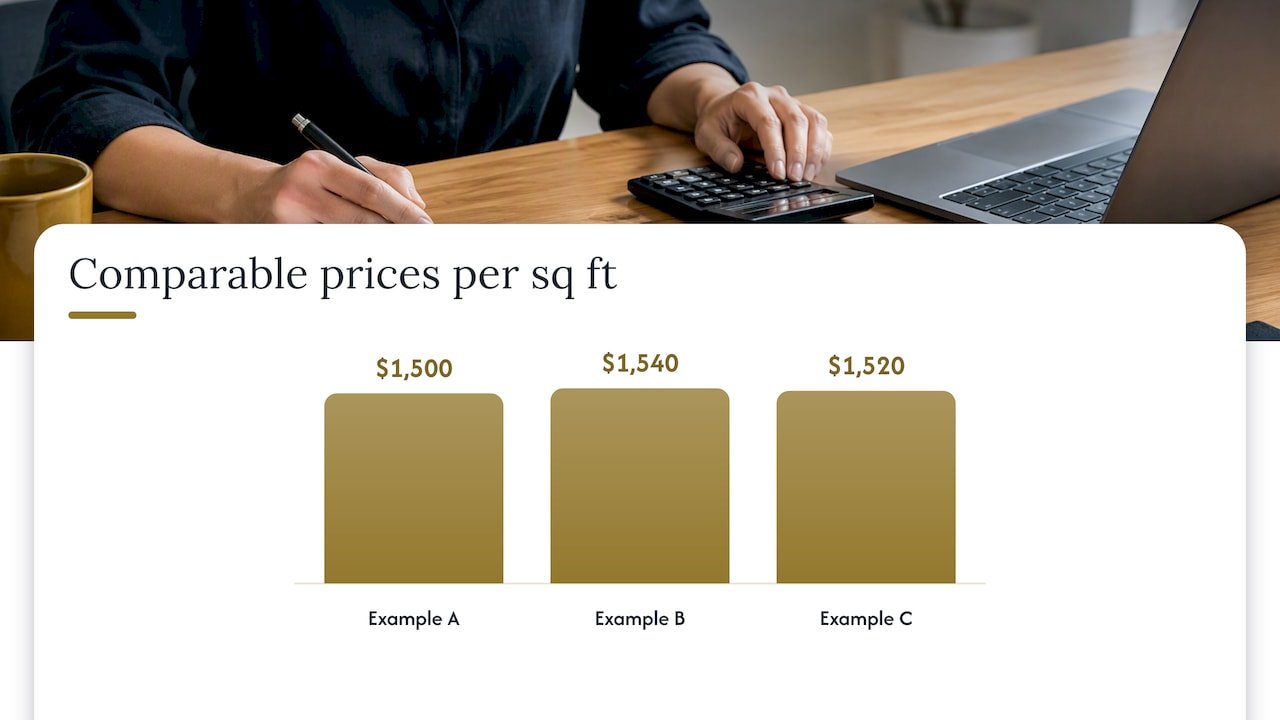
Suppose you are assessing a 1,000 sq ft freehold condo unit on a mid-level floor. You find three recent sales in the same project:
| Comparable | Area | Price per sq ft | Difference from subject | Adjustment |
|---|---|---|---|---|
| A | 980 sq ft | $1,500 | Lower floor | Add a small premium for the higher floor |
| B | 1,020 sq ft | $1,540 | Renovated | Deduct for renovation value |
| C | 1,000 sq ft | $1,520 | Sold six months ago | Adjust for market movement since then |
These figures are illustrative, not market data. The point is the method: each comparable is moved toward the subject, and the adjusted figures should cluster. If one is far off the others, check why before including it. You would then multiply the central price per square foot by 1,000 sq ft to get a central estimate, and keep the spread as your range.
Our guide to PSF analysis in Singapore shows how price per square foot translates into what a $1.5M condo really costs.
Residential versus commercial CMAs
The method is the same, but the inputs differ.
- Residential CMAs lean on sale price per square foot, tenure, floor, project age and proximity to schools and transport. Families often weight school catchment and amenities, which can explain price gaps between otherwise similar projects.
- Commercial CMAs also depend on permitted use, lease length, tenant quality and rental yield. RICS notes that valuation methods include the income approach for income-producing assets, using the investment or capitalisation method or the profits method, and that these methods themselves rely on comparable evidence. In practice, a commercial CMA should compare both sale prices and rents.
Before you compare commercial units, confirm what each may legally be used for. Our Singapore commercial property guide explains use checks, BSD and TDSR, and the zoning checks that avoid ABSD surprises matter when a property has a residential component. If you are deciding between asset types, the four financial metrics for commercial versus residential give a structured way to compare.
How recent should the evidence be?
Use the latest deals you can find, and give them more weight. Sales from a year ago may reflect a different interest-rate and demand environment. Rents move more slowly than prices, which is why the government uses rental transactions in setting property tax: gov.sg explains that deriving Annual Value from rents helps keep property tax more stable because sale prices are more volatile than rents. The same logic applies to your CMA: a rent-based check can steady a price-based estimate when sales are thin or swinging.
Practical rules of thumb:
- Prefer deals from the last few months in the same project.
- Where you must use older deals, adjust for the direction of the market since then, and mark them as lower-weight.
- Watch for diverging segments. Private homes, HDB resale flats and commercial space can move differently in the same quarter.
- Review market outlooks before finalising. Our three scenarios and buyer checklist sets out how to think about different directions for the market.
CMA versus a formal valuation
A CMA and a valuation both use comparable evidence, but they have different jobs.
| CMA | Formal valuation | |
|---|---|---|
| Purpose | Pricing, negotiation, shortlisting | Lending, legal, accounting, disputes |
| Prepared by | Agent, analyst or you | Qualified valuer |
| Inspection | Often none | Usually on site |
| Standard | Informal, flexible | Written valuations by RICS members and firms must comply with the Red Book |
| Result | A range | A stated opinion of value |
The RICS Singapore guidance also says property owners benefit from understanding valuation factors such as tenure, planning regulations and ownership structures, all of which a good CMA should reflect too.
The key limit of a CMA is that it depends on which comparables you choose. Two people can reach different figures from the same data. That is why the choice and adjustment of comparables should be written down and open to challenge. If a bank’s valuation later comes in below the price you agreed, you may face a cash shortfall, so read our guide on avoiding loan shortfalls from valuation gaps.
Using a CMA to negotiate and budget
As a buyer
Compare the asking price with your adjusted range. If the ask is above the top of the range, you have evidence for a lower offer. If it is within the range, focus on terms, such as completion date and included items. Our piece on negotiating property prices in Singapore explains how valuation gaps affect the cash you need.
As a seller
Price at or slightly above the central estimate if the property is strong on floor, condition or view, and near the lower-central estimate if you need a quick sale. Check whether you face holding-period tax: see capital gains tax rules on selling within four years.
Add the transaction costs
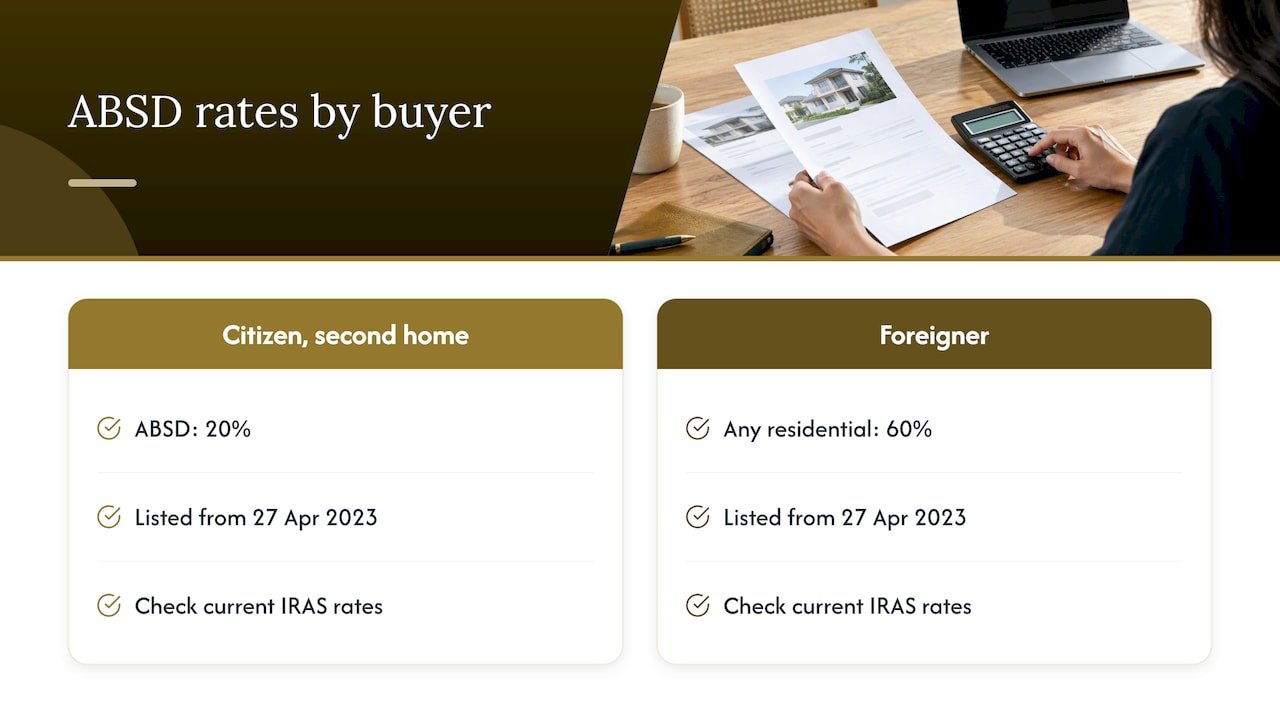
The CMA gives a price, not a total cost. For residential purchases, Additional Buyer’s Stamp Duty depends on who you are and how many homes you own. IRAS lists rates from 27 April 2023 including 20% for a Singapore citizen’s second residential property and 60% for foreigners buying any residential property. Rates can change, so check the IRAS page for the current table before you budget.
As an investor
Use the CMA to find properties priced below their adjusted range, then check whether the gap is real or explained by lease length, condition or use. Our screening method for undervalued properties shows how to use URA and HDB data for this.
Common CMA mistakes
- Using asking prices as evidence. They show hopes, not deals.
- Ignoring tenure. A cheap price per square foot may reflect a short remaining lease.
- Comparing across very different sizes. Small units distort price per square foot.
- Using stale deals without adjustment. Markets move.
- Forgetting incentives. Especially on commercial leases.
- Stopping at one number. Always give a range and the reasoning.
Our perspective
A CMA is only as good as the judgement behind it. We see buyers and sellers anchor on a single average, when the useful work is in choosing the right comparables and explaining each adjustment.
Our approach is to run detailed market evaluations that look for gaps and opportunities, then negotiate from that evidence. We believe a transparent analysis, where the client can see every comparable and every adjustment, leads to better decisions than a bare number. It also supports our aim of helping clients structure property purchases in Singapore in a way that makes investment more affordable, including the ABSD considerations that shape what a deal really costs.
Whether you are buying a first home, looking at commercial space or selling, ask for the comparables behind any price you are given.
Anderson
Get a CMA-style view of your property
If you own a property and want a grounded starting point, our free property valuation gives you an evaluation at no charge. If you are buying or renting, you can browse residential listings and commercial listings, and we can help with personalised negotiation on the ones you shortlist.

To start, visit Register Today and tell us whether you want to buy, sell or rent.
FAQ
Is a CMA free in Singapore?
There is no regulated fee for a CMA, and many agents prepare one as part of a listing or purchase discussion. You can also build your own from public transaction data. We offer a free property valuation as a starting point for owners.
How many comparables do I need?
Aim for five to ten, with the closest and most recent weighted most heavily. If a project has few recent deals, widen the area and be explicit about the extra adjustments. Quality of match matters more than quantity.
Can a CMA replace a bank valuation?
No. A CMA guides pricing and negotiation, while the bank or a qualified valuer produces the figure used for lending. Written valuations by RICS members must follow the Red Book, so a CMA does not carry the same standing. Compare both before you exercise an option, so that any gap is covered in your budget.
Does a CMA work for commercial property?
Yes, but compare both sale prices and rents, and confirm permitted use, lease terms and incentives first. The income approach is common for investment property, and it still relies on comparable evidence. Our commercial property guide covers the checks to make first.
Sources
- RICS: Comparable evidence in real estate valuation
- RICS: Valuation Global Standards, Singapore jurisdiction guide
- URA: REALIS coverage and methodology
- IRAS: About Annual Value
- gov.sg: Property tax on residential property
- IRAS: Additional Buyer’s Stamp Duty (ABSD)