
First-Time Homebuyer in Singapore: A Practical Guide
Buying your first home in Singapore comes down to five decisions made in order: what you can afford, which type of home you are eligible for, how you will finance it, which taxes and fees apply, and which location suits your life. This guide takes them in that order, using figures from the agencies that set the rules.
TL;DR
- Start with affordability: look for homes priced within five years of your combined annual income, and aim to keep mortgage payments within 25% of gross monthly income.
- For an HDB flat, get your HFE letter first. It shows your eligibility, grants and HDB loan amount, and it is valid for nine months.
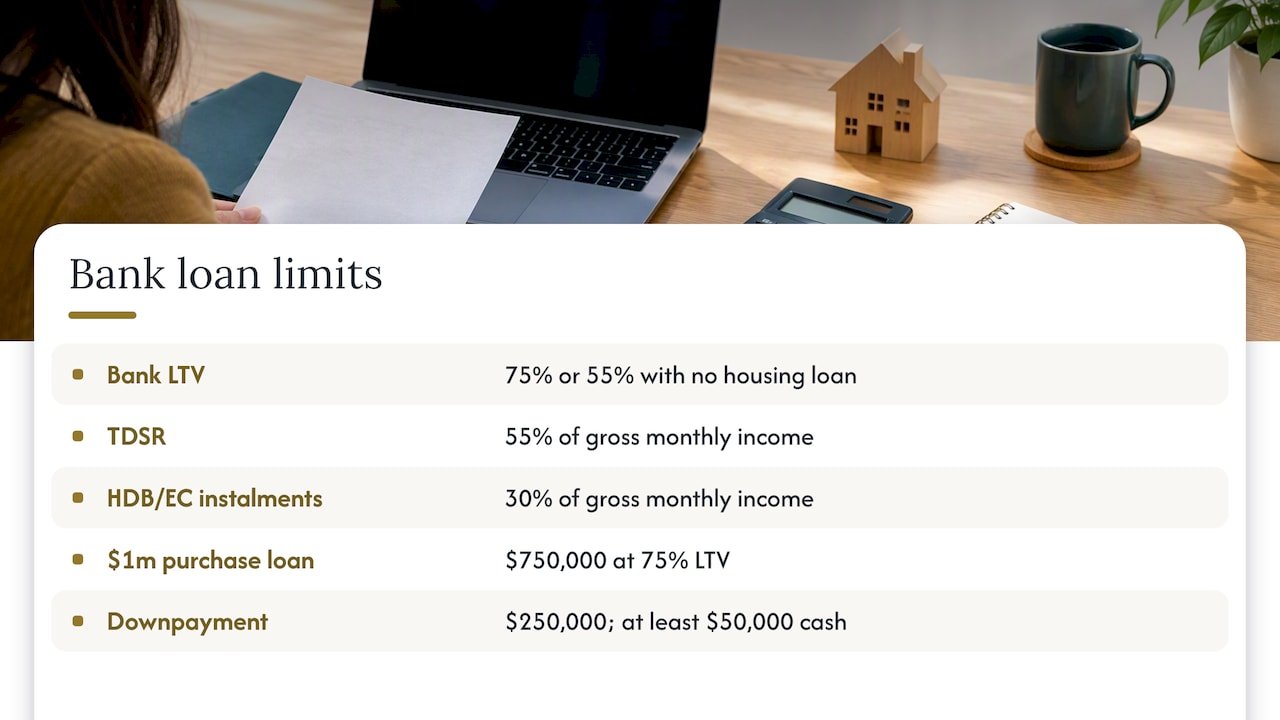
- Bank loans are capped by the 55% TDSR. At a 75% loan-to-value limit, the minimum cash downpayment is 5%.
- Singapore Citizens buying their first residential property pay no ABSD. Singapore Permanent Residents pay 5%, and everyone pays tiered Buyer’s Stamp Duty.
- Visit shortlisted homes by day and night, and judge location, lease and age before you fall in love with a unit.
Table of Contents
- Step 1: Work out a realistic budget
- Step 2: Decide between an HDB flat and a private home
- Step 3: Get your HFE letter before you shop for an HDB flat
- Step 4: Know your grants
- Step 5: Choose a loan and respect the limits
- Step 6: Budget for the costs beyond the price
- Step 7: Judge the location, lease and condition
- Our perspective
- Where Register Today fits in
- A first-timer’s timeline
- FAQ
- Sources
Step 1: Work out a realistic budget
Begin with the price range, not the listings. The CPF Board suggests looking for homes priced within five years of your combined annual income, with mortgage payments within 25% of gross monthly income. It also asks buyers to count cash, CPF savings and monthly expenses together.
A worked example makes this concrete. A couple earning $10,000 a month between them has $120,000 a year in combined income. Five years of that is $600,000, and 25% of $10,000 is $2,500 a month for the mortgage. These are guide rails rather than approvals, but they show quickly whether a $900,000 shortlist is realistic.
Two habits keep the budget honest:
- Keep a buffer in your Ordinary Account. CPF guidance says that if it is within your means, you can use cash towards your housing loan and retain Ordinary Account savings equal to six months’ income.
- Let affordability lead. CPF Board’s advice to first-timers is to treat affordability and long-term financial resilience as the starting point, instead of letting the hunt for a perfect home push you over budget.
Step 2: Decide between an HDB flat and a private home
The first fork is public or private housing, and eligibility decides how much choice you have.
HDB flats come as new Build-To-Order (BTO) flats or resale flats. CPF Board describes the trade-off this way: BTO flats come with a fresh 99-year lease, while resale flats are generally faster to occupy but often cost more because of location and demand. If you need a home soon, resale usually fits the timeline better. If you can wait and want a longer lease, BTO deserves a place on the shortlist.
Private homes, such as condominiums and apartments, have no HDB eligibility gate, but they carry their own checks. URA says private-home buyers should assess financing and costs, pay Buyer’s Stamp Duty, and may owe ABSD depending on whether they buy as an individual or an entity, their residency status and the properties they already own. Sellers’ Stamp Duty may also apply if they sell within the holding period. Non-citizens should note that approval from the Controller of Residential Property is generally needed for landed residential property, including strata-landed homes, per the same URA page.
A simple way to frame it:
| Question | HDB flat | Private condo or apartment |
|---|---|---|
| Who can buy | Subject to HDB eligibility and an HFE letter | Open to buyers, with ABSD depending on residency and properties owned |
| Financing | HDB loan or bank loan | Bank loan, with TDSR and LTV limits |
| Grants | EHG and PHG may apply for eligible first-timers | Housing grants for flats do not apply |
| Typical trade-off | Generally lower price | Facilities and amenities, with maintenance fees |
If you want to see what is currently on the market in each category, you can browse our residential listings and apartments.
Step 3: Get your HFE letter before you shop for an HDB flat
The HDB Flat Eligibility (HFE) letter is the document that tells you whether you can buy an HDB flat, which grants you may receive and how much you can borrow from HDB. MoneySense advises first-timers to start with the HFE letter to understand eligibility and HDB loan amount.
Two timing rules matter:
- The letter is valid for nine months, so apply when you are ready to view flats seriously, not a year ahead.
- For a resale purchase, HDB’s FAQ states you need a valid HFE letter before obtaining the seller’s Option to Purchase and when you submit the resale application.
If you are buying a private home, you do not need an HFE letter, but you do need to know your loan limits, covered in the next section.
Step 4: Know your grants
Grants can change the price you can afford by tens of thousands of dollars, so check them early.
- Enhanced CPF Housing Grant (EHG): First-time Singapore Citizen and PR flat buyers may qualify for up to $120,000 in EHG, subject to income, employment and citizenship conditions.
- Couples and families: CPF Board states the grant can reach $120,000 depending on household income, with a monthly household income ceiling of $9,000 for first-timer households.
- Singles: First-time single buyers can receive up to $60,000, or up to $120,000 when buying with other first-timer singles. The income ceilings are $4,500 for an individual and $9,000 for singles buying together.
- Proximity Housing Grant (PHG): Buyers of a resale flat who live with or near their parents or children may qualify for up to $30,000.
Grant rules are updated from time to time, so confirm your own figures through the official HDB and CPF channels before you commit to an Option to Purchase.
Step 5: Choose a loan and respect the limits
Two caps shape what a bank will lend you.
TDSR. Bank borrowers must meet the 55% Total Debt Servicing Ratio threshold, which means all monthly debt payments, including the new mortgage, should not exceed 55% of gross monthly income. For HDB or EC loans, monthly instalments must not exceed 30% of gross monthly income, per the same MoneySense page. Our guide to the 55% borrowing limit and how TDSR sets your price band shows how existing car or personal loans cut into that ceiling.
LTV. For bank loans on residential property where you have no outstanding housing loan, MoneySense lists LTV limits of 75% or 55%, with a minimum cash downpayment of 5% at 75% LTV. In plain terms, on a $1,000,000 purchase at 75% LTV the bank lends up to $750,000. The other $250,000 is the downpayment, of which at least $50,000 must be cash and the rest can come from CPF where permitted. Read more on LTV limits for Singapore buyers and the cash and CPF needed for a condo downpayment.
When comparing loan packages, look beyond the first-year rate. Our overview of mortgage types in Singapore explains how MSR, TDSR and LTV checks work before you apply.
One timing point for new launches: if you buy under construction, payments are staged. See the progressive payment schedule for Singapore buyers to plan cash flow while you are still paying rent.
Step 6: Budget for the costs beyond the price
MoneySense lists the upfront costs to plan for: option fee, downpayment, stamp duty, legal costs, agent’s commission and fees, renovation and miscellaneous costs. First-timers most often underestimate stamp duty and renovation.
Buyer’s Stamp Duty
IRAS sets residential BSD in tiers: 1% on the first $180,000, 2% on the next $180,000, 3% on the next $640,000, 4% on the next $500,000, 5% on the next $1,500,000 and 6% on the remainder.
Applied to a $1,000,000 home, that works out as:
| Tier | Amount taxed | Rate | Duty |
|---|---|---|---|
| First $180,000 | $180,000 | 1% | $1,800 |
| Next $180,000 | $180,000 | 2% | $3,600 |
| Next $640,000 | $640,000 | 3% | $19,200 |
| Total BSD | $1,000,000 | $24,600 |
This is our own arithmetic from the published tiers, so check the final figure on the IRAS calculator for your purchase. For how the valuation of a property can affect the amount, read why valuation risk raises BSD, and note the filing deadlines in our stamp duty timeline.
ABSD
For most first-time buyers, ABSD is the question that separates a manageable purchase from an expensive one:
- Singapore Citizens buying their first residential property do not pay ABSD.
- The ABSD rate for Singapore Permanent Residents buying their first residential property is 5%.
Foreign buyers face a much higher rate, which we cover in what foreign buyers must budget for ABSD. For rates by buyer profile and cash examples, see our guide on planning around ABSD.
Step 7: Judge the location, lease and condition
Price and eligibility get you to a shortlist. Location and condition decide whether you are still happy in year ten.
CPF Board’s checklist for resale flats is a good template for any home. It advises you to set a budget and a priority list, then assess the age and condition, position, floor, MRT access, amenities, proximity to family and schools. On viewings, it suggests visiting by day and night, checking for moisture, testing windows and doors, and speaking with neighbours.
To turn that into a routine:
- Rank your priorities. Commute, school access, lease length and floor area rarely all fit one budget. Decide which two matter most.
- View twice. Once on a weekday morning and once in the evening. Noise, parking and lift waiting times look different.
- Check the lease. A 99-year lease that started decades ago is a different asset from a fresh one, and it affects how banks lend and how easily you can resell.
- Walk the commute. Time the trip from the MRT station to the door, not just the train ride.
- Ask about works. For private homes, URA stresses verifying approvals and unauthorised works before committing.
Families choosing around schools should map the shortlist against the distance to their preferred schools early, because that narrows the search faster than any other filter.
Our perspective
Most first-time buyers we speak to start with a favourite listing and work backwards to the numbers. We suggest the reverse. Fix your price band, your cash and CPF split and your loan ceiling first, then let the market show you what fits.
The second step is to look at the gap between asking prices and what comparable homes are worth. A detailed market evaluation that identifies gaps and opportunities helps a buyer negotiate from facts rather than nerves. That is the approach behind our personalised negotiation support.
Taxes are the third piece. Additional Buyer’s Stamp Duty can change the economics of a purchase, and our platform is built to help clients invest without the burden of ABSD. We would rather a buyer understand their position before the Option to Purchase than discover it after.
We say all this with over $1 billion in sales behind our team, and we measure ourselves by whether clients feel informed and well treated at every step.
Anderson
Where Register Today fits in
We list commercial and residential properties across Singapore and support buyers, sellers and tenants through to completion. If you are still deciding on a budget, start with our free property valuation. It costs nothing and gives you a benchmark for what comparable homes are worth.
When you are ready to look at homes, you can browse our residential listings or reach our team through the Register Today homepage to talk through buying, selling or renting. Our team can also help you understand how to screen for undervalued properties before you make an offer.
A first-timer’s timeline
The order below keeps you from making a commitment before you know your limits.
- Check your finances. Combine income, cash, CPF and existing debts. Apply the 25% and five-year guide rails.
- Get your HFE letter if you are considering an HDB flat, and note its nine-month validity.
- Confirm grants you may qualify for, and your loan ceiling under TDSR and LTV.
- Shortlist and view at different times of day.
- Value the home and compare it with similar recent transactions before offering.
- Exercise the Option to Purchase, pay the option fee and complete the downpayment.
- Pay stamp duties on time and arrange legal work and the loan.
- Plan renovation and moving costs so they do not land on your credit card.
FAQ
Can I buy a private condo as a first-time buyer?
Yes. Private homes have no HDB eligibility requirement, but you must meet bank lending rules, including the 55% TDSR, and pay BSD. URA also notes that ABSD may apply depending on your residency and the properties you own. Citizens buying their first residential property pay no ABSD.
How much cash do I need for a first home?
For a bank loan at 75% LTV, the minimum cash downpayment is 5% of the price, according to MoneySense. You also need to budget for stamp duty, legal fees, agent fees and renovation. Your exact cash and CPF split depends on your loan and the property type.
Do I need an HFE letter for every purchase?
Only for HDB flats. For a resale flat, you need a valid HFE letter before obtaining the seller’s Option to Purchase. The letter is valid for nine months, so time your application close to when you start serious viewings.
What grants can a first-time buyer receive?
Eligible first-time citizen and PR flat buyers may receive up to $120,000 in EHG, and resale buyers living with or near parents or children may receive up to $30,000 in PHG. Both depend on income, employment, citizenship and proximity conditions. Check your own eligibility with HDB and CPF before you commit.
Should I use cash or CPF for the downpayment?
CPF guidance says to use cash towards your housing loan if it is within your means and to keep Ordinary Account savings equal to six months’ income. A mix of cash and CPF can also leave more for retirement. Your own balances and loan terms decide the best split.
Sources
- CPFB: Quick tips to effectively manage your home budget
- CPFB: Guide for first-time resale flat buyers
- CPFB: A heart decision, buying your first home
- CPFB: A guide to the Enhanced CPF Housing Grant and Proximity Grant
- CPFB: Essential budgeting tips for your BTO flat
- CPFB: HDB Flat Eligibility (HFE) letter, what to know
- HDB: Frequently asked questions
- MoneySense: Buying a property, how much can you afford?
- URA: Buying Property
- IRAS: Stamp Duty
- IRAS: Additional Buyer’s Stamp Duty (ABSD)