

Decoupling vs 99-1 in Singapore: Differences, ABSD and Risks
Decoupling is the later transfer of one co-owner’s whole interest in a property to the other. A 99-1 arrangement is a way of holding title from the start, with one party owning 99% and the other 1%. Both are lawful when they are genuine. The trouble starts when the two are strung together as a planned sequence whose main purpose is to cut Additional Buyer’s Stamp Duty (ABSD), because IRAS can then treat the whole thing as one joint purchase.
This guide explains how the two differ, how each interacts with ABSD and Buyer’s Stamp Duty (BSD), where the legal line sits after the 2025 High Court decision, and what to check before you sign anything.
TL;DR
- Decoupling is a transfer of ownership after purchase. A 99-1 split is a way of holding title at purchase. They are different steps, often confused.
- A 99-1 split is not illegal in itself. The High Court held that it is acceptable if the parties genuinely intend that ratio and the rights that come with it.
- The risk is a staged plan to reduce ABSD. IRAS can disregard it, recover the duty and add a 50% surcharge.
- A genuine decoupling needs a complete transfer of legal and beneficial interest, plus a financing and CPF plan that works.
- Run the numbers and the paperwork with a lawyer and your bank before you commit.
Table of Contents
- What decoupling means
- What a 99-1 arrangement means
- Decoupling vs 99-1: side by side
- How each affects ABSD
- Where the legal line sits after 2025
- Penalties and enforcement
- What a decoupling transfer costs
- Steps and conditions for a genuine transfer
- Which route fits which situation
- Our perspective
- Start with a valuation
- FAQ
- Sources
What decoupling means
Decoupling happens when co-owners divide their ownership and one transfers their entire share to the other, so the property ends up solely owned. A couple who bought a home jointly might do this when one partner wants to buy a second property in their own name. After a genuine transfer, the departing owner holds no residential property, so their next purchase may be assessed at the first-property ABSD rate, if their profile otherwise qualifies.
The operative word is genuine. The High Court judgment in 2025 describes decoupling as the later transfer of one co-owner’s entire interest. That means both the legal interest and any beneficial interest, which is the right to the economic benefit of the property. A transfer that moves only the registered share while the departing owner keeps a hidden stake is not a decoupling in the legal sense.
If you are walking through the process itself, our seven-step decoupling guide covers the sequence in practical order.
What a 99-1 arrangement means
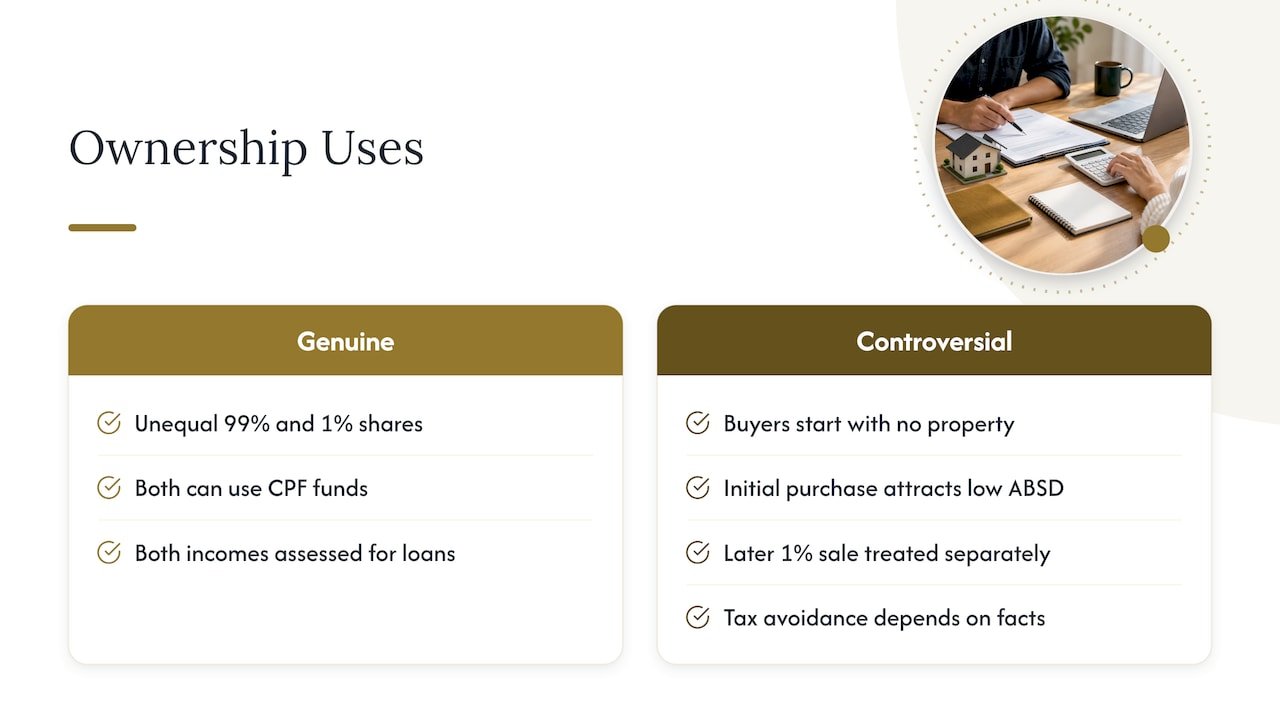
In a 99-1 arrangement, two parties hold title as tenants in common in unequal shares: one owns 99%, the other 1%. The structure has ordinary uses. According to the same High Court judgment, a genuine 99:1 purchase can let both co-owners use CPF funds and have both incomes assessed for loan eligibility, which a sole-name purchase would not allow.
The Ministry of Finance described the controversial version in April 2023. In that pattern, people with no existing property buy a residential property in their own names, then sell 1% to someone with a higher ABSD profile within a very short period. The idea is that the first purchase attracts a low ABSD rate, and the later 1% sale is treated as a small, separate transaction. MOF’s policy statement says whether such an arrangement involves tax avoidance depends on the facts and circumstances.
So “99-1” names a shape of ownership, not a verdict. What matters is why it was set up and what each party truly holds.
Decoupling vs 99-1: side by side
| Point | Decoupling | 99-1 arrangement |
|---|---|---|
| What it is | Transfer of one co-owner’s whole interest to the other | Unequal co-ownership, 99% and 1%, from the start |
| When it happens | After purchase, as a restructuring | At purchase, or shortly after |
| Typical purpose | One owner exits so the other is sole owner, or the exiting owner buys elsewhere | Use both incomes and CPF, or (in the contested form) stage the purchase to lower ABSD |
| Duty on the transfer | BSD on the share transferred, and ABSD if the receiving owner’s profile attracts it | Duty on the initial purchase; later 1% transfers carry BSD on that 1% |
| Main legal risk | Declaring a small legal share while keeping a larger hidden beneficial share | Being treated as one joint purchase under the anti-avoidance rules |
| Lawful when | The exit is complete and genuine | Both parties genuinely hold the stated ratio and rights |
The two meet in a common plan: buy 99-1, then have the 1% owner transfer out so they can buy another property. The High Court examined exactly this path, and the rest of this article explains where it holds up and where it does not.
How each affects ABSD
The rates that decide the outcome
For acquisitions on or after 27 April 2023, IRAS lists these ABSD rates:
| Buyer profile | 1st residential property | 2nd | 3rd and subsequent |
|---|---|---|---|
| Singapore citizen | No ABSD | 20% | 30% |
| Singapore permanent resident | 5% | 30% | 35% |
| Foreigner | 60% on any residential property | 60% | 60% |
In a joint purchase, the highest applicable buyer profile applies to the whole property. That single rule explains why the 99-1 structure attracted so much attention: if one buyer has a high-ABSD profile, the whole property is assessed at their rate, whatever the split. Foreign buyers can read the budgeting side in our guide to 60% ABSD for foreign buyers.
What a genuine decoupling can do
The High Court explained that when only the 1% share is transferred, BSD is payable on that transferred share. If the transfer is genuine and the buyer’s profile otherwise qualifies, the former 1% owner may then buy another property without ABSD. In short, the benefit comes from no longer owning residential property, not from the ratio itself.
Where a co-owner instead takes on more of a property they already part-own, IRAS notes a special rule may apply: the ABSD rate is generally based on the buyer’s existing property count rather than treating the transfer as unrelated. There is also a limited remission: IRAS says qualifying citizens who own two residential properties may see ABSD reduced from 30% to 20% when acquiring additional interest in one of them, with published outcomes for permanent residents too, subject to detailed conditions. Check those conditions on the IRAS page before relying on them.
What a staged 99-to-1 sequence risks
MOF states that the Commissioner of Stamp Duties may use section 33A of the Stamp Duties Act to disregard staged transactions and assess them as one joint purchase when a single purchase has been split to reduce tax. In that case the ABSD that should have applied to the single purchase is recovered.
Where the legal line sits after 2025
The High Court decision in [2025] SGHC 119 drew a useful distinction. In summary:
- Registering 99:1 is not inherently objectionable, provided the parties genuinely intend that ownership ratio and the legal and beneficial rights attached to it.
- The risk arises at the decoupling stage. If the departing owner declares or transfers only a 1% legal interest while keeping a larger undisclosed beneficial interest, the transfer is understamped and the declaration may be false.
- The initial 99:1 registration alone did not avoid a tax liability that had already accrued when a second purchase was merely contemplated. The problem was the intended later understamping or concealed beneficial ownership, as set out in the judgment summary.
The Straits Times reported in August 2025 that the court’s position is that transferring full ownership so the other spouse can buy another property without ABSD is unlawful when tax avoidance is the sole purpose, while a genuine outright transfer leaving no beneficial interest may be permissible. Motive therefore matters alongside mechanics. A transfer driven by real changes in a couple’s circumstances, such as separation, a change in who will live where, or a restructure of finances, sits differently from one that exists only to unlock a lower tax rate.
The court also separated two kinds of liability. Understamping is strict liability: paying too little duty is an offence of failing to pay the proper amount, even without knowledge. Tax evasion needs a knowing false declaration, and knowingly misdeclaring the true beneficial interest may amount to evasion punishable under section 62 of the Stamp Duties Act.
Penalties and enforcement
If IRAS finds avoidance, it may recover the rightful stamp duty and impose a 50% surcharge. MOF notes that stamp duty audits have no statutory time limit, and that identified facilitators may be referred to the relevant regulatory agencies. IRAS adds that if the duty and surcharge are not paid by the deadline, further penalties of up to four times the outstanding amount may apply.
The scale is not theoretical. The Straits Times reported in May 2024, citing the Finance Minister’s parliamentary reply, that IRAS had reviewed 187 cases, found tax avoidance in 166, and intended to claw back about S$60 million in ABSD and surcharges. Because there is no time limit on stamp duty audits, a structure set up years ago can still be examined. Our article on proving a genuine 99-1 split goes through the evidence owners typically need to hold.
What a decoupling transfer costs
The IRAS stamp duty page sets out BSD for residential property acquired on or after 15 February 2023 as marginal rates: 1% on the first S$180,000, 2% on the next S$180,000, 3% on the next S$640,000, 4% on the next S$500,000, 5% on the next S$1.5 million and 6% on the remainder. Mortgage duty is generally 0.4% of the loan amount, capped at S$500. Seller’s Stamp Duty can apply if the transferred interest is sold within the applicable holding period; the current schedule is on the same page, and our note on seller’s stamp duty after July 2026 explains what to check.
A worked example
Take a property valued at S$1,500,000 for illustration. These figures are our own arithmetic from the IRAS table, not a quote:
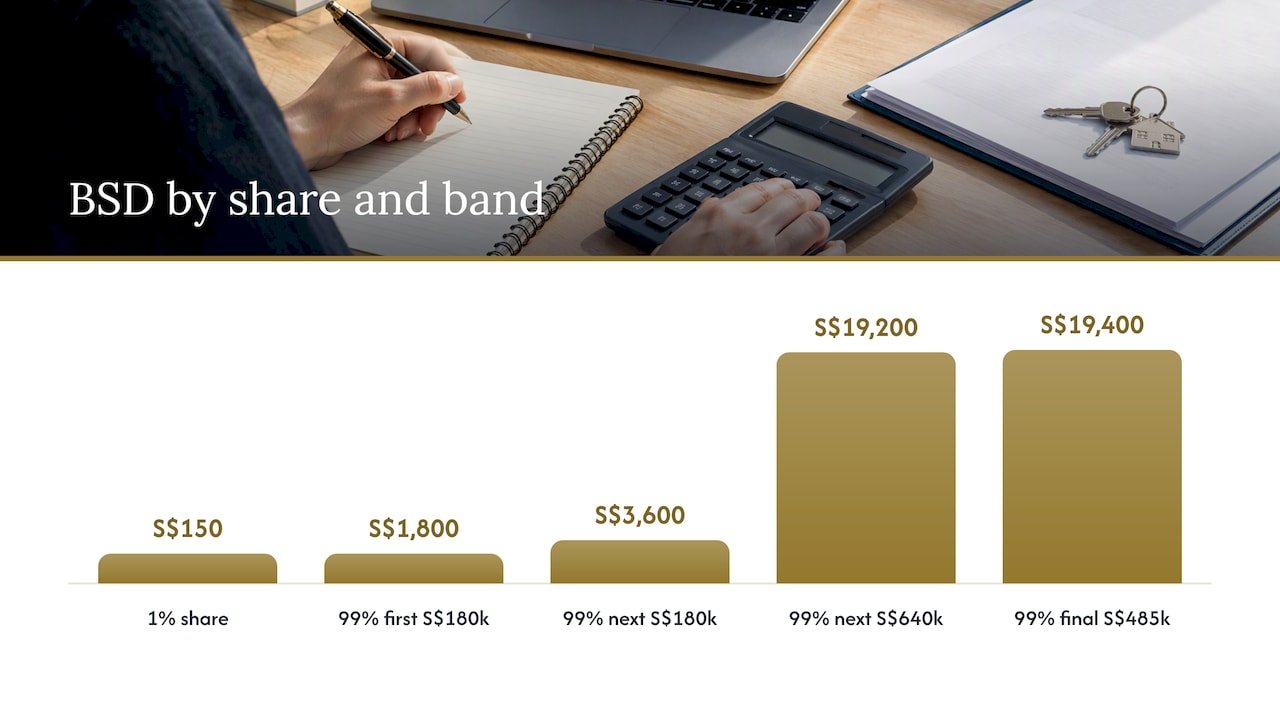
- Transfer of the 1% share (value S$15,000): BSD at 1% on the first band is S$150.
- Transfer of the 99% share (value S$1,485,000): S$1,800 on the first S$180,000, S$3,600 on the next S$180,000, S$19,200 on the next S$640,000 and S$19,400 on the remaining S$485,000, a total of S$44,000.
The gap shows why people ask about 99-1 structures, and also why scrutiny follows. Where the share is understated, or where the departing owner keeps a hidden stake, the saving is exactly what the court called understamping. Duty is also assessed on value, so an inaccurate valuation can raise the bill; see why valuation risk raises BSD.
Beyond duty, expect legal fees, valuation costs and possible loan restructuring. A 2024 guide by a Singapore law practice lists these as typical components of a decoupling and separates genuine restructuring from 99-to-1 arrangements scrutinised for tax-motivated staging.
Steps and conditions for a genuine transfer
The usual sequence, consistent with the High Court’s description, runs as follows:
- Agree the share and value. Obtain a valuation and settle what the departing owner receives.
- Check the tax position first. Confirm the BSD on the share, whether ABSD applies to the receiving owner, and whether a remission could apply.
- Sort out the mortgage. Where the property is financed, arrange the lender’s consent, and the redemption, variation or replacement of the loan, so that the remaining owner becomes the sole borrower. Check the new loan against the remaining owner’s income alone.
- Settle CPF. CPF used for the purchase may need to be refunded with accrued interest on a sale or transfer. Our spousal transfer guide covers CPF and bank consent.
- Execute and stamp the transfer. Stamping has deadlines; see the stamp duty timeline for 14 and 30 day cases.
- Make the exit complete. The departing owner must genuinely give up all legal and beneficial interest. Keeping a side agreement for a continuing share defeats the point and creates the exact risk the court described.
If the other party is a spouse, read the rules on transferring property to a spouse before you start, since ABSD and affordability checks differ from a sale between strangers.
Which route fits which situation
- You are buying together and want both incomes and CPF counted. A genuine 99-1 or other split ratio can serve this, as long as the ratio reflects what you really own and contribute.
- A relationship or household changes and one owner is leaving. A full, genuine decoupling with a proper financing plan is the usual route.
- You want to buy a second property and are considering a plan involving your current co-owner. Get advice before any step. A sequence designed in advance to lower ABSD is what MOF and IRAS target, and our overview of lawful ways to approach a second property explains the options that do not depend on staging.
- You are a foreign buyer or a permanent resident. Your profile sets the rate for the whole property in a joint purchase, so a minority share does not change the outcome.
Our perspective
We see the same misunderstanding repeatedly: buyers hear “99-1” and “decoupling” as one trick. They are two separate decisions, and each should stand on its own reasons.
Our approach at Register Today is to start with the full picture before any structure is chosen. That means a clear valuation, the buyer profiles of everyone involved, the CPF and loan position, and a realistic view of what a second purchase will cost in duty. We would rather a client know the true ABSD position on day one than discover it in an audit letter.
For clients who plan to hold property in more than one name, we work through lawful ownership structures with the clients’ lawyers, and we negotiate on price and terms so the economics of the purchase hold up on their own. Our team has handled over $1 billion in sales, and detailed market evaluations of gaps and opportunities are part of how we advise.
The best structure is one you could explain to IRAS in plain words, with documents that match.
Anderson
Start with a valuation
Both decoupling and a split-ownership purchase depend on an accurate value, since duty is assessed on it. Our free property valuation gives you a starting figure at no cost, and our team can then walk you through buying, selling or renting on the Register Today homepage.

If you are comparing residential options before you decide on a structure, you can browse our residential listings and speak to us about negotiation and market analysis.
FAQ
Is a 99-1 property arrangement illegal in Singapore?
No. The High Court held that registering a property 99:1 is not inherently objectionable if the parties genuinely intend that ratio and the rights attached to it. It becomes a problem when it is part of a staged plan to reduce tax, or when beneficial ownership is concealed.
Can I buy another property without ABSD after decoupling?
Possibly. If the transfer is genuine and you no longer own any residential property, your next purchase may be assessed at the first-property rate for your profile, such as no ABSD for a Singapore citizen. IRAS can look through arrangements made solely to avoid tax, so take legal advice first.
What happens if IRAS decides a 99-1 deal was tax avoidance?
IRAS may recover the stamp duty that should have been paid and add a 50% surcharge. Further penalties of up to four times the outstanding amount can apply if payment is late, and stamp duty audits have no statutory time limit.
Does the 1% owner still count as owning property?
While they hold the 1% legal interest, yes, they are an owner. Only after a complete and genuine transfer of all legal and beneficial interest can they be treated as owning no residential property for their next purchase.
Who pays BSD in a decoupling transfer?
BSD is payable on the share being transferred, using the IRAS residential rates. Whether ABSD also applies depends on the receiving owner’s profile and property count, and the parties should agree in writing who bears the cost.
Sources
- High Court judgment, 2025 SGHC 119 (PDF)
- High Court judgment summary, 2025 SGHC 119
- IRAS: Additional Buyer’s Stamp Duty
- IRAS: Stamp Duty rates
- IRAS: Acquisition of additional interest in property
- IRAS on transfer of interest where the buyer already has an interest
- MOF: Policy on 99 to 1 arrangements
- The Straits Times: High Court on property decoupling
- The Straits Times: IRAS to claw back $60m
- Guardian Law: ABSD, 99-1 ownership and decoupling