
Singapore Commercial Property: Check Use, BSD & TDSR — Register Today
If you want commercial property in Singapore, confirm permitted use, run your Buyer’s Stamp Duty and GST numbers, and secure financing pre-approval before you exercise any option. Two checks come first: verify permitted use and the seller’s GST status, then get lender pre-approval alongside an independent tax calculation. Platforms offering commercial listings and free property valuation services are a practical starting point for that process.
TL;DR:
- Verifying permitted use, GST status, and securing pre-approval from lenders are crucial steps before exercising any option for Singapore commercial property.
- Lease structures vary from gross to triple net, with lease length typically two to three years for retail and office, and longer for industrial, affecting overall costs and flexibility.
- Buyer’s Stamp Duty can reach up to 5% on the purchase price or market value, and GST may be applicable unless the seller is not GST registered.
- Net yields are significantly lower than gross yields once vacancy, interest, repairs, and agent fees are deducted, making careful calculation essential.
- Conduct thorough due diligence on title, tenancy, valuation, and tax obligations with professional advice before committing financially.
Table of Contents
- Step-by-step buying process for commercial property in Singapore
- Commercial lease types and key lease terms to watch in Singapore
- Financing and tax essentials: BSD, GST, TDSR and other constraints that change the deal economics
- Investment considerations: how to judge yields, lease tenor and exit liquidity
- Practical due-diligence checklist to run with your lawyer, valuer and lender before you sign
- How Register Today helps: services, proof points and when to use the platform
- A practitioner’s note on common deal traps and negotiation levers
- Start with a valuation or browse current commercial listings
- Sources
- FAQ
Step-by-step buying process for commercial property in Singapore
Buying commercial property in Singapore follows a fairly fixed sequence, and skipping a stage tends to cost more later than doing it properly the first time. Start by defining what you actually want: tenant profile, lease tenor and investment horizon shape which properties are worth shortlisting at all. From there, the typical transaction workflow runs through the following stages.
- Define your objective: tenant type, lease tenor and how long you plan to hold the asset.
- Search and shortlist: check tenure, approved use, existing tenancy and outgoings on every listing.
- Due diligence: run a title and encumbrance search, commission an independent valuation, calculate tax exposure and confirm URA planning permission.
- Option to Purchase: negotiate terms, pay the option fee and exercise the option within the agreed window.
- Conveyancing and registration: your lawyer handles the sale and purchase agreement, and the transaction is registered with the Singapore Land Authority.
- Completion and post-completion budgeting: plan for fit-out, maintenance, service charges, property tax, insurance and a vacancy allowance.
Each stage feeds the next, so a valuation done late or a planning check skipped early tends to resurface as a problem at completion.
Commercial lease types and key lease terms to watch in Singapore
Rent per square foot is only part of the cost of a commercial lease. The lease structure and its clauses often determine whether a space is affordable once you factor in everything else. Three lease forms are common in Singapore: gross leases, where the landlord absorbs most outgoings; modified gross leases, which split certain costs; and triple net leases, common in industrial and some retail settings, where the tenant covers property tax, insurance and maintenance on top of rent. Lease lengths vary by sector, with retail and office typically running two to three years and industrial leases often longer.
Beyond rent, a handful of clauses do most of the work in determining your real cost:
- Permitted use: whether the lease restricts you to a specific trade or activity.
- Rent review: how and when rent can be revised during the term.
- Assignment rights: whether you can transfer or sublet the lease if your plans change.
- Repair obligations: which party pays for structural versus fit-out repairs.
- Service charge apportionment: how shared building costs are split among tenants.
- Break clauses: whether either party can exit early, and under what notice.
To compare leases fairly, add base rent, service charge, property tax pass-through and estimated fit-out amortisation into one all-in occupancy cost per square foot, then compare that figure across shortlisted units rather than headline rent alone.
Pro Tip: Ask for the last two years of service charge statements before signing. A low headline rent with a rising service charge trend can cost more than a higher rent with stable outgoings.
Financing and tax essentials: BSD, GST, TDSR and other constraints that change the deal economics
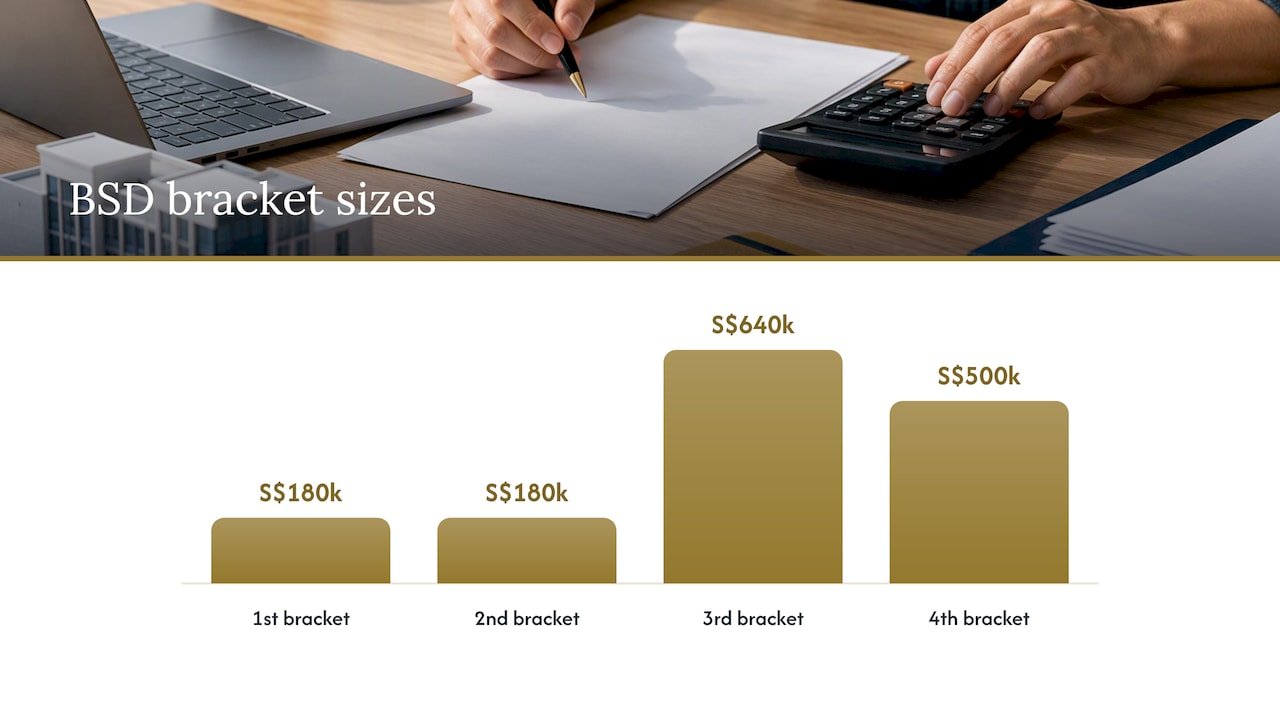
Tax and financing rules shape whether a commercial deal is affordable long before yield comes into the picture. Buyer’s Stamp Duty is calculated on the higher of the purchase price or the property’s market value, which is why an independent valuation matters even when a contract price looks favourable. For non-residential property bought on or after 15 February 2023, IRAS applies a stepped schedule: 1% on the first S$180,000, 2% on the next S$180,000, 3% on the next S$640,000, 4% on the next S$500,000, and 5% on the remainder.
On top of BSD, four constraints regularly change the numbers:
- GST: IRAS treats most non-residential sales and leases as taxable supplies; confirm the seller’s GST registration and whether input tax on your purchase is actually recoverable, since it may not be immediate.
- TDSR: MAS guidance expects banks to apply a 60% Total Debt Servicing Ratio threshold and to stress-test your repayment ability, so build in a buffer above the minimum you think you need.
- CPF: CPF funds cannot be used for commercial property purchases, unlike residential.
- Corporate structures: buying through a company or Variable Capital Company can trigger additional conveyance duties on qualifying acquisitions of equity interests in property-holding entities.
A stepped BSD schedule means the marginal rate rises with price, so larger commercial purchases carry a materially higher effective duty rate than the headline first-bracket rate suggests. This background on the 55% TDSR ceiling explains in plain terms how the ratio limits borrowing before you approach a bank.
Investment considerations: how to judge yields, lease tenor and exit liquidity
A headline gross yield on a commercial listing rarely survives contact with real operating costs. Commercial property can offer higher gross yields than residential, but net yield is what actually matters, and it depends on vacancy periods, GST treatment, financing costs, repairs and agent fees.
- Calculate net, not gross: deduct vacancy allowance, GST cash-flow drag, loan interest, maintenance and agent commission from gross rental income.
- Weigh lease tenor and tenant mix: a property with a long, stable lease to a creditworthy tenant tends to sell faster than one with fragmented short leases, regardless of asset class.
- Read the permitted use carefully: a restrictive use clause narrows your buyer pool at exit even if the building itself is desirable.
- Factor in sector dynamics: industrial demand often tracks logistics and manufacturing activity, retail is sensitive to footfall trends, and office space faces ongoing adjustment from hybrid work patterns.
Exit liquidity is shaped more by lease terms and tenant quality than by whether the asset is office, retail or industrial.
Practical due-diligence checklist to run with your lawyer, valuer and lender before you sign
Before paying an option fee, work through this sequence with your professional team rather than relying on the listing description alone.
- Confirm permitted use with URA, in writing if the intended use is critical to your plans.
- Check title, tenure and encumbrances, and review any existing tenancy terms and tenant obligations.
- Commission an independent valuation and calculate BSD, potential additional conveyance duty exposure, and the seller’s GST status.
- Complete your finance checklist: pre-approval, loan covenants, and stress tests for vacancy and interest rate rises.
- Total your cash requirement: deposit, stamp duty, legal fees, fit-out costs and a contingency buffer.
Pro Tip: Get URA’s written confirmation on permitted use before you pay an option fee. A verbal assurance from an agent is not a substitute if the intended use is the reason you are buying.
How Register Today helps: services, proof points and when to use the platform
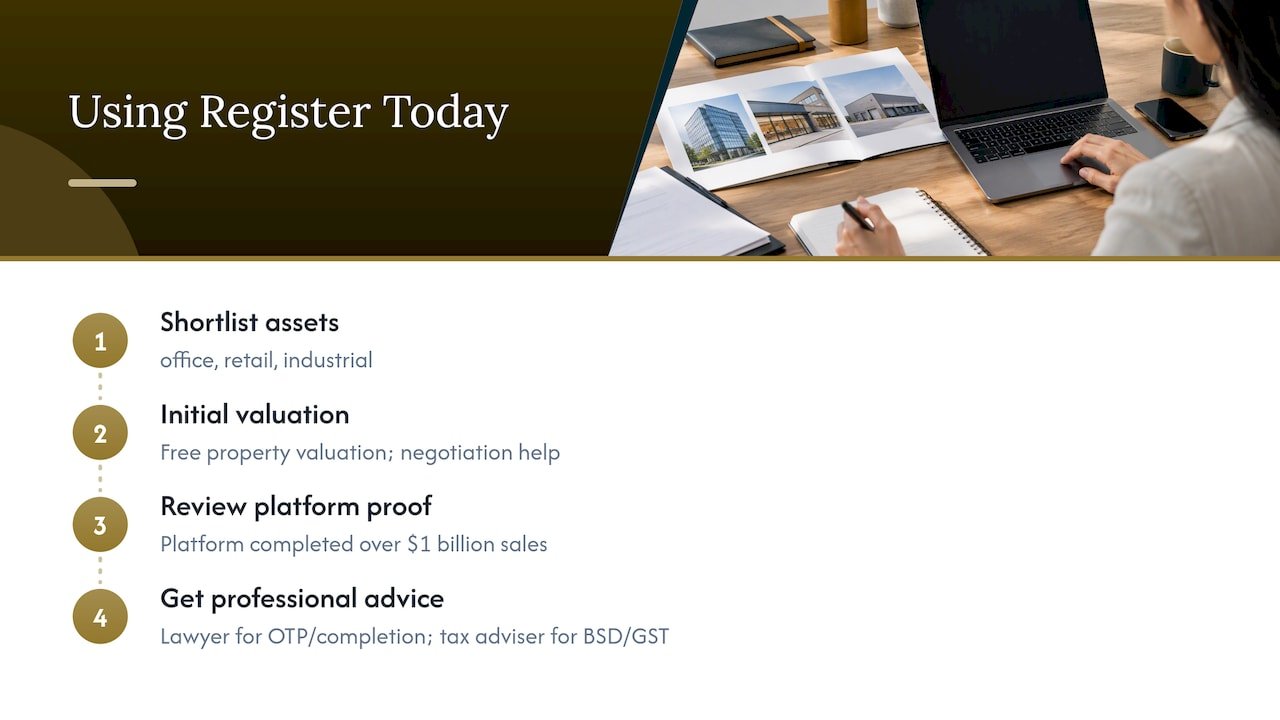
Register Today lists commercial spaces including commercial office, retail and industrial assets, alongside a free property valuation service and personalised negotiation support. The platform states it has completed over $1 billion in sales and positions itself around helping clients invest without incurring Additional Buyer’s Stamp Duty, alongside detailed market evaluations aimed at identifying gaps and opportunities.
None of that replaces independent advice. Use a platform like this to shortlist assets and get an initial valuation, then bring in a conveyancing lawyer for the Option to Purchase and completion, and a tax adviser to confirm your BSD and GST position before you commit.
A practitioner’s note on common deal traps and negotiation levers
The buyers who run into trouble are usually the ones who chased a headline yield instead of checking permitted use and running a conservative net-yield estimate first. Before you negotiate price, look at the option fee size, whether a rent-free fitting period is available, any landlord fit-out contribution, and your assignment rights. Those levers often matter more than a small discount on the asking price.
— Anderson
Start with a valuation or browse current commercial listings
Register Today gives you a way to test the market without committing to an agent relationship first: a free valuation on a property you already have in mind, or a browse through current commercial listings to see what tenure, use and pricing look like across sectors.

If you are ready to move, here is where to start:
- Compile your documents: tenancy schedules, title information and financing pre-approval, ready to hand to a lawyer or adviser.
- Browse the commercial category to compare office, retail and industrial listings side by side.
- Visit the Register Today homepage to explore buying, selling or renting options and book an initial consultation.
Sources
- IRAS | Stamp Duty
- IRAS | Goods and Services Tax (GST) — real estate
- MAS | Guidelines on the application of TDSR
- Withers | Singapore commercial real estate guide
- DBS | A guide to commercial real estate investing in Singapore
FAQ
What is Buyer’s Stamp Duty on commercial property in Singapore?
Buyer’s Stamp Duty on non-residential property follows a stepped schedule set by IRAS: 1% on the first S$180,000, 2% on the next S$180,000, 3% on the next S$640,000, 4% on the next S$500,000, and 5% on the remainder, for purchases on or after 15 February 2023. It is calculated on whichever is higher between the purchase price and the market valuation.
Does GST apply to commercial property purchases and leases?
Yes, IRAS generally treats sales and leases of non-residential property as taxable supplies. Whether you can claim input tax on the purchase depends on conditions around your intended taxable use, so confirm the seller’s GST registration status before you commit.
How does TDSR affect financing for commercial property?
MAS guidance expects banks to apply a Total Debt Servicing Ratio threshold of 60% when assessing property loans, and to stress-test a borrower’s repayment ability against scenarios such as rate rises. This can limit how much you can borrow even if your income looks sufficient on paper.
Can I use CPF savings to buy commercial property in Singapore?
No, CPF funds are not available for commercial property purchases in Singapore, unlike residential property where CPF use is permitted under specific schemes. Buyers need to plan financing entirely through cash and bank loans.
What should I check before signing an Option to Purchase?
Confirm permitted use with URA, verify title, tenure and any existing tenancy terms, and get an independent valuation alongside a full tax calculation covering BSD and the seller’s GST status. Register Today’s free property valuation can serve as a starting point before you bring in a lawyer for the formal due diligence.


