


Why valuation risk raises BSD in Singapore, Register Today tips
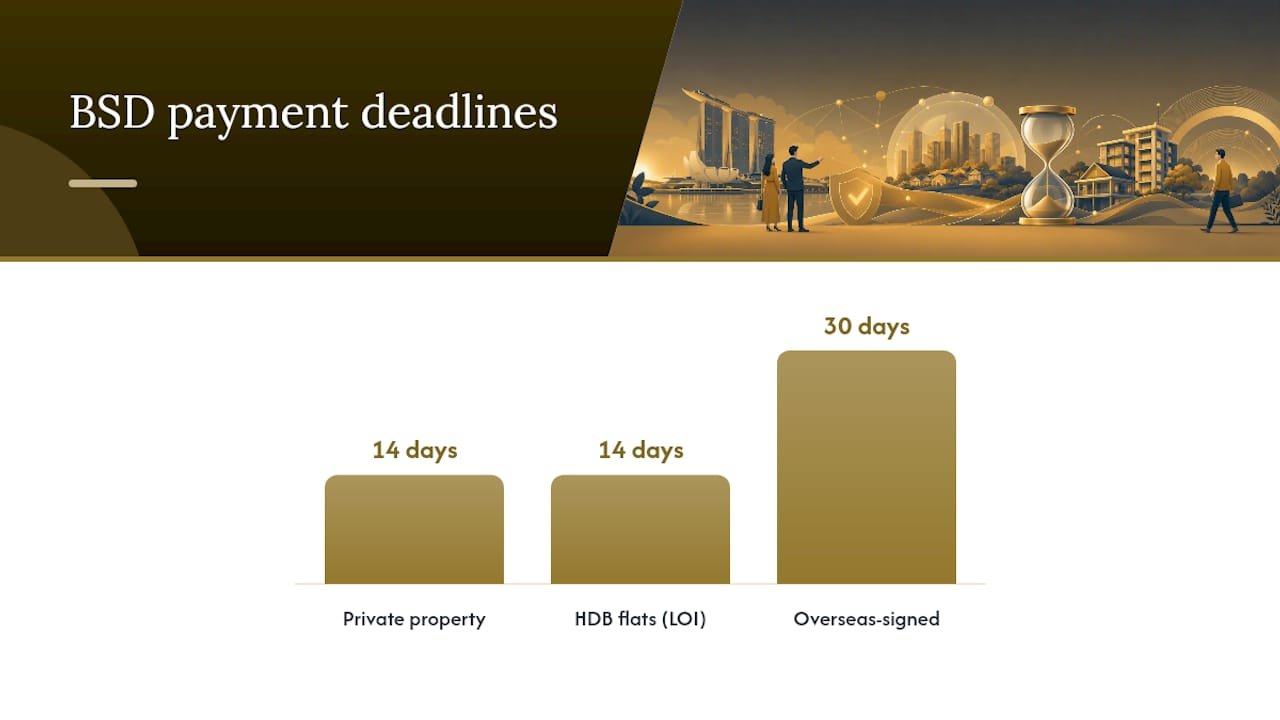
Buyer’s Stamp Duty (BSD) is a mandatory tax on every property purchase in Singapore, calculated on tiered bands against the purchase price or market value, whichever is higher. It is separate from Additional Buyer’s Stamp Duty (ABSD) and Seller’s Stamp Duty (SSD). Private property buyers must pay it within 14 days of exercising the Option to Purchase; HDB buyers work from the Letter of Intent to Purchase timeline instead.
TL;DR:
- BSD is calculated progressively on the dutiable amount, with rates rising from 1% for the first $300,000 to 6% for amounts above $1 million, and rounded down to the nearest dollar.
- Buyers must pay BSD within 14 days of exercising the Option to Purchase for private properties, or from the Letter of Intent for HDB flats, with late payments incurring penalties.
- The dutiable amount is the higher of the purchase price or market value, which IRAS assesses independently and may lead to higher duty if below-market prices are used.
- ABSD and SSD are separate duties that can apply on top of BSD based on buyer profile, property type, and holding period, with ABSD rates changing frequently and SSD based on sale timing.
- Pre-purchase valuation checks and understanding your ABSD profile help prevent surprises from valuation gaps or unexpected tax liabilities after signing the contract.
Table of Contents
- What is buyer stamp duty in Singapore and how is it different from other property taxes?
- How do you calculate buyer stamp duty step by step?
- When must you pay stamp duty, and how do you actually pay it?
- BSD vs ABSD vs SSD: how do they interact?
- What about HDB flats, en-bloc deals, and IRAS valuation risk?
- Are there any remissions or reliefs on buyer stamp duty?
- What should you check before signing an offer?
- Why Register Today treats valuation risk as the real BSD story
- How Registertoday helps you plan around stamp duty before you sign
- Where to check the official rates and calculators
- Sources
What is buyer stamp duty in Singapore and how is it different from other property taxes?
BSD is the base transaction tax that every buyer pays when acquiring property in Singapore, regardless of nationality or how many properties they already own. It exists purely to tax the transfer itself, unlike ABSD, which is a policy lever aimed at cooling demand from specific buyer profiles. The Ministry of Finance frames stamp duties as serving two distinct roles: BSD as a fixed transaction cost, and ABSD as a discretionary tool that shifts with market conditions.
That distinction matters when you are budgeting. BSD will apply to you no matter what, so it is worth treating it as a fixed line item in your purchase costs from day one. ABSD, by contrast, depends entirely on your citizenship status and how many residential properties you already hold, which means two buyers on the same unit can face wildly different total stamp duty bills.
The residential BSD rate schedule, current since 15 February 2023 and confirmed by IRAS, works on a marginal band system rather than a flat percentage:
| Portion of price or value | BSD rate |
|---|---|
| First $300,000 | 1% |
| Next $300,000 | 2% |
| Next $300,000 | 3% |
| — | 4% |
| — | 5% |
| Remaining amount above $1,000,000 | 6% |
Non-residential property, such as commercial or industrial units, follows a shorter schedule and tops out at a 5% marginal rate rather than 6%.
The single most common misunderstanding buyers bring to Registertoday is assuming BSD is charged as one flat percentage on the whole price. It is not. Each band is taxed only on the portion of the price that falls within it, the same logic that applies to Singapore’s personal income tax bands. A $1.5 million condo does not get taxed at a single rate across the full sum.
Two mechanical rules round out the calculation:
- BSD is always rounded down to the nearest whole dollar, never rounded up.
- There is a minimum duty of $1 payable on any dutiable transaction, however small the value.
These rounding rules rarely change the outcome by more than a dollar or two, but they matter when you are reconciling the exact figure IRAS bills against your own estimate. If your calculation is off by more than a few dollars, you have likely made an error in the band split rather than the rounding.
How do you calculate buyer stamp duty step by step?
Work out BSD in three moves: identify the dutiable amount, split it across the bands, then apply each band’s rate and add the results together.
- Establish the dutiable amount. This is the purchase price stated in your Option to Purchase or Sale and Purchase Agreement, or the IRAS-assessed market value, whichever is higher.
- Slice the amount into bands. Work through the schedule in order, filling each band before moving to the next, until you have allocated the entire dutiable amount.
- Multiply and total. Apply the matching rate to each slice, sum the results, then round down to the nearest dollar.
S$300,000 HDB resale flat: The BSD is calculated progressively across bands, with the first portion taxed at the lowest rate and the remaining amount at the next rate, resulting in a total BSD payable in the expected range for such a price.
S$5 million high-end property: The BSD is calculated progressively across the applicable bands corresponding to the purchase price, resulting in a substantial total BSD payable consistent with the tiered marginal rates.
Pro Tip: Run your own numbers before relying on an agent’s verbal estimate. A property valuation check against comparable transactions will tell you whether your agreed price is close to what IRAS is likely to accept as market value, which affects the dutiable amount you use in step one.
Notice how the effective rate climbs as the price rises. Lower-priced properties pay a smaller effective rate, while higher-priced properties incur a higher effective rate due to the progressive band structure. That gap is the entire point of a marginal system: higher-value transactions absorb progressively more of the tax burden.
When must you pay stamp duty, and how do you actually pay it?
BSD is due within 14 days of the date of purchase for private property, counted from whichever comes first: the date you exercise the Option to Purchase or the date the Sale and Purchase Agreement is signed. For HDB flats, the clock starts from the HDB Letter of Intent to Purchase rather than the exercise date used for private deals, a distinction that trips up a surprising number of first-time buyers moving between the two systems.
If your purchase agreement was signed overseas, you get a longer window. IRAS allows 30 days from the date the document is received in Singapore, rather than 30 days from signing, which matters if the document takes time to reach you by post or courier.
Practical steps to keep the payment clean:
- Pay through Mytax, which also hosts IRAS’s own stamp duty calculators for cross-checking your figures.
- Keep the electronic stamp certificate IRAS issues on payment. Your lawyer or conveyancer will need it to complete the transfer.
- Retain proof of the OTP exercise date or S&P signing date, since this is what determines your 14-day deadline if a dispute arises later.
Miss the deadline and IRAS charges penalties on top of the outstanding duty, on a scale that increases the longer payment is delayed. There is no grace period for forgetting, so treat the 14-day window as fixed the moment your OTP is exercised, not as a target you can nudge if your lawyer is slow to process paperwork.
BSD vs ABSD vs SSD: how do they interact?
BSD, ABSD and SSD are three separate duties that can all apply to the same transaction, and confusing them is one of the costliest mistakes a buyer can make. BSD is the base transaction tax every buyer pays. ABSD is an additional duty layered on top, charged only to buyers who meet certain citizenship or property-count conditions. SSD applies not to buyers at all but to sellers who dispose of a property within a defined holding period after purchase.
All three are calculated on the higher of the purchase price or market value, which means a below-market purchase price will not reduce your exposure to any of them. Where ABSD applies, it stacks fully on top of BSD rather than replacing it. The MOF’s framing of BSD as fixed and ABSD as policy-driven is the clearest way to think about the difference: your BSD bill will not move because of a cooling measure announcement, but your ABSD exposure can change overnight if the government revises rates, as it did on 27 April 2023.
Buyer profiles that commonly trigger ABSD liability include:
- Singapore citizens purchasing a second or subsequent residential property.
- Permanent residents purchasing any residential property, with higher rates from the second onward.
- Foreigners purchasing any residential property in Singapore.
- Entities and trustees purchasing residential property, generally at the highest rate band.
SSD, by contrast, is time-based rather than profile-based. It applies on a sliding scale to sellers who sell within a set number of years of purchase, with the rate falling the longer the property is held. It is worth knowing about even as a buyer, because it shapes how motivated a seller might be to negotiate if they are close to clearing their own SSD exposure window.
What about HDB flats, en-bloc deals, and IRAS valuation risk?
HDB purchases follow their own timing logic rather than the private-property rule. The 14-day payment window begins from the date of the HDB Letter of Intent to Purchase, not from an Option to Purchase, since HDB resale transactions do not use the same OTP structure as private sales. Buyers new to the process, including permanent resident families settling in Singapore, sometimes assume the private-property deadline applies and miss the correct trigger date. If you are navigating HDB eligibility as a new PR, this housing guide for new PR families is a useful primer on eligibility before you even reach the stamp duty stage.
En-bloc sales and multi-property contracts introduce a different complication. When a single contract covers several units or lots, IRAS treats the document as dutiable in aggregate, calculating BSD on the combined value rather than unit by unit. A collective sale that looks modest per apartment can still generate a substantial total BSD bill once every unit on the contract is added together, so buyers in en-bloc situations should model the aggregate figure, not just their individual share.
Valuation risk deserves particular attention:
- IRAS is not bound by the price stated in your contract. If your purchase price sits below what IRAS assesses as market value, duty is calculated on the higher market valuation instead.
- This risk is highest in private transactions between related parties, distressed sales, or deals struck well below recent comparable transactions.
- A pre-purchase valuation check reduces the chance of an unexpected bill arriving after your contract is already signed.
Are there any remissions or reliefs on buyer stamp duty?
IRAS does grant remissions in specific, narrow circumstances, and it is worth checking whether your purchase qualifies before assuming the full rate applies. Common categories include remissions for residential land subject to development or use restrictions, and remissions tied to specific development conditions set out in the sale terms.
Remissions reduce the BSD calculation itself, which is distinct from any separate ABSD remission you might be eligible for, such as the remission available to married couples who sell their first property within the required timeframe after buying a second. To apply, you will generally need supporting documents such as the sale contract, title particulars, and any planning or use-restriction documentation IRAS specifies for that remission category. Applications go through IRAS directly, and eligibility is assessed on a case-by-case basis rather than automatically applied at the point of payment.
What should you check before signing an offer?
Run through this checklist before you commit to a price, ideally with your agent or conveyancer alongside you:
- Confirm your likely valuation exposure. Check whether your offer price is close to market value or likely to trigger an IRAS assessment above your contract price.
- Establish your ABSD profile. Know your citizenship status and existing property count before you make an offer, not after.
- Budget for CPF versus cash. Decide upfront how you will fund stamp duty, since CPF usage rules for stamp duty differ from those for the purchase price itself.
- Lock in your 14-day deadline. Note the exact date your OTP is exercised or your HDB IPA is issued, and calendar the payment deadline immediately.
- Request documents that affect duty. Ask for title particulars, use restrictions, or development conditions that could unlock a remission or change your dutiable amount.
Pro Tip: Ask your agent for a written valuation comparison against three recent, similar transactions before you finalise your offer price. It is the single fastest way to spot whether IRAS is likely to challenge your contract price later.
Why Register Today treats valuation risk as the real BSD story
Most guides to Buyer’s Stamp Duty stop at the rate table. What buyers actually get caught out by is the valuation gap between what they agreed to pay and what IRAS decides the property is worth. That gap does not just increase your BSD bill; it can shift ABSD exposure at the same time if the revised valuation pushes you into a different calculation basis.
Registertoday works from local sold-price data across residential and commercial transactions, which is what gives valuation checks their accuracy. Our record of completed sales reflects patterns IRAS itself draws on when assessing market value, so buyers who check comparables before signing tend to face fewer surprises after.
The honest advice we give clients is simple: treat BSD as fixed, treat valuation as the variable worth managing, and never assume a below-market offer price protects you from anything.
— Anderson
How Registertoday helps you plan around stamp duty before you sign
Registertoday exists to help buyers avoid the two most expensive surprises in a Singapore property purchase: an unexpected valuation assessment and unplanned ABSD exposure. Where a typical agency hands you a rate table and leaves you to work out the rest, Registertoday pairs every transaction with a free property evaluation, so you know your likely dutiable amount before you commit to an offer price.

That valuation check matters most in the exact scenario this guide has walked through: a purchase price that sits below comparable market value, where IRAS could reassess and increase your BSD bill after the fact. Registertoday’s negotiation support also factors ABSD exposure into your offer strategy from the outset, particularly useful if you are weighing residential against non-residential property to manage your total stamp duty position. Browse current listings on our property search page, or start with a free home valuation to see where your target property sits against recent comparable sales before you make an offer.
Where to check the official rates and calculators
For the current rate schedule, always check IRAS’s stamp duty rates page and the main IRAS property stamp duty portal directly, since bands and remissions are revised periodically. Use IRAS’s own calculator on mytax.iras.gov.sg to verify any figure before you rely on it for budgeting.
This article is general information, not a substitute for advice from a qualified financial advisor. Consult a qualified financial professional about your own circumstances before acting on anything here.