

Tender Date Decides: Which ECs in Singapore Keep 5 Year MOP After 2026
Executive condominiums remain a legitimate housing option for Singapore families, but the May 2026 changes reset the maths. The minimum occupation period has increased to 10 years, full privatisation now takes 15 years, and the Deferred Payment Scheme has been removed. Anyone buying an executive condominium in Singapore now needs a $16,000 household income ceiling check, a longer holding-period plan, and more cash on hand during construction than buyers needed before.
TL;DR:
- Buyers must now confirm the tender closing date before purchasing, as the MOP doubles from 5 to 10 years depending on that date.
- The full privatisation timeline extends from 10 to 15 years, making ECs a less short-term investment option for future resale to foreigners or companies.
- The removal of the Deferred Payment Scheme requires buyers to have stronger liquidity, paying progressively during construction without extra concessionary loans.
- Households earning up to $16,000 gross monthly remain eligible, but bank approval depends on MSR and TDSR limits, not just income ceiling.
- Only EC projects tendered before May 8, 2026, retain the 5-year MOP, often commanding higher demand and short-term price premiums.
Table of Contents
- What changed in the executive condominium Singapore policy in 2026?
- Who qualifies to buy an EC in Singapore?
- How much CPF grant and financing can EC buyers get?
- How do you actually buy a new or resale EC?
- What are your obligations after collecting the keys?
- Which EC projects still carry the old 5-year MOP?
- How do you decide if an EC fits your family?
- How Registertoday helps you navigate an EC purchase
- What mistakes do EC buyers commonly make?
- A tactical take on buying an EC under the new rules
- Ready to buy or sell your executive condominium?
- Sources
What changed in the executive condominium Singapore policy in 2026?
The Ministry of National Development announced sweeping changes to the Executive Condominium Housing Scheme, effective for sites with tender closing dates on or after 8 May 2026. The headline shift: the minimum occupation period has doubled to 10 years, with full privatisation extended to 15 years.
- MOP rises from 5 to 10 years for affected projects
- Privatisation (when non-Singaporeans and companies can buy) rises from 10 to 15 years
- The Deferred Payment Scheme is removed, so buyers follow the standard progressive payment schedule
- First-timer quota rises from 70% to 90% of units, with priority booking extended from one month to two years
The rule hinges entirely on tender closing date, not launch date or completion date. A project tendered on 7 May 2026 keeps the old 5-year MOP; one tendered a day later falls under the new 10-year regime. That single date determines whether a buyer is locked in for a decade or half that time, and it reshapes how developers bid for land and how upgraders weigh resale timing against new launches.
Who qualifies to buy an EC in Singapore?
Executive condo eligibility hasn’t changed as dramatically as the occupation rules, but the checks remain strict and worth reading carefully before you commit to a booking fee.
- You need a core family nucleus (spouse, children, or parents) or must apply under the Joint Singles Scheme if unmarried, with a minimum age of 35 for single applicants
- Combined gross monthly household income must not exceed $16,000
- You must not have owned or disposed of any private residential property within the last 30 months of your application
- If you own an HDB flat, you typically need to sell it within six months of collecting your EC keys
- Second-timer applicants face a resale levy if they’ve received housing subsidies before, which reduces the CPF grant available
Pro Tip: Run the 30-month disposal check before you even shortlist a project. Sold your condo 28 months ago? You’re still barred from applying today, and that clock doesn’t bend for anyone.
Core family members named in the application must actually reside in the unit during the MOP; the eligibility framework is set out in the Executive Condominium Housing Scheme Act and its regulations, so this isn’t a soft guideline.
How much CPF grant and financing can EC buyers get?
Eligible first-timer households can receive a CPF Housing Grant of up to $30,000 for an EC, with the amount tiered by income band, similar in structure to the HDB grant tables most upgraders already know.
| Household income band | Approximate grant |
|---|---|
| — | Higher tier, up to $30,000 |
| — | Reduced mid tier |
| — | Lowest qualifying tier |
Unlike HDB flats, ECs are financed entirely through bank loans, not HDB concessionary loans. That means your mortgage is bound by the Mortgage Servicing Ratio (30%) and Total Debt Servicing Ratio (55%), and passing the HDB income ceiling doesn’t guarantee bank approval. With the Deferred Payment Scheme now removed, buyers on affected projects pay progressively as construction hits each milestone, drawing down loans earlier and needing stronger liquidity from day one rather than at completion.
How do you actually buy a new or resale EC?
The sequence differs depending on whether you’re booking a new launch or buying resale, and skipping a step here tends to cost buyers weeks at the bank, not just paperwork.
- Confirm eligibility first. Check income ceiling, the 30-month disposal rule, and whether you qualify for the CPF grant before you set foot in a showflat.
- Get financing pre-approved. Since ECs use bank loans, secure an in-principle approval so MSR and TDSR limits don’t surprise you at booking.
- Book during the priority window. First-timers now get up to two years of priority access before second-timers and singles can apply for the same units.
- Pay the booking fee and sign the Sale and Purchase Agreement, then follow the progressive payment schedule tied to construction milestones.
- For resale ECs, check how far the seller is into their MOP. Resale buyers must still meet the standard eligibility criteria, and MOP restrictions transfer with the unit until the original period expires.
What are your obligations after collecting the keys?
Buying the unit isn’t the finish line. The occupation period brings binding conditions that catch out buyers who assume an EC behaves like a private condo from day one.
- You and your listed family members must physically live in the unit for the full MOP; renting out the entire flat during this period isn’t allowed
- You must dispose of any HDB flat you own within six months of taking possession
- If you’re a second-timer, expect a resale levy deducted from your proceeds or payable in cash
- Only after privatisation, now 15 years out for affected projects, can the unit be sold to foreigners or companies without restriction
The extended timeline changes how you should think about the purchase. A decade-long MOP means treating an EC less like a stepping stone and more like a long-term family home, since the exit routes that upgraders used to rely on at year five simply don’t exist anymore for projects under the new rules.
Which EC projects still carry the old 5-year MOP?
Not every upcoming launch falls under the new regime. Because the rule change is tied to tender closing date, a handful of sites that were tendered before 8 May 2026 will still complete under the shorter timeline. Straits Times reporting names Senja Close, Woodlands Drive 17, Sembawang Road, and Miltonia Close among the last sites to retain the 5-year MOP.
- These projects tend to attract stronger launch demand precisely because of their shorter lock-in
- Some analysts note this can produce short-term price premiums compared with equivalent new-MOP launches, according to StackedHomes market analysis
- The wider first-timer quota (now 90%) may also shift resale demand as more units get reserved for upgrader households rather than investors
Pro Tip: Ask the developer or your agent for the exact GLS tender closing date in writing, not just a verbal assurance. Marketing brochures don’t always spell this out clearly, and it’s the one date that decides your entire ownership timeline.
How do you decide if an EC fits your family?
Run through a short fit test before you book anything, because the wrong answer here is expensive to reverse.
- Check your ownership horizon. If you might need to sell or relocate within a decade, a new-MOP EC may not suit you as well as a resale flat or private condo.
- Confirm financing readiness. Get your bank loan pre-approved and stress-test it against MSR and TDSR before falling in love with a unit.
- Verify the tender date and MOP class directly with HDB or the developer, not through secondhand marketing claims.
- Ask about the payment schedule. With DPS gone for new-MOP sites, confirm exactly when each progressive payment falls due.
- Watch for red flags, including vague answers about tender dates or any lingering marketing language referencing deferred payment terms on sites where DPS no longer applies.
Pro Tip: If a sales team can’t immediately confirm whether a project sits under the 5-year or 10-year MOP, treat that as a warning sign, not a minor detail.
How Registertoday helps you navigate an EC purchase
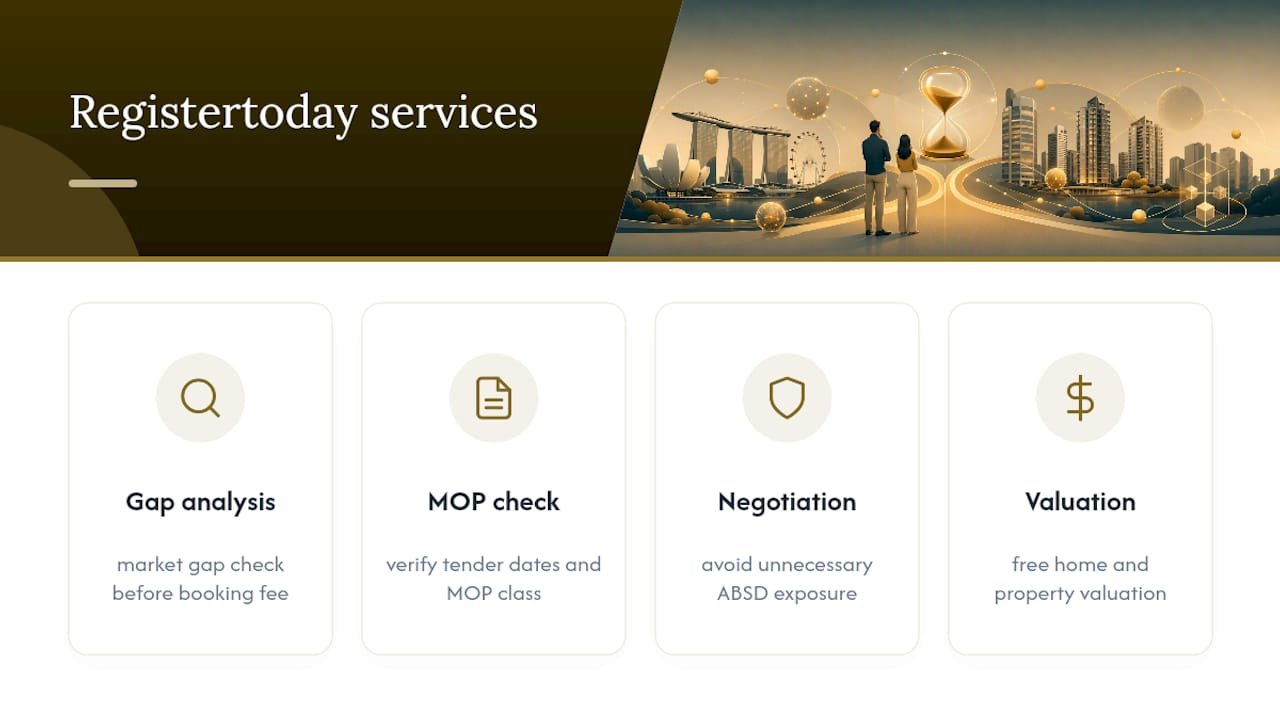
Buying an EC now means checking a tender date, an income ceiling, a CPF grant band, and a bank’s MSR and TDSR limits before you even queue for a showflat. Registertoday has completed over $1 billion in property transactions across Singapore, and that scale means the team has seen most of the eligibility and financing snags that trip up first-time EC buyers.

- Free property evaluations to help you budget for HDB disposal timing against your EC completion date
- Personalised negotiation support for both new-launch bookings and resale EC purchases
- Tender date and MOP class verification, so you know exactly which rules apply before you commit
- Guidance structured around avoiding unnecessary Additional Buyer’s Stamp Duty exposure where it applies to your situation
| What you get | Why it matters for EC buyers |
|---|---|
| Free property evaluation | Confirms your HDB disposal value against EC payment milestones |
| Negotiation support | Applies to new launches and resale units alike |
| Tender/MOP verification | Confirms 5-year versus 10-year MOP before you sign |
Families weighing long-term ownership structures may also want to look at property trust planning given how much longer the new privatisation timeline runs. If you’re ready to see what’s currently listed, browse the property list or request a home valuation to start planning your numbers today.
What mistakes do EC buyers commonly make?
The most common pitfall is assuming every EC launch follows the same MOP timeline. Buyers who don’t check the tender closing date sometimes discover, after signing, that they’re locked in for a decade rather than five years, which changes the entire resale and rental strategy they’d planned around.
A second frequent error involves financing. Because ECs use bank loans rather than HDB concessionary loans, some buyers assume meeting the HDB income ceiling guarantees loan approval. It doesn’t. Banks apply MSR and TDSR independently, and buyers who skip pre-approval sometimes find their preferred unit is unaffordable once the bank runs its own numbers.
Buyers also underestimate cashflow needs now that the Deferred Payment Scheme has been removed for new-MOP sites. Progressive payments during construction mean money leaves your account, and your CPF, well before the keys arrive. Without planning for this, some households find themselves short on liquidity midway through the build.
Finally, many buyers forget the 30-month private property disposal rule applies strictly, with no grace period for “almost” cases. Selling a condo 29 months before applying still disqualifies you. And second-timers frequently overlook the resale levy until it’s deducted from their proceeds at completion, which can shrink the CPF grant they expected to receive.
Checking these four areas early, tender date, financing pre-approval, cashflow planning, and disposal timing, resolves most of the problems that surface later in the process.
A tactical take on buying an EC under the new rules
The 2026 changes favour genuine family buyers over short-term flippers, and that’s the point. If you’re planning to live in the unit for a decade anyway, the longer MOP costs you little. If you were counting on a five-year exit, verify the tender date before you book, because that single detail now decides your entire financial timeline.
— Anderson
Ready to buy or sell your executive condominium?
Registertoday gives EC buyers something most agencies don’t offer upfront: a genuine market gap analysis before you commit to a booking fee, paired with negotiation support built around avoiding unnecessary ABSD exposure where it applies to your purchase structure. Where other routes leave you cross-checking tender dates and MOP classes on your own, Registertoday’s team does that verification as standard, alongside a free property evaluation to confirm your numbers stack up against the new payment schedule.
For buyers weighing whether their household composition still qualifies, particularly non-citizen family members, background on PR application timelines can also clarify eligibility questions before you apply.
Start by getting a free home valuation to see where your current property stands, or browse the property list to compare available EC and resale options right now.