
CPF Accrued Interest: What You Refund When You Sell
CPF accrued interest is the interest your CPF savings would have earned had you not used them for your home. When you sell or transfer the property, you refund the CPF principal you used plus this interest, and the money goes back into your own CPF account, not to the government. You can see your own figure at any time in the CPF Home ownership dashboard, so you can plan your sale proceeds before you list.
TL;DR
- Accrued interest is the CPF interest your withdrawn savings would have earned, not a charge from the bank or CPF Board. It is refunded to your own CPF account.
- It runs from the day you first used CPF for the property until the refund date, and keeps building after your loan is fully repaid.
- On a sale you refund principal plus accrued interest. If you sold at market value and proceeds fall short, you do not top up the gap in cash.
- The same rules apply to condos and other private homes bought with CPF Ordinary Account (OA) savings.
- Check your figure in the “What Happens If” section of the CPF Home ownership dashboard before you set an asking price.
Table of Contents
- What CPF accrued interest actually is
- How the interest is calculated
- What you refund when you sell or transfer
- Checking your own accrued interest
- Using CPF for a condo or other private property
- Situations that change the sum
- Should you refund voluntarily before selling?
- Our view on planning around accrued interest
- Start with a valuation
- FAQ
- Sources
What CPF accrued interest actually is
Every dollar of CPF you put into a home stops earning CPF interest. CPF Board’s explanation is that accrued interest represents what the withdrawn savings would have earned if they had stayed in your account. It is not a bank-loan interest charge, and nobody is lending you money at that rate.
The reasoning is about retirement. Housing withdrawals reduce the savings that would have compounded for your later years. Refunding the principal and the interest restores the position you would have been in, and the refund is credited back to your CPF accounts.
For most readers, the practical meaning is simple: the CPF money you use for a home is not free. Part of the cost is the growth you give up, and that growth is tallied and settled when you sell.
How the interest is calculated
The calculation runs from the date you first used your CPF savings for the property until the date the refund is made. It uses the prevailing CPF interest rates and compounds annually. It also keeps accruing after the housing loan is fully repaid. Paying off your mortgage does not stop the clock: it stops only when the CPF refund is made.
Two details help you picture it:
- CPF interest is calculated monthly but credited and compounded annually at year-end, according to CPF’s Home Purchase Planner.
- The OA rate is the one that matters for most home buyers, because housing withdrawals come mainly from the OA. CPF states that OA interest is 2.5% per annum from 1 October to 31 December 2026. The rate is reviewed quarterly and has a legislated minimum of 2.5%, so read that as the published rate for that quarter and check the CPF page for later quarters.
A worked example
This is an illustration using a flat 2.5% a year, compounded annually, with no other changes. It is not a quote for any property.
Suppose you use S$200,000 of OA savings on a condo and sell later:
| Years held | Approximate accrued interest | Approximate total CPF refund |
|---|---|---|
| 5 | S$26,300 | S$226,300 |
| 10 | S$56,000 | S$256,000 |
| 20 | S$127,700 | S$327,700 |
The longer you hold, the larger the interest portion, because it compounds on itself. Monthly instalments that come from CPF add to the principal over time, and each amount accrues from the date it left your account. Your real number depends on every withdrawal date and every rate in force, which is why the dashboard figure, not a rule of thumb, is the one to use.
What you refund when you sell or transfer
When you sell the whole property, or sell or transfer your share, you refund the CPF principal you used and the accrued interest. If you are 55 or above and pledged your property, you also refund the pledged amount.
Sale proceeds are applied in a set order: the outstanding housing loan is repaid first, then the CPF principal plus accrued interest is refunded, and what remains is your cash. A few points sellers often miss:
- Grants count. Housing grants and their accrued interest are included in the CPF housing refund when the property is sold.
- Option money counts. Cash option money is part of the selling price and must also be refunded.
- Other deductions. CPF’s planner works out projected sales proceeds as the selling price less the outstanding loan, the principal and accrued interest, any resale levy and other expenses. If you are upgrading from a subsidised flat, our guide to the resale levy helps you budget for that line.
If the sale does not cover everything
This is the question that worries sellers most. If the property was sold at market value and proceeds are not enough to cover everything, you do not have to top up the shortfall in cash. You refund the selling price less the outstanding loan. That applies to a sale at market value, so a transaction priced well below value is a different situation and worth raising before you commit.
Where the refund goes
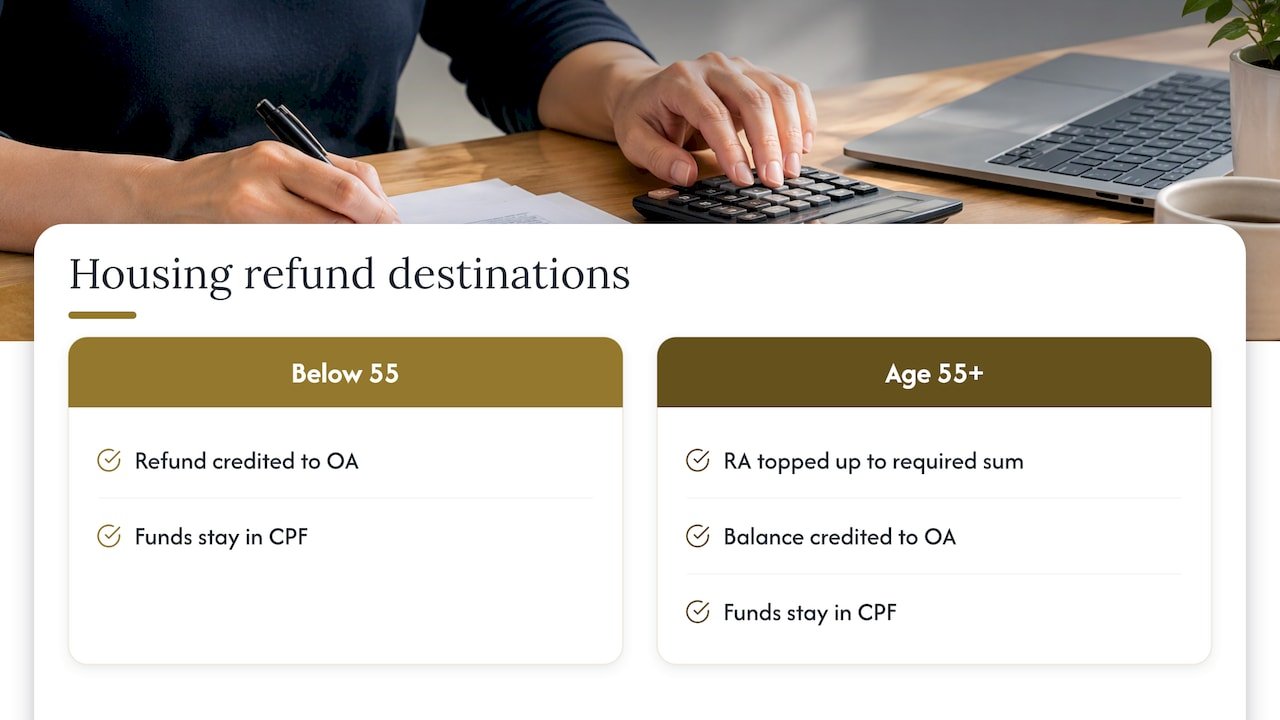
Below age 55, housing refunds are credited to your Ordinary Account. From age 55, refunds first top up your Retirement Account to the required retirement sum, and the balance stays in the Ordinary Account. Either way, the money stays in your CPF.
Checking your own accrued interest
You do not need to calculate this by hand. Log in to CPF’s Home ownership dashboard and open the “What Happens If” section, which shows the amount refundable if you sold now. The dashboard also shows how much OA you have used and how much more you may use before limits apply.
A sensible routine for any seller:
- Read the refundable amount on the dashboard.
- Get the outstanding loan figure from your bank.
- Get a realistic market value for the property.
- Subtract the loan and the CPF refund from that value, then deduct costs such as agent fees, legal fees and any levy.
- The result is the cash you can expect to hold after completion.
Step 3 is where most plans go wrong. An optimistic price makes the cash figure look larger than it is. Our free property valuation gives you a market-based figure to put into step 3, so the net-proceeds sum starts from a number you can rely on.
Using CPF for a condo or other private property
Buyers searching for CPF and private property are usually asking how much CPF they can use and what that creates later. OA savings may fund a private residential property, including the down payment, housing-loan payments, stamp and legal fees, and qualifying construction or vacant-land costs, as set out in CPF’s page on using your CPF to buy a home.
The amount you can use is limited. CPF’s guidance says the OA limit depends on the remaining lease, property type and loan type, and the lease generally has to cover the youngest CPF-using buyer until age 95 for the standard cap. For a qualifying lease, use is capped at the lower of the purchase price and the valuation. For a bank-loan purchase, OA use can generally continue up to 120% of that lower figure once the applicable Basic Retirement Sum has been set aside.
To estimate your own limit, use CPF’s housing usage calculator. It is an estimate based on your age, property type and loan type. It does not apply to HDB studio apartments, short-lease 2-room Flexi flats or transactions below market valuation. If you already have property usage, log in to the dashboard for your actual position.
Two links to other buying costs are worth reading alongside this. The loan you take sets how much cash and CPF you need on day one, so see the loan-to-value limits for first and second loans. New-launch buyers pay in stages, which affects when CPF is drawn, and the progressive payment schedule lays that out. First-time buyers can start with our practical guide to buying your first home.
The retirement trade-off
CPF’s own home-ownership guidance reminds members that every dollar used for housing is a dollar less for retirement, and it recommends balancing OA use with cash. Accrued interest is the number that makes this trade-off concrete. Using less CPF on a purchase means a smaller refund later, and more of your sale proceeds arrive as cash.
Situations that change the sum
Selling or transferring part of a property
If you sell or transfer only your share, the refund applies to your share. Joint owners should work out each person’s CPF usage separately before agreeing a price. Our guide to selling a part share of a property covers the process.
Divorce and taking over an ex-spouse’s share
When a member takes over an ex-spouse’s property share, CPF generally requires a refund of the ex-spouse’s principal and accrued interest. A court may order a transfer without the full refund. On a later sale, both parties’ applicable amounts are included.
Transfers between spouses
A transfer between spouses involves CPF and bank consent as well as stamp duty questions. Read about spousal transfers and ABSD before you sign anything.
Withdrawing retirement savings at 55
For property owners withdrawing Retirement Account savings, CPF requires the retirement sum remaining after withdrawal, plus the property’s CPF usage including accrued interest, to be enough to make up the Full Retirement Sum. In applicable cases a property pledge may be required. The details are on CPF’s page for property owners withdrawing RA savings.
Sellers who are watching taxes
Accrued interest is a refund of your own savings and is separate from tax. If you may sell within a short holding period, read our explainer on capital gains tax on Singapore property so the whole cost picture is in front of you.
Should you refund voluntarily before selling?
Because accrued interest keeps building, some owners choose to refund CPF to their account earlier than the sale date. CPF offers a voluntary housing refund so you can continue to enjoy CPF interest rates on the returned money. The logic is straightforward: the refunded sum starts earning CPF interest again. Whether it suits you depends on your cash flow, your retirement plans and how long you will hold the property. Work it through with the dashboard figures and your own budget rather than a rule of thumb.
CPF’s Home Purchase Planner is a useful companion here. It projects balances using 2.5% OA and 4% Special and Retirement Account assumptions, so treat its results as projections that depend on those assumptions.
Our view on planning around accrued interest
We see accrued interest as a planning number, not a surprise. Most of the stress sellers feel comes from learning the refund figure after they have fixed a price in their head.
Our advice is to put three numbers on the table before listing: the CPF refund from the dashboard, the outstanding loan from the bank, and a market valuation. With those, the cash you will hold at completion is a sum, not a guess.
This is the reason we pair every sale with a detailed market evaluation and personalised negotiation. A well-supported price protects your cash after the CPF refund, and our team has handled over $1 billion in sales.
For buyers, the same discipline applies in reverse. Decide how much CPF you are willing to commit, understand that the interest builds with every year you hold, and choose a property that still fits your plan if you sell sooner than expected.
Anderson
Start with a valuation
The refund is fixed by your CPF history, but your cash outcome depends on the price you achieve. If you are weighing a sale, request a free property valuation from Register Today and use it with your dashboard figure. Our service covers selling, buying and renting across residential and commercial property in Singapore, with personalised negotiation on every transaction.

If you are buying, you can browse residential listings or commercial listings on our site.
FAQ
Do I need to pay back CPF accrued interest?
Generally yes, when you sell the whole property or sell or transfer your share. You refund the CPF principal used plus the accrued interest, and the money is credited back to your own CPF account. If you are 55 or above and pledged your property, the pledged amount is refunded too.
How much accrued interest will I owe?
It depends on how much CPF you used, when each amount left your account, and the CPF rates over the period. At 2.5% compounded annually, S$200,000 used and held for ten years would carry roughly S$56,000 of interest, as an illustration. Your actual figure is in the Home ownership dashboard.
How do I see my accrued interest?
Log in to the CPF Home ownership dashboard and open the “What Happens If” section. It shows the amount refundable if you sold now, so you can use it in your net-proceeds calculation.
Does accrued interest stop once my loan is paid off?
No. It continues to accrue after the housing loan is fully repaid and stops only when the CPF refund is made. That is why a long-held, fully paid property can still carry a sizeable refund.
Do I have to top up in cash if the sale does not cover the refund?
Not if the property was sold at market value. You refund the selling price less the outstanding loan, and no cash top-up is needed for the shortfall.
Sources
- CPFB: CPF refund when selling or transferring property
- CPF: Why do I need to refund the accrued interest
- CPF: Do I need to refund my ex-spouse’s share
- CPFB: Home Purchase Planner
- CPFB: Home ownership
- CPFB: What happens to the sales proceeds after selling your home
- CPFB: Using your CPF to buy a home
- CPFB: How much CPF savings you can use for your home purchase
- CPFB: CPF housing usage calculator
- CPFB: Earning CPF interest
- CPFB: Withdrawal of RA savings for property owners