

Rental Stamp Duty in Singapore: Rates, Who Pays and How to Stamp
Stamp duty on a Singapore tenancy is 0.4% of the rent over the lease, worked out on the average annual rent, and the tenant pays it unless the agreement says otherwise. The document must be stamped within 14 days of signing. Landlords have two further bills that are not stamp duty: income tax on the net rent and annual property tax on the property. This guide covers all three, with the sums worked out.
It is written for tenants signing a first lease, expats arriving on a work contract, landlords letting out a flat or condo, and buyers who plan to rent out what they buy.
TL;DR
- Lease stamp duty is 0.4% of the total rent for leases of 4 years or less, on the average annual rent. Leases with an average annual rent of $1,000 or less are exempt.
- Stamp the agreement within 14 days of signing it in Singapore. The tenant pays unless the agreement states otherwise.
- Rental income tax and condo property tax are separate from stamp duty. Income tax applies to net rent after allowable expenses; property tax applies to ownership.
- Landlords of residential property can claim deemed expenses of 15% of gross rent plus mortgage interest, or claim their actual expenses.
Table of Contents
- What rental stamp duty is and which agreements it covers
- How to calculate the duty
- Who pays, and what the agreement should say
- Deadlines and how to stamp
- Landlord duties that sit next to stamp duty
- Tax on rental income: what landlords declare
- Property tax on a rented condo
- The three costs side by side
- Where first-time renters and landlords go wrong
- Perspective
- Renting or letting through Register Today
- FAQ
- Sources
What rental stamp duty is and which agreements it covers
Stamp duty is a tax on documents. In Singapore, the Inland Revenue Authority of Singapore (IRAS) collects it on documents relating to leases of immovable property. A tenancy agreement for a flat, condo, house, shophouse or office is such a document.
A few points catch people out:
- Licence agreements. A document that is only a licence and does not act as a lease may not be liable. If it is signed in connection with a lease, it is liable.
- Chat and app agreements. An agreement made through a mobile application or a messaging service such as WhatsApp creates an electronic document that is chargeable. A deal confirmed on a chat thread is not outside the rules.
- Letters of offer. An acceptance of a letter of offer to lease is also dutiable, as are agreements for lease and agreements to vary a lease.
Short stays are a different matter. If you are thinking of renting out a room or unit for a few days at a time, read the short-term rental rules for Singapore first, because the tenancy rules above assume a proper lease.
How to calculate the duty
IRAS charges lease duty on the contractual rent or the market rent, whichever is higher. The calculation runs in four steps.
- Find the Average Annual Rent (AAR). This is the total rent over the lease divided by the number of years. The AAR also includes other payments made for the lease, such as advertising, furniture and fittings, maintenance and service charges, but excludes GST.
- Check the exemption. If the AAR does not exceed $1,000, the lease is exempt.
- Apply the rate. If the AAR is above $1,000 and the lease runs 4 years or less, the duty is 0.4% of the total rent for the period. If the lease is longer than 4 years, or has no fixed end, the duty is 0.4% of 4 times the AAR.
- Round. The duty is rounded down to the nearest dollar, with a minimum of $1.
Worked example: a standard two-year lease
Rent is $3,000 a month for 24 months.
- Total rent: $3,000 × 24 = $72,000
- Lease is under 4 years, so duty = 0.4% × $72,000 = $288
On a one-year lease at the same rent, the total rent is $36,000 and the duty is $144.
Worked example: rent that steps up
A three-year lease charges $2,500 a month in year one, $2,800 in year two and $3,000 in year three.
- Year totals: $30,000 + $33,600 + $36,000 = $99,600
- Duty = 0.4% × $99,600 = $398.40, rounded down to $398
Worked example: a lease longer than four years
A six-year lease at $3,000 a month has an AAR of $36,000. Because it is longer than 4 years, the duty is capped at the 4-year basis: 0.4% × (4 × $36,000) = 0.4% × $144,000 = $576.
A quick reference
| Lease situation | Duty basis | Example at $3,000 a month |
|---|---|---|
| AAR of $1,000 or less | Exempt | Not applicable |
| 4 years or less | 0.4% of total rent | 2 years: $288 |
| More than 4 years or indefinite | 0.4% of 4 × AAR | 6 years: $576 |
If you pay for furniture, maintenance or service charges inside the lease, add them to the rent before you work out the AAR. Leaving them out is the most common reason a self-calculated figure comes out short.
Who pays, and what the agreement should say
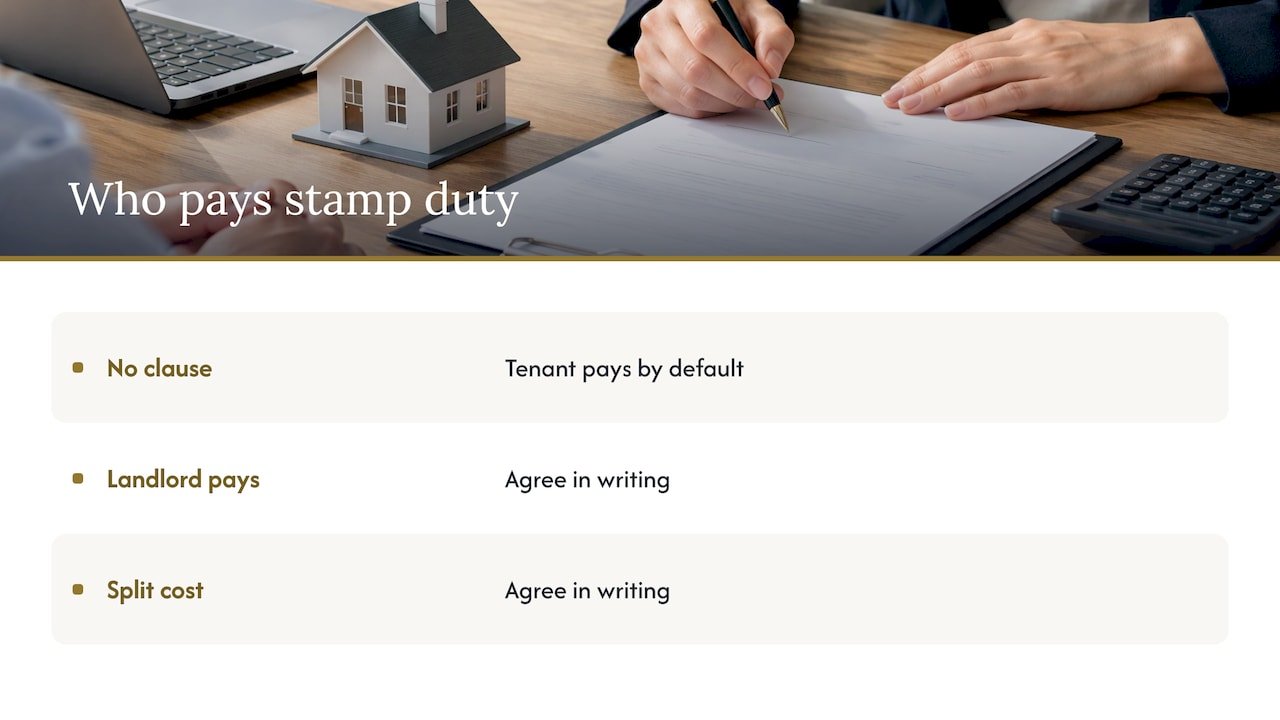
The law sets a default. When the agreement does not say who is liable, the tenant pays stamp duty on a tenancy agreement, an agreement for lease, an agreement to vary a lease, or an acceptance of a letter of offer.
It is only a default. The two parties can agree that the landlord pays or that the cost is split. If you want a different arrangement, write it into the agreement, so nobody argues about a $288 bill after move-in.
For the tenant, the duty is one line in a move-in budget that also holds the deposit and the first month’s rent. For the landlord, an agreement that is stamped on time is a document that holds up if a dispute follows. Tenants who want to know what remedies exist if something goes wrong later can read about tenant rights in Singapore, and tenants putting down a good-faith deposit should look at the letter of intent checklist before they pay anything.
Deadlines and how to stamp
Deadlines are the part that costs money when missed.
- A document signed in Singapore must be stamped within 14 days after it is signed.
- A document signed outside Singapore and later brought in must be stamped within 30 days after it is received in Singapore.
The 14 days count from the date of signing, so do not wait for the keys. IRAS sets out the consequences of late payment on the same stamp duty basics page, and the safest course is to stamp in the first week.
Stamping is done online through the myTax Portal. A landlord or tenant logs in through the Stamp Duty login, selects the stamping service and follows the prompts. IRAS also publishes a stamp duty calculator on the portal for working out the figure before you commit to a budget.
If you want a step-by-step view of the 14-day window together with the standard agreement templates, our guide to stamping a Singapore tenancy agreement covers it. Buyers who are also handling a purchase can compare it with the stamp duty timeline for buyers, which has its own 14 and 30 day rules.
Landlord duties that sit next to stamp duty
When you let out a property, you must inform IRAS within 15 days of the letting for property-tax purposes. If you stamp the lease through the myTax Portal, IRAS is notified automatically and no separate notification is needed. That is a good reason to stamp online and promptly.
Failing to notify IRAS of a letting carries a fine of up to $5,000, plus interest on the tax at any rate that may be prescribed.
Tax on rental income: what landlords declare
Stamp duty is paid once, at signing. Income tax on rent comes every year. Rent received from letting out a property is subject to income tax and must be declared in your Income Tax Return. What is taxed is the net rental income, which is the rent minus the expenses you are allowed to deduct.
Allowable and non-allowable expenses
Allowable expenses include:
- housing-loan interest
- property tax for the period the unit was rented
- fire insurance
- repairs and maintenance
- costs of securing tenants
- supervision or management fees
- replacement of furniture and fittings
Non-allowable items include:
- principal repayments on the loan
- renovation costs
- depreciation of furnishings
- capital improvements
Two ways to claim
An owner who lets out a residential property can either:
- claim deemed rental expenses of 15% of gross rent, plus mortgage interest; or
- claim actual expenses, with the records to back them.
Worked example
A condo earns $36,000 a year in rent. The mortgage interest for the year is $10,000.
- Deemed expenses: 15% × $36,000 = $5,400
- Net rental income: $36,000 − $5,400 − $10,000 = $20,600
That $20,600 goes into your income for the year. If your actual repairs, insurance and agent fees come to more than $5,400, the actual-expenses route may leave you with a lower figure, but only if you keep the receipts. Whichever you choose, the principal part of your loan repayment is never deductible, so look at your loan statement for the interest portion only.
If you are comparing a rental with a sale, our guide to capital gains tax on Singapore property shows how holding periods change the picture.
Property tax on a rented condo
Property tax is an annual tax on owning immovable property in Singapore. It is not a tax on rental income. You pay it whether or not the unit is let, and the rented period is a deductible expense against your rental income.
It is charged on the Annual Value (AV), which is IRAS’s estimate of the market rent. IRAS analyses rents of similar properties and adjusts for location, size and condition. The AV can be higher or lower than the rent you actually receive, because a lease signed earlier may carry an older rent.
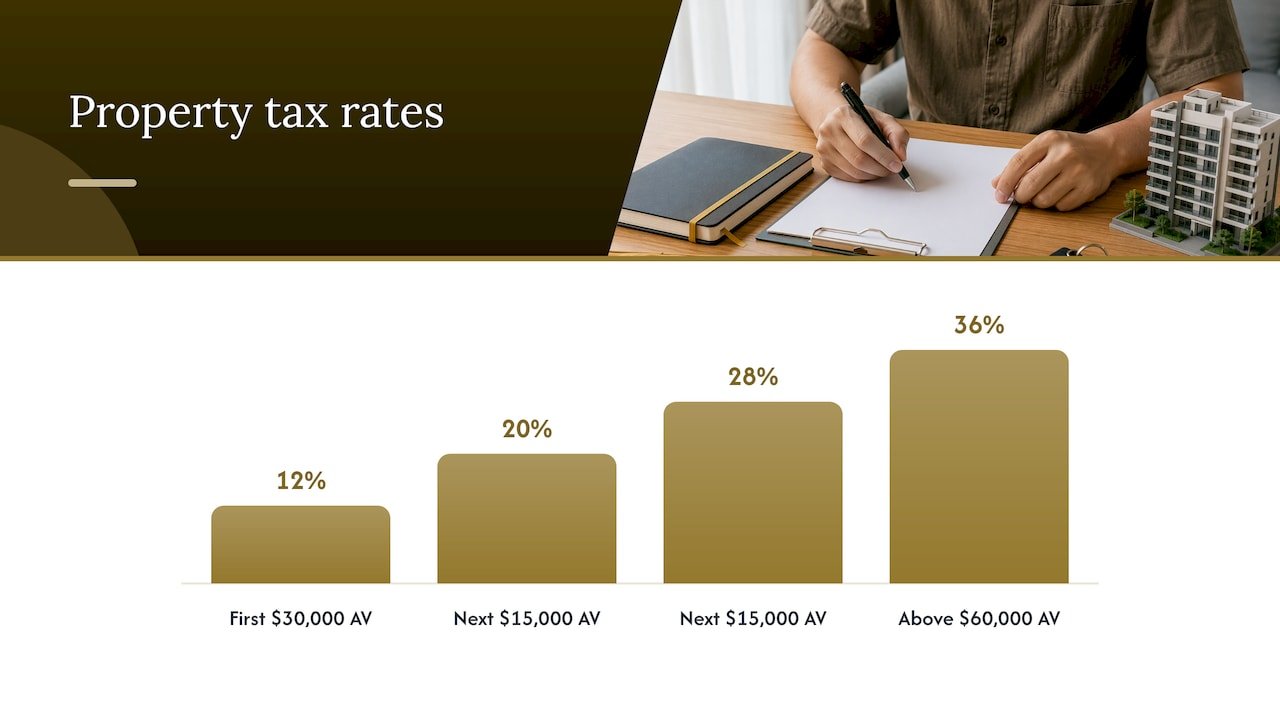
A rented-out home is non-owner-occupied. For non-owner-occupied residential property, the rates effective from 1 January 2024 are progressive:
| Slice of Annual Value | Rate |
|---|---|
| First $30,000 | 12% |
| Next $15,000 | 20% |
| Next $15,000 | 28% |
| Above $60,000 | 36% |
The Ministry of Finance stated in February 2026 that these non-owner-occupied rates were raised in 2023 and 2024 to their current 12% to 36% range.
Worked example
A condo has an AV of $40,000 and is rented out.
- 12% × $30,000 = $3,600
- 20% × $10,000 = $2,000
- Annual property tax: $5,600
Bills are issued once a year, around the turn of the year, and the IRAS property tax bill page gives the dates for the current cycle. The one-off property tax rebates announced for 2026 apply to owner-occupied homes, so a landlord should not budget for one on a rented unit.
The three costs side by side
| Stamp duty on the lease | Income tax on rent | Property tax | |
|---|---|---|---|
| What it taxes | The tenancy document | Net rent received | Owning the property |
| How often | Once per lease | Every year | Every year |
| Usually paid by | Tenant, unless agreed otherwise | Landlord | Owner |
| Basis | 0.4% of rent on the AAR | Rent less allowable expenses | Annual Value, progressive rates |
Where first-time renters and landlords go wrong
- Treating a chat agreement as informal. If the terms are fixed over an app, the electronic record is still dutiful.
- Missing the 14 days. The deadline runs from signing, not move-in.
- Leaving out extras from the AAR. Furniture, maintenance and service charges count towards the figure.
- Mixing up the three taxes. Paying stamp duty does not settle property tax or income tax.
- Claiming renovation or principal repayments. Neither is an allowable expense.
- Assuming the agreement fixes who pays. If it is silent, the tenant is liable.
Perspective
Most of the disputes we hear about start with a rent figure, not a tax. A lease is signed, the numbers are rushed, and the duty, the deposit and the first month’s rent turn up as a surprise at the same moment.
Our view is that a tenancy should be priced before it is signed. That means knowing what comparable units are renting for, knowing who pays the stamp duty, and knowing what the landlord’s own tax position is. A landlord who understands their net rental income can negotiate with confidence, and a tenant who understands the 0.4% can budget without guessing.
This is why we put detailed market evaluation and personalised negotiation at the front of the work we do on rentals, sales and purchases in Singapore. The tax figures here are small next to the rent, but the rent is where good advice pays for itself.
Anderson
Renting or letting through Register Today
If you are searching for a rental, Register Today lists residential and commercial properties in Singapore, and we help expats with rental assistance. If you own a unit and want to know what it could rent for, or what it is worth before you decide to let or sell, we offer a free property valuation. Browse residential listings or start from the Register Today home page.

Expats arriving in Singapore can also read our guide to renting in Singapore as an expat, and owners can request a free property valuation to set a realistic rent or price.
FAQ
Is stamp duty compulsory on a tenancy agreement in Singapore?
Yes, where the agreement is a lease of immovable property and the average annual rent is above $1,000. Agreements that fall at or below that figure are exempt. Even an agreement agreed over WhatsApp can be a dutiable electronic document.
How much is the stamp duty on a two-year tenancy at $3,000 a month?
The total rent is $72,000. At 0.4%, the stamp duty is $288. Add any dutiable extras, such as furniture or service charges included in the rent, before applying the rate.
Who pays stamp duty, the tenant or the landlord?
The tenant pays when the agreement does not state otherwise. The two sides can agree that the landlord pays or that they split it, and that arrangement should be written in the agreement.
How soon must the agreement be stamped?
Within 14 days after signing if it is signed in Singapore. If it is signed overseas and brought into Singapore, the deadline is 30 days after receipt. Stamping through the myTax Portal also notifies IRAS of the letting automatically.
Is property tax the same as tax on rental income?
No. Property tax is charged yearly on owning the property, based on its Annual Value. Income tax is charged on your net rental income, which is the rent less allowable expenses such as mortgage interest, repairs and the 15% deemed expense option.
Sources
- IRAS | Renting a Property
- IRAS | Stamp Duty Basics for Property
- IRAS | Who Should Pay Stamp Duty
- IRAS | Renting out your Property
- IRAS | Income from property rented out
- IRAS | Property Tax Rates
- IRAS | Property Tax Bill
- IRAS | Property Tax Reliefs
- Ministry of Finance | Property tax on non-owner-occupied properties
- IRAS myTax Portal | Stamp Duty Calculator